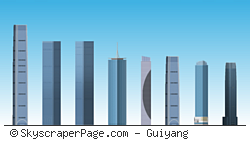
Guiyang, abbreviated as Zhu or Jinzhu, also known as Lincheng or Zhucheng, is a prefecture level city, provincial capital, and economic and transportation center under the jurisdiction of Guizhou Province. It is located in the central part of Guizhou Province, bordering Weng'an, Longli, Huishui, and Changshun counties in Qiannan Buyi and Miao Autonomous Prefecture to the southeast; To the west are Pingba County in Anshun area and Zhijin County in Bijie area; To the north, it borders Qianxi and Jinsha counties in Bijie area, as well as Bozhou District in Zunyi City. As of 2023, the total area of the city is 8043 square kilometers. As of May 31, 2020, the city has 6 districts, 3 counties, and 1 county-level city under its jurisdiction. At the end of 2024, the permanent resident population of Guiyang City was 6.6025 million
The regional gross domestic product for the whole year of 2022 reached 492.117 billion yuan. Guiyang belongs to the subtropical (subtropical) plateau monsoon humid climate zone. The overall climate characteristics are no severe cold in winter, no extreme heat in summer, abundant heat, long frost free period, abundant rainfall, rain and heat in the same season, cloudy with less sunshine, low wind speed, high relative humidity, and a distinct three-dimensional climate. Guiyang has abundant natural resources. The abundant coal and hydropower resources have made Guiyang a famous energy city in China; The abundant bauxite and phosphate deposits have made Guiyang a famous aluminum and phosphorus city in China; The rich natural tourism resources characterized by karst landforms have laid the foundation for the development of tourism in Guiyang.
As of the end of 2022, there were a total of 2122 schools of all levels and types in the city (819 private schools). Among them, there are 1195 kindergartens (684 privately run), 532 primary schools (37 privately run), 208 junior high schools (48 privately run), 81 high schools (31 privately run), 56 secondary vocational schools (19 privately run), 10 special education schools, 2 work study schools, 2 adult higher education institutions, 35 general higher education institutions, and 1 scientific research institution. The city has 3507 health institutions, a total of 49264 beds, and 65653 health technicians.
During the Spring and Autumn Period, present-day Guiyang was under the jurisdiction of the state of Zang; In the Tang Dynasty, a frontier prefecture was established south of the Wujiang River, and Guiyang was under the jurisdiction of Juzhou; In the 17th year of the Yuan Dynasty's Zhiyuan era (1280 AD), the Shunyuan Road Xuanfu Department was established; In the 16th year of the Shunzhi reign of the Qing Dynasty (1659), the Guizhou Governor was stationed in Guiyang Military and Civilian Prefecture; In the third year of the Republic of China (1914), Guiyang Prefecture was abolished and Guiyang County was established; On July 1, 1941, Guiyang County was abolished and Guiyang City was established; On November 15, 1949, Guiyang City was liberated; On November 23rd, the People's Government of Guiyang City was established
|






 Login
Login
 Skyscraper Diagram
 Timeline Diagram
 Skyscraper Map
 Development Map
 Discussion Forum