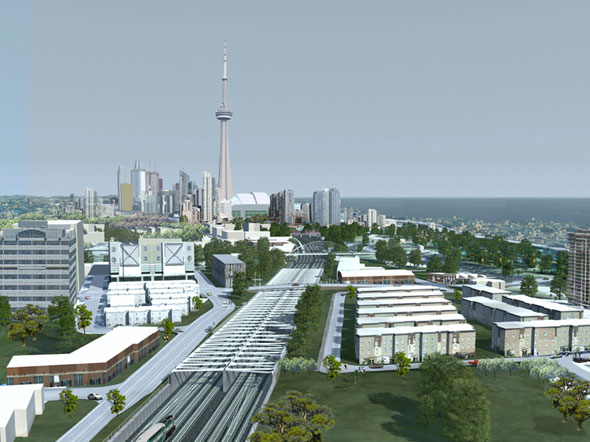
TORONTO - Transit Developments


Should rush hour commuters pay more to take the TTC?

Read More: http://www.thestar.com/news/ttc/2013/02/06/should_rush_hour_commuters_pay_more_to_take_the_ttc.html

.....

With more people piling on buses, streetcars and subways, some observers believe charging a higher fare at busy hours could encourage people to avoid travel when there’s no room for them.

- A report by the Residential and Civil Construction Alliance of Ontario that looks at ways to pay for public transit and roads in the GTA says flat fares encourage overinvesting in “public transit infrastructure.” “You’re going to have those capacity problems and they will try to overbuild the infrastructure to take in that peak capacity,” RCCAO spokesman Andy Manahan said.

- Many other public transit systems around the world have separate prices at peak and off-peak times on some routes — including London’s Tube and New York’s Metropolitan Transportation Authority. Ottawa’s system experimented with a similar structure about 20 years ago and was successful in spreading out peak travel times, said Michael Roschlau, president and CEO of the Canadian Urban Transit Association. “That kind of fare structure would generate an incentive for some people to shift their travel patterns if they can do so,” Roschlau said. Generally, many people in large cities take transit by choice and have a vehicle they could use if they want, he said.

.....


ttc_subway.jpg.size.xxlarge.promo.jpg
 
I don't even remember Ottawa's experiment with peak fares, so it didn't last very long. Before an article quotes such things, they should also find out why it was discontinued.

The same comments about building public transit for peak demand also applies to roads. Is a similar proposal in the works for those commuting by car? I am sure road tolling during peak periods would go over very well politically.
 
Vancouver has a similar system where you pay less in the evenings and on weekends but the busiest 14 hours of the day is regular fare.

I remember Ottawa's rush hour fares, seemed to be a lot of cheating and a bit too complicated. No doubt the fare evasion would be much larger on POP.
 
I hate the squeek but I guess that's the tracks.

I like the "hum" of the old Streetcars though, that last video with the comparisons the old/current Streetcars have that undeniable "hum" when they go by, you know when one is coming (or you know if you just missed one) simply by that noise, I will miss it.
 
How do the acceleration/deceleration of the new vehicles compare to the CLRVs?

I ask because (a) I remember being unenthused with the in-service performance of the Flexity's I rode in Europe, though they were very comfortable and attractive, and (b) the quick ride --- well, relatively, and only on some routes --- is something that always impressed about the CLRVs while visiting.
 
Last edited:
Tolls, taxes the only way to pay for transit needs, Premier Kathleen Wynne says

Transit infrastructure in and around Toronto “needs tens of billions of dollars over the next 20 years” and new tolls and taxes are the only way to pay for it, says Premier Kathleen Wynne.
But in a major speech to 350 people at the Toronto Region Board of Trade on Monday, Wynne stressed any looming levies for combating gridlock would be earmarked to improve public transit and roads.
“I believe that any investments from new revenue must be entirely and transparently dedicated to transportation projects so that the cost is tied to a measurable result,” the premier said.

http://www.thestar.com/news/canada/2013/04/08/tolls_taxes_the_only_way_to_pay_for_transit_needs_premier_kathleen_wynne_says.html
 
How do the acceleration/deceleration of the new vehicles compare to the CLRVs?

I ask because (a) I remember being unenthused with the in-service performance of the Flexity's I rode in Europe, though they were very comfortable and attractive, and (b) the quick ride --- well, relatively, and only on some routes --- is something that always impressed about the CLRVs while visiting.

Perhaps the flexities you rode in Europe were outfitted as streetcars/trams rather than LRVs, meaning they might have smaller, less powerful motors with a lower top speed and lower resulting acceleration. The TTC may have used the old Toronto streetcars like trams being in mixed traffic on normal streets, but they are actually true LRVs with powerful motors and can reach full highway speed.

The manufacturer will normally outfit the stock based on the operators requirements, and the TTC originally planned to use the streetcars are high speed links to the suburbs, and in right of ways as rapid transit. But neither of these plans came to widespread fruition.
 
These LRVs aren't true LRVs. These LRVs are just streetcars. The LRVs usesd for Transit City will be true LRVs.
 
tunnel1.jpg


Eglinton Crosstown LRT Gets it's Drilling (Boring) Machine

From the National Post:


http://news.nationalpost.com/2013/0...chines-set-to-dig-the-eglinton-crosstown-lrt/

Almost two decades since the last effort to dig a transit tunnel along Eglinton Avenue was halted, construction of the Crosstown LRT tunnel is set to begin anew.

One of two tunnel-boring machines that will be used to dig the 11-kilometre underground portion of the Eglinton Crosstown LRT is now in place, with the other soon to follow. Both are due to start digging on May 15.

“This a historic day for Toronto, for Ontario and for public transit,” said Glen Murray, Ontario’s Minister of Transportation, during a media tour Tuesday of the launch site for the tunnel-boring machines at Eglinton Avenue West and Black Creek Drive.


Airport Rail Link Update


The first Article is from the Junction - It's called the Diamond Project : Read Here

Blogto has done a series on all the Underground Underpasses that will be required for the Airport Rail Link, Regular Go Service, and Freight Service to navigate crossings level and otherwise. Quite Interesting, the about of work that is needed, to ensure smooth transfer from the downtown core to Pearson International Airport

Here are some of the photos from the Report

20130409-Junction-Tunnel.jpg


20130409-Junction-Diagram.jpg


Project Stats:

Rail companies using the corridor: 4 (CPR, CNR, GO Transit, and Via)
Project lifespan: 100 years
Project stages: 4 (2006-2015)
New tracks: 2
Number of pipe-piles reinforcing lowered corridor walls: 2,338
Deepest piles: 23m
Concrete used: 55,000 cubic metres - enough to fill Union Station's Great Hall
Excavation: 9m (max)
Soil removed: 200,000 cubic metres - enough to fill 80 Olympic swimming pools
Number of bridges: 4
Total bridge weight: 10,000 tonnes
Total bridge weight measured in empty 12-car GO trains: 14


Strachan Underpass


20130313-Strachan-Underpass1.jpg


20130313-Strachan-Render.jpg


Read the Article Here

Report by the Numbers


■DURATION OF PROJECT: 2011-2014 (projected)
■LENGTH OF TRENCH: 1.4 kilometres (King Street West to Bathurst Street)
■SIZE OF OVERPASS: 19m width X 42m length
■MAXIMUM DEPTH: 8 metres
■DIRT DISPLACED: Over 70,000 cubic meters
■PILES USED: Approx. 1,500 (drilled 10-20m deep for watertight depressed corridor)
■TUNNEL BORING MACHINES USED: 1 (to create a 520 meter long Siphon tunnel)
■PUMPING STATIONS: 1 (a dedicated station is necessary for drainage)
■BIKE LANES: 2 (hooray!)
■ANTI-GRAFFITI COATING: To be applied to all wall surfaces
■PUBLIC ART PROJECTS: 1 (on the temporary retaining wall at Strachan Avenue)
 
http://www.thestar.com/news/gta/201...ry_30_minutes_all_day_on_lakeshore_lines.html

GO trains to run every 30 minutes all day on Lakeshore lines

In the largest single service expansion of its 44-year history, GO transit is increasing train service along the lakeshore — from Oshawa to Aldershot — to every 30 minutes, seven days a week.

“This is the final step in turning GO from a bedroom commuter service into full, regular transit,” said Ontario Transportation Minister Glen Murray. Some 263 trains a week will be added on the Lakeshore East and West lines, starting June 29.


The announcement comes as the provincial Liberals prepare the ground for new taxes to pay for an unprecedented Toronto region transit expansion.

The $7.7 million annual increase in GO operating costs from the 30-minute Lakeshore line boost is expected to attract 50 per cent more GO riders almost immediately, said Metrolinx CEO Bruce McCuaig.


On a typical weekday, 60,500 people ride the Lakeshore West line and 51,500 ride east of Union Station, frequently packing the 1,500-seat trains.


Back
Top