
You are using an out of date browser. It may not display this or other websites correctly.
You should upgrade or use an alternative browser.
You should upgrade or use an alternative browser.
Paris Transit Thread
- Thread starter Minato Ku
- Start date


http://www.railjournal.com/index.php/signalling/paris-line-1-reaches-automation-milestone.htmlParis Line 1 reaches automation milestone
Written by Keith Barrow, Thursday, July 12, 2012
The project to automate Paris Metro Line 1 reached an important milestone on July 7 with the launch of full Unattended Train Operation (UTO) at weekends.
Paris Transport Authority (RATP) has been operating Line 1 in mixed mode with both UTO and semi-automatic train operation (STO) since last November, and the number of UTO-equipped trains in service has increased steadily in the first half of this year. RATP says more than 60% of services are now driverless, and on May 21 full UTO operation was introduced after 21.00 on weekdays. The transition to UTO will be completed at the end of the year.
New driverless MP05 trains from Alstom are entering service at a rate of two per month, and 28 of the 55 trains ordered by RATP are now in service. The fleet is gradually replacing the MP89 sets, 27 of which remain in operation on Line 1. These trains are gradually being cascaded to lines 4 and 11 as more MP05s are commissioned.
Line 1 is the oldest and busiest metro line in Paris, carrying around 750,000 passengers per day. Siemens was awarded a €30.8m contract in 2005 to upgrade the PA BF speed-code automatic train control system to CBTC using its Trainguard MT technology and Airlink free-propagation radio communication system. Siemens also provided onboard equipment and the new control centre, which was commissioned in May 2010. The existing relay-based interlockings were replaced with Thales LockTrac modular computer-based interlockings.
The introduction of CBTC has means headways will be reduced from 105 seconds to 85 seconds. Together with the introduction of new trains, this will boost capacity from 24,000 passengers per hour per direction in 2008 to 30,000 by the end of this year.


Video promotion of Siemens about the automation of the line 1.
It is in French but if Siemens creates an English speaking video, I will post it.


M II A II R II K
Active member
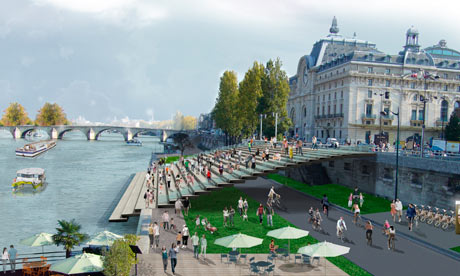
Paris to return Seine to the people with car-free riverside plan
2 August 2012
By Angelique Chrisafis
Read More: http://www.guardian.co.uk/world/201...-expressway-pedestrian?cat=world&type=article
2 August 2012
By Angelique Chrisafis
Read More: http://www.guardian.co.uk/world/201...-expressway-pedestrian?cat=world&type=article
.....
After a slanging match with the right, the city's Socialist mayor, Bertrand Delanoë has won his quest to break up the two-lane urban motorway that has run along the edge of the Seine since the 1960s, and return Paris's riverside world heritage sites to walkers and cyclists.
- From next month, a stretch of more than 1km (0.6 miles) on the right bank near the Hôtel de Ville will see the first narrowing of the road to make way for pedestrian corridors, riverside walkways, bars and cafes. Then in the spring the final promised masterpiece of pedestrianisation will be unveiled: a 2.5km car-free zone on the left bank, between the Musée d'Orsay and the Pont de l'Alma, with a riverside park, pedestrian promenades, floating botanic gardens, flower-market barges, sports courts, restaurants and even perhaps an archipelago of artificial islands.
- The pedestrianisation of one of Europe's most picturesque urban riversides means the death knell for the Seine's non-stop riverside expressways. These were the pride of Georges Pompidou in the 60s when France's love affair with the car was at its height. Opened in 1967 by him, under the slogan "Paris must adapt the to car", the dual carriageway with perhaps the best view in France allowed a speedy crossing of Paris from west to east. But environmentalists have long complained it was a dreadful, polluting waste of architectural heritage.
- Delanoë promised his new scheme would "give Parisians back their river", "profoundly change" the city and provide "an opportunity for happiness" for residents. But the mayor, who will not stand for re-election in 2014, also has an eye on his legacy, seeking to be remembered as the man who finally ended Parisian reverence to the car. He has expanded cycle routes and introduced the city's famous short-term bike-hire and car-hire schemes.
- The limiting of cars along the river was foreshadowed by his Paris Plages project, an annual "urban beach" along the Seine which began a decade ago and has been much imitated across Europe. It sees the expressway closed for a month in summer while Parisians reclaim the riverside to put their feet up on giant deckchairs along an artificial stretch of sand with potted palm-trees.
.....
M II A II R II K
Active member
Perhaps they should drive and park at a station and ride from there, or at least develop that option more.

I like it, Minato. What's good for tourists will be good for us all. Not in favor of banning cars, but there is still too many for now. It's invading, noisy and nasty. See how dirty buildings get because of gas emissions.
The Seine river's getting cleaner. Although there's still too much poop in its central Paris segment, some other parts of the Seine in the suburbs are clean enough to let people swim. That's historic, folks, nothing less.
In 1995, there were only 4 species of fish to live in the Seine river. Today, there are 32, including some highly sensitive to pollution. We're gonna win that fight over pollution. There's no reason to fail but stupidity.
 revious: Building new transit would be good and have more effect. Any new line in construction for the moment ? No.
So instead of adding capacity of transport and then decreasing the car traffic capacity, we do the oposite.
This is completly stupid.
Worse, it will increasing traffic jam will increase the pollution.
What is important is not to have less traffic but to have less pollution.
The center of Paris is a business and entrainement centers for Parisian first, not a museum for tourist.
Worsening the commute of suburbanite without creating new transport line is a good way to completly transform the center of Paris into a museum.
This means more and more people excluded of the center (Living, working...etc) , more and more segregation.
Delanoe only worsened the commute of the majority of inhabitants(obviously most live in suburbs and so they do cannot vote or not for him).
Velib, good but that's only 100,000 people everyday, ridiculous comparated with 5 million in the subway. Instead of always showing Velib as its transportation policy, he should give more money to renovate completly the metro.
I don't get it. Look at your own previous posts, there's some light rail currently developed all over the place and some bigger things to come. It's so big that I even get lost in there.
And I'm tired of that weird obsession with the historic arrondissements. They're no 'museum', they should be no so-called 'center', they're just historic. That's what they're supposed to be.
It's not forbidden to develop some attractive spots of different kinds elsewhere, even in the suburbs, and even though it will hurt the self-centered boring little bourgeois and establishment that live in the historic downtown. That's how you make justice over the metro area by the way, that's how you fuck 'segregation'.
Wow light rail lines, it is nothing in a large city like Paris.I don't get it. Look at your own previous posts, there's some light rail currently developed all over the place and some bigger things to come. It's so big that I even get lost in there.
The other big things planned will not be open when the bank will be closed to the traffic and work have not yet stated.
For the moment there isn't any new big line in construction, the last one were the line 14 and RER E, over a decade ago.
Nothing was done during Delanoe manda, even the famous T3 was a project of the previous mayor.
I don't say that the other one were better but I don't find the so called progressive mayor progressive at all.
He did almost nothing.
All he did was to please the self-centered boring little bourgeois called "Bobo".
Take a map and look at what area is served by the mass transit lines. It is not Saint-Denis or La Defense but an area located between the line 2 and 6.And I'm tired of that weird obsession with the historic arrondissements. They're no 'museum', they should be no so-called 'center', they're just historic. That's what they're supposed to be.
It's not forbidden to develop some attractive spots of different kinds elsewhere, even in the suburbs, and even though it will hurt the self-centered boring little bourgeois and establishment that live in the historic downtown. That's how you make justice over the metro area by the way, that's how you fuck 'segregation'.
It is what is called a center like the Yamanoté is the center of Tokyo, the zone 1 is the center of London and Manhattan the center of New York.
The best thing to not hurt the self-centered boring little bourgeois is obvious to build nothing in the center and transfer everything in poorly served suburbs. You know the normal people should not live, work and go in the center.
When we see the transit system of Paris, suburbs are overbuilt and the central Paris is underbuilt.
There are less station by inhabitants and jobs in Central Paris than in suburbs.
If you want a city based on public transit, it is not in not poorly served suburbs that we need to build more but in the center.
If you want a city based on car, build everything in suburbs.
Obviously the self-centered boring little bourgeois called "Bobo" will not see more traffic but the suburbanite but we don't care of the suburbanite.
I don't see why the traffic should be heavier in suburbs than in the center.
The only reason would be to not hurt the boring little bourgeois.
Why the normal things, people and jobs should be excluded of the "historic" area. An historic area where 90% of the mass transit is.
This is the best thing to destroy Paris, well at least tourists will love it.

Making a city liveable is not making a little area with few bourgois more liveable by worsening the life of 80% of the population.
In fact with better served suburbs and development based on transportation (more and taller construction in Central Paris) instead of transforming central Paris in an historic disneyland, I sure that traffic would be better in central Paris.
Segregation will be lower, housing will be better and we would have a higher economic growth.
This will not even lowered the number of tourists, as long there is still the Eiffel tower, Louvre, Notre Dame and few other monument, they will still come en masse.
We should not forget the business tourism that brings more money.
He! they don't know what bobos are over here, do they?  It was harsh from me, but they deserve it.
It's not just one but literally 8 light rail lines either extended or newly developed. It can't be a detail, Minato, that's pretty big stuff, though. I know a light rail is nothing big like a subway line, but wait, 8 lines currently developed? I tell you what, I'm glad about it, I think we're blessed as they say.
And we'll get our first suburb-to-suburb real big connections within 6 to 8 years, right? post #323? I guess that's it and that's just the beginning.
It was harsh from me, but they deserve it.It's not just one but literally 8 light rail lines either extended or newly developed. It can't be a detail, Minato, that's pretty big stuff, though. I know a light rail is nothing big like a subway line, but wait, 8 lines currently developed? I tell you what, I'm glad about it, I think we're blessed as they say.
And we'll get our first suburb-to-suburb real big connections within 6 to 8 years, right? post #323? I guess that's it and that's just the beginning.
That it is sell as if it was like a metro line will in fact it is closer to a bus line.
All the tram lines are overcrowded showing that it was not enouth at all.
revious: But infact if we see the number of people by station in suburbs even this line will not be enouth to create an equality.
We should still double the density of the center or doubling the number of line in suburbs.
It is not the Grand Paris project that we need but the double or even the third of it.
We can do a little comparaison. Using the metro in reference.
A metro station is 1 stations (a station with two independant line is counting as two stations).
A RER station is 2 stations
A tram station is 0.4 station.
Being inside a branch is divides by two the result of a station.
Neuilly-sur-Seine: 53,937 inhabitants and jobs by station
Ivry-sur-Seine: 45,048 inhabitants and jobs by station
Saint Ouen: 40,490 inhabitants and jobs by station
Levallois/Clichy: 32,797 inhabitants and jobs by station
Fontenay-sous-Bois: 25,971 inhabitants and jobs by station
13e arrondissement: 11,731 inhabitants and jobs by station
15e arrondissement: 9,696 inhabitants and jobs by station
5/6/7e arrondissements: 6,429 jobs and inhabitants by station
1er/2e/8e/9e arrondissements: 5,560 jobs and inhabitants by station
4e/3e arrondissements: 3,787 jobs and inhabitants by station
A quite shocking difference.
All the tram lines are overcrowded showing that it was not enouth at all.
He! they don't know what bobos are over here, do they?
It's not just one but literally 8 light rail lines either extended or newly developed. It can't be a detail, Minato, that's pretty big stuff, though. I know a light rail is nothing big like a subway line, but wait, 8 lines currently developed? I tell you what, I'm glad about it, I think we're blessed as they say.
And we'll get our first suburb-to-suburb real big connections within 6 to 8 years, right? post #323? I guess that's it and that's just the beginning.
revious: But infact if we see the number of people by station in suburbs even this line will not be enouth to create an equality. We should still double the density of the center or doubling the number of line in suburbs.
It is not the Grand Paris project that we need but the double or even the third of it.
We can do a little comparaison. Using the metro in reference.
A metro station is 1 stations (a station with two independant line is counting as two stations).
A RER station is 2 stations
A tram station is 0.4 station.
Being inside a branch is divides by two the result of a station.
Neuilly-sur-Seine: 53,937 inhabitants and jobs by station
Ivry-sur-Seine: 45,048 inhabitants and jobs by station
Saint Ouen: 40,490 inhabitants and jobs by station
Levallois/Clichy: 32,797 inhabitants and jobs by station
Fontenay-sous-Bois: 25,971 inhabitants and jobs by station
13e arrondissement: 11,731 inhabitants and jobs by station
15e arrondissement: 9,696 inhabitants and jobs by station
5/6/7e arrondissements: 6,429 jobs and inhabitants by station
1er/2e/8e/9e arrondissements: 5,560 jobs and inhabitants by station
4e/3e arrondissements: 3,787 jobs and inhabitants by station
A quite shocking difference.
Yea, the capacity of street cars/light rails would be over twice lower than underground bigger train lines...What's wrong with trams? Major cities like Barcelona and Moscow have them, so why not Paris?
The development (and maybe operating?) cost is nothing the same either, far cheaper to tax payers.
That it is sell as if it was like a metro line will in fact it is closer to a bus line.
All the tram lines are overcrowded showing that it was not enouth at all.
So you saying that trams are buses on rails, right?
revious: Yes, tramways are bus on rail.The development price is not a low as believe and the result is not as good as it is believed.
By exemple, the shops around the T3 still have a lower profit than before the tramway.
It didn't bring life on the Maraichaux Boulevards.
The people who use the T3 are not the people who drived in the Maraichaux Blvd but people who used other public transports before.
So instead of decreasing the traffic, it just bring more cars and congestion on Peripherique and surrounding suburban street .
So in reality this tramway did not lowered the polution but it has the oposite effect.
It is true that street are in better shape and it is faster and has more capacity than the bus but we don't need to built a tram to make better street. The fact that all the tram lines are overcrowded show that it wasn't enouth.
We clearly need new subway lines and extension, not tram.
I find the tram mania in France quite ridiculous, especially in Paris.
If they want a lower use of cars in Paris (Paris metropolitan area has already the lower use of car in France), they should built more mass transit lines in suburbs, not lowering the number of traffic lane in Central Paris.
Traffic will still be heavy in Central Paris but the use of car will be lower in Paris metropolitan area and the congestion will decrease, instead of having a Central Paris empty of car but with congested suburbs and a as high or maybe higher use of car in the metro area.

Beta_Magellan
Technocrat in Your Tank!
Minato Ku, there was a study that corroborated what you were saying, but it had some major methodological problems.