CHICAGO | General Developments


Status
Not open for further replies.
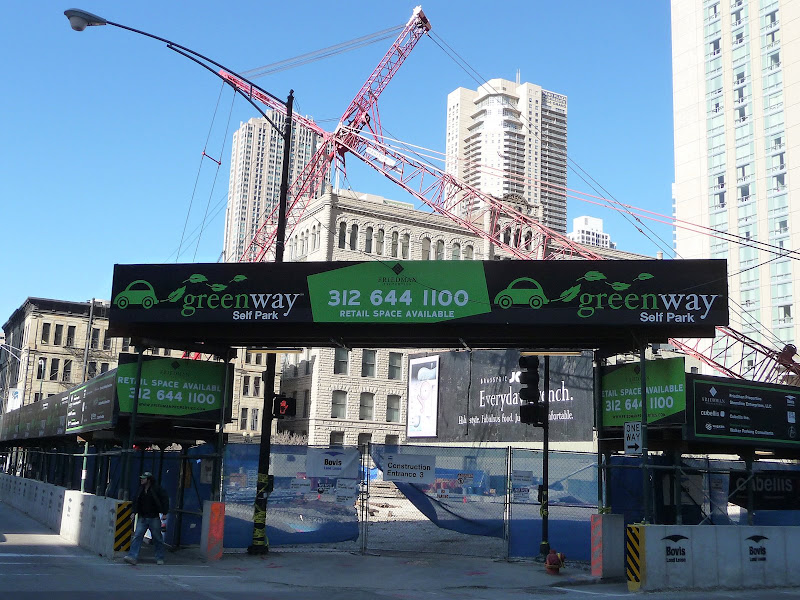
Meanwhile, back in the future, a parking lot continues to disappear: Friedman's garage across from 353 Clark has a colorful new barricade, and will call itself "Greenway Self Park". Looks like their logo is an image of a VW Beetle spewing green leaves as its exhaust. What, are they going to be prohibiting combustion engine vehicles? (Hmm, maybe they can just include a carbon credit offset in the parking fee..)

I took it as a tongue in cheek April Fools day sign.
P1310622.JPG
 
^ Remembering the renderings, this is one of the least offensive self-park garages being built downtown that I've seen (and that's hard to achieve, since self-park garages are goddamn wretched pieces of shit by definition)
 
I doubt that fire codes would accommodate the construction of such buildings today. Between a primary elevator and some auxiliary fire stairs, there'd be no room to occupy.

It's a shame, too.

I dunno, what about for example 2800 Lincoln?
 
Last edited by a moderator:
so, i'll ask again, where is the need for all these skyscrapers? to see the lake? :sly:

You seem to completely lack any knowledge of economics. Those buildings downtown are not there to see the lake, they are there because agglomeration economies. In other words, once you reach a critical mass of services and stores and nightlife, everyone wants to be in the same spot. The tall buildings downtown are not there because of the lake (there is lake just like it in Kenosha and Gary, why no highrises there?) they are there because all of the jobs, transit, stores, nightlife, and vibrancy are there. Also, businesses like to cluster (see the loop) because then information is shared inadvertently between firms. This means if employee from Megacompany A goes to lunch, he might talk to or overhear an employee from Megacompany B talking about this great new idea they have. This way everyone is kinda spying on each other and they all share ideas rapidly.

Essentially people have built downtown because they WANT to be there. The United States is a free country and people are allowed to do whatever they want so long as it doesn't violate the rights of others. If you want to give up that freedom then go away, Chicago is not a place for people who dislike capitalism. Its funny that you think this way because its the very forces of unbridled, cut-throat, capitalism in Chicago that no only unleashed the birth of the skyscraper and Chicago school, but also that allowed International Style to completely take off. Face it, modernism is not suited to socialism, it is suited to capitalism. If you want a city that limits the heights of all of its buildings in the name of the communal good, you best go elsewhere.
 
^ Don't be too hard on Adrian.

Remember, he's a college kid who has divorced himself from the realities of the world to immerse himself in architectural magazines and textbooks to no end, occasionally visiting this website to post "cutting edge" pictures and then retreat back to his design textbook jungle.
 
You seem to completely lack any knowledge of economics. Those buildings downtown are not there to see the lake, they are there because agglomeration economies. In other words, once you reach a critical mass of services and stores and nightlife, everyone wants to be in the same spot. The tall buildings downtown are not there because of the lake (there is lake just like it in Kenosha and Gary, why no highrises there?) they are there because all of the jobs, transit, stores, nightlife, and vibrancy are there. Also, businesses like to cluster (see the loop) because then information is shared inadvertently between firms. This means if employee from Megacompany A goes to lunch, he might talk to or overhear an employee from Megacompany B talking about this great new idea they have. This way everyone is kinda spying on each other and they all share ideas rapidly.
what did i ever say about limiting heights?
tall buildings are a necessity. i never said they weren't.
i must completely lack any knowledge of the urban condition, because, apparently certain areas are desirable and lots of people all wanna be there? huh... okay. and i also must not understand the phase, critical mass. apparently our city has reached it, all over the near north / gold coast area.
silly me... well sorry 'bout that.

Face it, modernism is not suited to socialism, it is suited to capitalism.
uh huh.
le_corbusier_vision_paris_small.jpg

so this is capitalism? or are you saying modernism wouldn't exist without capitalism? because it seems to me that all architecture exist because of funding, whether that is private or public, isn't it all the same?
 
I dunno, what about for example 2800 Lincoln?

The footprint of 2800 Lincoln is more than twice that of the Flatiron Building with that Turtle Wax sign. If you go to the site where the building once stood, you will appreciate just how small the footprint really was. (Of course, I believe the roads have been widened a bit since the building was demolished, but still....)
 
Last edited by a moderator:
also, we were a far denser city back in the 50s than now. again, isn't the function of a skyscraper to provide more space when density is at a capacity?

Actually, the areas where highrises and 4+1s were built in the 1960s onwards have gotten denser. Where Chicago lost the population is in the outlying neighborhoods as average household sizes shrank: the same number of housing units house fewer people. In addition to shrinking household sizes, add in the drip-drip-drip abandonment of the worst neighborhoods like Englewood, Douglas, Lawndale, and you've got your population loss.

Highrises are, for certain specific demographics, far more desirable than dumbell tenements with minimal natural light of comparable unit density (but less "visual pollution" than highrises, as you might describe it). As with the demolition of beautiful buildings like the Turtle Wax Flatiron, I think it's important to remember the basic context of fundamental economic indicators and trends in assessing these decisions. By all means, economics should not always trump planning and architecture, but the latter two can only operate with the bounds of the former, and if that fact bugs you then you will be quite dissatisfied for the rest of your life. Chicago has indeed often been too cozy to finance/development interests, and ignored planning/architectural concerns: but as honte alludes to, the loss of the vast majority of beautiful old buildings and neighborhoods throughout the city was not the result of deliberate "urban renewal" actions, but more the result of simple real estate economics.

Do we know when exactly the Turtle Wax Flatiron was torn down? I'm curious because I know a great deal of Madison Street reached it's current desolate state in 1968 when rioters torched hundreds of commercial buildings (and the economic fundamentals have never supported the development of new space to replace it).
 
If you want a city that limits the heights of all of its buildings in the name of the communal good, you best go elsewhere.

...like communist haven Washington DC. Don't pretend that tall buildings are the inevitable result of some kind of natural law of the market, or that different ways of assigning property rights via zoning are more or less friendly to the free market. Tall buildings depend fundamentally on how property rights are defined. It is a matter of legal tradition, not natural economic processes, that the owner of a piece of land also owns rights to the airspace above it. Different schema for assigning property rights would lead to different patterns of growth. Imagine if there were no zoning, but it was easy to form parties that would buy airspace, and airspace was not packaged together with land. We would see different ways that the market would determine building heights.. Now imagine that buying a piece of property meant buying the rights to the sunlight hitting that property... you get the idea. Sorry, I just don't like when people act like there's something inherent or natural about their preferred way of organizing property rights and any other ways are anti-freedom. In DC, building heights are heavily regulated. Is this system oppressive to property owners, or does it ensure that the public keeps the rights to whatever amenities it obtains by having regulated building heights? In Houston, you can build whatever you want. Is this freedom for property owners or does it take away my right to buy a house with a guarantee of full sun hitting the backyard?
 
so this is capitalism? or are you saying modernism wouldn't exist without capitalism? because it seems to me that all architecture exist because of funding, whether that is private or public, isn't it all the same?

Take it a step further: brutalism would be a minor architectural footnote if it weren't for government funding it, both in the US and in the Soviet Union.
 
It's a mistake to think that economics or the high value of land are the main cause of highrises in the US. That's a contributing cause in Chicago 1890 or in Hong Kong 1980, but almost nowhere else.

Highrises are primarily a lifestyle or business image choice. When there are enough people who want to live that way in the Gold Coast or Belmont Harbor or Skokie, we get highrises. When there are enough businesses who want that image, we get Oakbrook Terrace Tower or 191 North Wacker. One Museum Park is certainly not being built because there's no land nearby for townhouses. 311 South Wacker isn't 65 stories because there was no available land in the area for shorter, more economical buildings.

Madison/Ashland/Ogden was one of Chicago's great transfer corners. When the streetcars were a completely different system than the rapid transit, people riding long crosstown lines had to transfer and it cost them no additional fare to shop a little while at the transfer point. So "shopping centers" grew up at Lincoln/Belmont/Ashland, at Six Corners, at Madison/Pulaski, and here. The surrounding buildings housed banks, a Wieboldt's or Goldblatt's, a Woolworths and a Walgreens, a DeMar cafeteria, a Jewel Tea store, and various bakers, candy shops, meat markets, and greengrocers. The upper floors housed doctors, dentists, shoe repair, employment agencies, tailors, and the like. These businesses had to be within steps of the streetcar transfer corner, so economics did work to push the buildings upward.


The burgundy lines show the strip commercial of 1948 Chicago. The white circles are the "shopping centers" in proportion to their sales volumes:

2czd2qu.png

A version of this map appears in the Encyclopedia of Chicago. ©2004 The Newberry Library.
 
le_corbusier_vision_paris_small.jpg

so this is capitalism? or are you saying modernism wouldn't exist without capitalism? because it seems to me that all architecture exist because of funding, whether that is private or public, isn't it all the same?

Mmm yes, you are so right, because those buildings got completed! I think you are missing my point, my point is not that there would never have been any highrises ever built without capitalism, it is that main propagator of modernism in architecture has been the free market. Do you think we would have all the Mies buildings we have without the free market? Many modernists were indeed socialist, however, no matter how hard they dreamed, almost none of their buildings would have been completed if it weren't for private individuals and companies seeing value in their designs and paying for them to be completed.

It's a mistake to think that economics or the high value of land are the main cause of highrises in the US. That's a contributing cause in Chicago 1890 or in Hong Kong 1980, but almost nowhere else.

Highrises are primarily a lifestyle or business image choice.

And you think that lifestyle and image have no economic value? Ummm there is a reason why you can charge higher prices and rents in a highrise than a low rise. The reason is that there are percieved or real benefits to locating there. With the exception of the maybe 5-10% of tall buildings that were build by (housing projects) or used by (daley center) the government, almost all highrises are the result of free market demand.

Also, if economics and land value do not drive the construction of highrises then why is there a perfect correlation between highrise construction and economic growth? Is it just coincidence that we have gone from seeing a dozen proposals and 10 construction starts a month in 2007 to almost none in 2009? Or has the almighty people's government decided to stop building highrises?

Anyone who thinks that there is not a link between the things you list (views and image) and land value is a fool...
 
The burgundy lines show the strip commercial of 1948 Chicago. The white circles are the "shopping centers" in proportion to their sales volumes:

2czd2qu.png

A version of this map appears in the Encyclopedia of Chicago. ©2004 The Newberry Library.

I recognize a lot of those retail district intersections.

Uptown
Irving Park/Milwaukee/Cicero - 6 Points
Lincoln/Belmont/Ashland
Diversey/Milwaukee (Logan Square)
Madison/Pulaski
....and the district all the way down on 115th and Michigan.

But wow, look at how intense 63rd street used to be.

I wonder what that map would look like today, nearly all the South Side districts would be gone, along with Madison/Pulaski, and it would probably include:
26th/Pulaski (Little Village)
Devon/Western (West Rogers Park)
51st/Lake Park (Hyde Park)
Diversey/Clark/Broadway (Lakeview/Lincoln Park nexus)
Lawrence/Kimball (Albany Park)
Damen/North/Milwaukee (Wicker Park)
...anything else I'm missing?
 
isn't that great? you have the row houses on the neighborhood street, on modest sized retailers on the major street... the corner just lends itself to the two being married as such.

Seriously? I mean seriously?

You are the type of person who shouldn't live in a city.
 
Status
Not open for further replies.


Back
Top