Eurotrip Part 4
Paris Transportation
Paris: Outer Paris |
Central Paris |
Eiffel Tower |
Paris Transportation
Amsterdam: Urbanism |
Transportation
Bonus: TBD
It's been a couple of weeks since part 3. Sorry for the delay.
Being a transportation planner, I'm always interested in the transit and bicycling infrastructure of cities I visit. And Paris has everything. First I'll cover the various types of trains, then buses, then bikes, then a bit of car stuff at the end of the thread.
The Metro
Paris' subway is one of the world's most iconic. It goes
everywhere. Here's a map, with a 500 meter (1/3 mile) circle around each Metro and commuter rail station. Notice how almost every inch of the city inside the Périphérique beltway is covered.
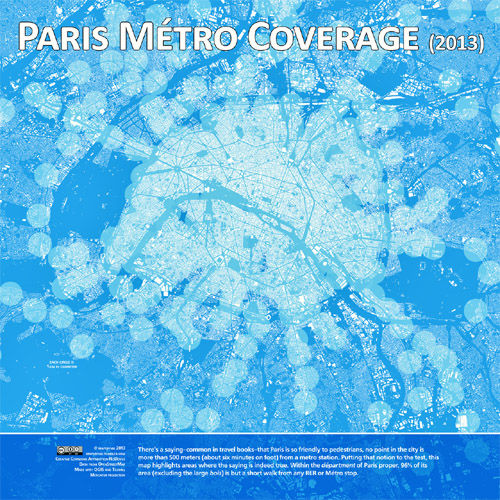
Click for biggers version. Map from mapsbynik. All other images in this thread are my photos.
No American city is like that. Not DC, not SF, not even New York. It's
insane, and awesome.
Let's see some trains.


And some stations.


Notice the time and the train headways. I think the longest we waited for a train the whole time was maybe 5 minutes.

Rare elevated station:


And even more rare, a station over water:

Some of the lines are fully automated, and thus have doors on the platform. I'm led to understand that recent transit worker strikes have pushed Paris to implement automated trains as quickly as possible.

Danger of death!

Paris has an interesting system where you open train doors manually. I've seen that elsewhere on streetcars, but not subways. The new trains have a button, but the older ones have a charming little crank that you turn.

And of course, the rubber tires. Montreal
mimics this idea.

Let's go into some trains. This is an older car.

For the newer trains, instead of several independent railcars joined together, the entire train is one loooong railcar, with multiple articulated segments. Like a
long tram, but in a subway. The advantage is increased capacity, because there's no wasted space between cars, and because passengers can walk through the train until they find a spot with more room. The disadvantage is it's more expensive and less flexible to operate.

Everyone knows about the historic central city station entrances.

But as you move outward they become more modern.


 Trams
Trams
Paris has trams/streetcars too. They're fairly new and travel through the outer areas where Metro lines don't cover absolutely everything so well. For the most part they have dedicated tramways.


 Commuter rail
The RER (Réseau Express Régional) is the suburban rail system. But by American standards it's more like San Francisco's BART than anything else. Trains come every 15 minutes or so throughout the day, and the lines operate like urban subways through the central city, with stations every half-mile or so rather than only one downtown terminal.
Here's the system map. The RER trains, however, look more like American commuter rail than subways. Maybe Philadelphia's regional rail is a better comparison than BART.


RER was built in the latter half of the 20th Century, and its stations reflect that dreary architecture. There's little ornament here.


Although those wood panels look pretty nice.

Inside of one of the newer trains.
 Intercity rail
Paris has a bunch of great old train stations. The French national railway (
SNCF) is the main provider, including its
LGV high-speed rail system. But there are also other intercity trains for lines going to foreign countries, like the
Eurostar to London, and
Thalys to Belgium, Netherlands, and Germany. Plus of course RER and Metro.
Gare de Lyon is my favorite:


Click for full-size

Click for full-size

Click for full-size

Both high-speed and regular speed trains in this photo.


It's such a large station it has a 2nd great hall off to one side.


Gare du Nord seemed to be the busiest of the big stations. It was a mad house. People everywhere. I forgot to take a picture of the outside, but
here it is if you're curious.

Click for full-size

Thalys high-speed trains. I rode these back and forth to Amsterdam. I'll save those pictures for a later thread.

Slow train.

Gare du Nord also has a big secondary train room, but it's not as pretty as Gare Lyon's.


Gare de l'Est is also pretty big. I was there at night so it was much less busy.


This was very interesting. It's a 3D pathway for blind people.

I didn't visit Gare Montparnasse (it looked ugly on google so I didn't bother), but the others were all a bit smaller. More on the level of Boston South Station than NY Grand Central.
Gare Saint-Lazare, with its unusual Metro entrance out front:


Gare d'Austerlitz, with an elevated Metro line running through a wing of the building:

Click for full-size
Gare Austerlitz was undergoing renovations. It was pretty bare on the inside, and only lightly used.


Charles de Gaulle airport rail station:

Much smaller Versailles rail station:

66 pictures later, I think that's about it for trains. Now let's do
Buses! It won't take as long. Whereas I rode at least 9 of Paris' various rail lines while there, I never set foot on a bus.
Here's your basic Parisian bus.


The articulated variety seems to account for about half. Definitely a high percentage, but not the highest I've ever seen.


There are tons of bus lanes and busways. If Paris were in the US, we'd say it has a sizable BRT network. In Paris, as far as I could tell, they just consider BRT to be regular buses (though I admit I might be wrong since I never rode).


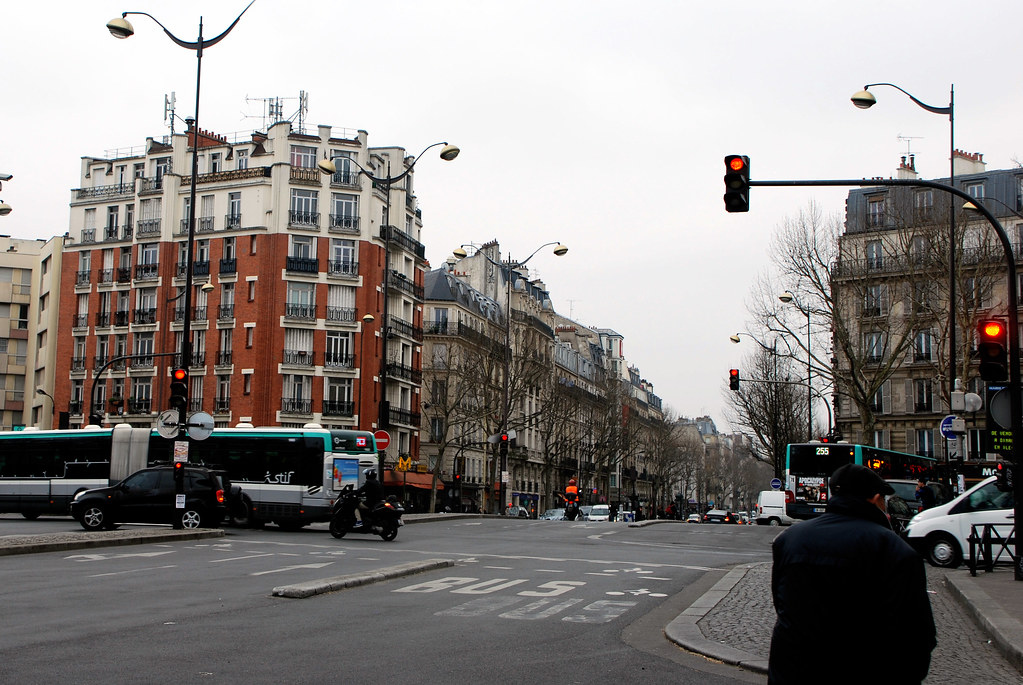
Bikes and buses, both allowed.

That's a nice transition to
bikes.
Paris' leading contribution to the world of bicycling is undoubtedly
Vélib', the most famous bikesharing system in the western world. Vélib' was not the first large modern bikesharing system in France, but Paris being Paris, it was Vélib' that really catapulted bikesharing onto the world stage. There's even a North American connection: The first North American city to really adopt bikesharing was Montreal, which being French-speaking has one foot in the French world. And Montreal's success was the leading inspiration for many a US system.
Vélib' works the same as DC's Capital Bikeshare, New York's Citibike, Chicago's Divvy, or any of them. Except it's bigger. The largest US systems so far (the 3 I just mentioned) all have a little over 300 bike stations. Vélib' has over 1,200.


They even do maintenance by bike:

But bikesharing is just the start. Paris also has great bike lanes. But I would not say they're world class. With such an amazing transit network, and with so many small local streets that don't need dedicated lanes to feel comfortable, Paris' bike infrastructure pales compared to Amsterdam or Copenhagen. It's better than Portland or New York, but not by such a tremendous degree.
First, bunches of cycletracks, including both the more American-like on-street variety, and the more Dutch-like sidewalk variety.


This bike path runs under the Metro bridge from the very first photo in this thread.

Plenty of normal non-protected bike lanes, especially on the narrow local streets.

Bike boxes
everywhere.


The green square symbol they use, both for bike lanes and bike boxes, is interesting. It adds visibility for car drivers, so they expect bikes to be there. But Paris uses a lot less green than some US cities, like
DC or
Chicago (Chicago's especially funny because it uses the exact opposite method from Paris: mostly green with unpainted squares). Paris' version saves money but doesn't look as good. I wonder what's most effective.

They do have extremely visible green checkerboards at some crossings like this, but it's rare. I suspect they've gone away from this in recent years in favor of a different standard.

One way you can tell bikes are convenient: So many services that rely on them, and mopeds.

This is a postal worker going about her rounds on an official postal bike.

Finally, some
cars.
Autolib' is Paris' city-owned carsharing network. The fleet is mostly plug-in electric.


Tuk-tuks, 3-wheeled motorized rickshaws, pop up in tourist areas. It's weird I've never seen these in the US, considering plenty of American cities have horse-drawn carriages and pedicabs. Maybe in the US anything with a motor isn't viewed as quaint enough? I dunno.

Bizarre sidewalk parking. To access it cars drive up on the sidewalk, use the sidewalk like a travel lane, then approach the parking from the sidewalk side rather than the vehicle lanes. This is because there's a bus lane and a row of trees between the street and the parking lane.
Here's a more illustrative angle from Street View.
Vancouver's has sidewalk parking sort of like this, but in a simpler arrangement.

Less weird but still different than anything seen in the US, an urban gas station. It's just plopped there on the sidewalk. You pull in like you're parallel parking. I wonder how the land ownership for this works.

And that's all! Goodbye from Washington! Next up, Amsterdam.








 Hé, that might partly be your germanophile mindset and clichés. I noticed some (usually conservative) in the anglophone world were pretty good at kissing the German butts and being harsh to us Frenchies, but that's okay. You don't sound completely wrong so don't get offended, eh. I assume people in Germany/Switzerland/Austria are generally more respectful of the public, commonly owned and shared space than douchy Parisians, but they're also still far from as diverse as we are. I think metro Paris is the most diverse place in entire Europe, even a bit more than London. So the Germans, Austrians and Swiss don't face the challenges of diversity as intensely as we do. There's constantly been a lot of people coming to Paris from countries in difficulties, most of them being poor and in the need for caring and education. That's part of our mission and duty in the world. That involves some heavy constraints and even often some inconvenience, but the reward in the end is surely glorious and worth the efforts. Besides, Paris's network is much larger than anything German-speaking you mention. You definitely couldn't see it all. So you don't know newer lines and vehicles are simply the latest you get anywhere and are still fairly clean.


 Linear Mode
