More leadership, less lip service ... that's Landsdale's cry for help
February 14, 2009
TERRY COOKE
The Hamilton Spectator
http://www.thespec.com/Opinions/article/513542
"Landsdale is now a community in crisis. Decades of neglect have resulted in a neighbourhood best known for its sex and drug trade, crack houses and low income."
-- Landsdale Area Neighbourhood Association, January 2009
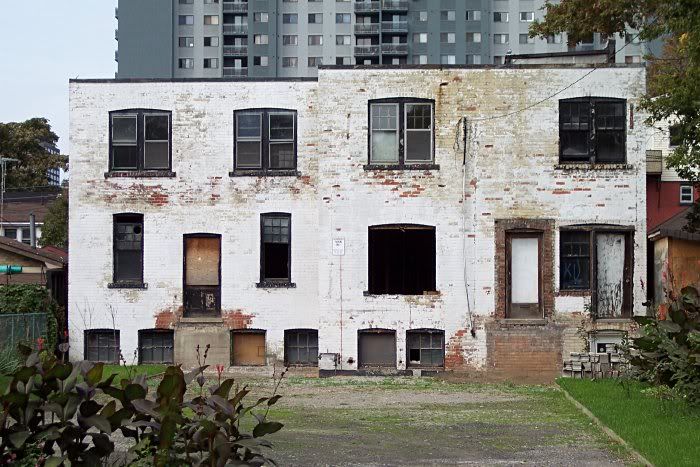
Irony seems to be in short supply at city hall these days. The Pearl Company has been ordered by the city to immediately cease the "illegal" activity they are committing in the heart of the Landsdale neighbourhood. That conduct consists mainly of art shows and theatre productions in the cultural centre that Gary Santucci and Barb Milne have lovingly restored from the bones of an old warehouse.
If local politicians were really interested in combating illicit activity, they would walk around the city block near Wentworth and King that Santucci and some dedicated neighbours are trying to reclaim. The streetscape is dominated by slumlords, hookers, drug dealers and heavily medicated residents of halfway houses.
The latest neighbourhood innovation is the creation of men's "social" clubs in vacant storefronts on King Street. Neighbours report the primary activity in these joints seems to revolve around illegal gambling and the patronage of prostitutes. It's not clear if they have received the same order to comply as Santucci.
Remarkably, there are still resilient area residents such as Anita Himes and Cindy Wilson who refuse to give up. They've organized a neighbourhood association and have started pressing the city to reverse planning policies that have directly contributed to the area's decline.
Their submission on the city's new official plan argues forcefully that inner-city neighbourhoods have been saturated with illegally converted rental properties, social housing and residential care facilities, effectively ghettoizing our most vulnerable citizens. They want the city to place a moratorium on any new halfway houses and take aggressive enforcement action on illegal properties and activity.
For years, our neighbours in Burlington and Oakville have used a combination of exclusionary zoning bylaws, tough property standards enforcement and an unwillingness to fund much of the social services we provide, encouraging a migration of their neediest to Hamilton. In addition to destabilizing downtown neighbourhoods, this practice has also unfairly burdened local taxpayers because of the downloading of provincial social service costs.
Hamilton needs to provide tough love in return to our suburban neighbours. We should do an inventory of all social services that attract people from beyond our borders and stop funding anything not 100 per cent recoverable from higher levels of government.
Landsdale activists know their best hope is in more owner-occupied houses and local businesses, particularly from our emerging creative class of artists such as Santucci and Milne. Businesses require more flexibility in zoning, welcoming adaptive re-use of buildings without unrealistic parking demands.
"We must stop trying to cure the inner city's problems by perpetually increasing social investment and hoping economic activity will follow," says Harvard economist Michael Porter.
He concludes absentee landlords and a shortage of business and jobs undermine urban neighbourhoods and believes municipalities can never subsidize their way out of the problem with more social spending.
A better alternative requires understanding the competitive advantages of urban neighbourhoods for commerce and stimulating wealth creation by incubating small businesses and promoting home ownership.
The renewal of downtown will only happen if neighbourhoods surrounding the core are healthy. But today they remain home to too many troubled souls and too few middle-class families with children for that to be true.
City hall would be wise to listen to the people of Landsdale and provide some leadership instead of lip service in dealing with the problems they face.





 Prev
Prev






 Linear Mode
