Quote:
Originally Posted by racc

A TBM under Broadway would be as disruptive as cut and cover or LRT due to station construction. As bored tunnels are often much deeper than cut and cover, the stations are deeper and construction takes longer and is more disruptive. The obvious solution is a bored tunnel along 10th.
|
The advantage of using a TBM instead of Cut and Cover is that with the TBM method the only surface disruption is at the launch box & the stations, instead of over the entire length of the subway when using the Cut and Cover method. It's inevitable that construction of a station will cause disruption on the street above, but there are ways to maintain some traffic during construction. I've discovered how New York is handling it for their new subway construction.
I've found a blog about the construction of the new Second Avenue Subway (The Launch Box:
http://thelaunchbox.blogspot.com/) that shows some of the construction in progress.
There are four phases planned for this new subway construction, with Phase One currently underway and expected to be finished by 2018. Phases Two through Four are in the initial planning stages, but have no money for construction.
Phase One will create new tunnels from 2nd Ave @ 95th to 2nd Ave @ 72nd, then curve west and connect to the existing existing Lexington Ave @ 63rd Station. There will be new stations along Second Avenue at 96th, 86th and 72nd Streets.
The first construction contract involves the construction of new tunnels between 92nd and 63rd Streets, and the excavation of the launch box for the tunnel boring (TBM) machine between 92nd and 95th Streets.
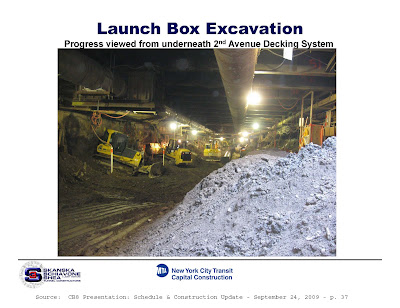
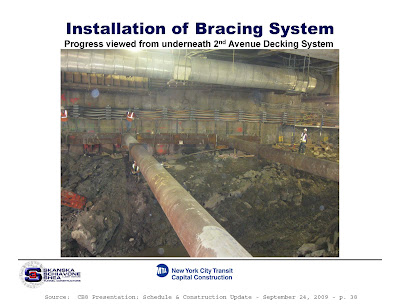
2nd Ave from 92nd to 95th has been partially dug out and decked over so that 4 lanes of traffic can still run on half the street while the other half of the street surface is used as a construction zone. Under the decking, construction continues to dig down to create the TBM launch Box, and next year the TBM itself will be assembled (under the decking) so it can start boring the tunnels. As with any construction site, traffic needs to be routed around the construction zone, but the street is still usable by vehicles -- unlike the C-Line Yaletown, VCC and Waterfront construction which blocked the entire street & forced traffic onto other nearby streets during construction.
When the TBM finishes the tunnels, the TBM launch Box will become the 92nd Street station -- just like Olympic on the C-Line.
Photos from The Launch Box showing a 'roof-level view' of the street. (These photos show few construction workers, since they were taken on the weekend)
2nd Ave @ 92nd, SE corner - looking N (approx. 60' above the street level)

2nd Ave @ 92nd, SE corner - looking S

Another view of the same construction access hole.

And here is a close up view of the surface at the bottom of the hole, again from the roof.
The left wall in this image is solid bedrock.

The construction company makes periodic presentations to the local community board to keep the community informed of the construction progress. Here are some views of the work that is on-going underneath the road decking that covers the TBM Launch Box.


Here is the full PDF of the presentation:
http://www.mta.info/capconstr/sas/documents/090924_C1C2AC5ACombined_CB8_final.pdf
This presentation shows the construction stages in more detail for those who want to know, but it shows there is no need to block the entire road surface during construction of the TBM Launch Box or a Station.





 Prev
Prev


 clarification, please



 Linear Mode
