There's always going to be a debate between investing in urban service where it'll serve more riders due to high density and walkability versus suburban service where it'll take more cars off the road (if successful). In the urban setting many of the riders of the new service would be existing transit users, but that's still a benefit because it improves the user experience and can lower operating costs. But offering an attractive non-car alternative to suburbanites can allow the city to reduce downtown parking and even consider core congestion fees.
But from my perspective, an urban transit tunnel and commuter rail aren't really competing alternatives since honestly if commuter rail were to cost the same as the tunnel project, I'm not sure it would even be worth it. A big advantage to commuter rail is that it can carry large numbers of people during the peak crush while costing little to set up since you just need to buy trains and build basic platforms. Having all day, two way service is much more costly since you need to basically duplicate the track capacity and sometimes even widen the corridors. That's because freight can temporarily pause their operations for a short time during peak periods but that won't permit all day passenger rail. In some cases you'd need to add tracks just for two way service if it's a single track corridor. GO transit operated this was for years with little to no off-peak train service and instead using buses. They could have just used commuter buses all the time but that wouldn't have been sufficient in terms of capacity. But for us, it would be (for now).
The urban option would be much costlier but would accomplish a lot more. Suburban commuters could transfer to the urban system at somewhere like Mumford or Bridge terminal and save time bypassing congestion, while also making travel much quicker and easier for urban dwellers. Another thing to remember is that it's much easier to have dedicated bus lanes in suburban areas due to the road widths while it's often impossible in central areas without demolishing buildings. So having peak period express buses that feed commuters into the urban system could be quite effective. Certainly more so than in Toronto since being dropped off at the end of a subway line would make for a pretty long trip.
This is the route I envisioned about a year ago which has a tunnel section under Gottingen, Barrington, and SGR. The part that extends into Dartmouth beyond the bridge terminal would be optional and maybe a 2nd phase.
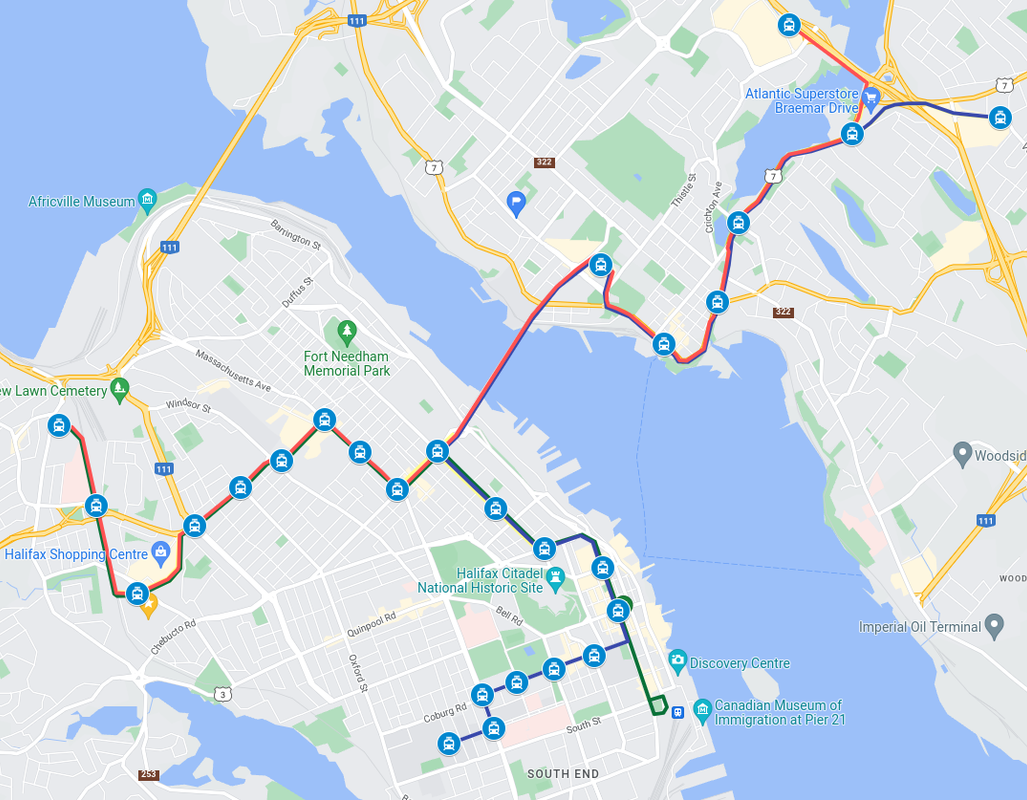
It would feature long sections of dedicated lanes (Bayers, Robie, and Alderney) with both tunneled and elevated sections. It would have sole use of 3rd lane on bridge which alternates directions every 2.5 minutes allowing a blue line and a red line streetcar to cross together every 5 minutes in each direction during peak periods. A vehicle similar to the new TTC streetcars would provide reasonable capacity at this point seeing as they're 50% longer than our current artic buses.





 Prev
Prev





 Linear Mode
