HomeDiagramsDatabaseMapsForum About
     

Go Back   SkyscraperPage Forum > Regional Sections > Canada


Closed Thread

 
Thread Tools Display Modes
     
     
  #16901  
Old Posted Nov 30, 2022, 4:15 AM
someone123's Avatar
someone123 someone123 is offline
hähnchenbrüstfiletstüc
 
Join Date: Nov 2001
Location: Vancouver
Posts: 35,681
Quote:
Originally Posted by swimmer_spe View Post
If they could have gotten it going, they could have then tunneled under the downtown to get to to the Base. Or, They could punch through at the Fairview area to connect to where it needs to. Doing anything for higher order transit will be tough on the peninsula.
I don't think it really made sense and it had a bunch of technical limitations. There was a rail ROW that ran directly to the base from the north and it might still be intact. The original passenger rail station (ICR) in Halifax was at North Street.

One problem is that by reusing the CN route the commuter rail would have to interact with heavy freight rail and deal with all of those issues. Transport Canada did not allow streetcar-style heavy rail with mixed traffic or light rail vehicles on the freight line. Underground would be possible but very expensive and a lot of alternatives would be possible with the same budget.

I think something like a streetcar potentially with some underground portions would likely end up being better. Or maybe some transit tunnels for electric buses, combined with ferries.
     
     
  #16902  
Old Posted Nov 30, 2022, 4:20 AM
swimmer_spe swimmer_spe is offline
BANNED
 
Join Date: Apr 2014
Posts: 10,743
Quote:
Originally Posted by someone123 View Post
I don't think it really made sense and it had a bunch of technical limitations. There was a rail ROW that ran directly to the base from the north and it might still be intact. The original passenger rail station (ICR) in Halifax was at North Street.

One problem is that by reusing the CN route the commuter rail would have to interact with heavy freight rail and deal with all of those issues. Transport Canada did not allow streetcar-style heavy rail with mixed traffic or light rail vehicles on the freight line. Underground would be possible but very expensive and a lot of alternatives would be possible with the same budget.

I think something like a streetcar potentially with some underground portions would likely end up being better. Or maybe some transit tunnels for electric buses, combined with ferries.
That old ROW is "intact" in the sense it is now just part of the parking lots of the shipyards and the base. The issue is there would not be a way to connect it to Scotia Square or the rest of the downtown area. So, it could be a circular route, but would still need some sort of downtown tunnel.
     
     
  #16903  
Old Posted Nov 30, 2022, 6:49 AM
Nouvellecosse's Avatar
Nouvellecosse Nouvellecosse is online now
Volatile Pacivist
 
Join Date: Aug 2005
Location: Nova Scotia
Posts: 11,121
Quote:
Originally Posted by hipster duck View Post
I'll admit it's difficult to make a legible map if 12-15 peak-only suburban bus routes travel down the same street, but if they insist on this service model, there are a lot of improvements they could have made to the overall usability of the map.

- For peak-only suburban routes that generally fan out into the same quadrant of town, it might make sense to bundle them to a single route number, show as a single line, and then give them A,B,C suffixes when they branch out in the suburban areas

- Stretches of roads where any combination of bus routes provides under 10 minute frequencies during all service hours, including evenings and weekends, should be highlighted as part of a frequent transit network

- The colours mean nothing. On top of shading frequent transit corridors, there should only be a single colour for lines that run 5am - 1am, the same colour but dashed lines for peak-only or seasonal lines, a colour for express services and a colour for local community shuttles.

You're probably aware of these ideas, since they're common in major system maps, like that of Translink or the TTC.

Without knowing more about the on-ground realities of Halifax, I still feel like the Alderney ferry should have more prominence on the map, given that it is the closest thing to rapid transit in Halifax, and runs at 15 minute frequencies for most of the day. Again, I don't know the context too well, but I'm surprised more of the peak-only suburban routes that cross over the bridges don't just terminate at the ferry terminal on the Dartmouth side. Vancouver is a useful comparator, even if it's quite a bit bigger. While there are still quite a few buses that go over the Lion's Gate bridge at rush hour, they do try to encourage people on the north shore to take the Seabus and connect at Lonsdale Quay.

A tram that ran from Water Street Terminal to Dalhousie would be a good medium capacity, high frequency distributor in the extended core, but I'm probably getting ahead of myself if the province won't even fund a rapid bus plan.
Yes those are all good map and service options. Another option would be to simply have separate maps for the core service vs peak service. With an online map you could just click a check box to hide or display the desired layers, but with paper or PDF maps there could just be two. After all, 9-5 suburban commuters tend to be a different type of customer than users of regular urban service.

And as Someone mentioned, having most people use the ferry would create a last mile problem for many people since we don't have a downtown circulator like the YUS line loop. It's a short walk for people working in the immediate office core, but for major destinations like the hospital complexes and universities which are in "central" Hfx but not directly downtown, it would be less convenient. Currently most routes go down Barrington and up Spring Garden which brings people close to a lot more things.
__________________
"The reasonable man adapts himself to the world; the unreasonable one persists in trying to adapt the world to himself. Therefore all progress depends on the unreasonable man." - George Bernard Shaw
Don't ask people not to debate a topic. Just stop making debatable assertions. Problem solved.
     
     
  #16904  
Old Posted Nov 30, 2022, 1:36 PM
swimmer_spe swimmer_spe is offline
BANNED
 
Join Date: Apr 2014
Posts: 10,743
Quote:
Originally Posted by Nouvellecosse View Post
Yes those are all good map and service options. Another option would be to simply have separate maps for the core service vs peak service. With an online map you could just click a check box to hide or display the desired layers, but with paper or PDF maps there could just be two. After all, 9-5 suburban commuters tend to be a different type of customer than users of regular urban service.

And as Someone mentioned, having most people use the ferry would create a last mile problem for many people since we don't have a downtown circulator like the YUS line loop. It's a short walk for people working in the immediate office core, but for major destinations like the hospital complexes and universities which are in "central" Hfx but not directly downtown, it would be less convenient. Currently most routes go down Barrington and up Spring Garden which brings people close to a lot more things.
Reality is, most transit users will be using some sort of app that will allow them to figure out which bus to take to get to their destination. these maps are kind of irrelevant to the users. No one is using them for route planning.
     
     
  #16905  
Old Posted Nov 30, 2022, 2:56 PM
Luisito's Avatar
Luisito Luisito is offline
Registered User
 
Join Date: Dec 2018
Posts: 1,884
Quote:
Originally Posted by someone123 View Post
I don't think it really made sense and it had a bunch of technical limitations. There was a rail ROW that ran directly to the base from the north and it might still be intact. The original passenger rail station (ICR) in Halifax was at North Street.

One problem is that by reusing the CN route the commuter rail would have to interact with heavy freight rail and deal with all of those issues. Transport Canada did not allow streetcar-style heavy rail with mixed traffic or light rail vehicles on the freight line. Underground would be possible but very expensive and a lot of alternatives would be possible with the same budget.

I think something like a streetcar potentially with some underground portions would likely end up being better. Or maybe some transit tunnels for electric buses, combined with ferries.

Building underground for street cars is over the top. Better to use that money for above ground commuter rail. Nothing wrong with commuter trains and freights running close together.
     
     
  #16906  
Old Posted Nov 30, 2022, 3:31 PM
Truenorth00 Truenorth00 is offline
Registered User
 
Join Date: May 2017
Posts: 28,755
Quote:
Originally Posted by Luisito View Post
Nothing wrong with commuter trains and freights running close together.
Transport Canada and the US FRA say otherwise.
     
     
  #16907  
Old Posted Nov 30, 2022, 5:03 PM
Luisito's Avatar
Luisito Luisito is offline
Registered User
 
Join Date: Dec 2018
Posts: 1,884
Quote:
Originally Posted by Truenorth00 View Post
Transport Canada and the US FRA say otherwise.

Yet we see them run close together in several places. Right next to each other.
     
     
  #16908  
Old Posted Nov 30, 2022, 6:57 PM
someone123's Avatar
someone123 someone123 is offline
hähnchenbrüstfiletstüc
 
Join Date: Nov 2001
Location: Vancouver
Posts: 35,681
Quote:
Originally Posted by Luisito View Post
Building underground for street cars is over the top. Better to use that money for above ground commuter rail. Nothing wrong with commuter trains and freights running close together.
I don't mean to be disrespectful but I think this is basically backwards even though it matches conventional wisdom. People think that because it's a small city it should reach for a modest toolkit (no tunnels, no new rail, etc.), but that implicitly it makes sense to wildly overbuild and overinvest in transit in very low density areas. I believe that commuter rail in Fall River is more of a stretch than an underground streetcar in the inner city. A nice modern streetcar service downtown would likely recover a lot more cost than 15 minute bus service in a lot of the suburban areas.

Eventually the city will need some kind of answer for transportation in high density inner city areas. I don't think people generally appreciate the densities that are being zoned for and hit. It is a bit like Toronto, but at a smaller scale and minus the existing transit infrastructure. In 2021, part of downtown hit intra-muros Paris density levels. These higher density areas do not have enough extent for a big system but they likely will in the coming years and the municipality is deliberately concentrating a lot of development.
     
     
  #16909  
Old Posted Nov 30, 2022, 7:34 PM
Truenorth00 Truenorth00 is offline
Registered User
 
Join Date: May 2017
Posts: 28,755
Quote:
Originally Posted by Luisito View Post
Yet we see them run close together in several places. Right next to each other.
Which places and how close?
     
     
  #16910  
Old Posted Nov 30, 2022, 7:38 PM
Nouvellecosse's Avatar
Nouvellecosse Nouvellecosse is online now
Volatile Pacivist
 
Join Date: Aug 2005
Location: Nova Scotia
Posts: 11,121
There's always going to be a debate between investing in urban service where it'll serve more riders due to high density and walkability versus suburban service where it'll take more cars off the road (if successful). In the urban setting many of the riders of the new service would be existing transit users, but that's still a benefit because it improves the user experience and can lower operating costs. But offering an attractive non-car alternative to suburbanites can allow the city to reduce downtown parking and even consider core congestion fees.

But from my perspective, an urban transit tunnel and commuter rail aren't really competing alternatives since honestly if commuter rail were to cost the same as the tunnel project, I'm not sure it would even be worth it. A big advantage to commuter rail is that it can carry large numbers of people during the peak crush while costing little to set up since you just need to buy trains and build basic platforms. Having all day, two way service is much more costly since you need to basically duplicate the track capacity and sometimes even widen the corridors. That's because freight can temporarily pause their operations for a short time during peak periods but that won't permit all day passenger rail. In some cases you'd need to add tracks just for two way service if it's a single track corridor. GO transit operated this was for years with little to no off-peak train service and instead using buses. They could have just used commuter buses all the time but that wouldn't have been sufficient in terms of capacity. But for us, it would be (for now).

The urban option would be much costlier but would accomplish a lot more. Suburban commuters could transfer to the urban system at somewhere like Mumford or Bridge terminal and save time bypassing congestion, while also making travel much quicker and easier for urban dwellers. Another thing to remember is that it's much easier to have dedicated bus lanes in suburban areas due to the road widths while it's often impossible in central areas without demolishing buildings. So having peak period express buses that feed commuters into the urban system could be quite effective. Certainly more so than in Toronto since being dropped off at the end of a subway line would make for a pretty long trip.

This is the route I envisioned about a year ago which has a tunnel section under Gottingen, Barrington, and SGR. The part that extends into Dartmouth beyond the bridge terminal would be optional and maybe a 2nd phase.
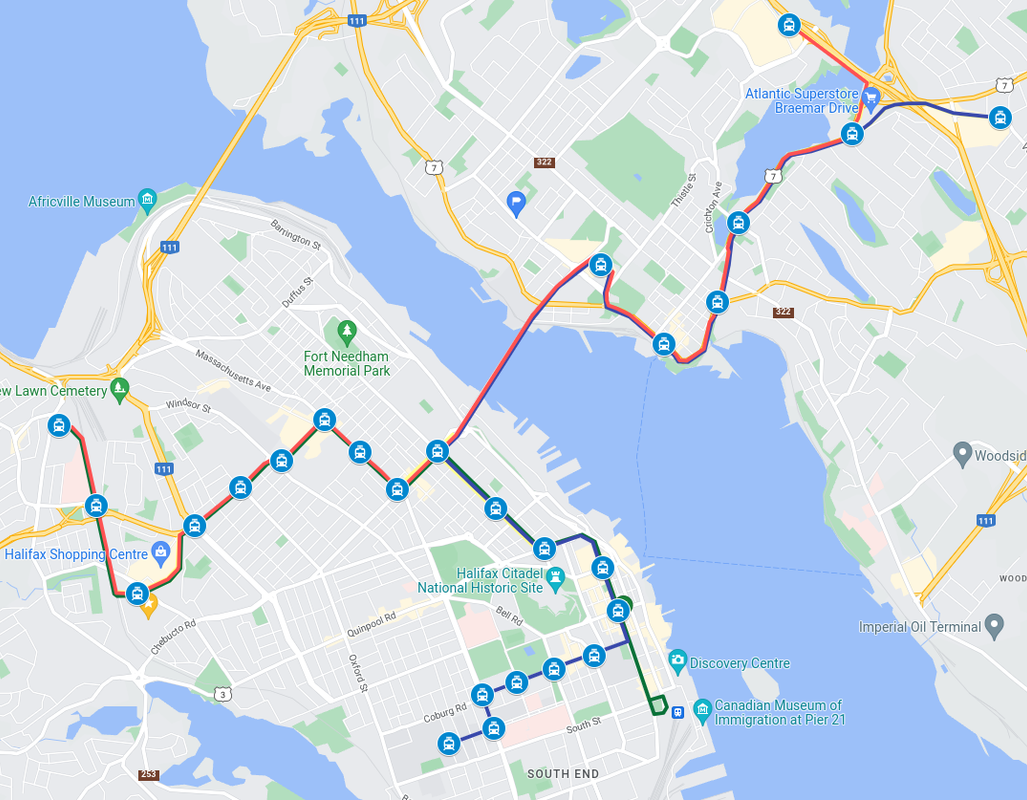


It would feature long sections of dedicated lanes (Bayers, Robie, and Alderney) with both tunneled and elevated sections. It would have sole use of 3rd lane on bridge which alternates directions every 2.5 minutes allowing a blue line and a red line streetcar to cross together every 5 minutes in each direction during peak periods. A vehicle similar to the new TTC streetcars would provide reasonable capacity at this point seeing as they're 50% longer than our current artic buses.

__________________
"The reasonable man adapts himself to the world; the unreasonable one persists in trying to adapt the world to himself. Therefore all progress depends on the unreasonable man." - George Bernard Shaw
Don't ask people not to debate a topic. Just stop making debatable assertions. Problem solved.
     
     
  #16911  
Old Posted Nov 30, 2022, 7:46 PM
Doady's Avatar
Doady Doady is offline
Registered User
 
Join Date: Apr 2004
Posts: 5,166
So many buses bunched together on a peninsula, and on bridges crossing the bay too, I think it will need a rail solution sooner rather than later, kinda like Muni Metro and BART.

London is another city that should invest in rail transit soon, being in the snow belt, and inability of articulated buses to operate in heavy snow, which Ottawa learned the hard way.
     
     
  #16912  
Old Posted Nov 30, 2022, 8:04 PM
Luisito's Avatar
Luisito Luisito is offline
Registered User
 
Join Date: Dec 2018
Posts: 1,884
Quote:
Originally Posted by Truenorth00 View Post
Which places and how close?
There are places where the Go Train and EXO trains run next to freights. I have seen freight use EXO lines. Pretty much every north american commuter train I have seen runs in proximity to freights.
     
     
  #16913  
Old Posted Nov 30, 2022, 8:07 PM
Truenorth00 Truenorth00 is offline
Registered User
 
Join Date: May 2017
Posts: 28,755
Quote:
Originally Posted by someone123 View Post
I believe that commuter rail in Fall River is more of a stretch than an underground streetcar in the inner city.
A town of 2.5k needs vans. Not trains. We saw the same in Ottawa with the MOOSE clowns arguing that instead of a high frequency metro (Trillium Line) serving hundreds of thousands who live and work along that corridor, the priority should be regional rail service to places like Arnprior, which generates maybe a few hundred commuters to Ottawa per day and a fraction of that to the core. If you insist on living 50 km from work that's your problem. Not the transit service's.
     
     
  #16914  
Old Posted Nov 30, 2022, 8:08 PM
Truenorth00 Truenorth00 is offline
Registered User
 
Join Date: May 2017
Posts: 28,755
Quote:
Originally Posted by Luisito View Post
There are places where the Go Train and EXO trains run next to freights. I have seen freight use EXO lines. Pretty much every north american commuter train I have seen runs in proximity to freights.
Next to. Not with. The regulations are pretty clear.
     
     
  #16915  
Old Posted Nov 30, 2022, 8:17 PM
someone123's Avatar
someone123 someone123 is offline
hähnchenbrüstfiletstüc
 
Join Date: Nov 2001
Location: Vancouver
Posts: 35,681
Quote:
Originally Posted by Truenorth00 View Post
A town of 2.5k needs vans. Not trains. We saw the same in Ottawa with the MOOSE clowns arguing that instead of a high frequency metro (Trillium Line) serving hundreds of thousands who live and work along that corridor, the priority should be regional rail service to places like Arnprior, which generates maybe a few hundred commuters to Ottawa per day and a fraction of that to the core. If you insist on living 50 km from work that's your problem. Not the transit service's.
Fall River is not even a town. It is a pretty area with lots of nice forest and lakes that resembles the GTA's cottage country but is populated by commuters. It is an exurb with a low density population and there are no specific physical locations to put transit stops that will serve significant numbers of people without something like park and ride. Park and ride customers are going to be harder to attract and the argument for subsidizing critical park and ride service is weak.

This was a long time ago but I used to take the bus in Hammonds Plains. I would have to walk about 30 minutes to a bus stop and it came 2x in the morning and 2x in the evening. I couldn't take it sometimes because it didn't align with my schedule. Apparently at the time it was a money losing service even though those buses were usually pretty full, while some other routes like the 1 generated a profit. In the early 2000's the 1 had ridership comparable to some Portland OR streetcars.

There's nothing wrong with these services per se but they're, shall we say, not the path to victory for transit operators. A transit system that focuses on them will require heavy subsidy and have low ridership. In the end you might actually end up with less exurban service by ignoring the city.
     
     
  #16916  
Old Posted Nov 30, 2022, 8:20 PM
Nouvellecosse's Avatar
Nouvellecosse Nouvellecosse is online now
Volatile Pacivist
 
Join Date: Aug 2005
Location: Nova Scotia
Posts: 11,121
Quote:
Originally Posted by Luisito View Post
There are places where the Go Train and EXO trains run next to freights. I have seen freight use EXO lines. Pretty much every north american commuter train I have seen runs in proximity to freights.
Quote:
Originally Posted by Truenorth00 View Post
Next to. Not with. The regulations are pretty clear.
GO and Exo, like VIA, use mainline rail trains that are built to robust standards that help them survive collisions with heavier trains. The restrictions never pertained to north american passenger mainline rail trains sharing track with freight. It applied to lighter trains like metros, LRT, and European spec mainline trains. Exceptions like Riverline in NJ and the Trillium line pertain to track sections where freight trains operate only overnight when the passenger service isn't running. Other regions like Europe and Asia are less strict because they have smaller freight trains and they focus most of their safety measures of preventing collisions rather than surviving them.

That said, my understanding is that the restrictions were relaxed a couple of years ago so perhaps things are changing.
__________________
"The reasonable man adapts himself to the world; the unreasonable one persists in trying to adapt the world to himself. Therefore all progress depends on the unreasonable man." - George Bernard Shaw
Don't ask people not to debate a topic. Just stop making debatable assertions. Problem solved.
     
     
  #16917  
Old Posted Nov 30, 2022, 8:21 PM
Luisito's Avatar
Luisito Luisito is offline
Registered User
 
Join Date: Dec 2018
Posts: 1,884
Quote:
Originally Posted by someone123 View Post
I don't mean to be disrespectful but I think this is basically backwards even though it matches conventional wisdom. People think that because it's a small city it should reach for a modest toolkit (no tunnels, no new rail, etc.), but that implicitly it makes sense to wildly overbuild and overinvest in transit in very low density areas. I believe that commuter rail in Fall River is more of a stretch than an underground streetcar in the inner city. A nice modern streetcar service downtown would likely recover a lot more cost than 15 minute bus service in a lot of the suburban areas.
I see your point of view and I am not against street cars, though i think building underground tunnels for them is too much. The cost seems would be way to high. If you're going to build underground you might as well aim higher than LRT, go for a light metro at least. I am not sure what you mean by reaching for a modest tool kit and no new rail. Modern commuter rail systems are awesome.


Quote:
Eventually the city will need some kind of answer for transportation in high density inner city areas. I don't think people generally appreciate the densities that are being zoned for and hit. It is a bit like Toronto, but at a smaller scale and minus the existing transit infrastructure. In 2021, part of downtown hit intra-muros Paris density levels. These higher density areas do not have enough extent for a big system but they likely will in the coming years and the municipality is deliberately concentrating a lot of development.
The areas off the peninsula will grow as well. Specially considering how expensive it is these days. I think areas like Bedford, Fall River, etc will see nice growth in the coming years. I have heard traffic along the bedford highway has become a real pain during rush hour. Imagine a nice train along there to get you home quickly.
     
     
  #16918  
Old Posted Nov 30, 2022, 8:22 PM
Luisito's Avatar
Luisito Luisito is offline
Registered User
 
Join Date: Dec 2018
Posts: 1,884
Quote:
Originally Posted by Truenorth00 View Post
Next to. Not with. The regulations are pretty clear.
And yet i have seen freights role by while waiting for an exo train with an exo train coming in the other direction.
     
     
  #16919  
Old Posted Nov 30, 2022, 8:25 PM
Luisito's Avatar
Luisito Luisito is offline
Registered User
 
Join Date: Dec 2018
Posts: 1,884
Quote:
Originally Posted by Nouvellecosse View Post
GO and Exo, like VIA, use mainline rail trains that are built to robust standards that help them survive collisions with heavier trains. The restrictions never pertained to north american passenger mainline rail trains sharing track with freight. It applied to lighter trains like metros, LRT, and European spec mainline trains. Exceptions like Riverline in NJ and the Trillium line pertain to track sections where freight trains operate only overnight when the passenger service isn't running. Other regions like Europe and Asia are less strict because they have smaller freight trains and they focus most of their safety measures of preventing collisions rather than surviving them.

That said, my understanding is that the restrictions were relaxed a couple of years ago so perhaps things are changing.

Interesting thank you for sharing that. Makes sense. Alot of modern commuter trains resemble metros. Like the Long island rail road in NY and SEPTA trains in Phiadelphia.
     
     
  #16920  
Old Posted Nov 30, 2022, 8:28 PM
Truenorth00 Truenorth00 is offline
Registered User
 
Join Date: May 2017
Posts: 28,755
Quote:
Originally Posted by Luisito View Post
And yet i have seen freights role by while waiting for an exo train with an exo train coming in the other direction.
Suggesting EXO or GO type service for Halifax is pretty laughable. You could fit the entire population of some of these Halifax exurbs in a single GO Train.

And if you have to use smaller trains like Ottawa on Trillium, you need to temporally separate freight and passenger rail. And even those trains are probably overkill for Halifax exurban.

Focus on transit for the core. It'll free up roadsoace for the exurban residents. They are cool with spending hours in their cars. They know what they signed up for.
     
     
This discussion thread continues

Use the page links to the lower-right to go to the next page for additional posts
 
 
Closed Thread

Go Back   SkyscraperPage Forum > Regional Sections > Canada
Forum Jump


Forum Jump


All times are GMT. The time now is 10:39 PM.

     
SkyscraperPage.com - Privacy Statement - Top

Powered by vBulletin® Version 3.8.7
Copyright ©2000 - 2026, vBulletin Solutions, Inc.