HomeDiagramsDatabaseMapsForum About
     

Go Back   SkyscraperPage Forum > Regional Sections > Canada > Alberta & British Columbia > Vancouver > Transportation & Infrastructure


Reply

 
Thread Tools Display Modes
     
     
  #1461  
Old Posted Jul 3, 2023, 7:07 PM
fredinno's Avatar
fredinno fredinno is offline
Registered User
 
Join Date: Jan 2012
Posts: 2,317
Quote:
Originally Posted by Migrant_Coconut View Post
The direct subsidies still work out to $43 billion, or around 3% of this country's GDP. Solar and wind can only dream of getting that much annual funding.
IMF also states that the number globally (which BTW, includes indirect subsidies from environmental costs) as 6.8% globally.

Note that many developing nations directly subsidize energy, and are generally worse at carbon accounting or mitigation.

Also note that Canada is a large oil and gas exporter, which means that subsidies are more economically viable and important for Canada because it makes a profit from it.

Also note that if Canada lowers oil and gas production, that's just going to be taken up by those more carbon-intensive (per barrel) developing nations.
Or you get a Russia situation.

Either way, it's not great.

Obama let the fracking revolution happen for a reason- and it wasn't because he was some Republican or was a deep friend to the oil and gas industry.

Quote:
Originally Posted by Changing City View Post
It seems likely that the IMF study is overly conservative. According to the Canadian Medical Association, burning fossil fuels is responsible for annual health-related costs of CAD 53.5 billion in Canada. There are 90,000 abandoned oil wells, toxic tailing ponds and ageing pipelines that could cost up to CAD 260 billion to clean up. How much contribution has climate change made to the state of Canada's forests? What's the dollar value of the 5.8 million hectares of forest that's burned so far this year? Or the impact of all the additional carbon dioxide released?
Dunno man, what about the jobs and money from oil and gas?

These are externalities, not direct subsidies.


BTW, the IMF estimates also include 'environmental and social' costs, and adds them to its numbers by adding externalities not accounted for by things like carbon taxes.
https://www.imf.org/en/Topics/climate-change/energy-subsidies

So it already covers your concerns.
Reply With Quote
     
     
  #1462  
Old Posted Jul 3, 2023, 7:37 PM
Migrant_Coconut's Avatar
Migrant_Coconut Migrant_Coconut is offline
Registered User
 
Join Date: Oct 2015
Location: Kitsilano/Fairview
Posts: 10,076
Good for them. The average Canadian pollutes triple what the rest of the world does per capita; doesn’t matter if that makes a difference overall, there’s no possible way to ask China, India or the States to decarbonize and not do likewise without us ending up looking like massive hypocrites.

Obama was last in office seven years ago. The world’s changed since then. As soon as everybody’s off oil, LNG’s next... and seeing as methane is sometimes worse for the climate than petroleum, many politicians aren’t even going to wait that long.

Toxic waste and sweatshops create jobs/revenue too – doesn’t mean they should be subsidized. CC’s already noted that there’s at least $230 billion worth of externalities the IMF missed.
Reply With Quote
     
     
  #1463  
Old Posted Jul 3, 2023, 9:03 PM
fredinno's Avatar
fredinno fredinno is offline
Registered User
 
Join Date: Jan 2012
Posts: 2,317
Quote:
Originally Posted by Migrant_Coconut View Post
Good for them. The average Canadian pollutes triple what the rest of the world does per capita; doesn’t matter if that makes a difference overall, there’s no possible way to ask China, India or the States to decarbonize and not do likewise without us ending up looking like massive hypocrites.
All developed nations have their GHG levels per capita dropping since the mid-2000s- including the States and Canada.

It won't matter if China continues building 2 coal plants a week.
https://www.cnn.com/2023/02/27/energy/china-new-coal-plants-climate-report-intl-hnk/index.html


The only reason developed nations generate more GHGs/capita is because their economic output is so much higher... from a pure GHG/output basis, developed nations are much more efficient.
Which is my point.
Quote:
Obama was last in office seven years ago. The world’s changed since then. As soon as everybody’s off oil, LNG’s next... and seeing as methane is sometimes worse for the climate than petroleum, many politicians aren’t even going to wait that long.
First, Biden was...Obama's VP.

Second, other than his first 6 months or so, Biden has basically just continued Obama's policies.
Like https://news.yahoo.com/biden-granted-mor...s-first-2-years-in-office-190528616.html
Quote:
Data from the Bureau of Land Management shows that President Biden approved more oil and gas drilling permits in his first two years in office than former President Donald Trump. From Jan. 20, 2021, to Jan. 19 of this year, the BLM approved 6,430 permits for oil or gas drilling on federal land, compared with 6,172 drilling permits approved during the first two years of the Trump administration.
Also, he was perfectly willing to fast-track the Mountain East pipeline to get Joe Manchin to agree to sign off on the Inflation Reduction Act.

Basically, the US is either drill, baby, drill- or drill...a bit slower.

Quote:
Toxic waste and sweatshops create jobs/revenue too – doesn’t mean they should be subsidized. CC’s already noted that there’s at least $230 billion worth of externalities the IMF missed.
No there isn't.
Again, look back at the IMF's methodology, it includes implicit subsidies and accounts for mitigation:
Quote:
Implicit subsidies occur when the retail price fails to include external costs and/or there are preferential consumption tax rates on energy. External costs include contributions to climate change through greenhouse gas emissions, local health damages (primarily pre-mature deaths) through the release of harmful local pollutants like particulates, and traffic congestion and accident externalities associated with the use of road fuels.
Reply With Quote
     
     
  #1464  
Old Posted Jul 3, 2023, 9:24 PM
Migrant_Coconut's Avatar
Migrant_Coconut Migrant_Coconut is offline
Registered User
 
Join Date: Oct 2015
Location: Kitsilano/Fairview
Posts: 10,076
If China’s building two coal plants a week, that means they’re not interested in buying “clean” Canadian oil and gas instead, so that argument has no weight. Luckily, China’s also managed to make ~50% of its energy renewable in a fairly short period - so yes, it’s largely Americans dragging their heels that’s the problem. If the average PRC polluted as much as the average American or Canadian, we'd already be goners.

Yes there is. The IMF’s in DC, using metrics to calculate their externalities, while Canadians in Canada found over $300 billion in climate-related taxpayer expenses.

More to the point: again, externalities aside, there’s $43 billion of direct subsidies we can cut right this minute and spend on other more important things.
Reply With Quote
     
     
  #1465  
Old Posted Jul 3, 2023, 9:51 PM
fredinno's Avatar
fredinno fredinno is offline
Registered User
 
Join Date: Jan 2012
Posts: 2,317
Quote:
Originally Posted by Migrant_Coconut View Post
If China’s building two coal plants a week, that means they’re not interested in buying “clean” Canadian oil and gas instead, so that argument has no weight. Luckily, China’s also managed to make ~50% of its energy renewable in a fairly short period - so yes, it’s largely Americans dragging their heels that’s the problem. If the average PRC polluted as much as the average American or Canadian, we'd already be goners.
You're citing Chinese State-run media (which is where the 50% claim comes from when you click through the MSM links).
That's not reliable. At all.

You have no idea whether that 'capacity on paper' is actually useful or not, or if some corrupt official put up cardboard cutouts of solar panels instead of actual solar panels and then counted it as 'capacity'.


More reliable sources show a supermajority of the electricity in China (not even overall energy) is produced by coal.


If the average Chinese person produced as much as the average American or Canadian, we'd be singing the Communist Anthem, building cities in the ocean, and covering the world in solar shades to cool off the earth from all that CO2 we produced.

Assuming, of course, there are actually 1.4 Billion Chinese.
Shockingly, we're not 100% sure that's not BS either.

China might not be interested, but Japan and South Korea are still importing the vast majority of their oil and gas from the Gulf. Nuclear or not, they'll still be consuming for a while.

Quote:
Yes there is. The IMF’s in DC, using metrics to calculate their externalities, while Canadians in Canada found over $300 billion in climate-related taxpayer expenses.
Again, apples to oranges. This is why I don't like indirect costs.
There's too many different ways to fudge the numbers.

Reply With Quote
     
     
  #1466  
Old Posted Jul 3, 2023, 10:16 PM
Migrant_Coconut's Avatar
Migrant_Coconut Migrant_Coconut is offline
Registered User
 
Join Date: Oct 2015
Location: Kitsilano/Fairview
Posts: 10,076
The US EIA puts China at 33%, which is still ahead of their own federal government. And since America has outsourced much all its stuff to PRC manufacturers, and Canada’s manufacturing sector was never big to begin with, production maybe isn’t the best way to compare countries. Either way, Canada can ditch its fossil fuel subsidies with a clear conscience, knowing that they won’t make a lick of difference to what the CCP does next.

It’s a fact that the federal Liberals have already spent $1.7 billion on orphan well cleanup, and that Alberta’s own regulators have found $58+ billion worth of total costs. But if you don’t like those numbers, then once again, $43 billion/year - straight from the budget, directly to the oil companies, no fudging at all - could solve a lot of the country’s problems.
Reply With Quote
     
     
  #1467  
Old Posted Jul 3, 2023, 10:35 PM
fredinno's Avatar
fredinno fredinno is offline
Registered User
 
Join Date: Jan 2012
Posts: 2,317
Quote:
Originally Posted by Migrant_Coconut View Post
The US EIA puts China at 33%, which is still ahead of their own federal government. And since America has outsourced much all its stuff to PRC manufacturers, and Canada’s manufacturing sector was never big to begin with, production maybe isn’t the best way to compare countries. Either way, Canada can ditch its fossil fuel subsidies with a clear conscience, knowing that they won’t make a lick of difference to what the CCP does next.

It’s a fact that the federal Liberals have already spent $1.7 billion on orphan well cleanup, and that Alberta’s own regulators have found $58+ billion worth of total costs. But if you don’t like those numbers, then once again, $43 billion/year - straight from the budget, directly to the oil companies, no fudging at all - could solve a lot of the country’s problems.
Fair enough.

TBF, though, those numbers are actually 17% non-fossil-fuel primary energy for China, and 21% for the US.
So no, the US is still higher.
https://www.eia.gov/energyexplained/us-energy-facts/data-and-statistics.php
The USA also doesn't consume anywhere near as much coal.


Note also that both the US and EU are implementing protectionist measures for climate reasons (the US more haphazardly, the EU as an actual official policy: https://www.dw.com/en/eu-backs-plan-to-impose-carbon-emissions-tariff-on-imports/a-61139117
so that'll hopefully start changing.)

Canada should probably get on that train too before the US forces them to in a decade.
Reply With Quote
     
     
  #1468  
Old Posted Jul 4, 2023, 4:45 PM
WarrenC12's Avatar
WarrenC12 WarrenC12 is online now
Registered User
 
Join Date: May 2007
Location: East OV!
Posts: 24,583
Quote:
Originally Posted by Changing City View Post
So gas today is reported at $1.93 on E Broadway and Clark. A year ago it was $2.25. What's the problem again?
The problem is that it isn't expensive enough.
Reply With Quote
     
     
  #1469  
Old Posted Jul 4, 2023, 5:19 PM
FarmerHaight's Avatar
FarmerHaight FarmerHaight is offline
Peddling to progress
 
Join Date: Jul 2019
Location: Vancouver's West End
Posts: 1,631
Quote:
Originally Posted by fredinno View Post
Also note that if Canada lowers oil and gas production, that's just going to be taken up by those more carbon-intensive (per barrel) developing nations.
Quote:
Originally Posted by fredinno View Post
You're citing Chinese State-run media (which is where the 50% claim comes from when you click through the MSM links).
That's not reliable. At all.
And you're just repeating what you hear from Canadian O&G commercials on the television and radio.

Scrubbing the oil sands’ record

Quote:
Trouble is, a close look at the leading comparisons of the world’s crude oil sources, assembled by governments, academics and private-sector analysts, shows that, overall, producing a barrel of crude from oil sands still emits more greenhouse gas than the average of all sources. The best or newest oil sands developments, whose emissions are below the mean, remain exceptions. “You have a lot of amazing trees here. But it is not the forest,” says Benjamin Israel, senior analyst at the Pembina Institute, a clean energy think tank.

Research analyst Kevin Birn, for one, has watched investor interest in carbon footprints rapidly increase. “Three years ago, I’d get a call [from investors] every six months. Last year it was once a quarter, and this year it was once a month,” says the vice-president for North American crude markets at IHS Markit. Birn is an apt guy to ask. Last year, he produced a report—oft cited by industry—which found that, sector-wide, oil sands’ carbon intensity had fallen by 21 per cent between 2009 and 2017. Future technical improvements, his study forecast, would drop levels on an intensity basis by another fifth by 2030. (Absolute emissions, it is important to note, will still rise, due to ramped up extraction, at a time when Canada has committed to substantial reduction.)

But his paper includes one table that should temper the excitement of those talking up oil sands’ carbon-competitive edge. Of the various types of oil sands extraction he forecast out to 2030, only one type—next-generation mining projects that pre-treat oil sands before upgrading—would have emissions per barrel at the same level as the average for crude from around the world. (Birn uses as his baseline 2012 numbers for oil shipped to and processed by U.S. refineries.) And they would reach the average only in a scenario where more aggressive improvements come online in the future. Traditional oil sands mining projects, which require an energy-intensive upgrading process, would remain 7.1 per cent above average in emissions intensity, while the “thermal” operations that pump steam into wells to extract bitumen would remain 2.6 per cent worse than average in this rosier scenario.

A more comprehensive 2018 paper, published in the journal Science, compared upstream emissions estimates from 8,966 different oil fields in 90 countries. It ranked Canada’s average oil output fourth-most intensive in the world, behind only Algeria, Venezuela and Cameroon and well above the global average and rates of other major producers such as the United States, Russia, China and Saudi Arabia. Of the 34 Canadian oil sands operations measured in this study, led by Stanford University researchers, none fell below the global midpoint for emissions. Ten were double that mark; five of those were triple or higher.

Canada’s oil lobby has long had a mission: “tell our story” to Canadians. In a recent “myth buster” post on its website, the Canadian Association of Petroleum Producers (CAPP) insists oil sands production is “cleaner than you think.” The post refers to data produced by the California government showing that numerous oil fields in that state have higher per-barrel emissions than Canadian oil sands. To ensure it is meeting its low-carbon fuel standards, California produces annual reports on intensities of all crudes that its refineries handle. And it’s true: a few aging California operations are terrible polluters. But they don’t produce as much oil as Canada’s oil sands. And, according to the state’s 2018 data for the 63 imported oil sources from 22 countries, the two products with the highest emission-intensity counts were from the oil sands. (California refineries handled dirtier crudes in past years from Brazil or Nigeria.) Other oil sands crudes ranked fourth, seventh, 10th, 13th, 14th and 20th. Only one, Suncor’s new Fort Hills mine, had emissions intensity below the weighted average of all fuels.

In a recent interview, CAPP president Tim McMillan spoke of continuous improvement since the first oil sands barrel was produced a half-century ago. “Today we’re on par with the average barrel; a decade from now we’re going to be another 20 per cent below where we are today,” he said. He conceded that he wasn’t sure which research declared oil sands to have reached parity levels. CAPP staff later pointed to Birn’s IHS study. After this reporter pointed out that the IHS study doesn’t say the oil sands sector outperforms the overall emissions average, an association spokeswoman said McMillan “misspoke.”

So, in the race to tell a better story, oil sands advocates—including the ones elected to political office—will reach for the best-sounding proclamations they can extract from the sludge of data. “We should celebrate the fact and share with the world that Alberta heavy oil now has a lower carbon footprint than the average barrel of heavy oil around the world, and soon with this technology we will be catching up with the average barrel of oil generally in terms of carbon intensity,” Alberta Premier Jason Kenney said in September at a conference in Fort McMurray. (His government is launching a $30-million war room to help the energy sector fight misinformation.)

The “soon” in the second part of that sentence is a vague and relative term, of course. As for the boast in the first part, the data the premier’s officials shared with Maclean’s when asked for an explanation did not actually justify his statement.
__________________
“Nothing compares to the simple pleasure of riding a bike” – John F Kennedy
Reply With Quote
     
     
  #1470  
Old Posted Jul 4, 2023, 5:46 PM
CanSpice's Avatar
CanSpice CanSpice is offline
Registered User
 
Join Date: Dec 2014
Location: New Westminster, BC
Posts: 2,709
Quote:
Originally Posted by fredinno View Post
All developed nations have their GHG levels per capita dropping since the mid-2000s- including the States and Canada.
That's not the metric we need to be worried about though, we need to worry about the absolute amount of carbon we're dumping into the atmosphere. Canada's GHG emissions have plateaued at between 700 and 800 megatonnes per year since 1998. It only dropped below 700 in 2020 because of the pandemic.

Dropping per capita means your emissions can still rise, they just have to rise slower than your population is growing. We need to reduce the absolute amount of carbon, not the relative amount.
Reply With Quote
     
     
  #1471  
Old Posted Jul 4, 2023, 6:20 PM
fredinno's Avatar
fredinno fredinno is offline
Registered User
 
Join Date: Jan 2012
Posts: 2,317
Quote:
Originally Posted by FarmerHaight View Post
And you're just repeating what you hear from Canadian O&G commercials on the television and radio.

Scrubbing the oil sands’ record
By the way environmentalists act, you'd think it'd be 50%.

Considering the progress they've made in cutting emissions, the claim that oil sands will fall below the average in carbon production is not unreasonable.

Oil Sands compete against other heavy oils, which tend to be more carbon-intensive anyways, since refineries can't process both light and heavy oils well. Which the same article points out.


And it's not just oil sands, it's tight/shale, deepwater/offshore, and arctic oil/gas too.
Oil Sands production is the least profitable and the first to drop off the market.

Quote:
Originally Posted by CanSpice View Post
That's not the metric we need to be worried about though, we need to worry about the absolute amount of carbon we're dumping into the atmosphere. Canada's GHG emissions have plateaued at between 700 and 800 megatonnes per year since 1998. It only dropped below 700 in 2020 because of the pandemic.

Dropping per capita means your emissions can still rise, they just have to rise slower than your population is growing. We need to reduce the absolute amount of carbon, not the relative amount.
Maybe Trudeau needs to stop bringing in so many immigrants then?

No, but seriously though, developed nations aren't the ones responsible for increasing emissions.
Even when you account for population growth, it's still plateaued out:
https://www.macrotrends.net/countries/CAN/canada/carbon-co2-emissions
Reply With Quote
     
     
  #1472  
Old Posted Jul 4, 2023, 6:39 PM
MalcolmTucker MalcolmTucker is online now
Registered User
 
Join Date: May 2007
Posts: 11,595
Quote:
Originally Posted by fredinno View Post
Oil Sands production is the least profitable and the first to drop off the market.
The costs include a huge chunk of already spent fixed costs though. For many projects, the marginal costs between choosing to produce 100 million barrels at an existing oil sands plant versus 100 million barrels at an incremental project elsewhere, oil sands wins. Likely even when chasing net zero via carbon capture. The hurdle for new investment is just so high compared to continuing to use an existing asset.
Reply With Quote
     
     
  #1473  
Old Posted Jul 5, 2023, 1:32 AM
fredinno's Avatar
fredinno fredinno is offline
Registered User
 
Join Date: Jan 2012
Posts: 2,317
Quote:
Originally Posted by MalcolmTucker View Post
The costs include a huge chunk of already spent fixed costs though. For many projects, the marginal costs between choosing to produce 100 million barrels at an existing oil sands plant versus 100 million barrels at an incremental project elsewhere, oil sands wins. Likely even when chasing net zero via carbon capture. The hurdle for new investment is just so high compared to continuing to use an existing asset.
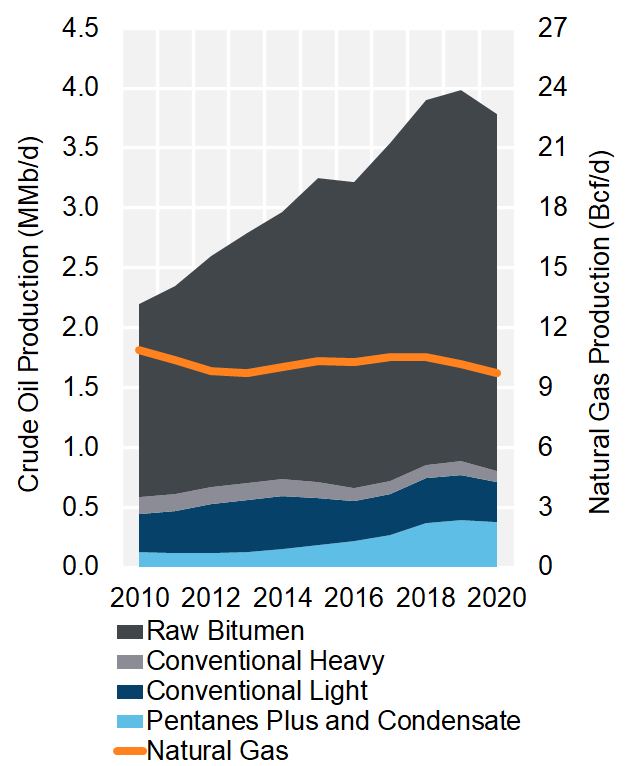
Eh, kind of:


Other oil and gas production has the same problem.
It's the reason oil briefly went negative in the middle of the pandemic.

Oil Sands is still the marginal producer, as shown by Alberta themselves in the above graph.
Reply With Quote
     
     
  #1474  
Old Posted Jul 5, 2023, 1:40 AM
Changing City's Avatar
Changing City Changing City is online now
Registered User
 
Join Date: Nov 2016
Posts: 8,129
Quote:
Originally Posted by fredinno View Post

Even when you account for population growth, it's still plateaued out:
https://www.macrotrends.net/countries/CAN/canada/carbon-co2-emissions
You're looking at the wrong chart. Canada's greenhouse gas emissions were still rising. [Hint, they need to fall. A lot.]
__________________
Contemporary Vancouver development blog, https://changingcitybook.wordpress.com/ Then and now Vancouver blog https://changingvancouver.wordpress.com/
Reply With Quote
     
     
  #1475  
Old Posted Jul 5, 2023, 3:03 AM
Migrant_Coconut's Avatar
Migrant_Coconut Migrant_Coconut is offline
Registered User
 
Join Date: Oct 2015
Location: Kitsilano/Fairview
Posts: 10,076
In fairness, that only goes up to 2019. '20 had a medium-sized dip, then once the lockdown was over GHGs started going back up again in '21, so the country as a whole isn't flattening the curve any time soon.
Reply With Quote
     
     
  #1476  
Old Posted Jul 5, 2023, 4:57 AM
Changing City's Avatar
Changing City Changing City is online now
Registered User
 
Join Date: Nov 2016
Posts: 8,129
Quote:
Originally Posted by Migrant_Coconut View Post
In fairness, that only goes up to 2019. '20 had a medium-sized dip, then once the lockdown was over GHGs started going back up again in '21, so the country as a whole isn't flattening the curve any time soon.
Indeed - which is why I noted ghg emissions were going up (as CanSpice had stated). They dropped during covid, but they're undoubtedly going back up again - especially given what's happening to Canada's forests, especially in the east. BC is contributing too as we have the largest fire on record burning, and there's a lot of fire season left to go. This year "Emissions from the Canada wildfires in May reached 54.8 million tonnes, which is more than double the past records for that month since estimates began in 2003, according to the Copernicus Atmosphere Monitoring Service." [BBC]. Note that the BC Government reported total doesn't include ghgs from forest fires. "The B.C. government includes forest fire emissions in the provincial greenhouse-gas inventory for transparency, however they’re not counted toward the reported totals." [Sun].
__________________
Contemporary Vancouver development blog, https://changingcitybook.wordpress.com/ Then and now Vancouver blog https://changingvancouver.wordpress.com/
Reply With Quote
     
     
  #1477  
Old Posted Jul 5, 2023, 4:52 PM
MalcolmTucker MalcolmTucker is online now
Registered User
 
Join Date: May 2007
Posts: 11,595
Quote:
Originally Posted by fredinno View Post
Eh, kind of:


Other oil and gas production has the same problem.
It's the reason oil briefly went negative in the middle of the pandemic.

Oil Sands is still the marginal producer, as shown by Alberta themselves in the above graph.
Oh, I'm more thinking as an investor in 2035. Do I shut down an oil sands plant in favour of opening a new project somewhere else with the same productive capacity, or do I just keep the oil sands plant open?

Different that deciding whether to stop steaming and shut in assets when uncertainty is incredibly high. That those assets were returned to production rather than replaced with production elsewhere kinda makes my point (though the time scales make the comparison a not as good as it could be one).
Reply With Quote
     
     
  #1478  
Old Posted Aug 14, 2023, 9:35 PM
jollyburger jollyburger is offline
Registered User
 
Join Date: Dec 2015
Posts: 15,616
Quote:
BC Hydro bids to raise EV charging fees, but customers say time-based fees are unfair

Nanaimo resident Rick Butzelaar bought an electric vehicle less than two months ago and the savings so far have been significant, but he doesn't have a home charger and a recent bid by BC Hydro to increase public charging rates has him concerned.

The provincial Crown corporation wants to raise rates at public electric vehicle charging stations by 15 per cent from Sept. 1, which the company says would allow it to recover the costs of providing them over 10 years.

Some consumers say the proposed rate hike would reduce the incentive for others to make the switch to an electric vehicle.

When Butzelaar and his partner sold two gas-powered cars and bought an electric Volkswagen, he estimates they saved about $350 in the first month on fuel alone.

While researching electric vehicles, he said he discovered that all chargers aren't the same, some charging much faster than others, some charging fees by the minute, and some by the amount of power consumed.

BC Hydro says the new rates would vary depending on the type of charger employed. Time-based charges would be between three and 60 cents per minute, and power-based charges from 33 to 44 cents per kilowatt hour. Extended-stay charges would be 40 cents per minute.

The BC Utilities Commission has appointed a panel to consider the July 28 application and is currently accepting public comments.

When Butzelaar found out BC Hydro was seeking a rate increase, he emailed the commission, urging the regulator to deny the company's "illogical" request because it still wants to charge fees by the minute.

"What kind of concerned me more about the increase (is) as soon as we bought the EV, the home charger rebate ended," Butzelaar said. "We don't have a home charger."

In its submissions to the utilities commission, BC Hydro says the proposed rate hike is "just and reasonable," and will protect its other customers from the costs of providing power through public charging stations.

BC Hydro notified customers about the proposed rate increase earlier this month, prompting Butzelaar and others to write to the utilities commission, which posted public comment letters this week.

"I do not feel that BC Hydro should be granted a rate increase at their EV chargers at this time. First, they should not be allowed any increase until they change from by the minute to by the (kilowatt hour) charging," wrote Warren Lemcke of Surrey, B.C. "As I am sure you know, the rate that a vehicle draws electricity from a BC Hydro machine is determined by the vehicle, not the machine."

Other letters echo Butzelaar and Lemcke's concerns.

"There should be no problem in charging by the kilowatt hour rather then the minute," wrote Saul Brudy of Nanaimo, B.C. "BC Hydro already has infrastructure in place where they can read my home meter and charge me for the appropriate amount of kilowatts my home has used."

Jennifer Lactin of Vernon, B.C., said in a letter to the utilities commission that BC Hydro should be incentivizing people to use electric vehicles by providing subsidized charging rates.

"BC Hydro should be providing EV charging at a reduced rate to encourage people to switch (to) EV’s," her letter says. "BC Hydro should be displaying leadership in encouraging EV ownership by providing non‐market prices."

Blair Qualey, president and CEO of the New Car Dealers Association, said he sometimes uses BC Hydro's public charging stations for his electric vehicle.

He said he understands that BC Hydro needs to keep up with its own costs.

"But it doesn't mean we necessarily like to see more costs being put on consumers in B.C.," he said. "Consumers who are thinking about electric vehicles need as many incentives as possible to make that step."

He said many people are curious about the costs of electric vehicle ownership, but "range anxiety" remains an issue, with confusion about how long a battery charge will last and how far it can take them.

Qualey said the rate increase sought by BC Hydro may be understandable, but the timing and "optics" are less than perfect.

"It just adds a further stumbling block, I think, in the process of consumers trying to make the decision to, you know, put their toe in the water for an electric vehicle," he said.

Qualey said the association hasn't decided on a formal position about the proposed rate hikes, but he said BC Hydro needs to be transparent and communicative to properly educate the public about the need for them.

"Folks can say, 'geez, yeah, that makes sense. I don't necessarily want to pay more, but I see where it's going to help me and the province down the road,' and they might accept it," Qualey said.

BC Hydro did not immediately respond to requests for comment.
https://biv.com/article/2023/08/bc-hydro...customers-say-time-based-fees-are-unfair
Reply With Quote
     
     
  #1479  
Old Posted Aug 14, 2023, 9:58 PM
officedweller officedweller is offline
Registered User
 
Join Date: Jul 2001
Location: Vancouver
Posts: 41,553
Yeah, it makes no sense to me based on charging time rather than kilowatts used.
Imagine BC Hydro charging the same for 2 hours use of an LED lightbulb versus 2 hours use of an incandescent light bulb.
Reply With Quote
     
     
  #1480  
Old Posted Aug 14, 2023, 10:25 PM
MalcolmTucker MalcolmTucker is online now
Registered User
 
Join Date: May 2007
Posts: 11,595
Quote:
Originally Posted by officedweller View Post
Yeah, it makes no sense to me based on charging time rather than kilowatts used.
Imagine BC Hydro charging the same for 2 hours use of an LED lightbulb versus 2 hours use of an incandescent light bulb.
If the more expensive component is fixed costs rather than energy costs, makes sense to use time. Most private chargers started to use time due to it being illegal for other entities in the jurisdiction to meter and sell electricity. Plus you want to make sure chargers are free for people, that you move your car once it is charged.
Reply With Quote
     
     
This discussion thread continues

Use the page links to the lower-right to go to the next page for additional posts
 
 
Reply

Go Back   SkyscraperPage Forum > Regional Sections > Canada > Alberta & British Columbia > Vancouver > Transportation & Infrastructure
Forum Jump


Forum Jump


All times are GMT. The time now is 4:40 PM.

     
SkyscraperPage.com - Privacy Statement - Top

Powered by vBulletin® Version 3.8.7
Copyright ©2000 - 2026, vBulletin Solutions, Inc.