Quote:
Originally Posted by Reecemartin

I don't know what Viva you are talking about. Blue is ok service, yes, but other lines are often 30 minutes or even worse frequencies. Green doesn't operate at all outside of peak hours.
|
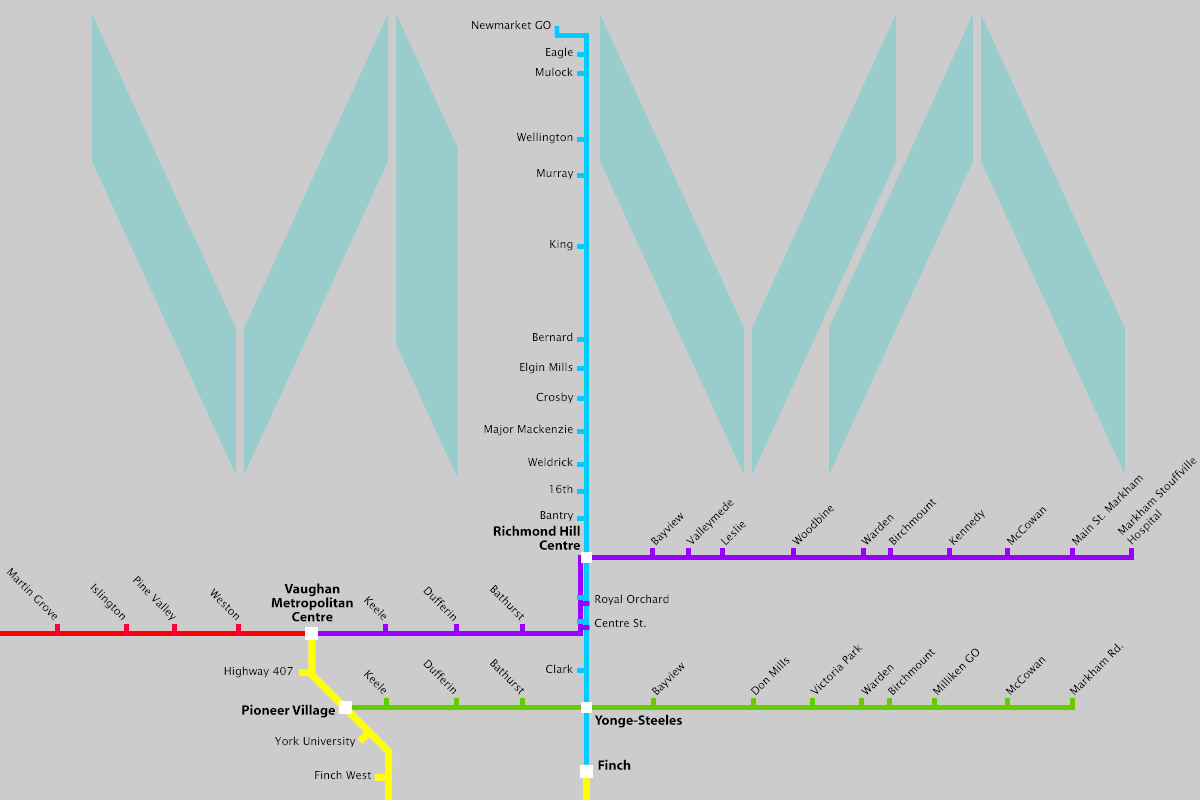
You're the one who doesn't know what VIVA you are talking about. VIVA debuted in 2005 with 10-15 minute frequency ALL DAY on ALL routes (Blue, Orange, Purple, Green), on top of the existing local YRT service. It was an immediate increase of around 700k service hours to 1.0M service hours annually, a 50% increase in service, but the ridership only increased around 20%. That's why they had to cut the system to its current state.
Because the problem with the YRT system is not gaps in the schedules, but the huge gaps between routes, namely the gap at Steeles. They need to add a route along Steeles. Not even one continuous east-west corridor south of Rutherford. They need a complete grid. South of Rutherford is where most of the ridership is and that is where the gap is. They need to close this gap.
Service level follows ridership level, not the other way around. They can double all the frequencies but ridership will not grow to fill those buses until this fill this huge gap in their system.
Mississauga had the same problem with the lack of service along Matheson. They extend 39 Britanna east from Kennedy along Matheson and suddenly ridership of the route exploded, to the point they have to use articulated buses. Articulated buses on a route with 25-30 minute frequency all day. Frequency basically the same as before, what drew riders was the closing of the gap. That's what YRT needs to focus on, filling all of the gaps in the system.
Having a complete network, allowing people to go from A to B, in the most direct path possible, with the shortest walking distances possible, those are the foundations of a useful transit system. Things like frequencies and limited stops are on top of that foundation, they are secondary. YRT just lacks the proper foundation.





 Prev
Prev











 Linear Mode
