 RE-IMAGINING THE RUBIN BLOCK
A heritage building becomes a safe haven
By Matthew Bradford
Revival is coming to Winnipeg’s Rubin Block. After 10 years of vacancy and neglect, the 111-year-old building is being transformed by the Fisher River Cree Nation, First Nation Healing Centre, the University of Winnipeg Community Renewal Corporation (UWCRC 2.0), and local partners Into transitional housing for women and children.
“Together through the generous support of funding partners, we are embarking on a visionary project,” says Chief David Crate of Fisher River Cree Nation. “The transformation of this historic building into a modern multi-family transitional complex signifies a monumental step towards meeting the critical demand for safe transitional housing for families in need.”
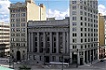
Situated at the southeast corner of Mulvey Avenue and Osborne Street, the Rubin Block is a three-storey brick and Tyndall stone building built in 1914 by local architect Max Zev Blankstein. Originally, it was home to a branch of the Merchants Bank of Canada, who shared the structure with a barber and a tailor on the ground floor, and 18 residential apartments on the upper floors. Now its new its new owners at Fisher River are working with UWCRC 2.0, AtLRG Architecture Inc. and Akman Construction to create a safe, secure and healing home for women and children who have experienced abuse.
“The Rubin Block project will stand as a testament to our collective commitment to fostering resilience and empowerment,” says Chief Crate. “Beyond providing physical shelter, this endeavour offers a beacon of hope and stability, illuminating the path to a brighter tomorrow for those grappling with housing challenges.”
MORE THAN A HOME
It’s been a rough decade for the Rubin Block. Years of neglect, damage from multiple fires and the accumulation of mould and structural decay had rendered the building in dire need of attention. Fortunately, Fisher River and UWCRC 2.0 have put together a team adept at helping buildings like this return to their full potential, including AtLRG Architecture, which has been working closely with all project stakeholders to “preserve where possible, restore with intention and enhance with sensitivity,” as per its guiding philosophy.
“We approach heritage restoration with deep respect for history while integrating modern functionality,” says Pamela Kwasetsky, senior architect with the firm. “[For the Rubin Block] we are preserving its signature masonry courtyards, brickwork, Tyndall stone, cornices and replacing PVC windows with historically aligned fibreglass ones.”
As for integrating new and modern features, AtLRG Architecture’s design includes the addition of an elevator for enhanced accessibility, a communal kitchen, playroom, exterior courtyard and a distinctive Round Room addition to complement the original storefront niche. Importantly, the revitalized Rubin Block will incorporate a number of safety and security features that “prioritize the safety, dignity and comfort of all users of the building without being overly obvious.”
Ultimately, says Kwasetsky, “This building is more than a home for families – it is a community.”
THE TRANSFORMATION BEGINS
Akman Construction is now on site, bringing AtLRG Architecture’s concept off the page. Its work includes mould abatement, fire damage remediation, roof and joist replacement, brick repointing, envelope upgrades, structural reinforcement and concrete slab installation.
“We’re addressing the building’s core structural needs,” reports Jared Akman, president of Akman Construction. “We’ve taken the building back to its bare bones, now we are rebuilding it the right way – strong, safe and ready to stand for generations.”
Sequencing has been a critical consideration throughout the project, particularly when tackling some of the project’s more complex phases, such as determining when and how to remove floors, roofs and joists without compromising the building’s integrity or adding a new elevator to a building that was never designed to support one. In this case, says Akman, the team’s highly coordinated and collaborative approach has been nothing short of essential.
“We really want to collaborate with all stakeholders, because that's When when you win. This project needs it. If anyone were doing anything in isolation, it just wouldn’t work.”
Granted, these challenges are not uncommon for heritage building restorations. They are also familiar complexities for the teams at AtLRG and Akman, who have applied their expertise to numerous heritage building projects throughout the city.
“It’s been very challenging, but also very rewarding,” Akman says. “When this building is complete, it will be a remarkable space that honours and showcases its history.”
The Rubin Block is slated for completion in spring 2026.
FUNDING PARTNERS
The University of Winnipeg Community Renewal Corporation would like to acknowledge the following funding partners, who made the restoration of the Rubin Block possible:
- Canada Mortgage and Housing Corporation (CMHC) – Indigenous Shelter and Transitional Housing Initiative & Affordable Housing Fund
- National Indigenous Collaborative Housing Inc. (NICHI)
- End Homelessness Winnipeg – Reaching Home: Canada’s Homelessness Strategy
- City of Winnipeg – Affordable Housing Now
- Federation of Canadian Municipalities’ Green Municipal Fund – Sustainable Affordable Housing
- Efficiency Manitoba
- RBC Foundation





 Prev
Prev









 Linear Mode
