HomeDiagramsDatabaseMapsForum About
     

Go Back   SkyscraperPage Forum > Regional Sections > Canada


Closed Thread

 
Thread Tools Display Modes
     
     
  #4321  
Old Posted Aug 24, 2015, 5:32 AM
Mister F Mister F is offline
Registered User
 
Join Date: Jun 2004
Posts: 2,986
Quote:
Originally Posted by swimmer_spe View Post
AADT is not the only reason to upgrade a highway. If a road is particularly unsafe and dividing it will make it safer, then why not do it.

If you only use one singular reason to upgrade a highway then many divided highways outside of the cities would not have been done for a much longer time.
Quote:
Originally Posted by manny_santos View Post
I also believe Ontario Northland Railway would still be in service had Highway 11 not been twinned.
Indeed, the money that was put into the highway could have made the Northlander faster than driving. I quoted swimmer_spe too because the argument for twinning lightly travelled highways is usually safety. But no amount of highway upgrades can make driving as safe as taking the train. People in cars die at a rate of 7.3 per billion passenger-miles, compared to 0.15 per billion on trains. Those numbers are staggering. So by abandoning the rail service and putting that money into Highway 11 instead, the government has made travelling to North Bay more dangerous than ever. The safety argument completely falls apart when you look at it that way.
     
     
  #4322  
Old Posted Aug 24, 2015, 10:52 AM
eemy's Avatar
eemy eemy is offline
Closed account
 
Join Date: Aug 2006
Posts: 4,425
Urban Interstate: .54 deaths per 100 million
Urban Highways and Arterials: .92 deaths per 100 million
Urban Streets: 1.32 deaths per 100 million

(http://freakonomics.com/2010/01/29/the-irony-of-road-fear/)

I expect rural interstates would have even lower death rates.

In any case, I don't think your analysis is correct. The difference in safety between two lane highway to divided highway is significant and you completely disregard that change. You can't just expect everyone is going to jump on a train. A significant portion of the users of Hwy 11 are ones who cannot just jump on a train for various reasons (final destination other than North Bay, truckers, people who don't like public transportation etc) and would use the highway regardless of its configuration. Rural areas are one of the situations where divided highway are most definitely an improvement.
     
     
  #4323  
Old Posted Aug 24, 2015, 11:56 AM
sonysnob sonysnob is online now
Registered User
 
Join Date: Aug 2011
Posts: 1,803
Quote:
Originally Posted by jeremy_haak View Post
Urban Interstate: .54 deaths per 100 million
Urban Highways and Arterials: .92 deaths per 100 million
Urban Streets: 1.32 deaths per 100 million

(http://freakonomics.com/2010/01/29/the-irony-of-road-fear/)

I expect rural interstates would have even lower death rates.

In any case, I don't think your analysis is correct. The difference in safety between two lane highway to divided highway is significant and you completely disregard that change. You can't just expect everyone is going to jump on a train. A significant portion of the users of Hwy 11 are ones who cannot just jump on a train for various reasons (final destination other than North Bay, truckers, people who don't like public transportation etc) and would use the highway regardless of its configuration. Rural areas are one of the situations where divided highway are most definitely an improvement.
Agree.

Having twinned Hwy 11 between Barrie and North Bay may have made it more politically palatable to cancel passenger rail service on the ONR line, but it had nothing to do with the fact that ONR passenger service was not sustainable, and that it did not adequate service most travel demand along the corridor.

Last edited by sonysnob; Aug 24, 2015 at 12:09 PM.
     
     
  #4324  
Old Posted Aug 24, 2015, 12:22 PM
sonysnob sonysnob is online now
Registered User
 
Join Date: Aug 2011
Posts: 1,803
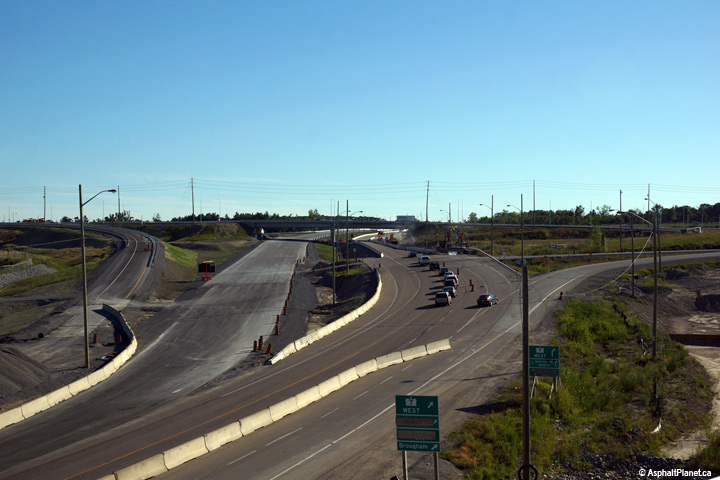
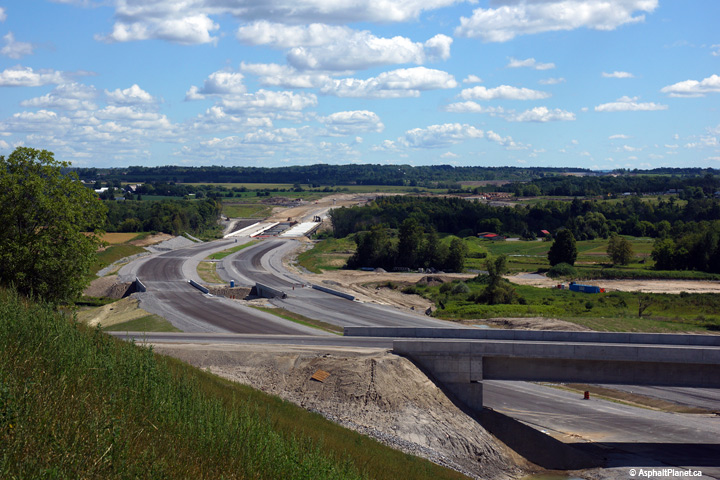
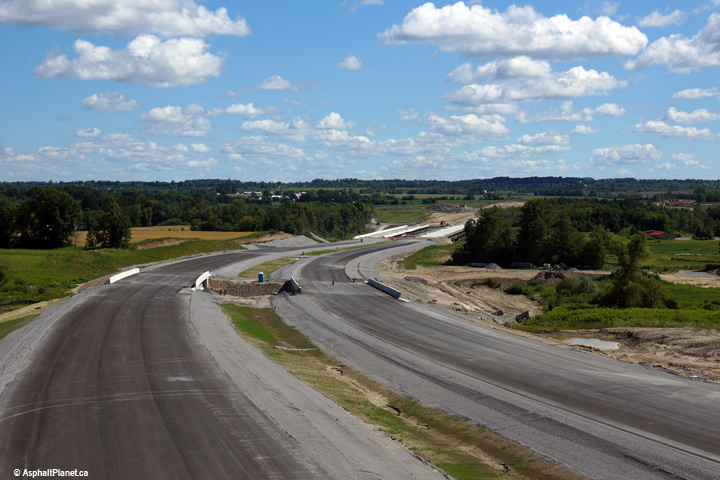
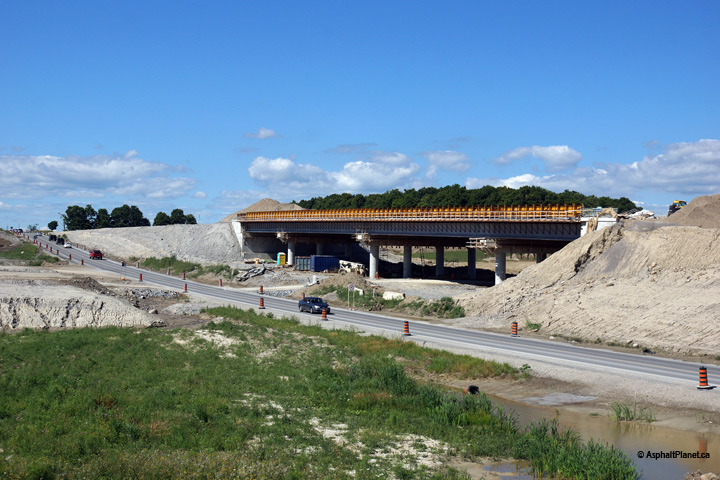
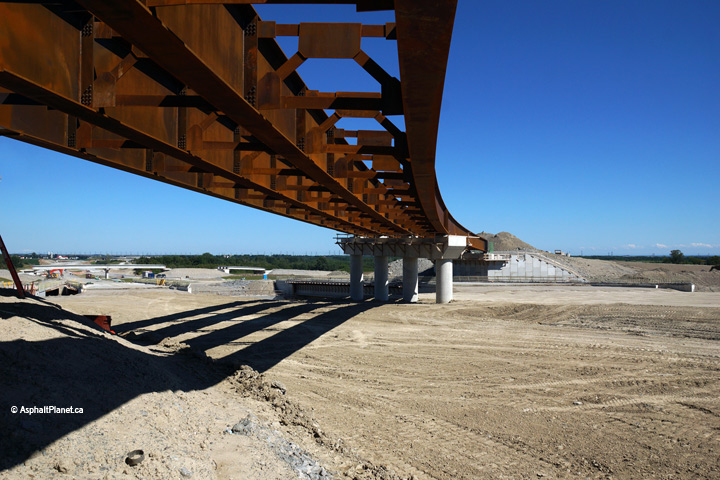
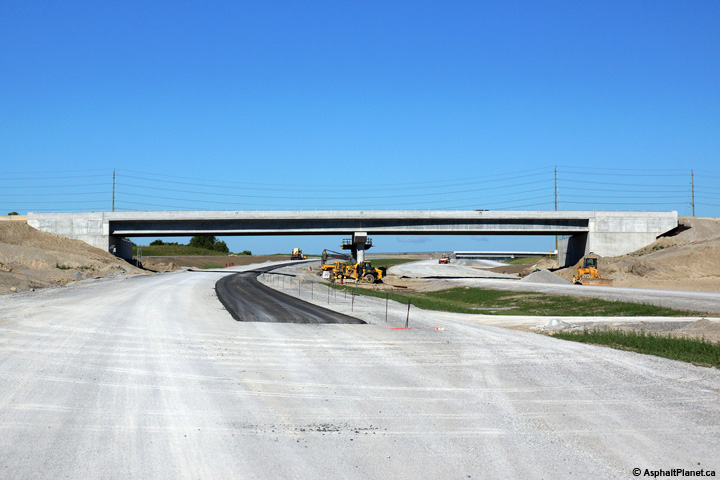
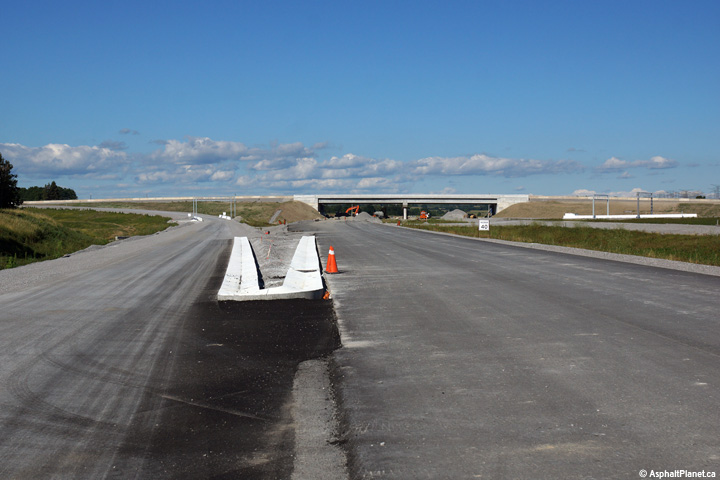
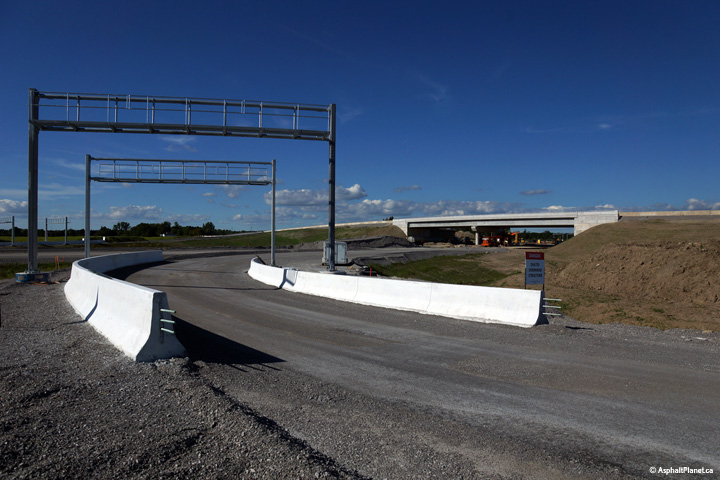
A few new photos taken of the construction along the Highway 407 corridor in Durham Region. Construction is moving along well, but I am still not certain if they can finish the highway by the start of winter this year:


View of the then un-opened Brock Road interchange from the future Highway 407 overpass. (The Brock Road interchange opened the day after these photos were taken).


View looking easterly approaching the Sideline 14 overpass.


Easterly view from the Sideline 14 overpass


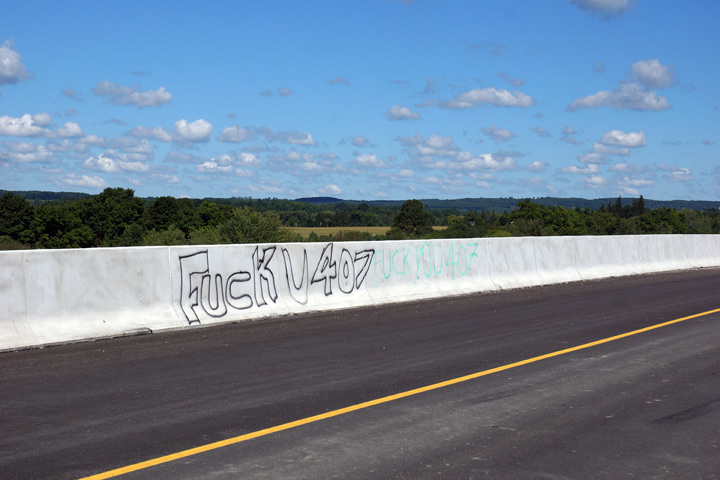
Not everyone is excited about the extension of the 407.


View of the Lake Ridge Road overpass with the temporary Lake Ridge Road diversion operated adjacent to the new overpass


This steel structure will carry the ramp from Hwy 412 north to Hwy 407 west.


View looking westerly approaching the Hwy 12 overpass. Paving operations had just commenced in this area when this photo was taken.


Easterly view approaching the Simcoe Street overpass.


Additional view of the Simcoe Street overpass from the future southbound to eastbound loop ramp.

For the full set, and full resolution versions of the above photos, click here:
http://www.asphaltplanet.ca/ON/hwy_407-409_images/407E/Hwy407_ConstructionImages.htm#Aug15
     
     
  #4325  
Old Posted Aug 24, 2015, 1:36 PM
RyLucky's Avatar
RyLucky RyLucky is offline
Registered User
 
Join Date: Feb 2012
Posts: 2,498
Quote:
Originally Posted by jeremy_haak View Post
Urban Interstate: .54 deaths per 100 million
Urban Highways and Arterials: .92 deaths per 100 million
Urban Streets: 1.32 deaths per 100 million

(http://freakonomics.com/2010/01/29/the-irony-of-road-fear/)

I expect rural interstates would have even lower death rates.
My assumption is that most collisions occur at intersections, not during high-volume stretches of freeway. Is that true?

Does that include pedestrians and cyclists on each of those types of roads?

Here's an interesting read on Why Sweden has so few road deaths.
They have the famous "Vision Zero" and "2 + 1" roads. The basic principle is to strictly enforce slow limits where collisions with pedestrians and cyclists are possible, and separate modes with a barrier wherever possible.
     
     
  #4326  
Old Posted Aug 24, 2015, 3:41 PM
Mister F Mister F is offline
Registered User
 
Join Date: Jun 2004
Posts: 2,986
Quote:
Originally Posted by jeremy_haak View Post
Urban Interstate: .54 deaths per 100 million
Urban Highways and Arterials: .92 deaths per 100 million
Urban Streets: 1.32 deaths per 100 million

(http://freakonomics.com/2010/01/29/the-irony-of-road-fear/)

I expect rural interstates would have even lower death rates.

In any case, I don't think your analysis is correct. The difference in safety between two lane highway to divided highway is significant and you completely disregard that change. You can't just expect everyone is going to jump on a train. A significant portion of the users of Hwy 11 are ones who cannot just jump on a train for various reasons (final destination other than North Bay, truckers, people who don't like public transportation etc) and would use the highway regardless of its configuration. Rural areas are one of the situations where divided highway are most definitely an improvement.
My analysis is sound. 0.54 deaths per 100 million is 5.4 deaths per billion. Note that you're using vehicle miles while I was using passenger-miles. Those numbers are several orders of magnitude higher than the rail death rate of 0.15 per billion passenger-miles. Sure not everyone can take a train, but now the option to take the train has been taken away in favour of a far more dangerous way of travelling. To do that in the name of safety is bizarro logic at its best.

Quote:
Originally Posted by sonysnob View Post
Agree.

Having twinned Hwy 11 between Barrie and North Bay may have made it more politically palatable to cancel passenger rail service on the ONR line, but it had nothing to do with the fact that ONR passenger service was not sustainable, and that it did not adequate service most travel demand along the corridor.
The ONR line was only made infeasible because it was neglected while billions were put into the highway. If we use the same standard of feasibility for both modes, the highway isn't feasible either. A properly maintained rail line with the same kind of investment the highway got would have attracted way more riders, just like similar rail lines in similar contexts all over the world.
     
     
  #4327  
Old Posted Aug 24, 2015, 3:53 PM
swimmer_spe swimmer_spe is offline
BANNED
 
Join Date: Apr 2014
Posts: 10,743
Quote:
Originally Posted by Mister F View Post
The ONR line was only made infeasible because it was neglected while billions were put into the highway. If we use the same standard of feasibility for both modes, the highway isn't feasible either. A properly maintained rail line with the same kind of investment the highway got would have attracted way more riders, just like similar rail lines in similar contexts all over the world.
The fact that it did not run on Sundays, and that it was running the wrong direction didn't help much.
     
     
  #4328  
Old Posted Aug 24, 2015, 6:11 PM
eternallyme eternallyme is offline
Registered User
 
Join Date: Mar 2009
Posts: 5,243
Quote:
Originally Posted by jeremy_haak View Post
Urban Interstate: .54 deaths per 100 million
Urban Highways and Arterials: .92 deaths per 100 million
Urban Streets: 1.32 deaths per 100 million

(http://freakonomics.com/2010/01/29/the-irony-of-road-fear/)

I expect rural interstates would have even lower death rates.

In any case, I don't think your analysis is correct. The difference in safety between two lane highway to divided highway is significant and you completely disregard that change. You can't just expect everyone is going to jump on a train. A significant portion of the users of Hwy 11 are ones who cannot just jump on a train for various reasons (final destination other than North Bay, truckers, people who don't like public transportation etc) and would use the highway regardless of its configuration. Rural areas are one of the situations where divided highway are most definitely an improvement.
How do rural Interstates compare to rural arterials? I'd expect a much greater difference.

Also I find that a lot more high-intensity/fatal accidents happen on rural arterials than on any other kind of highway (i.e. busy 2 lane highways such as 2-lane sections of 11, 17 and 69 in that region, and in Southern Ontario highways like 6, 7 and 12). That is likely due to the speed (~100 km/h is the flow), the lack of protection in side or head-on accidents, the many intersections and high traffic volumes considering the capacity.

I'd personally expect rural collectors/locals to have a lower fatality rate since a lot less traffic uses them at lower speed. I know, in that region, fatal accidents on collector highways like 64, 124, 518 and 520 are not common.
     
     
  #4329  
Old Posted Aug 24, 2015, 7:39 PM
GoTrans GoTrans is offline
Registered User
 
Join Date: Jan 2010
Posts: 695
Quote:
Originally Posted by swimmer_spe View Post
The fact that it did not run on Sundays, and that it was running the wrong direction didn't help much.
For most of its career, the Northlander ran 2 trains each direction south of North Bay, one started in Timmins ( later moved to Cochrane ) and the other started in North Bay in addition to the joint Via/ONR Northland train to Hearst which was cut back to Cochrane before being eliminated. In the 70's and 80's the problem was with poor maintenance on CN track south of North Bay rather than the ONR's trackage north of North Bay. Track condition was the main impediment to shorter transit times on the route. When CN abandoned the Newmarket sub between Washago and Barrie the Northlander also had to deal with congestion on the Bala sub on the east side of Lake Simcoe. Most freight trains traversed the Bala sub with the exception of the iron ore trains from Dane and Temagami headed to Stelco.

The design speed of 4 lane highways is probably about 135-140 km/hr while the design speed of the railways built in the early 1900's is about 75-80 km/hr. The quality of the track brings the average speed down to even less than that due to the fact that the rail still follows its original alignments unlike the road.

Investment is the key. We need to give railways the same priority we give highways. The railways and government need to improve alignments and grade separations on major rail routes. Railways need to be encouraged to build more double track and improve the quality of the track, especially when used by passenger trains.
     
     
  #4330  
Old Posted Aug 24, 2015, 11:02 PM
manny_santos's Avatar
manny_santos manny_santos is offline
Registered User
 
Join Date: Jul 2006
Location: New Westminster
Posts: 5,141
Quote:
Originally Posted by Loco101 View Post
You feel that Hwy 11 between Huntsville and North Bay would be okay if it was only 2 lanes??? I was always annoyed at having to go through the towns. Sundridge was probably the worst. It really shows how backwards some of the people in those places could be by not wanting a better highway. I can see if affecting businesses but I don't understand how the value of homes would take a hit.
I went through Sundridge many times over the years and I never remember it being congested. Certainly a much more pleasant drive than the 401 through Toronto.

Home values took a hit because the region became less desirable as businesses closed. Same problem Detroit has. What I do know is that a flood of houses went on the market up there in the late 90s when the highway was announced and it often took 3-5 years to sell. Towns like Sundridge were just a little far from North Bay to be bedroom communities.
     
     
  #4331  
Old Posted Aug 25, 2015, 4:24 AM
Loco101's Avatar
Loco101 Loco101 is offline
Registered User
 
Join Date: May 2013
Location: Timmins, Northern Ontario
Posts: 8,957
Quote:
Originally Posted by manny_santos View Post
I went through Sundridge many times over the years and I never remember it being congested. Certainly a much more pleasant drive than the 401 through Toronto.

Home values took a hit because the region became less desirable as businesses closed. Same problem Detroit has. What I do know is that a flood of houses went on the market up there in the late 90s when the highway was announced and it often took 3-5 years to sell. Towns like Sundridge were just a little far from North Bay to be bedroom communities.
The economic decline was likely affected by a sawmill closure. Also, most smaller places haven't done well as people are centralizing more and more to larger centres.

I find the new highway bypassing around Sundridge and other nearby towns to be much faster and safer. I have even exited to Sundridge a few times for gas and food. I didn't like having to drive through the town and found it could really slow you down when you didn't want to go there.
     
     
  #4332  
Old Posted Aug 25, 2015, 12:47 PM
eemy's Avatar
eemy eemy is offline
Closed account
 
Join Date: Aug 2006
Posts: 4,425
Let's do some back of the envelope calculations. The death rate for divided highways is roughly half the death rate for undivided highways. For my purposes, the death rate for railways is zero. This is quite conservative, the ratio of deaths from divided to undivided for rural highways is likely lower than that for reasons already discussed in this thread.

If we were to hypothetically not have divided Highway 11, roughly twice as many drivers would die in vehicle incidents. Therefore, if a railway would save more lives than a divided highway, it would have to carry more than half the number of current users of Highway 11 to bring the overall death rate below the current one.

The lowest usage portion of Highway 11 has approximately 8000 AADT, or roughly 3 million vehicles per year. Based on average occupancy of ~1.5 (based on urban figures again, couldn't find rural ones), that translate to 4.5 million people per year on the lowest travelled sections.

Therefore, if the government were to build a railway instead because it is safer, that railway would, very conservatively, need to carry approximately 2-2.5 million passengers per year. That is approximately half of VIA Rail's current ridership on a railway line to North Bay or ten times Ontario Northland's ridership when the decision was made to cut the service.
     
     
  #4333  
Old Posted Aug 25, 2015, 1:03 PM
sonysnob sonysnob is online now
Registered User
 
Join Date: Aug 2011
Posts: 1,803
Quote:
Originally Posted by Loco101 View Post
The economic decline was likely affected by a sawmill closure. Also, most smaller places haven't done well as people are centralizing more and more to larger centres.

I find the new highway bypassing around Sundridge and other nearby towns to be much faster and safer. I have even exited to Sundridge a few times for gas and food. I didn't like having to drive through the town and found it could really slow you down when you didn't want to go there.
It should be noted too, that in 2011 (the most recent census figures), the townships of Perry, Powassan, Machar and Strong all showed positive growth compared to 2006. Considering what has happened with the forestry industry in recent years, the picture is far from bleak in any of those towns.
     
     
  #4334  
Old Posted Aug 25, 2015, 2:14 PM
sonysnob sonysnob is online now
Registered User
 
Join Date: Aug 2011
Posts: 1,803
The 2015-2019 Southern and Northern Highway programs are up for Ontario

http://www.mto.gov.on.ca/english/highway-bridges/southern-and-northern-highways-programs.shtml
     
     
  #4335  
Old Posted Aug 25, 2015, 2:47 PM
eternallyme eternallyme is offline
Registered User
 
Join Date: Mar 2009
Posts: 5,243
Quote:
Originally Posted by sonysnob View Post
It should be noted too, that in 2011 (the most recent census figures), the townships of Perry, Powassan, Machar and Strong all showed positive growth compared to 2006. Considering what has happened with the forestry industry in recent years, the picture is far from bleak in any of those towns.
Although closer to North Bay, there was very high growth in Callander as well.
     
     
  #4336  
Old Posted Aug 25, 2015, 6:12 PM
SignalHillHiker's Avatar
SignalHillHiker SignalHillHiker is offline
I ♣ Baby Seals
 
Join Date: Jul 2012
Location: Sin Jaaawnz, Newf'nland
Posts: 36,273
Took a couple of mobile pics to demonstrate just how awful the weather is in St. John's compared to the rest of the island - it's enough that even the fauna is strikingly different.

This is a few hours outside the city:


This is north of Gander, in Central Newfoundland - WAY north of St. John's.


It was that way ALL DAY in both places. It wasn't a result of weather changing.

Fun driving, though.
__________________
Note to self: "The plural of anecdote is not evidence."
     
     
  #4337  
Old Posted Aug 26, 2015, 2:00 AM
Mister F Mister F is offline
Registered User
 
Join Date: Jun 2004
Posts: 2,986
Quote:
Originally Posted by jeremy_haak View Post
Let's do some back of the envelope calculations. The death rate for divided highways is roughly half the death rate for undivided highways. For my purposes, the death rate for railways is zero. This is quite conservative, the ratio of deaths from divided to undivided for rural highways is likely lower than that for reasons already discussed in this thread.

If we were to hypothetically not have divided Highway 11, roughly twice as many drivers would die in vehicle incidents. Therefore, if a railway would save more lives than a divided highway, it would have to carry more than half the number of current users of Highway 11 to bring the overall death rate below the current one.

The lowest usage portion of Highway 11 has approximately 8000 AADT, or roughly 3 million vehicles per year. Based on average occupancy of ~1.5 (based on urban figures again, couldn't find rural ones), that translate to 4.5 million people per year on the lowest travelled sections.

Therefore, if the government were to build a railway instead because it is safer, that railway would, very conservatively, need to carry approximately 2-2.5 million passengers per year. That is approximately half of VIA Rail's current ridership on a railway line to North Bay or ten times Ontario Northland's ridership when the decision was made to cut the service.
It would be interesting to see actual figures for this - how many fatalities there were before twinning and after. The problem with your analysis is induced traffic. Modal share tends to gravitate to the easier and faster mode of transportation. With a 2 lane highway next to a modern railway with good service, there would be less traffic on the highway than there is now. So the railway wouldn't need as many riders as you think. Not to mention the effect winter has on safety.

VIA Rail isn't any sort of benchmark to use for ridership, it's mickey mouse compared to pretty much any other system. For an idea of what could have been possible, look at Australia or Scotland or Norway. Scotland's system carries well over 80 million passengers every year. That's 20 times VIA's ridership in a country with fewer people than greater Toronto. Granted, that probably includes commuter lines, but even when you include Canada's commuter lines the comparison isn't exactly flattering to us. Norway's system carries 58 million annual riders. All three countries maintain passenger rail to remote communities and only build expressways in densely populated areas.

Take Inverness, a city comparable to North Bay in population and distance from big cities. There's no divided highway to get there, but it's served by 35 trains a day and even more frequent service planned. So there you have it, Scotland's version of North Bay has better intercity rail service than Toronto. Kind of puts things in perspective.

The ship has sailed for North Bay, since the expressway has already been built. But it's not too late to shift from driving to rail in other corridors. Instead of twinning Highway 26 to Wasaga Beach and Collingwood, rebuild the rail line. Same thing with the Ottawa Valley towards Renfrew and Pembroke. Or the Kitchener-Hamilton corridor (actually that could probably support both). We're already making a shift to rail in the GTA, but we still have the mindset that driving is the only feasible way to get around in other areas. That's just not the case.

     
     
  #4338  
Old Posted Aug 26, 2015, 2:22 AM
TorontoDrew's Avatar
TorontoDrew TorontoDrew is offline
Registered User
 
Join Date: Nov 2014
Posts: 10,685
The highways in NFLD and Nova Scotia look like some of the best traffic free scenic routes in the country.
     
     
  #4339  
Old Posted Aug 26, 2015, 3:12 AM
Innsertnamehere's Avatar
Innsertnamehere Innsertnamehere is offline
Registered User
 
Join Date: Jan 2010
Location: Hamilton
Posts: 12,838
Quote:
Originally Posted by sonysnob View Post
The 2015-2019 Southern and Northern Highway programs are up for Ontario

http://www.mto.gov.on.ca/english/highway-bridges/southern-and-northern-highways-programs.shtml
nothing really big in there from what I can tell.. One thing I did notice is that the Bradford Bypass and 404 extension to Beaverton are back in the "planning for the future" section. The 401 widening through Milton has finally moved up to the planned expansions as well, despite being listed as funded for several years while still being placed in the "planning for the future" section.
     
     
  #4340  
Old Posted Aug 26, 2015, 12:04 PM
sonysnob sonysnob is online now
Registered User
 
Join Date: Aug 2011
Posts: 1,803
Quote:
Originally Posted by Innsertnamehere View Post
nothing really big in there from what I can tell.. One thing I did notice is that the Bradford Bypass and 404 extension to Beaverton are back in the "planning for the future" section. The 401 widening through Milton has finally moved up to the planned expansions as well, despite being listed as funded for several years while still being placed in the "planning for the future" section.
Yeah, there weren't really any surprises this year, aside from the planning for the future section.

I was also happy to see the widening of Hwy 12 through Beaverton included in the planning for the future segment. There is a lot of truck traffic on that road, and actually seems ready already for a full reconstruct.
     
     
This discussion thread continues

Use the page links to the lower-right to go to the next page for additional posts
 
 
Closed Thread

Go Back   SkyscraperPage Forum > Regional Sections > Canada
Forum Jump


Forum Jump


All times are GMT. The time now is 1:09 AM.

     
SkyscraperPage.com - Privacy Statement - Top

Powered by vBulletin® Version 3.8.7
Copyright ©2000 - 2026, vBulletin Solutions, Inc.