HomeDiagramsDatabaseMapsForum About
     

Go Back   SkyscraperPage Forum > Regional Sections > Canada > Atlantic Provinces > Halifax > Halifax Peninsula & Downtown Dartmouth


Reply

 
Thread Tools Display Modes
     
     
  #3021  
Old Posted Nov 28, 2011, 12:05 AM
Empire's Avatar
Empire Empire is offline
Salty Town
 
Join Date: Sep 2003
Location: Halifax
Posts: 2,193
Quote:
Originally Posted by cormiermax View Post
And to think Halifax was once filled with buildings like that. If only we kept them, I would say Halifax would rival Quebec City for its European historic feel.
Exactly....but now we have the VIC!!! etc
__________________
Salty Town
Reply With Quote
     
     
  #3022  
Old Posted Nov 28, 2011, 12:28 AM
cormiermax's Avatar
cormiermax cormiermax is offline
Registered User
 
Join Date: Oct 2009
Location: Beijing
Posts: 884
Quote:
Originally Posted by Empire View Post
Exactly....but now we have the VIC!!! etc
Well I wouldn't say the old apartment building was worth saving, all the neighbouring houses where though. I think its time a true heritage district is established, Perhaps even move some of the endangered structures too such an area.
Reply With Quote
     
     
  #3023  
Old Posted Nov 28, 2011, 1:47 AM
Keith P.'s Avatar
Keith P. Keith P. is offline
Registered User
 
Join Date: Mar 2006
Posts: 8,758
Quote:
Originally Posted by cormiermax View Post
And to think Halifax was once filled with buildings like that. If only we kept them, I would say Halifax would rival Quebec City for its European historic feel.
Hardly. Halifax was filled with mostly unremarkable wood-frame structures that met the fate of most such buildings. There were few British Museums or Penn Stations here.
Reply With Quote
     
     
  #3024  
Old Posted Nov 28, 2011, 1:58 AM
cormiermax's Avatar
cormiermax cormiermax is offline
Registered User
 
Join Date: Oct 2009
Location: Beijing
Posts: 884
Quote:
Originally Posted by Keith P. View Post
Hardly. Halifax was filled with mostly unremarkable wood-frame structures that met the fate of most such buildings. There were few British Museums or Penn Stations here.
The old row houses that filled downtown and what is now cogswell interchange, from what I could tell mostly brick structures in a very British style. If around today Halifax would be a British Quebec City.
Reply With Quote
     
     
  #3025  
Old Posted Nov 28, 2011, 2:15 AM
someone123's Avatar
someone123 someone123 is offline
hähnchenbrüstfiletstüc
 
Join Date: Nov 2001
Location: Vancouver
Posts: 35,652
Quote:
Originally Posted by Keith P. View Post
Hardly. Halifax was filled with mostly unremarkable wood-frame structures that met the fate of most such buildings. There were few British Museums or Penn Stations here.
I think that's an unrealistically high standard to hold heritage buildings to, particularly when we're talking about spending on the order of hundreds of thousands or a few million dollars to save them or incorporate them into new developments (they do not all need to be 100% preserved -- often the value is just in the facade or some other component).

Not everything is worth preserving but there are also many great buildings that are declared unsalvageable only after decades of preventable neglect. You could turn the British Museum into an unsafe firetrap if you wanted to -- stop maintaining it for 50 years, watch vandals move in and trash it, then declare it a loss, demolish, and build disposable vinyl apartments. Actually this type of scenario doesn't seem like a stretch in Halifax.

Conversely many of the major heritage buildings required huge maintenance and upgrade projects to be viable. Grand Central has seen billions in restoration and improvement work. I don't necessarily think it's true that these other buildings were better designed than the ones in Halifax. All older buildings at one point had deficiencies in terms of a lack of modern wiring, HVAC, etc. These excuses used to demolish buildings in Halifax would apply anywhere else, but in some cities they opt for preservation instead.

Last edited by someone123; Nov 28, 2011 at 2:25 AM.
Reply With Quote
     
     
  #3026  
Old Posted Nov 28, 2011, 2:19 AM
fenwick16 fenwick16 is offline
Honored Member
 
Join Date: Feb 2007
Location: Toronto area (ex-Nova Scotian)
Posts: 5,558
Quote:
Originally Posted by cormiermax View Post
The old row houses that filled downtown and what is now cogswell interchange, from what I could tell mostly brick structures in a very British style. If around today Halifax would be a British Quebec City.
The Scotia Square area seemed to be mostly wooden structures that appeared to be rundown. Here are a couple of links to the area from 1935 - 1947 http://www.gov.ns.ca/nsarm/virtual/Builtheritage/archives.asp?ID=131 & http://www.gov.ns.ca/nsarm/virtual/built...200803099&Width=600&Height=455&Nav=false .

However, there are structures that I wish had been saved (such as the old Royal Exhibition Building on Tower Road).
Reply With Quote
     
     
  #3027  
Old Posted Nov 28, 2011, 2:30 AM
someone123's Avatar
someone123 someone123 is offline
hähnchenbrüstfiletstüc
 
Join Date: Nov 2001
Location: Vancouver
Posts: 35,652
Quote:
Originally Posted by fenwick16 View Post
The Scotia Square area seemed to be mostly wooden structures that appeared to be rundown. ... However, there are structures that I wish had been saved (such as the old Royal Exhibition Building on Tower Road).
Some structures in that area were run down but others could have been restored. There should have been more of an effort to selectively cull the low-end buildings and replace them with better buildings while preserving the neighbourhood fabric.

I think Halifax would have been better off if the 60s-80s era business district had been built next to the old downtown instead of on top of it. Quebec City has old and new business districts. Without the bigger office towers downtown there wouldn't have been the same need to shoehorn in more roadways and parking. Unfortunately I think highways and office towers were "sexy" back in the 60s. Every city wanted to have them regardless of whether or not they worked properly.
Reply With Quote
     
     
  #3028  
Old Posted Nov 28, 2011, 3:29 AM
Jstaleness's Avatar
Jstaleness Jstaleness is offline
Jelly Bean Sandwich
 
Join Date: Apr 2009
Location: Dartmouth
Posts: 1,768
__________________
I can't hear you with my eyes closed
Reply With Quote
     
     
  #3029  
Old Posted Nov 28, 2011, 3:41 PM
RyeJay RyeJay is offline
BANNED
 
Join Date: Apr 2011
Posts: 3,086
Quote:
Originally Posted by cormiermax View Post
And to think Halifax was once filled with buildings like that. If only we kept them, I would say Halifax would rival Quebec City for its European historic feel.
Old Quebec has the geographical advantage of being very enclosed (behind the cliff is the modern city), being at the mouth of the water-route to the other cities of Central Canada--and the population advantage of having enough local dollars to save a good deal of the their heritage buildings (which, again, is easier and less expensive to do in this context).

Halifax spans the entire peninsula, with a smaller population. The city may have been a successful military town in the past, and consequently a successful military city in the near future-- but for a great deal of time there has been a stagnation in the city's economy. It's expensive to hold onto heritage buildings, when you have potential income from interested developers that your economy needs.

Old Quebec is well preserved and I enjoy visiting. Halifax, however, has evolved with an entirely different history. I wonder how Quebec City would look today if half of it was blown up in 1917....
Reply With Quote
     
     
  #3030  
Old Posted Nov 28, 2011, 5:46 PM
halifaxboyns halifaxboyns is offline
Registered User
 
Join Date: Feb 2010
Location: Planet earth
Posts: 3,883
Fenwick had suggested some time ago that another method of attempting to conserve heritage buildings was some sort of tax waiving on the property. I believe this is similar to the concept that is now being floated to waive property taxes on a site for up to 5 years for former gas station sites.

I thought it was a good idea because you wouldn't be charged property taxes (which can often be hefty in a downtown or regional core circumstance) for 5 years - which could be a great incentive.
Reply With Quote
     
     
  #3031  
Old Posted Nov 28, 2011, 6:32 PM
someone123's Avatar
someone123 someone123 is offline
hähnchenbrüstfiletstüc
 
Join Date: Nov 2001
Location: Vancouver
Posts: 35,652
Quebec City has also had its good and bad times economically and overall it has grown about as much as Halifax. It seems to be doing better today but in the 1950s I suspect the biggest force preserving the older parts of the city was the simple fact that there wasn't much pressure to develop it. In Halifax there most of the demolition came about as the result of grand plans like Scotia Square which were very expensive to execute. Toronto is a case where there was even less preservation and even more development pressure.

Today there's a major gap between Halifax and Quebec City when it comes to the amount of energy spent on preservation of heritage assets. I don't believe that it comes down to Quebec having more money (note that poorer countries like Mexico have tons of well-preserved historic towns and cities). Maybe Quebec gets more money from the province and federal government but I think the biggest difference is that heritage is more of a priority there.

In Halifax council spends $40M on ice rinks. Imagine a proposal to spend $40M on historic buildings in the core (even with federal support). Council doesn't even keep the sidewalks on Spring Garden Road in reasonable shape. Like I said, priorities.
Reply With Quote
     
     
  #3032  
Old Posted Nov 28, 2011, 7:40 PM
JET JET is offline
Registered User
 
Join Date: Feb 2007
Posts: 1,988
Quote:
Originally Posted by RyeJay View Post
Old
Old Quebec is well preserved and I enjoy visiting. Halifax, however, has evolved with an entirely different history. I wonder how Quebec City would look today if half of it was blown up in 1917....
If half of Quebec City was blown up in 1917 and replaced by ticky-tacky cookie cutter houses, you can bet your ass that they would have hung on to all remaining historic buildings.
Our North End heritage blew up in a second; in the central and South ends, it's happening slowly but steadily.
Those houses on South St. were a terrible loss, just look at those entranceways.
Reply With Quote
     
     
  #3033  
Old Posted Nov 28, 2011, 8:40 PM
Acajack's Avatar
Acajack Acajack is offline
Gros Méchant Loup
 
Join Date: Aug 2006
Location: Province 2, Canadian Empire
Posts: 72,949
Quote:
Originally Posted by someone123 View Post
Quebec City has also had its good and bad times economically and overall it has grown about as much as Halifax. It seems to be doing better today but in the 1950s I suspect the biggest force preserving the older parts of the city was the simple fact that there wasn't much pressure to develop it. In Halifax there most of the demolition came about as the result of grand plans like Scotia Square which were very expensive to execute. Toronto is a case where there was even less preservation and even more development pressure.

Today there's a major gap between Halifax and Quebec City when it comes to the amount of energy spent on preservation of heritage assets. I don't believe that it comes down to Quebec having more money (note that poorer countries like Mexico have tons of well-preserved historic towns and cities). Maybe Quebec gets more money from the province and federal government but I think the biggest difference is that heritage is more of a priority there.
I think that for much of the 20th century a lot of Vieux-Québec (and also Vieux-Montréal) was in a relative state of abandonment. There was abundant modern space available elsewhere in the city for offices, residences and businesses and so all that activity simply moved there. I am not too old to remember when those two historic districts weren't exactly beehives of activity. Things weren't falling down (since most buildings were built rather solidly) and they weren't ghost towns, but there was a lot of empty stuff there and it wasn't the nicest part of town.

Things gradually started to pick up in both Quebec City and Montreal in the 80s, and then really took off in the 90s. But if you went back in time and visited these places in the 70s, you wouldn't recognize them.

It was in the 80s that stuff like Les Cours Le Royer started to take shape in Montreal. This when they kicked off the renewal of historic districts:
http://www.vieux.montreal.qc.ca/inventaire/fiches/fiche_rue.php?id=39&sec=g

Quebec City started improving its old town around the same time.
Reply With Quote
     
     
  #3034  
Old Posted Nov 28, 2011, 9:19 PM
someone123's Avatar
someone123 someone123 is offline
hähnchenbrüstfiletstüc
 
Join Date: Nov 2001
Location: Vancouver
Posts: 35,652
Judging by photos, the story in Halifax is similar. By the 50s/60s the old buildings were still there but were emptying out. There were some attempts to save some buildings that are now the Historic Properties and so on but the efforts don't seem proportional to the value of the heritage buildings.

One illustrative example is Keith House on Hollis Street. It is a three storey sandstone mansion from the 1850s. Most Canadian cities have zero buildings like this. Keith House is finally being restored but for years it sat deteriorating and it got to the point where its entryway was boarded up with plywood because the stonework was at risk of collapsing.

Unfortunately people in Halifax seem to be behind the times when it comes to heritage preservation and they do not appreciate what they have. Halifax is also somewhat under-appreciated in the rest of the country as a historic city, I guess because (English) Canadian history tends to be very Ontario-centric. It's pretty common to present the Atlantic region as peripheral throughout all of history -- books will have chapters on settlers in Toronto and Kingston in the 1700s and a footnote about Louisbourg. I've seen the Seven Years' War and 1812 presented as if they revolved around Toronto. No surprise that sites of national importance in Halifax are frequently neglected.
Reply With Quote
     
     
  #3035  
Old Posted Nov 28, 2011, 10:09 PM
-Harlington-'s Avatar
-Harlington- -Harlington- is offline
Registered User
 
Join Date: Jun 2009
Location: Halifax-Nova Scotia
Posts: 1,097
CTV news story says that theres going to be a huge 500 million residential development near mount saint vincent university connecting to lacewood dr. to be mostly mid-rise and should house 3500-4000 people
They said construction should start in two years .
Reply With Quote
     
     
  #3036  
Old Posted Nov 28, 2011, 10:23 PM
Keith P.'s Avatar
Keith P. Keith P. is offline
Registered User
 
Join Date: Mar 2006
Posts: 8,758
Quote:
Originally Posted by someone123 View Post
I suspect the biggest force preserving the older parts of the city was the simple fact that there wasn't much pressure to develop it. In Halifax there most of the demolition came about as the result of grand plans like Scotia Square which were very expensive to execute.
Scotia Square came about because the area of downtown where it is located was one of Halifax's worst slums. Run-down wooden buildings of questionable quality even when new. Over time they became horrible and needed to go. The rest of Halifax's downtown wasn't much to write home about either. The stretch along Water St was especially awful. I remember my dad telling me about visiting a family that lived somewhere on Water St who were burning old automotive batteries for winter heat. Imagine the toxic fumes those would have put out. But the people were dirt poor and that is all they had. That is the kind of housing these areas supported. It was a type of poverty that no longer exists; despite the issues that we still have it is nothing like it was back then.

We tend to look at these "heritage" buildings with rose-colored glasses but many of them had a dark history.
Reply With Quote
     
     
  #3037  
Old Posted Nov 28, 2011, 10:35 PM
someone123's Avatar
someone123 someone123 is offline
hähnchenbrüstfiletstüc
 
Join Date: Nov 2001
Location: Vancouver
Posts: 35,652
Well, I don't think the wooden shack type buildings along parts of Market Street or Water Street were salvageable. I am talking mostly about masonry buildings along areas like Hollis that would have been tired looking by the 1970s but, if they were still around today, could be rehabbed. There are lots of examples of desirable buildings today that looked awful before they were restored.

South Street is another example in 2011 where they could have done better than a bulldozer. Lots of people liked those brick facades; a developer could have retained them and built a tower in behind. It would have been more complicated for the owners but better for the city. We don't reward that kind of thing with public money though (instead it goes toward cat bylaws and McCluskey grandstanding), so most developers don't bother and we don't get ideal outcomes.

Even when it comes to the legitimate slums I'm not sure the city did very well. Africville is another clear-cut case where living standards were abysmal. Uniacke Square is probably better but isn't very successful, and the whole area nearby has basically gone to hell. My opinion is that some demolition was need but that they were too heavy-handed. I think the newer smaller-scale mixed public/private developments will work out better than the old public housing project style.
Reply With Quote
     
     
  #3038  
Old Posted Nov 28, 2011, 10:57 PM
Empire's Avatar
Empire Empire is offline
Salty Town
 
Join Date: Sep 2003
Location: Halifax
Posts: 2,193
Quote:
Originally Posted by Keith P. View Post
Scotia Square came about because the area of downtown where it is located was one of Halifax's worst slums. Run-down wooden buildings of questionable quality even when new. Over time they became horrible and needed to go. The rest of Halifax's downtown wasn't much to write home about either. The stretch along Water St was especially awful. I remember my dad telling me about visiting a family that lived somewhere on Water St who were burning old automotive batteries for winter heat. Imagine the toxic fumes those would have put out. But the people were dirt poor and that is all they had. That is the kind of housing these areas supported. It was a type of poverty that no longer exists; despite the issues that we still have it is nothing like it was back then.

We tend to look at these "heritage" buildings with rose-colored glasses but many of them had a dark history.
Not mention Jacob St. was the red light district...............
__________________
Salty Town
Reply With Quote
     
     
  #3039  
Old Posted Nov 28, 2011, 11:13 PM
-Harlington-'s Avatar
-Harlington- -Harlington- is offline
Registered User
 
Join Date: Jun 2009
Location: Halifax-Nova Scotia
Posts: 1,097
Quote:
Originally Posted by -Harlington- View Post
CTV news story says that theres going to be a huge 500 million residential development near mount saint vincent university connecting to lacewood dr. to be mostly mid-rise and should house 3500-4000 people
They said construction should start in two years .


Found an article for this :


Southwest Properties buys Motherhouse site


November 28, 2011 - 6:35pm

The Rockingham property where the Sisters of Charity Motherhouse once stood is the jewel of available real estate in the municipality, said the CEO of Southwest Properties Ltd.

It’s why Jim Spatz’s development company jumped at the chance to work with the congregation on purchasing the 25-hectare property for redevelopment.

“It’s an amazing site, close to the centre of (the municipality), close to the downtown, with wonderful views, and surrounded by a very good residential community,” Spatz said.

The congregation officially turned over possession of the property, which overlooks Bedford Basin, to Southwest Properties at a news conference Monday afternoon.

The company expects to break ground on the 10-year, $500-million project in two years.

“We’re just at the beginning of a process,” Spatz said. “We’re seeking community input and taking our design forward, and when we have it at a point where we like it, going to (the municipality) and submitting for a development permit.”

The development, which is still in the conceptual stage, would include various kinds of residential options, from single-family dwellings to townhouses, apartments and condominiums. Five per cent of those will be dedicated as low-income housing.

There will be about 4,000 people living in the mixed-used development, which would include a recreational centre — possibly a gym — and a host of retail opportunities.

“We’ve got experience doing retail, so we’d like to create a heart for the community, which will be a retail, restaurant, cafe kind of heart and rich with amenities,” said Spatz, whose firm built Sunnyside Mall in Bedford and Bishop’s Landing in Halifax.

The community would be pedestrian-friendly, with access to amenities within a six-minute walk, Spatz said.

It would also be a Leadership in Energy and Environmental Design-certified project, similar to what the company is building in the city’s south end at the 113-unit Grainery Lofts.

“We’ve learned a ton from that that we’re going to apply to this development,” Spatz said.

Southwest Properties is one of several parties that had expressed interest over the last decade in developing the property.

United Gulf Developments Ltd. had formed a partnership in 2004 to build a $350-million mixed-used development on the site before that partnership was mutually dissolved five years later.

The Motherhouse, a 350,000 square-foot building, was subsequently demolished and about 100 retired sisters moved into Caritas Residence, a six-storey building built by Shannex, a company owned by Cape Breton businessman Joe Shannon that builds and manages continuing-care residences.

Sister Donna Geernaert, congregational leader of the Sisters of Charity, said it was the right time to part with the property, which has been owned by the congregation since 1872.

“Part of it has to do with the fact that the land has been vacant since late 2009, and you don’t like to let it sit too long,” Geernaert said, noting that the Southwest proposal met the congregation’s wish list

“I think it appealed in terms of major values that meet ours, in terms of environmental sustainability. That’s one issue that we’ve been very conscious of in recent years. There were other aspects of environmental sensitivity, including the use of building material and the fact that it would be a pedestrian-friendly area with access to public transit.”

Spatz and Geernaert declined to say how much the property was sold for.

“I will say that fair-market price was important to us, but fair-market price means that we’re selling it as land that’s zoned as institutional and requires a fair bit of servicing before it can actually be truly valued,” Geernaert said.

Spatz said the project will be built in phases, with about 150 units built each year over the course of the decade-long project.

“We haven’t determined exactly our phasing. We’re getting some ideas around that. And if the market demand is stronger than that, we’ll speed up our schedule a bit.”


^^ The general area of the development
There was renderings on the CTV news story on tv though

EDIT: found some conceptuals


Last edited by -Harlington-; Nov 29, 2011 at 1:57 AM.
Reply With Quote
     
     
  #3040  
Old Posted Nov 28, 2011, 11:25 PM
Empire's Avatar
Empire Empire is offline
Salty Town
 
Join Date: Sep 2003
Location: Halifax
Posts: 2,193
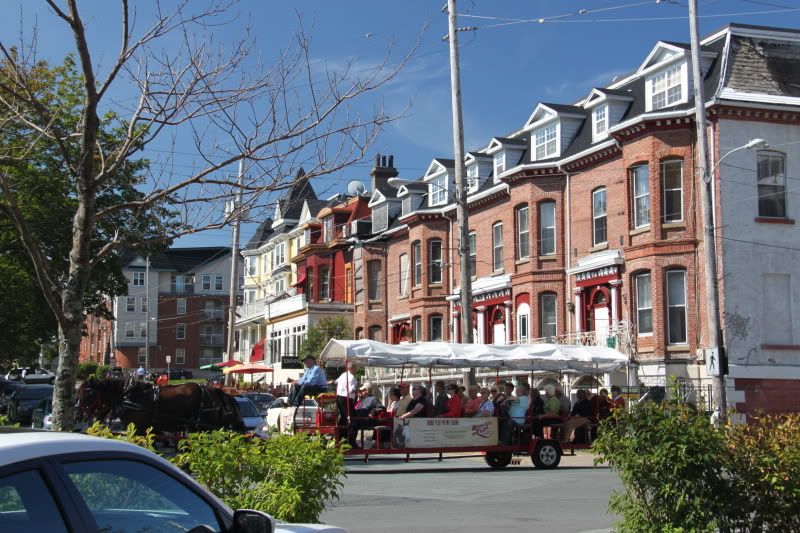
I hereby call upon council, Heritage Trust, the provincial government, heritage advocates, developers, philanthropists, Occupy NS, Ocupy Wall St., regular Jo citizens, fellow forumites, and anyone else that will listen...........rebuild the row houses just as they were. Jack up the building height behind it if necessary and/or do whatever it takes to get the job done. We all know it can be rebuilt and this is far too important to let slide. I will pay for one entry way....door, framing, columns, lintel...windows..


Great pic by kph06...except for the destrution element...

__________________
Salty Town

Last edited by Empire; Nov 29, 2011 at 12:10 AM.
Reply With Quote
     
     
This discussion thread continues

Use the page links to the lower-right to go to the next page for additional posts
 
 
Reply

Go Back   SkyscraperPage Forum > Regional Sections > Canada > Atlantic Provinces > Halifax > Halifax Peninsula & Downtown Dartmouth
Forum Jump


Forum Jump


All times are GMT. The time now is 9:31 AM.

     
SkyscraperPage.com - Privacy Statement - Top

Powered by vBulletin® Version 3.8.7
Copyright ©2000 - 2026, vBulletin Solutions, Inc.