Vancouver Art Gallery chooses site for new home
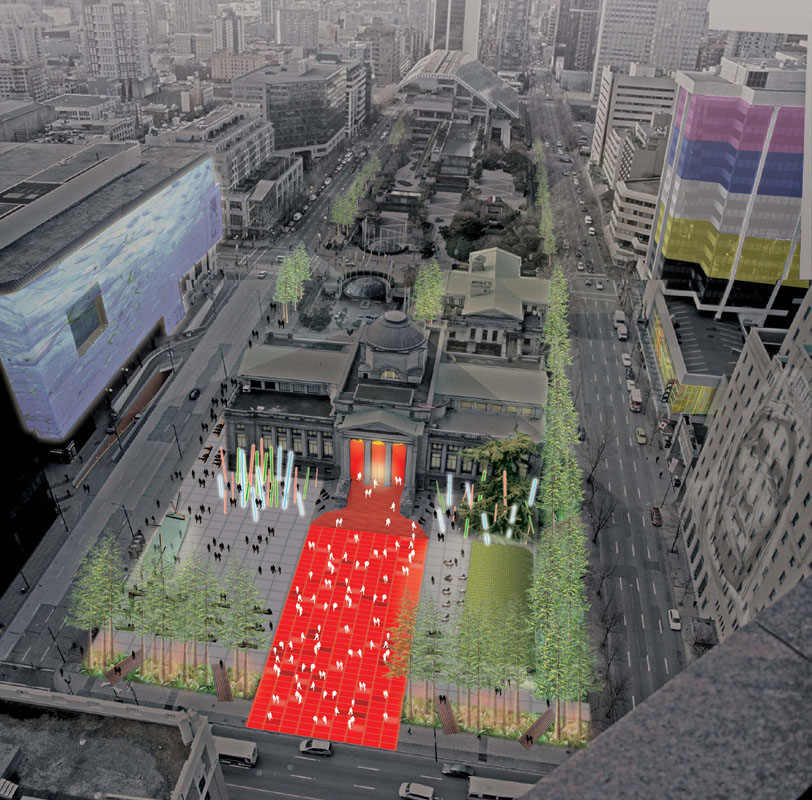
The Vancouver Art Gallery wants to build its new home on the entire square block of the former bus depot site at Georgia and Cambie streets, and says it intends to make it the greenest art museum in North America.
The site between Cambie and Beatty was originally chosen by the VAG’s board of trustees in the fall of 2007 after a three-year search. But in May of 2008, the provincial government came calling with an offer to move the VAG to the False Creek waterfront on the site of the Plaza of Nations.
David Aisenstat, chairman of the VAG board of trustees, told The Vancouver Sun on Wednesday that the board has unanimously agreed that the best site for the new art gallery is downtown, across the street from the Queen Elizabeth Theatre and near the CBC. With the addition of the VAG, the area has the potential to become a vibrant cultural district for the city.
Aisenstat said the VAG is negotiating with the city to obtain the entire block.
“We have commenced discussions with the city and had a fairly productive initial couple of meetings,” Aisenstat said from Toronto.
Aisenstat said in May 2008 that the board had agreed to the province’s request to first consider the False Creek site as a potential new home.
“We always emphasized that what we agreed to do was to take a look at that site. We did that and gave that site every possible consideration and found it to be unsuitable.”
Michael Audain, the chairman of the relocation committee of the VAG’s board of trustees, said the False Creek site had several major drawbacks.
“One of the problems there is that there’s a very high water table,” he said. “Normally, art museums put their art storage vaults underground. They’re considered the safest areas. We would have had to raise the vaults above the high tide level — not just the ordinary high tide but a super-high tide.”
Audain said any building on that site would also have to take into account the possibility of a tsunami coming up False Creek. The site is built on fill, so removing all the loose material for the building’s foundations would have added “tremendously to the expense of construction,” he said.
The False Creek site wasn’t as centrally located as the former bus depot, which is only a short walk from the gallery’s current home in the heart of the downtown on Georgia Street between Hornby and Howe. The old bus depot site has much better access to public transit, including SkyTrain.
Further complicating matters, Audain said, is the ownership of the two sites: the False Creek site is owned by a private developer – Canadian Metropolitan Properties – while the old bus depot site is owned by the City of Vancouver.
“The land [at False Creek] is owned by a private developer and we would be constrained somewhat by the rezoning and development schedule,” he said.
One of the country’s major arts philanthropists, Audain has donated, personally and through the Audain Foundation, $8.059 million to the VAG in the past several years.
Officially, the downtown site is known as 150 Dunsmuir. It was once called the Cambie Street Grounds or Larwill Park.
Kathleen Bartels, VAG director, said once negotiations with the city are successfully concluded, the gallery will begin the process of selecting an architect as well as developing a conceptual design and fundraising campaign.
She said it was still to early to put a price tag on a new gallery, which is intended to be 330,000 square feet in size, about double the size of the current VAG.
“We want to be a stand-alone facility on a highly visible location,” she said.
In an interview at the VAG, Audain added that “we’re thinking of the greenest art building in North America.
“If there are any doubters about why we should move, I think the tremendous exposure we had during the Olympics demonstrates the interest in visual arts in this town,” Audain said, referring to a VAG attendance of almost 100,000 during the 17 days of the Winter Olympics.
“Now is the time to build something magnificent for the community which will do the job for the next 50 years because I don’t think this building can.”
Aisenstat said the province’s contribution of $50 million to the new gallery, announced in 2008, is already in the VAG’s bank account.
“We’re talking about a real spectacular facility and a spectacular art museum,” he said.
“I really think that among governments, citizens, donors and corporations, if we aim for something great, we can actually achieve it.”





 Prev
Prev










 Hybrid Mode