HomeDiagramsDatabaseMapsForum About
     

Go Back   SkyscraperPage Forum > Regional Sections > Canada


Closed Thread

 
Thread Tools Display Modes
     
     
  #17341  
Old Posted Jun 12, 2023, 2:31 AM
ScreamingViking's Avatar
ScreamingViking ScreamingViking is offline
Ham-burgher
 
Join Date: Jun 2013
Location: Hamilton
Posts: 7,476
HSR probably will require its own right of way that is apart from other train services.

Wayfinding through Union is much improved. People will adapt - the numbering system was changed last decade to orient around passenger platforms rather than track numbers (e.g., there used to be a 5A and 5B for each side of Track 5; now they're different). It would be great if electronic destination signs were installed on the trains though... rather than having to wait for the announcement. Most trains use the same platforms for their scheduled service, but occasionally that changes.

Agreed - more tracks and service will just create more passenger congestion. Will it be more cost-efficient to somehow (?) expand the PATH at Union, or extend the PATH to a new station, or improve surface pedestrian access at that new station and worry about weather-friendly alternatives later? Needs to be studied.


Quote:
Originally Posted by swimmer_spe View Post
I understand how delays can cause a problem. I am guessing they have extra trains if that delay is going to be enough to cause problems.

Extending platforms could have a problem with people getting on the wrong train even though they are on the right platform and right track. Remember, the cars do not have destination signs.

I doubt HSR is going to use the mess that is Union as it is right now. My thinking is that it may see tunneling or, maybe it will be elevated through that area.

Passenger congestion will not be solved by more tracks.
     
     
  #17342  
Old Posted Jun 12, 2023, 2:34 AM
swimmer_spe swimmer_spe is offline
BANNED
 
Join Date: Apr 2014
Posts: 10,743
Quote:
Originally Posted by ScreamingViking View Post
HSR probably will require its own right of way that is apart from other train services.

Wayfinding through Union is much improved. People will adapt - the numbering system was changed last decade to orient around passenger platforms rather than track numbers (e.g., there used to be a 5A and 5B for each side of Track 5; now they're different). It would be great if electronic destination signs were installed on the trains though... rather than having to wait for the announcement. Most trains use the same platforms for their scheduled service, but occasionally that changes.

Agreed - more tracks and service will just create more passenger congestion. Will it be more cost-efficient to somehow (?) expand the PATH at Union, or extend the PATH to a new station, or improve surface pedestrian access at that new station and worry about weather-friendly alternatives later? Needs to be studied.
One discussion I have seen is to use the North Toronto Sub for the HSR.
     
     
  #17343  
Old Posted Jun 12, 2023, 2:35 AM
Nouvellecosse's Avatar
Nouvellecosse Nouvellecosse is online now
Volatile Pacivist
 
Join Date: Aug 2005
Location: Nova Scotia
Posts: 11,305
That said, issues with future Union capacity has little to do with the physical space for trains. The main issues are with the track and platform configuration (hopefully will be addressed as part of GO electrification) and with passenger circulation getting to/from trains and in/out of the building. Having fully level boarding, trains with more doors, and more stairs/elevators between platforms and concourses will help tremendously. So will having fewer, wider platforms and potentially even platform screen doors like the UPE.

Wider platforms allow trains to enter the station more quickly with fewer safety concerns, and more doors, level boarding and between circulation between platform and concourse will reduce dwell times. These will combine to allow more trains to pass through each platform. What we're talking about is making the suburban services more like metro services. There are metros that have 36 trains per hour serve a single platform. You'll never see suburban mainline services operate that frequently since the trains will still have more seating and fewer doors than metro trains. But you could have upwards of 24 tph which is what you see on Crossrail, Thameslink, RER. etc. RER A actually had 30tph at one point but it has several stations across central Paris.

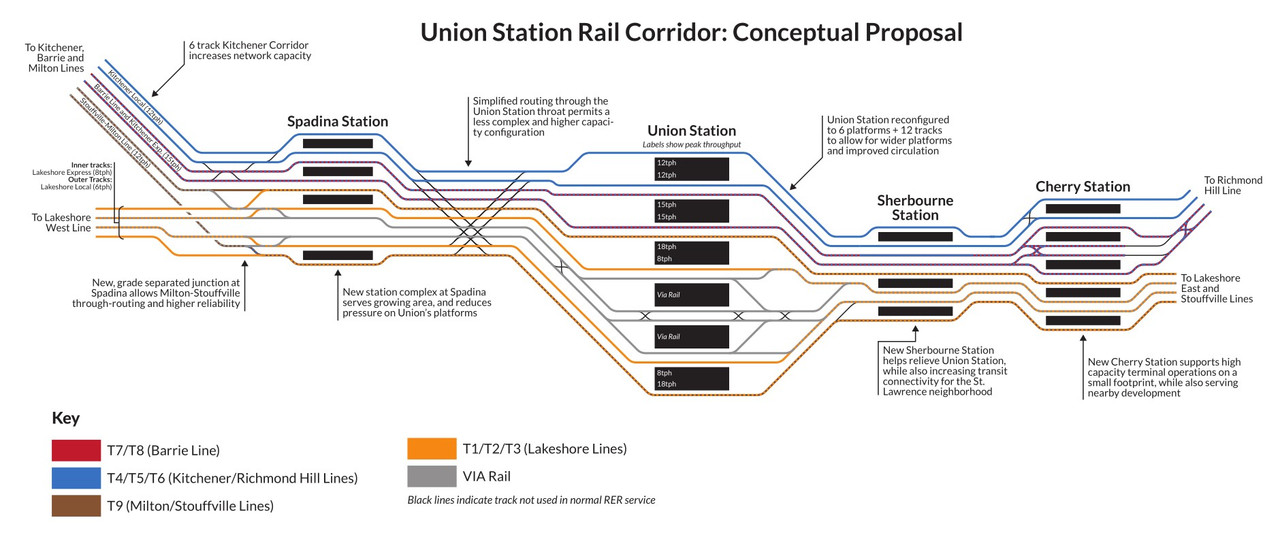
A couple years ago, the Toronto board of trade released a study recommending that there be 6 platforms with a couple seeing 18tph under their preferred configuration (below). They also recommend shoulder stations to relieve Union but under their proposal Union would still handle far more passengers than it does today. I would like to see a few tweaks to it but their proposal is a solid start.


https://urbantoronto.ca/news/2021/03/tor...ade-proposes-regional-rail-network.44683
__________________
"The reasonable man adapts himself to the world; the unreasonable one persists in trying to adapt the world to himself. Therefore all progress depends on the unreasonable man." - George Bernard Shaw
Don't ask people not to debate a topic. Just stop making debatable assertions. Problem solved.
     
     
  #17344  
Old Posted Jun 12, 2023, 2:46 AM
ScreamingViking's Avatar
ScreamingViking ScreamingViking is offline
Ham-burgher
 
Join Date: Jun 2013
Location: Hamilton
Posts: 7,476
Quote:
Originally Posted by Nouvellecosse View Post
The main issues are with the track and platform configuration (hopefully will be addressed as part of GO electrification) and with passenger circulation getting to/from trains and in/out of the building. Having fully level boarding, trains with more doors, and more stairs/elevators between platforms and concourses will help tremendously. So will having fewer, wider platforms and potentially even platform screen doors like the UPE.
I seem to recall track configuration was also something they had to work around because of the historical issues (e.g., some of the tracks make a bit of a jog within the trainshed; this was retained). There are many places where it's a tight squeeze between the stairwells (which can also be narrow) and the tracks. Should have basically ripped everything up and started over, especially given the LONG time it took for the renovations that were done.

Level boarding is going to be a fantasy until CN says so or there's a change in the passenger cars (I don't know if they can go any lower) or platform technology. Even though CN doesn't run freights on most of the GO lines these days, there's some restriction that the platforms can't be level with the doors of the existing passenger cars because that would interfere with potential freight train use. It's not going to be a problem for platforms at Union, but it is for some suburban stations. Lowest common denominator wins on this issue, unfortunately, for now.
     
     
  #17345  
Old Posted Jun 12, 2023, 3:32 AM
Nouvellecosse's Avatar
Nouvellecosse Nouvellecosse is online now
Volatile Pacivist
 
Join Date: Aug 2005
Location: Nova Scotia
Posts: 11,305
Quote:
Originally Posted by ScreamingViking View Post
Level boarding is going to be a fantasy until CN says so or there's a change in the passenger cars (I don't know if they can go any lower) or platform technology. Even though CN doesn't run freights on most of the GO lines these days, there's some restriction that the platforms can't be level with the doors of the existing passenger cars because that would interfere with potential freight train use. It's not going to be a problem for platforms at Union, but it is for some suburban stations. Lowest common denominator wins on this issue, unfortunately, for now.
There are many examples of suburban systems having high platforms at some stops and not at others so I wouldn't be too concerned. It even happens on venerated networks like London and Paris, not to mention that Gare Centrale is high platform in Montreal while the rest of the suburban network isn't. And how UPE is high platform already. Plus there are also solutions such as gauntlet tracks and retractable steps. But yes none of that would be done until a decision is made on rolling stock.
__________________
"The reasonable man adapts himself to the world; the unreasonable one persists in trying to adapt the world to himself. Therefore all progress depends on the unreasonable man." - George Bernard Shaw
Don't ask people not to debate a topic. Just stop making debatable assertions. Problem solved.
     
     
  #17346  
Old Posted Jun 12, 2023, 3:49 AM
swimmer_spe swimmer_spe is offline
BANNED
 
Join Date: Apr 2014
Posts: 10,743
Quote:
Originally Posted by ScreamingViking View Post
I seem to recall track configuration was also something they had to work around because of the historical issues (e.g., some of the tracks make a bit of a jog within the trainshed; this was retained). There are many places where it's a tight squeeze between the stairwells (which can also be narrow) and the tracks. Should have basically ripped everything up and started over, especially given the LONG time it took for the renovations that were done.

Level boarding is going to be a fantasy until CN says so or there's a change in the passenger cars (I don't know if they can go any lower) or platform technology. Even though CN doesn't run freights on most of the GO lines these days, there's some restriction that the platforms can't be level with the doors of the existing passenger cars because that would interfere with potential freight train use. It's not going to be a problem for platforms at Union, but it is for some suburban stations. Lowest common denominator wins on this issue, unfortunately, for now.
I wonder if Via could afford to move all Corridor stations to sidings. What I mean by that is the existing mainlines are maintained, but the trains going into the stations would stop in sidings not on the mainline.
     
     
  #17347  
Old Posted Jun 12, 2023, 3:38 PM
hipster duck's Avatar
hipster duck hipster duck is offline
Registered User
 
Join Date: Oct 2014
Location: Toronto
Posts: 4,912
Quote:
Originally Posted by Nouvellecosse View Post
That said, issues with future Union capacity has little to do with the physical space for trains. The main issues are with the track and platform configuration (hopefully will be addressed as part of GO electrification) and with passenger circulation getting to/from trains and in/out of the building. Having fully level boarding, trains with more doors, and more stairs/elevators between platforms and concourses will help tremendously. So will having fewer, wider platforms and potentially even platform screen doors like the UPE.

Wider platforms allow trains to enter the station more quickly with fewer safety concerns, and more doors, level boarding and between circulation between platform and concourse will reduce dwell times. These will combine to allow more trains to pass through each platform. What we're talking about is making the suburban services more like metro services. There are metros that have 36 trains per hour serve a single platform. You'll never see suburban mainline services operate that frequently since the trains will still have more seating and fewer doors than metro trains. But you could have upwards of 24 tph which is what you see on Crossrail, Thameslink, RER. etc. RER A actually had 30tph at one point but it has several stations across central Paris.

A couple years ago, the Toronto board of trade released a study recommending that there be 6 platforms with a couple seeing 18tph under their preferred configuration (below). They also recommend shoulder stations to relieve Union but under their proposal Union would still handle far more passengers than it does today. I would like to see a few tweaks to it but their proposal is a solid start.


https://urbantoronto.ca/news/2021/03/tor...ade-proposes-regional-rail-network.44683
I really liked this report - it was one of the few things I've read about Toronto and planning in recent years where I felt I really learned something.

I believe - but I could be wrong, and maybe someone with more knowledge of this can chime in - that as a 'baby step' towards RER operation, the Kitchener and Stouffville lines are increasingly treated as one operation, even if it doesn't show up in official scheduling. I think some Kitchener trains arrive on a platform, go out of service, and then continue on as Stouffville trains. This would make sense operationally, since the Kitchener line should kind of come in in the middle, wedged between the Milton and Lakeshore lines to the south, and the Stouffville line exits out the middle as well, since Richmond Hill splits off first. LSE-LSW are already effectively a through-running service served on the southernmost platforms which are currently being expanded to wide, RER-optimized platforms as we speak.
     
     
  #17348  
Old Posted Jun 12, 2023, 4:19 PM
ScreamingViking's Avatar
ScreamingViking ScreamingViking is offline
Ham-burgher
 
Join Date: Jun 2013
Location: Hamilton
Posts: 7,476
Quote:
Originally Posted by Nouvellecosse View Post
There are many examples of suburban systems having high platforms at some stops and not at others so I wouldn't be too concerned. It even happens on venerated networks like London and Paris, not to mention that Gare Centrale is high platform in Montreal while the rest of the suburban network isn't. And how UPE is high platform already. Plus there are also solutions such as gauntlet tracks and retractable steps. But yes none of that would be done until a decision is made on rolling stock.
Yes to all of that. I was just relaying how it was explained to me.

And perhaps it's more of a legacy issue now, given Metrolinx's ownership of so much of the rail on which GO operates. There are still many businesses that have spurs off the main lines, but there is little reason a freight operator today needs full access to all tracks that go through a passenger station. I'm sure CN would argue that they do, but they largely operate in the GTA on their own tracks; they just have no incentive to cooperate on this issue.

The costs of changing the platforms across 70+ stations will probably be very high. But if RER is going to be the game-changer Metrolinx is banking on, increasing operational efficiency (never mind making life easier for GO customers) will justify that expense.
     
     
  #17349  
Old Posted Jun 12, 2023, 8:46 PM
swimmer_spe swimmer_spe is offline
BANNED
 
Join Date: Apr 2014
Posts: 10,743
Quote:
Originally Posted by ScreamingViking View Post
Yes to all of that. I was just relaying how it was explained to me.

And perhaps it's more of a legacy issue now, given Metrolinx's ownership of so much of the rail on which GO operates. There are still many businesses that have spurs off the main lines, but there is little reason a freight operator today needs full access to all tracks that go through a passenger station. I'm sure CN would argue that they do, but they largely operate in the GTA on their own tracks; they just have no incentive to cooperate on this issue.

The costs of changing the platforms across 70+ stations will probably be very high. But if RER is going to be the game-changer Metrolinx is banking on, increasing operational efficiency (never mind making life easier for GO customers) will justify that expense.
Another option, and this I saw on the MBTA commuter lines was a raised section of the platforms. These lined up with the doors for some of the single level cars.
     
     
  #17350  
Old Posted Jun 13, 2023, 1:12 AM
ScreamingViking's Avatar
ScreamingViking ScreamingViking is offline
Ham-burgher
 
Join Date: Jun 2013
Location: Hamilton
Posts: 7,476
Quote:
Originally Posted by swimmer_spe View Post
Another option, and this I saw on the MBTA commuter lines was a raised section of the platforms. These lined up with the doors for some of the single level cars.
The raised platforms GO does have for the accessible cars are set back a little from the "main" platform edge. So much so that a ramp needs to be lowered by the "customer service representative" (a.k.a. conductor) to bridge the gap for those who would need that.

The majority of people can probably traverse the gap on foot. But guaranteed someone would get a shoe or bag caught in there, and it would be a safety/liability issue.

Trains very often have to be repositioned forward or backward to align with the accessible ramps, after undershooting or overshooting the platforms. But if that can be resolved by automation, and if a means can be found to have door platforms that retract to meet the freight rail "requirements", it may work!

I think the best case is to have "through" tracks for freight and station tracks restricted for passenger use. It will probably take several rounds (years, decades) of federal panels issuing papers and updated papers... including or followed by long and numerous meetings with CN and CP mucky-mucks to make it happen.

     
     
  #17351  
Old Posted Jun 13, 2023, 1:56 AM
swimmer_spe swimmer_spe is offline
BANNED
 
Join Date: Apr 2014
Posts: 10,743
Quote:
Originally Posted by ScreamingViking View Post
The raised platforms GO does have for the accessible cars are set back a little from the "main" platform edge. So much so that a ramp needs to be lowered by the "customer service representative" (a.k.a. conductor) to bridge the gap for those who would need that.

The majority of people can probably traverse the gap on foot. But guaranteed someone would get a shoe or bag caught in there, and it would be a safety/liability issue.

Trains very often have to be repositioned forward or backward to align with the accessible ramps, after undershooting or overshooting the platforms. But if that can be resolved by automation, and if a means can be found to have door platforms that retract to meet the freight rail "requirements", it may work!

I think the best case is to have "through" tracks for freight and station tracks restricted for passenger use. It will probably take several rounds (years, decades) of federal panels issuing papers and updated papers... including or followed by long and numerous meetings with CN and CP mucky-mucks to make it happen.

The station was Framingham station.

I do agree that all stations should become sidings.
     
     
  #17352  
Old Posted Jun 19, 2023, 4:52 AM
IRT_BMT_IND IRT_BMT_IND is offline
Registered User
 
Join Date: Jan 2015
Posts: 22
Quote:
Originally Posted by hipster duck View Post
I really liked this report - it was one of the few things I've read about Toronto and planning in recent years where I felt I really learned something.

I believe - but I could be wrong, and maybe someone with more knowledge of this can chime in - that as a 'baby step' towards RER operation, the Kitchener and Stouffville lines are increasingly treated as one operation, even if it doesn't show up in official scheduling. I think some Kitchener trains arrive on a platform, go out of service, and then continue on as Stouffville trains. This would make sense operationally, since the Kitchener line should kind of come in in the middle, wedged between the Milton and Lakeshore lines to the south, and the Stouffville line exits out the middle as well, since Richmond Hill splits off first. LSE-LSW are already effectively a through-running service served on the southernmost platforms which are currently being expanded to wide, RER-optimized platforms as we speak.
That diagram reminds me of how Japanese rail services are organized. The reason the commuter rail system in Tokyo can move so many people is that trains don't have to inch through complex interlockings at station throats at a walking pace (and block access for other trains in the process). The flip side is that at major terminals like Tokyo and Shinjuku only certain platforms can be accessed from certain tracks and service has to be built around that.

Also it's easy to forget that North American passenger terminals before the decline of passenger trains operated more like airports than rapid transit stations (rapid transit and regional transit was the mostly the domain of the interurban systems). There were really only a handful of exceptions, like the regional platforms at Grand Central Station, Suburban Station in Philadelphia, or the Randolph Street Terminal (Millennium Station) in Chicago. Long distance trains operated like intercontinental flights, except for the busiest city pairs they ran at usually 1x day or less frequencies and would sit at the platforms for a relatively long time. For something like a 72 or 96 hour trip 5 or 10 extra minutes getting out of station wasn't that big a deal in relative terms.

Long distance trains were also mostly scheduled to depart in banks at a handful of specific times, which meant inefficient use of infrastructure that was underused for much of the day (long distance trains in some countries like India still mostly operate like this for a modern example). There's a reason why Grand Central Station had something like 30 platforms for long distance trains, while the Tokaido Shinkansen operates out of a 6 track terminal that's probably smaller than a lot of suburban GO stations. Unfortunately this is the legacy that any "new" (really post WWII) regional rail service has to work around.
     
     
  #17353  
Old Posted Jun 19, 2023, 8:06 PM
esquire's Avatar
esquire esquire is offline
Registered User
 
Join Date: Oct 2001
Posts: 37,480
^ Thank you for that informative post, you might average only one post every four years but you certainly make it count
     
     
  #17354  
Old Posted Jun 20, 2023, 8:38 PM
Doady's Avatar
Doady Doady is offline
Registered User
 
Join Date: Apr 2004
Posts: 5,166
I wonder if GO will ever recover all its ridership, let alone become the "game changer". 2023 train ridership still only 36% of 2019, while the suburban bus systems have fully recovered, Brampton reached 100% in May 2022 and Mississauga reached 110% in February this year. You can see the similar problem with the TTC, the subway and streetcar ridership at 56% and 38% respectively, while the bus ridership is at 85%.
     
     
  #17355  
Old Posted Jun 20, 2023, 9:22 PM
Nouvellecosse's Avatar
Nouvellecosse Nouvellecosse is online now
Volatile Pacivist
 
Join Date: Aug 2005
Location: Nova Scotia
Posts: 11,305
Quote:
Originally Posted by Doady View Post
I wonder if GO will ever recover all its ridership, let alone become the "game changer". 2023 train ridership still only 36% of 2019, while the suburban bus systems have fully recovered, Brampton reached 100% in May 2022 and Mississauga reached 110% in February this year. You can see the similar problem with the TTC, the subway and streetcar ridership at 56% and 38% respectively, while the bus ridership is at 85%.
It may never recover in terms of peak commuter volumes (or at least until the metro area is much bigger). But my guess is that the total ridership will probably be equal or greater once we get frequent all-day, two-way service across the network improving non-commute, non-peak trips.
__________________
"The reasonable man adapts himself to the world; the unreasonable one persists in trying to adapt the world to himself. Therefore all progress depends on the unreasonable man." - George Bernard Shaw
Don't ask people not to debate a topic. Just stop making debatable assertions. Problem solved.
     
     
  #17356  
Old Posted Jun 20, 2023, 10:00 PM
swimmer_spe swimmer_spe is offline
BANNED
 
Join Date: Apr 2014
Posts: 10,743
Quote:
Originally Posted by Doady View Post
I wonder if GO will ever recover all its ridership, let alone become the "game changer". 2023 train ridership still only 36% of 2019, while the suburban bus systems have fully recovered, Brampton reached 100% in May 2022 and Mississauga reached 110% in February this year. You can see the similar problem with the TTC, the subway and streetcar ridership at 56% and 38% respectively, while the bus ridership is at 85%.
Maybe the reality is that those crazy numbers have been resolved in other ways. This can allow the province and city build transit out, but not at such a crush.
     
     
  #17357  
Old Posted Jun 21, 2023, 12:37 AM
DirectionNorth's Avatar
DirectionNorth DirectionNorth is offline
Registered User
 
Join Date: Oct 2020
Posts: 236
Quote:
Originally Posted by Doady View Post
I wonder if GO will ever recover all its ridership, let alone become the "game changer". 2023 train ridership still only 36% of 2019, while the suburban bus systems have fully recovered, Brampton reached 100% in May 2022 and Mississauga reached 110% in February this year. You can see the similar problem with the TTC, the subway and streetcar ridership at 56% and 38% respectively, while the bus ridership is at 85%.
Are we looking at the same GO Transit? Ridership was 35 million in 2022 compared to 60 million in 2019, that's 60%. I am hearing of overcrowded buses and trains on many weekend and evening routes.

Unless you are talking about the peak period services, which I could believe is at 33% recovery.
__________________
My YouTube Channel
     
     
  #17358  
Old Posted Jun 21, 2023, 1:15 AM
mikevbar1 mikevbar1 is offline
Registered User
 
Join Date: Dec 2017
Posts: 216
Quote:
Originally Posted by DirectionNorth View Post
Are we looking at the same GO Transit? Ridership was 35 million in 2022 compared to 60 million in 2019, that's 60%. I am hearing of overcrowded buses and trains on many weekend and evening routes.

Unless you are talking about the peak period services, which I could believe is at 33% recovery.
GO buses have definitely exceeded pre-pandemic ridership, and so has weekend ridership on the rail services. Everything except peak rail service has recovered fully. Obviously peak makes up most of GO’s traditional base, and means lines like Milton are going to suffer for a while- but, slowly but surely, service levels and ridership are recovering- downtown employers are requiring people come in more and more. And the future of GO is not peak-oriented anyway.
__________________
Steeltowner & Urban Planning Undergrad.
     
     
  #17359  
Old Posted Jun 21, 2023, 2:09 AM
Nite's Avatar
Nite Nite is offline
Registered User
 
Join Date: Dec 2007
Location: Toronto
Posts: 3,382
Urban public transit operating revenue and passenger trips, monthly, 2019 to 2023


Quote:
Highlights
In April, 118.8 million passenger trips were made on urban transit networks in Canada.

For the first time since the onset of the COVID-19 pandemic, passenger volumes recovered to over three-quarters (75.5%) of pre-pandemic levels from April 2019.

Ridership remains on track
Canada's urban transit networks recorded an estimated 118.8 million rides in April 2023, an increase of 29.4% (+27.0 million trips) from April 2022. This marks more than two years of consecutive monthly year-over-year increases.

With employment edging up in April 2023, ridership recovered to 75.5% of pre-pandemic levels from April 2019. However, there were 38.5 million fewer passenger trips in April 2023 compared with the same month in 2019.

On a monthly basis, public transit ridership edged down 2.5% from March, a decrease smaller than the typical seasonal drop of about 6% observed in the two years before the pandemic.

Financial situation steady
In April 2023, transit agency operating revenues (excluding subsidies) were $274.8 million, an increase of $60.7 million or 28.4% from April 2022, albeit $62.1 million lower than the pre-pandemic April 2019 level.

https://www150.statcan.gc.ca/n1/daily-quotidien/230619/dq230619d-eng.htm
     
     
  #17360  
Old Posted Jun 21, 2023, 2:35 AM
Doady's Avatar
Doady Doady is offline
Registered User
 
Join Date: Apr 2004
Posts: 5,166
Quote:
Originally Posted by Nouvellecosse View Post
It may never recover in terms of peak commuter volumes (or at least until the metro area is much bigger). But my guess is that the total ridership will probably be equal or greater once we get frequent all-day, two-way service across the network improving non-commute, non-peak trips.
All-day Milton Line is my dream, but that proposed combined Milton-Stouffville Line will be the key. The line will have to serve more than just Union to be successful. Those other proposed stations will be important too.

Combining the Kitchener and Richmond Hill Lines might not be as useful...

Quote:
Originally Posted by DirectionNorth View Post
Are we looking at the same GO Transit? Ridership was 35 million in 2022 compared to 60 million in 2019, that's 60%. I am hearing of overcrowded buses and trains on many weekend and evening routes.

Unless you are talking about the peak period services, which I could believe is at 33% recovery.
Oh, I mistakenly used the weekday ridership for GO and TTC, so the total train ridership including weekends for the first three months of 2023 was 56% compared to 2019. TTC subway was at 59%, streetcar at 40%, and bus at 86%. GO Train ridership increased 191% in the first three months of 2023 compared to 2022.

I was referring to GO Trains only, not GO Buses. That's why I also compared TTC rail ridership to the TTC bus ridership.

That 60.3 million figure is for GO Train and Bus combined from April 2019 to December 2019. Full year ridership was 79.4 million. So ridership in 2022 was 44% of 2019 ridership.
     
     
This discussion thread continues

Use the page links to the lower-right to go to the next page for additional posts
 
 
Closed Thread

Go Back   SkyscraperPage Forum > Regional Sections > Canada
Forum Jump


Forum Jump


All times are GMT. The time now is 4:37 AM.


Powered by vBulletin® Version 3.8.7
Copyright ©2000 - 2026, vBulletin Solutions, Inc.