HomeDiagramsDatabaseMapsForum About
     

Go Back   SkyscraperPage Forum > Regional Sections > Canada > Ontario > Ottawa-Gatineau > General Discussion


Reply

 
Thread Tools Display Modes
     
     
  #121  
Old Posted May 8, 2023, 3:28 PM
le calmar's Avatar
le calmar le calmar is offline
 
Join Date: Dec 2006
Posts: 5,240
Quote:
Originally Posted by J.OT13 View Post
No, stryrofoam is not accepted in Ottawa. In Gatineau, you can bring it to an Eco Centre. It is recyclable, but Ottawa's system is quite limited. Lots of wish-cycling.
Ok that’s what I thought. I was wondering if they started accepting styrofoam and I was not aware.
Reply With Quote
     
     
  #122  
Old Posted May 11, 2023, 9:50 PM
Richard Eade Richard Eade is offline
 
Join Date: Mar 2008
Posts: 2,685
Dare I agree with Denley? (see below) He has a valid point, I think. The Bag Tags are predicted to increase the diversion rate by "up to 6%", according to the city. (https://ottawa.ca/en/city-hall/city-news...ide-garbage-policy-divert-waste-landfill)

Also in that city press release:
Quote:
The recommendation of 55 tags per year is in line with the best practice of setting garbage item limits at or below what the average household sets out. On average, Ottawa garbage set-outs include two garbage items every other week, and 74 per cent of garbage set-outs include two items or fewer every other week, which would put them within the allotted amount of 55 tags per year.
Which is incorrect, since previously, the city has been saying that the average set-out is 4.18 items every collection day – which represents 2.1 items every WEEK – not every two weeks. This is information that has been available for a few years, and was used in the Engage Ottawa survey about a waste solution. (https://ehq-production-canada.s3.ca-cent...1259a0d617d6e01e3963f3e41e449123e37b992b)

But I have made the point, previously, that the Bag Tag proposal (as presented to Councillors) is based on an error; so I will not harp on that here.

Returning to my support of the Denley article: IF, Bag Tags increase the diversion rate by the full 6%, then the 13 years that we have left before the Trail Road Landfill is full, extends to just under 14 years from now.

Why is this important?

Because, according to staff, it will take up to 15 years to develop an alternative for waste disposal. Even if this Council makes a major decision this year, it is possible that the Trail Road Landfill will be full – and closed – for a year before the next option opens. The Bag Tag issue is inconsequential in the big picture. It is a distraction that will serve no purpose but to act as a ‘Cash-Grab’ until the crunch hits.

This has been an issue for decades, but no previous Council has had the courage to make a decision. Now, we are in a pickle. That decision had to have been made last year.

Let’s go Council. Make the hard decision, and throw that pickle into the Green Bin, once and for all.


The article from The Citizen:

Denley: Bag tags won't solve Ottawa's growing garbage problem
Only a new landfill or waste-to-energy plant will fix the waste-disposal problem for the long term.

Author of the article: Randall Denley
Published May 09, 2023 • 3 minute read

Enough already! Ottawa city councillors have put off a long-term solution to Ottawa’s garbage disposal problem for years. It’s time to act, not buy a bit of time with a plan to make everyone attach tags to their garbage bags.

City staff’s warning that the city’s Trail Road landfill site is filling up is hardly surprising. Dump garbage into a site with a fixed capacity and that’s what happens. Council after council has looked at solving this problem, but instead chose stopgap measures such as the green bin and eliminating weekly garbage collection, all designed to send less stuff to the landfill.

The city had hoped that an experimental waste-to-energy plant designed by a local company called Plasco would solve the problem, but that deal collapsed in 2015.

Now, it’s crunch time. City staff say Trail Road will finally be filled in 13 to 15 years. Finding a replacement, they say, will take up to 15 years. Simple arithmetic would suggest that now is the time for councillors to either tell staff to start looking for a new landfill or, better yet, make a plan to incinerate the city’s garbage using a proven technology.

Instead of getting to the big picture, which is expected to be addressed in a major report this fall, city staff are distracting councillors and the public with a bag tag debate. Staff have spent the last two years consulting the public and preparing a plan to compel people to attach a tag to every bag they take to the curb. One would think the plan was ready to go, but if councillors approve it next month, it will take another year to implement.

It won’t be cheap, either. There will be a one-time cost of $3.5 million for a “promotion and education campaign,” plus more bins and temporary staff to help implement the program. After that, annual costs will be $1.5 million.

The hope is that a charge of $3 a bag for each bag over the annual allotment of 55 will persuade Ottawans to rethink the amount of garbage they are putting at the curb. Well, some Ottawans, at least. According to a city study, 74 per cent of Ottawans already put out two or fewer items on garbage day, the city’s target.

Years of so-called education and persuasion have not had notable success. The city says that more than half of what is put out in garbage bags could go into green bins or recycling containers. Now they think a $3 tag fee will bring big change. That faith in the perfectability of Ottawans has not been borne out by history.

City staff point to a $450-million expense for a new landfill or other disposal approach if residents don’t do better, but it’s a false argument. The city is going to have to spend that money, regardless of bag tags. The tag program might buy two more years of delay, staff say, if people choose to co-operate.

For past councils that dawdled on the garbage disposal decision, the idea of choosing a new landfill site was almost unspeakably frightening, something to be postponed at any cost. One would have to contrast that attitude to the city’s approach to the Waste Management landfill on Carp Road near Highway 417. As development creeps closer and closer to that landfill, the city has been unconcerned.

Surely, there is a site for a landfill somewhere in the vast rural regions of Ottawa, or even in a community nearby, that’s looking for a business opportunity. Better yet, the city should seriously look at a waste-to-energy plant.

Either a new landfill or waste-to-energy plant will resolve the city’s garbage problem for decades to come. It’s time for councillors to make a choice.

Randall Denley is an Ottawa political commentator and author. Contact him at [email protected]

From: https://ottawacitizen.com/opinion/denley-bag-tags-wont-solve-ottawas-growing-garbage-problem
Reply With Quote
     
     
  #123  
Old Posted May 13, 2023, 12:40 AM
Richard Eade Richard Eade is offline
 
Join Date: Mar 2008
Posts: 2,685
I have been reading a bunch of the city-produced documents pertaining to the Trail Road Landfill – known as Trail Waste Facility, or TWF.

The TWF opened, in 1980, with an authorized capacity of about 88 million cubic metres. This was to be used in four stages, and was expected to last about 20 years. However, it was filling faster than anticipated, and by 1985 it was predicted to be full by about 1990. In 1987, the Blue Bin was introduced in Ottawa, Nepean, and Gloucester to divert recyclable materials away from the TWF. This helped extend the expected life of the TWF. As did the distribution of backyard composters, starting in 1991. Organics collection, in the form of the Green Bin, didn’t start until 2010.

But, how did the TWF survive, despite being imminently full all this time?

Well, even with a Black Bin and Blue Bin diverting some recyclables, in 2002 the city submitted an environmental assessment to the province requesting permission to almost double the capacity of the landfill. Stages 1, 2, 3, and 4 were to grow to much higher height, and a new Stage 5 was to be added. This took the capacity of the TWF up to almost 170 million cubic metres. The approval came in 2005. This significant expansion was expected to add somewhere between 10 and 40 years to the life of the facility.

Stages 1 and 2 of the TWF have already been expanded (upwards), with Stage 3;s expansion almost full, and Stage 4 also being built up. Stage 5 is just being created now.

With the diversions, and the (privately-run) Carp Landfill taking most of the Industrial, Commercial, and Institutional (IC&I) waste, the fill-rate at the TWF has been quite reasonable. In 2021, the prediction was that the ‘Full Date’ was 2041 or 2042, since there was about 30% of the total capacity remaining. It was expected that that could be extended a bit further with additional measures – one of which was increased diversion, of course. Thus the scheme with the Bag Tags.

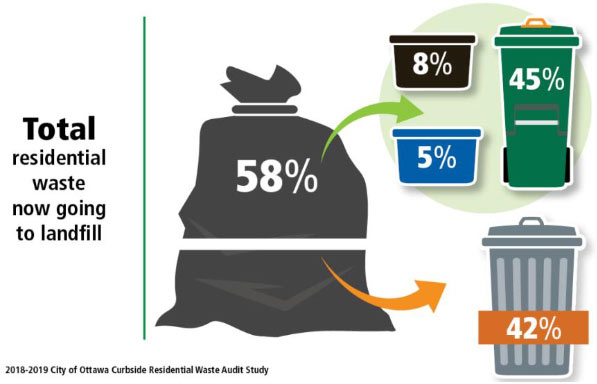
As it stood in 2021, about 48% of the waste picked up at curbside was diverted. However, according to garbage analysis, roughly 58% of what arrived at the TWF could still have been diverted; with 45% being suitably for the Green Bin, 8% for the Black Bin, and 5% for the Blue Bin. The Green Bin has the lowest rate of usage; with about 75% of Blue Bin material and 79% of paper being recycled.

So, what’s next for the TWF, since its life will need to be extended because no alternative has yet been determined?

There are some options being worked on, from what I’ve read. A much heavier compactor is being purchased. The new one will be 100 tons, so it should be able to pack the trash more densely. (Remember, the site is approved to accept a certain VOLUME, so dense is best.) However, this might be counter productive to another option that is also to be tried – Leachate Recirculation.

Leachate is the toxic ‘tea’ that results as water trickles down through the garbage stack. Only Stages 3 and 4 currently have the plastic liners under the garbage to collect the leachate. (Stage 5 will also be lined.) The other stages (1 & 2), and the old Nepean Dump, situated immediately across Trail Road, try to prevent water from entering the garbage by ‘capping’. This is done with a large plastic sheet covering the pile. The idea is that if no water enters the top, then no leachate seeps put the bottom – into the groundwater. (Unfortunately, Capping is not a 100% solution and there is groundwater contamination from the older garbage piles.)

The good thing about the leachate is that it can be sprayed up onto the garbage of Stages 3 & 4, and it helps break down the garbage much faster. It also helps settle things so that the trash is more compact. A pilot project found that the volume of trash can be quickly reduced by 20%-30%. As I mentioned above, they should probably use the Leachate Recirculation before they densify the garbage with the big compactor. (Although, the big compactor could be used on Stages 1 & 2, since neither has a liner, so they can not use Leachate Recirculation.)

Alas, everything has drawbacks. The more rapid decomposition caused by Leachate Recirculation causes an increase in smell. This is an indication that increased methane is also being released. Due to provincial regulations, the TWF must capture as much of the methane emission as possible. Fortunately, the city is in the process of expanding and upgrading the active gas extraction system. These are perforated pipes driven into the trash, which are attached to a vacuum collection system. Luckily, this system also reduces the smell, as other gases (like Hydrogen Sulfide) are also captured.

Currently, a portion of the methane collected is fed into combustion engines that drive six 1 MW electrical generators. The rest of the methane is flared off. As more methane is collected – because of the increased size of the TWF, and due to increased decomposition from Leachate Recirculation – more methane will be flared-off. The company which runs the generators would like to add more, but the Hydro Ottawa grid in that area is limited in capacity to accepting 6 MW.

Current provincial regulations state that the garbage added must be sealed over at the end of each day. This has been done by adding a 6” (15 cm) covering of soil or clean fill. However, all of these layers of cover are counted as part of the volume of waste being added. Since the total volume capacity of the site is limited by the licence, reducing these daily coverings would be helpful. The city is moving to a new spray-on cover that does the same job as the soil, but occupies only 1/12th of the volume. The sprayed-on cover is only ½” thick – but it requires the city to buy new equipment to apply it.

Personally, I would like to see the city begin an additional operation. I would like the old Nepean Dump mined. Since this dump has no liner, it has leachate contaminating the aquifers below it. The Cap is a partial solution, but it is not perfect. By mining the old dump, recyclables can be recovered and sold. The residual would be moved to the new Stage 5 of the TWF. As the Nepean Dump is cleared, it could be dug down and a leachate liner installed. This would then be a large, future, landfill site for the city’s use. It is a much larger area than Stage 5, so it would offer much more capacity.

Regardless of what the city finally gets around to selecting for its waste management, I suspect that there will always be unavoidable waste. Thus, there will always be a need to fine a place to ‘store’ it. Reusing the old Nepean Dump site should be a suitable option.
Reply With Quote
     
     
  #124  
Old Posted May 24, 2023, 9:26 PM
rocketphish's Avatar
rocketphish rocketphish is offline
 
Join Date: Feb 2009
Posts: 14,722
Burning waste back on the table as a possible solution to Ottawa's landfill problem
City staff have been tasked by council with gathering information on ways to divert waste from the increasingly packed Trail Road landfill

Blair Crawford, Ottawa Citizen
Published May 24, 2023 • 3 minute read


A decade after the City of Ottawa’s disastrous foray with Plasco Energy Group, city council is again exploring a trash-to-energy plan as a solution to its garbage problem.

Council voted unanimously Wednesday in favour of a motion from Kanata South Coun. Allan Hubley to explore new technologies to divert garbage from the increasingly packed Trail Road landfill, including incineration.

Some councillors made clear they oppose burning trash — Kitchissippi Coun. Jeff Leiper called the increased greenhouse gas emissions and air pollution from an incinerator “existential threats” — but Hubley stressed his motion is meant only to ensure the city explores every option when it comes to dealing with its garbage.

“What we are asking is for staff to provide more information about all the options,” Hubley said. “We’re not zeroing in on incineration. We’re asking staff to give us more information so we can make an informed choice.”

The information is to come back to council next fall when councillors receive for debate the city’s Solid Waste Management Plan. The plan is expected to be approved early in 2024.

The city is already looking at ways to extend the life of the landfill, including a controversial “bag tag” program that would limit the number of garbage bags residents can put out for collection, charging fees for extra bags. But that’s a short-sighted solution, said Orléan East-Cumberland Coun. Matthew Luloff.

“We need to stop fooling ourselves,” Luloff said. “This is an issue that’s going to catch up with us and we’ve been avoiding it for 12 years. Bringing in a new and expensive program that’s going to extend the life of the landfill for a few years is really not a progressive policy, nor is it acceptable to most residents.”

Charging for excess garbage would “disproportionately punish larger families and poorer families,” Luloff said.

Luloff rhymed off a list of cities that successfully convert waste to energy, either through incineration or other means: Brampton; Durham; Ft. Myers, Florida; Newark, New Jersey; Vienna, Austria; and Malmo, Sweden.

“There’s loads of examples out there,” he said.

Ottawa’s Trail Road landfill is expected to be full as soon as 2036 and council will have to decide soon what to do about it, said Alain Gonthier, the city’s director of public works.

“When we look at the time span required to even consider those options, we’re looking at 10 or 15 years from the time that we start feasibilities until the time that they’re running,” Gonthier told reporters after the meeting. “Some key decisions will have to be made.”

But Ottawa’s past experience in producing energy from waste is tainted. In 2006, Ottawa businessman and former Ottawa Senators owner Rod Bryden’s Plasco Energy Group built a $27 million test plant at Trail Road to produce energy from waste through a process called “plasma gasification.” The project was plagued with technical and financial problems, but eventually, the city and Plasco signed a $180-million, 20-year agreement in which Plasco would process nearly 110,000 tonnes of city waste annually.

But the trouble continued and Plasco repeatedly failed to prove to the city that it had secured all the financing it needed to go ahead. In 2014, Bryden resigned from the board and by 2015 Plasco had fallen into bankruptcy.

Mayor Mark Sutcliffe, who wrote about Bryden and Plasco as a business columnist for the Ottawa Citizen, said he’s aware of the risks.

“I know there are concerns. There are pros and cons to every potential solution and every form of technology,” Sutcliffe said. “With Plasco, it’s a shame that that didn’t work out. It didn’t turn out to be a great deal for the City of Ottawa but it was only one scenario. I’m sure there are lots of different options and a lot of time has passed.

“I think have to look at what the best options are, what people are doing in other communities and choose that option that’s right for Ottawa.”

https://ottawacitizen.com/news/local-new...ble-solution-to-ottawas-landfill-problem
Reply With Quote
     
     
  #125  
Old Posted May 24, 2023, 11:58 PM
J.OT13's Avatar
J.OT13 J.OT13 is offline
 
Join Date: Mar 2012
Posts: 29,160
FFS, we've been through this. Plasco ring any bells? We can't implement the most basic waste reduction program without a big debate. How dare we ask people to do the bare minimum to do their part. Any minor inconvenience is preposterous!
Reply With Quote
     
     
  #126  
Old Posted May 25, 2023, 1:34 AM
rocketphish's Avatar
rocketphish rocketphish is offline
 
Join Date: Feb 2009
Posts: 14,722
Quote:
Originally Posted by J.OT13 View Post
FFS, we've been through this. Plasco ring any bells? We can't implement the most basic waste reduction program without a big debate. How dare we ask people to do the bare minimum to do their part. Any minor inconvenience is preposterous!
As mentioned in the article above, waste-to-energy plants are running successfully around the world, and we should be doing it here too. It's not rocket science. We should have brought in a company that already specializes in this technology, not one that's trying to reinvent the wheel under shady management.

The problem with Plasco was Rod Bryden. Plasco failed not because of the new technology, but because of leadership and financing. His backers came to their senses and realized that this was Rod Bryden they were dealing with. He's a serial business investor, but those businesses have a record of failure. He has overseen the downfall of numerous Ottawa companies:
  • Systemhouse Ltd: Bryden was an early investor and took it public, then led it to two subsequent near-failures in 1982 and 1990 before he left.
  • Ottawa Senators: Led the Sens to bankruptcy in 2003. Narrowly averted personal bankruptcy as well.
  • World Heart Corp: Bryden was an early investor in 1996, took it public, but it was failing after 8 years. He was ousted in 2004.
  • Plasco Energy: Founded by Bryden in 2005, it never has a successful product. Bryden left in 2014 and the company went bankrupt in 2015.

This isn't exactly a stellar track record.
Reply With Quote
     
     
  #127  
Old Posted May 25, 2023, 1:17 PM
Richard Eade Richard Eade is offline
 
Join Date: Mar 2008
Posts: 2,685
Rod Bryden is like Walt of the Disney family: He comes up with fantastic ideas that he believes are possible, or he believes that he can do something better than all the rest (nod to Tina, RIP). He is a dreamer. He is not a manager. What Rod needs is a Roy to ground him and handle the business – just like Walt had.
Reply With Quote
     
     
  #128  
Old Posted May 25, 2023, 3:27 PM
Richard Eade Richard Eade is offline
 
Join Date: Mar 2008
Posts: 2,685
The concept of GASIFICATION is a good one – and not a new one. Bryden saw the possibility of it and thought that he could ‘build a better mouse-trap’. Alas, as so often happens, it is not until you get into the water that you find that there are a lot of weeds.

As I understand it, the actual gasification worked fine. Once a good quality feed stock was in the plasma chamber, PLASCOSyngas™ and PLASCORock™ came out. I believe that Plasco’s issues with the entire process was the handling of the raw waste.

It was found that the carbon-rich organic waste was a good material, but it contained too much water; so it required extensive drying. It was kind of a setback for Plasco when the city signed a 20-year deal with Orgaworld to divert the organics from Trail Road. However, there was still a fairly high concentration of plastics in the waste that could be gasified, so all was not lost.

Metals had to be removed from the waste before gasification. It was easy to extract ferrous metals with a strong magnet, but other metals proved to be more difficult to fish out from the moving waste stream.

What Bryden’s Plasco needed was a lot more expertise in waste handling. They tried to invent it all themselves at the beginning. This led to a string of issues that made the entire concept look dubious. By the time that they brought in experts, things had gone too far, and they could no longer get further financial backing.

OMNI Conversion Technologies (as it became when the bankrupt PLASCO was bought by Rod Bryden for dimes on the dollar) continued to work on the design of their system after the pilot plant was dismantled. As far as I know, OMNI CT is still active, and should be considered as a possible option for Ottawa’s municipal waste.
(See the 2020 presentation to the Global Syngas Technologies Conference – which was still using the Plasco name: https://globalsyngas.org/wp-content/conf.../2020/2020-w2-d1-a3-GSTCpresentation.pdf)

It is possible that gasification is not suitable for general municipal waste. The waste stream might be too contaminated. But that doesn’t mean that it couldn’t be useful for diverted streams. For example, the Organics contract with Renewi (formerly Orgaworld) is up in 2027, I believe. A switch to gasification might be a better option than trying to create compost. Maybe the city could open up a GREY bin that takes ALL metal – regardless of type or condition – which could leave the residual waste much more suitable for gasification.

And, lest you think that I am a shill for OMNI CT, there are several other companies pushing gasification including: Unilever, EnerKem, Stopford Projects, All Power Labs, Lanza Tech, Mainstream Engineering, Wildfire Energy, Gas Data, Microbeam Technologies, Naoden, Plagazi AB, Red Rock Biofuels, EQTEC, Eco Research LTD, Thermochem Recovery, Yeda Research CTEC Energy, Refgas, H Cycle, SunGas Renewables, and New CO2 Fuels, to name a few.

Of course, there are currently peripheral limitations to a municipal waste to energy plant at the Trail Road site. One of which has hampered PowerTrail from using more of the methane being captured – the limited electrical grid in the area. (Although I am hopeful that the newly renovated Cambrian MTS will be able to accept a larger feed from Trail Road.) If Syngas is generated, it might be possible to tie that directly into a local natural gas main.
Reply With Quote
     
     
  #129  
Old Posted May 25, 2023, 3:39 PM
J.OT13's Avatar
J.OT13 J.OT13 is offline
 
Join Date: Mar 2012
Posts: 29,160
Maybe a waste to energy plant is something we should get into, but we should still implement bag and tag; people need to be forced to do the bare minimum to contribute since many seem incapable of doing that on their own.

As for metal, they are all 100% recycle. I agree, we should have a "grey" bin program, and the City could have a deal with a scrap yard.

We should also have proper Eco Centres across the City for anything we can't throw into recycling bins or green bins. The occasional hazardous waste depots that pop up at random spots in the City are literally not sustainable.
Reply With Quote
     
     
  #130  
Old Posted May 25, 2023, 4:45 PM
Richard Eade Richard Eade is offline
 
Join Date: Mar 2008
Posts: 2,685
Well, according to the city, about 58% of what arrives at the Trail Waste Facility (TWF) could have been diverted:


Notice that the Blue and Black bins are fairly well used, but that most of the non-garbage is organic. Is this really a surprise when only 50% of ‘curbside households’ use their Green bin, and only about 1/3 of multi-residential properties use it?

Do we really think that a Bag Tag system is going to change people’s attitudes toward the Green bin that much?

Staff estimates that it might increase the total diversion rate by up to 6%. That is not really a significant amount. Is it worth a program that will cost (at least) $3.5M to set up, and an additional $1.5M every year to administer? Not to mention all of the bad-will that it will generate?

At the last survey, 85% of curbside homes were using the Blue and Black bins. Yet garbage audits showed that 25% of Blue-bin-able materials were still getting into the ‘garbage’ (making up 5% of the trash); and 21% of the Black-bin-able stuff was still winding up as 8% of the trash. Are the 15% who don’t use the bins throwing out more than their share? Or is it that the multi-residential homes are not at the 85% participation level?

Unfortunately, I believe that the garbage audits are done at the TWF, so the origin of who is throwing recyclables into the garbage might have been lost.

I don’t know what the garbage audit found that it considers recyclables. Is it just a case of better education, because people don’t know about one or two things? Is it problems with the city’s website?

I had a small bird hit a window and die. I looked on the city’s website and found nothing for a bird. However, a mouse or rat is to be thrown into the garbage. Why? Because the Green bin is restricted to only food-scraps of animals, not wild small rodents or birds. Is there a worry about disease from the carcasses? Are they more safely handled at the TWF?

I think that if the city is gung-ho on spending extra money to divert waste, then it could perhaps start with more detailed research that tells it who is throwing out divert-ables and why. Then work on educating those folks. Also, find out why a few percent of households are throwing out more than the 6-item limit. Are these home-based businesses that are trying to avoid the Yellow Bag program – which costs them $3.90 per bag? (If they are, will it make much difference in the amount of garbage generated by them if they have to pay more to dispose of it?)
Reply With Quote
     
     
  #131  
Old Posted May 26, 2023, 12:49 PM
J.OT13's Avatar
J.OT13 J.OT13 is offline
 
Join Date: Mar 2012
Posts: 29,160
The City needs to do much more to bolster its recycling program. Canada needs to do much more to reduce unnecessary waste (a true single use plastic bans, not the watered-down BudLight the Feds gave us years later than promised; we don't need to plastic wrap fruits and vegies; they are already in natural wrapping).

With that said, I still believe in forcing people to do the bare minimum since many still don't bother with even recycling. It frustrates me to no end walking down the street and seeing a decent amount of homes with 4-8+ garbage bags, no green bin or recycling.
Reply With Quote
     
     
  #132  
Old Posted May 26, 2023, 1:36 PM
YOWetal YOWetal is offline
 
Join Date: Oct 2006
Posts: 7,763
Quote:
Originally Posted by J.OT13 View Post
The City needs to do much more to bolster its recycling program. Canada needs to do much more to reduce unnecessary waste (a true single use plastic bans, not the watered-down BudLight the Feds gave us years later than promised; we don't need to plastic wrap fruits and vegies; they are already in natural wrapping).

With that said, I still believe in forcing people to do the bare minimum since many still don't bother with even recycling. It frustrates me to no end walking down the street and seeing a decent amount of homes with 4-8+ garbage bags, no green bin or recycling.
Why? There is of course some unnecessary plastic but is that even in the top five most pressing environmental problems let alone overall issues for us as a city/country? Paper straws don't work. Cucumbers need to be wrapped in plastic or they rot. Green bin is great if it works with ground based housing but in an apartment the hassle isn't worth it. Meanwhile those suburban households are burning more oil moving around than any single use plastics.

How many hours a week do y'all spend sorting and cleaning all your recylables. Wouldn't this time be better spent working and buying a cleaner car or more central housing?
Reply With Quote
     
     
  #133  
Old Posted May 26, 2023, 1:56 PM
J.OT13's Avatar
J.OT13 J.OT13 is offline
 
Join Date: Mar 2012
Posts: 29,160
Quote:
Originally Posted by YOWetal View Post
Why? There is of course some unnecessary plastic but is that even in the top five most pressing environmental problems let alone overall issues for us as a city/country? Paper straws don't work. Cucumbers need to be wrapped in plastic or they rot. Green bin is great if it works with ground based housing but in an apartment the hassle isn't worth it. Meanwhile those suburban households are burning more oil moving around than any single use plastics.

How many hours a week do y'all spend sorting and cleaning all your recylables. Wouldn't this time be better spent working and buying a cleaner car or more central housing?
The environmental crisis is a multi faceted crisis. You can't just focus on one thing, we have to tackle the whole.

This reminds me of the Conservative Leadership race, 2 or 3 races ago, when McKay said he believed in climate change, but there's no point in Canada doing anything about it because we're only a small part of the problem o a global scale. We have to lead by example, not just give up because other countries are a bigger part of the problem.
Reply With Quote
     
     
  #134  
Old Posted May 26, 2023, 4:05 PM
Richard Eade Richard Eade is offline
 
Join Date: Mar 2008
Posts: 2,685
Yeah, there are a lot of ‘Virtue Signals’, but little work towards actually doing something about the environment.

Why, for example were ‘Single-use’ plastic bags for my groceries banned, but not paper grocery bags? According to the National Geographic Society, it takes about 4 times the energy to create a paper bag, compared to a plastic one.

Of course, the issue was that sea turtles were eating the floating plastic bags, thinking that they were jellyfish. The removal of plastic shopping bags was not about the energy used to create them.

I used to re-use the, so-called, ‘Single-use’ plastic bags for lots of other uses. I’m sure that I wasn’t the only one. And, did you know that once you are done with them, the plastic bags can be returned to the recycling bins in Metro stores? They are used to make plastic benches and other useful items.

The issue should not be with the product, but how some people improperly dispose of it. This is an education and enforcement problem.

But back to our waste problems:
What about all of the methane and other GHG that are emitted when the organics in the landfill naturally decomposes?

Let’s say that we get everyone to divert the organics to the Green Bin. This will reduce the amount of waste going to the TWF by about 40%. (The TWF has about 30% of its allowed volume remaining, and at the current fill-rate, should be full in about 13-15 years. The trash going into the TWF consists of 80% residential waste and 20% IC&I waste. If 50% of the household waste is diverted, then the fill-rate should drop by about 40%. This will extend the life of the TWF by about 6 years.)

Great. Now we don’t have to worry about creating a new landfill until, maybe 2042. But that day will still come. And, since it costs much more to send waste to any of the divergence streams than to the landfill, the taxpayers will see increased property taxes.
(Speaking of cost; the 2021 report to Council estimated the cost to create a new landfill was $100M-$200M.
Quote:
The Trail Waste Facility is a significant asset for the City and its residents. The cost of
establishing a new landfill could be in the range of $100 - $200 million and could take up
to 15 years before becoming fully operational.
Odd that the media is now spouting a possible $450M cost. My interpretation is that the number has been artificially inflated to add a sense of urgency to the issue.)
Guess what we do with the organic waste? We partially decompose it to create compost that is spread on gardens and farm fields. How is that better than leaving it to decompose in a landfill that has a vacuum system that captures over 90% of the released methane? It isn’t.

The latest analysis (2020) found that 55% of Green Bins now have a visible plastic liner. This has contributed to the increase in the apparent tonnage of ‘organics’ being collected, but those plastic bags (Single-use plastic bags, which are still permitted and encouraged) are then fished out and sent to the TWF. So, they are counted twice; once as ‘green’ waste (to make us feel as if we are diverting more organic waste), and then as residual waste (presumably as part of the IC&I waste).

The 'Environment Crisis' is a convenient hook to hang things on, but what is being done doesn't always make sense.
Reply With Quote
     
     
  #135  
Old Posted May 28, 2023, 1:28 PM
DogsWithJobs DogsWithJobs is offline
 
Join Date: Oct 2017
Posts: 71
You are simplifying the issue with plastics down to an energy use and oil consumption problem but in fact the issue is the resulting plastic itself. We have no means of properly disposing of these plastics. They break down into micro and nano plastics which enter the environment and we are only starting to realize the impact they have. Micro organisms consume them and die and that has a ripple effect up the food chain. New research also shows that nano plastics can pierce the blood brain barrier and accumulate within the bodies of animals and humans alike. This is the problem that will only grow as time goes on and we do not even know the full impact this will have yet.
You can't focus on the manufacturing process alone. Climate change and plastic proliferation are two seperate issues.
Reply With Quote
     
     
  #136  
Old Posted May 29, 2023, 4:41 PM
J.OT13's Avatar
J.OT13 J.OT13 is offline
 
Join Date: Mar 2012
Posts: 29,160
Quote:
Originally Posted by DogsWithJobs View Post
You are simplifying the issue with plastics down to an energy use and oil consumption problem but in fact the issue is the resulting plastic itself. We have no means of properly disposing of these plastics. They break down into micro and nano plastics which enter the environment and we are only starting to realize the impact they have. Micro organisms consume them and die and that has a ripple effect up the food chain. New research also shows that nano plastics can pierce the blood brain barrier and accumulate within the bodies of animals and humans alike. This is the problem that will only grow as time goes on and we do not even know the full impact this will have yet.
You can't focus on the manufacturing process alone. Climate change and plastic proliferation are two seperate issues.
Reply With Quote
     
     
  #137  
Old Posted May 29, 2023, 9:49 PM
Richard Eade Richard Eade is offline
 
Join Date: Mar 2008
Posts: 2,685
It seems that some have not accurately read the title of this particular thread: Waste Management in Ottawa. I try to keep the comments that I post in this thread pertaining to that topic, and ones closely related to it.

For example, I have mentioned that I used to re-use the (inaccurately named) ‘single-use’ plastic grocery bags for bundling my garbage. However, these bags were banned for the good of the environment; although paper bags that require more resources to create have not been banned. (I believe that 'the environment' is multi-faceted. Taking resources out and putting waste in are two sides of the same coin, in my view.)

I also pointed out that such plastic bags could be diverted from the waste stream and RESPONSIBLY disposed of in a way that keeps them out of the general environment – and the landfill. Proper disposal of all types of waste is the key. It should not matter what the waste material is; the proper methods of disposal for the various materials is what matters.

You seem to be implying that putting a plastic bag full of garbage into the Trail Waste Facility is somehow going to disperse micro-plastics into the environment so that they can cross the ‘blood-brain’ barrier in humans. I would argue that it is not the plastics that go into well managed landfill sites that is the problem.

I agree that protecting the environment is important, but so is proper waste disposal. And the later contributes to the former.

If you would like to start a new thread on ‘the dangers of plastics to society and the environment’, please do so. I would be happy to comment on the issue of micro-plastics, and others, in that thread.
Reply With Quote
     
     
  #138  
Old Posted Jun 5, 2023, 1:37 PM
rocketphish's Avatar
rocketphish rocketphish is offline
 
Join Date: Feb 2009
Posts: 14,722
Garbage bag tag system prompting backlash, say councillors
New tag system would cost people who put out more than two bags per pickup

Elyse Skura · CBC News
Posted: Jun 05, 2023 4:00 AM EDT | Last Updated: 1 hour ago


City of Ottawa staff say having people pay if they put out more than 55 garbage bags or bins a year will help push late-adopters to use their green bins and add years to the life of the Trail Road landfill.

Councillors will debate the proposed program Monday at what's likely to be a lengthy meeting of the environment and climate change committee.

"Of course, it's not going to be the most popular thing in the world," said Coun. Shawn Menard, who chairs the committee. "This is a change and nobody loves a change such as this."

But he said there are plenty of reasons to support it: "We have a landfill that is filling up rapidly, our diversion rates are very low and it will cost us a significant amount of money more if we don't make this change."

Under the proposal, residents will get enough tags over the course of the year to put about two out on the curb each garbage day. Once they're gone, additional tags will cost $3 each.

While staff call that an incentive for change, some councillors say it's inequitable and places an extra burden on large families.

The program would begin next spring. Enforcement would gradually ramp up, starting with a written notice to anyone not following the rules and ending with tagless garbage being left at the curb.

Staff predict it would prompt people to toss out up to 19 per cent less trash.

Garbage collection may feel like a free service, but residents pay for it annually through a solid waste user fee. City staff say the new system will be treated as a utility like water or gas, with some households paying more based on their usage.

"I agree a pay-per-use system would be fair, if we weren't already paying for the service on our property tax bill," said Rideau-Jock Coun. David Brown, whose ward houses the landfill.

"When you institute a bag tag program, you're punishing larger families," he added. "You're punishing rural residents in particular and, certainly, many families in the suburbs."

West Carleton-March Coun. Clarke Kelly said he's already received over 100 comments from constituents in his mostly rural ward, all of them negative.

"I can assure you that not a single e-mail or call that my office has received has been in support of the proposed tag program," said Kelly. "We should take a more equitable approach."

He says families like his own, with young children, can't be expected to produce the same amount of trash as a single person.

For the program to meet its goals, a staff report said the item limit should be set at or below the amount of trash currently being put out by the average household.

Roughly three-quarters of households are now putting out two items or less biweekly, the report said.

But many are still tossing out stuff that could go in the black, blue or green bins. Right now, the average trash bag is 42 per cent trash, 13 per cent recyclables and a whopping 45 per cent organic materials.

"The basic fact of the matter is the city is behind when it comes to diversion," Menard said. "Not just [behind] the provincial targets, but other cities that have implemented more stringent waste management practices."

Ottawa is one of the last major cities in Ontario to institute a "pay as you throw" system, with some 135 municipalities already having gone that route.

The Trail Road landfill is estimated to reach capacity by 2036 to 2038. Given it could take 15 years to build another landfill or introduce a different waste disposal technology, city staff are relying on a new curbside strategy to buy some time.

The city recognizes a pay-as-you-throw system comes with challenges and expects some residents to cry foul.

Data shows that, on average, rural households put out more garbage than those who live closer to downtown. Lower-income families also produce slightly more trash. Then there's concerns about excess trash created over the holidays and during a move.

Menard said he recognizes there are "legitimate" concerns the public will want to see addressed

"There's a number of motions that speak to ensuring lower-income families are accommodated, that the farming community is accommodated," he said.

The city is also looking to expand a program that allows people who need to dispose of diapers and incontinence products to register for special collection on garbage off-weeks. It would include non-hazardous medical waste like gloves, masks, catheters and IV bags.

Despite such efforts, the city is prepared for an uptick in illegal dumping, similar to what it saw when it moved to once-a-week pickup.

That's a "major concern," said Kelly, who grew up down the street from a popular dumping spot. But Menard said the experience of other municipalities suggests the effect would be temporary — and offset by the creation of two new full-time enforcement positions.

If the environment and climate change committee gives its stamp to the system Monday, full city council will vote on it on June 14.

But there were two other options reviewed by residents in a city-run focus group. One would see a strict two-bag limit, while the other would make it mandatory for residents to put their trash in clear bags and place a clear ban on throwing out organics.

"The clear bags would have been the best option for the most diversion that we could have achieved as a city," said Menard, who notes that these remain on the table.

But Kelly has yet to see anything he'd support.

"Both of those options are terrible," he said.

"I would hate to see a scenario where neighbours are pitted against each other, looking at each other's trash to make sure they're throwing out or recycling certain things."

On Monday morning, Mayor Mark Sutcliffe shared a blog post with a proposal that centres around not requiring tags for the first two containers or items of garbage.

Kelly and Brown both said the best move is to focus on other options to reduce trash, from exploring incineration to promoting disposal of organic waste use in multi-unit dwellings.

Right now, newly built apartments and condos must provide residents with access to green bins, said Menard, with plans underway to expand that to all multi-residence buildings.

https://www.cbc.ca/news/canada/ottawa/ottawa-garbage-tags-debate-1.6863892

Reply With Quote
     
     
  #139  
Old Posted Jun 6, 2023, 3:48 AM
rocketphish's Avatar
rocketphish rocketphish is offline
 
Join Date: Feb 2009
Posts: 14,722
Everything you need to know about Ottawa’s proposed bag-tag garbage plan
Also called "partial pay-as-you-throw,” this system makes residents pay extra for garbage pickup if they throw out too much. And it might be here in 2024.

Jenna Legge, Special to the Citizen
Published May 09, 2023 • Last updated 14 hours ago • 5 minute read


Here’s what you need to know about Ottawa’s proposed bag tag garbage program, also called “partial pay-as-you-throw.”

Q. What, exactly, is “partial pay-as-you-throw”? What does this refer to?

A. “Partial pay-as-you-throw” means residents pay extra for municipal garbage collection if the amount of waste they leave for curbside pickup goes over a certain limit. If they stay under the limit, they don’t pay extra; their taxes have already covered that basic service.

Q. How would it work here?

A. In Ottawa, residents would get 55 “bag tags” a year from the city at no extra charge beyond what your taxes cover now. Every item of garbage, including bins, bags and other items, would need a garbage tag.

If a household uses up its 55 tags, then it has to buy extra ones, for $3 each, or the garbage won’t be collected.

If you use a garbage bin or can, it would need a tag on the top. Households could put several smaller bags in a container up to 140 litres with no need to purchase additional bags or tags, as long as the container wasn’t overflowing. Your green bin doesn’t need a tag.

Under this plan, the city says the maximum weight for a garbage bag or bin would be 33 lbs.

If approved, the program would start in 2024.

Q. Why does the city feel it needs to charge anything extra?

A. City Hall wants to reduce the household waste that goes to the Trail Waste Facility Landfill because it needs to extend the life of that dump, which, according to Public Works General Manager Alain Gonthier, could be full in the next 13 to 15 years. The “partial pay-as-you-throw” plan — i.e. the bag-tag program — is expected to add two years to the landfill’s life.

Extending the life of that dump is important because developing a new one, or implementing some other waste management technology, could cost taxpayers between $300 million and $450 million and could take 15 years to be fully operational, Gonthier said in a memo.

The city also hopes to divert more waste through recycling and green bin programs. The Ontario government wants municipalities to be collecting 70 per cent of food and organic waste in curbside green bins by the end of 2023. Ottawa is short of this goal.

City staff think the bag tag program could reduce waste by up to 19 per cent per capita in year one and up to 28 per cent in year five, and increase the curbside waste diversion rate by up to six per cent. (That diversion rate in 2022 was 53 per cent.)

Q. So to be totally clear, how much garbage could my household throw out in a year without being charged for extra tags?

A. With 55 tags a year provided at no extra charge by the city, each household could throw out roughly two garbage items at every bi-weekly collection. Staff say only one in four households would have to change their waste management habits.

City staff also propose expanding a program that allows eligible residents to set out diapers and incontinence products for collection even on off-weeks. This would not count toward a household’s annual allotment of tags.

Q. What if my household is very large, or several generations live under one roof? Does the proposal take that into account?

A. The plan so far does not provide any exceptions for households with larger numbers of people. If a household needed more than 55 tags in a year, it would have to pay for the extra tags. Households with extra tags could give them to others if they wished.

The rationale is that beyond a certain threshold, garbage should be treated like a utility, such as water, where households pay in proportion to how much they use the service.

Q. How will this work for apartment buildings or condos?

A. For the moment, it doesn’t apply there. The proposed program only involves curbside garbage collection. However, the city continues to explore how to divert waste from these multi-residential units.

Q. What about throwing out furniture or larger items? Would these need tags?

A. Yes. Large items such as sofas, mattresses and furniture left for curbside pickup would require one visible tag each.

Q. If we throw out less garbage, and people also pay for extra tags, will our municipal taxes go down?

A. Ha, no. City staff estimate they’d have to spend more for this waste-diversion plan: about $1.5 million per year starting in 2024. The sale of additional tags could offset costs by around $450,000 in year one, decreasing to approximately $400,000 per year by year five.

The proposal by staff also recommends a one-time capital injection of up to $3.5 million through the 2024 budget to support a citywide promotion and education campaign, supply additional diversion bins for residents and pay temporary staff to support program implementation. So what’s being saved is the landfill, not your pocketbook.

Q. Have other municipalities used this bag tag, “partial-pay-as-you-throw” scheme? How do they persuade residents to keep garbage to a minimum?

A. The city says 132 other municipalities in Ontario use pay-as-you-throw models. For instance, In Kingston, residents can throw out one untagged bag per week, with additional bags requiring tags which cost $2 each.

In Sudbury, residents are limited to two bags or items bi-weekly. Additional items require $2 bag tags.

In Carleton Place, each household is allowed to put out one bag of untagged garbage for collection each week. Any additional garbage bag requires a tag, which costs $3 each.

Q. Lots of critics think having to pay for extra garbage pickup will lead people to cheat — to dump their waste in city parks or business dumpsters, or just toss it at the side of the road off a highway.

A. City staff propose education programs and hiring more inspectors to combat illegal dumping. They say municipalities that have a “partial pay-as-you-throw” program had an increase in illegal dumping at first, but it tapered off in the first six months “with proactive monitoring, education, and enforcement.”

Q. Is the city contemplating other means to reduce residential garbage? Some councillors talk about incineration, or community composting, for instance.

A. The city is still considering other options, including waste-to-energy systems. The city will explore these short and long-term options through the Solid Waste Master Plan, to be discussed later in 2023.

Waste-to-energy involves diverting waste from landfills and burning it to produce steam or combustible gases, which are then used to make energy. Vancouver’s waste-to-energy incinerator, for instance, produces enough electricity to power the equivalent of 16,000 homes.

The proposed “partial pay-as-you-throw” program is one part of Ottawa’s plan to divert more waste. City staff say it’s a preferred option based on feedback from the public and internal discussion.

Q. When will council decide?

A. The Environment and Climate Change Committee will vote on the Curbside Waste Diversion Strategy on June 5. Council is supposed to debate and vote on the proposals on June 14.

https://ottawacitizen.com/news/everythin...ut-ottawas-proposed-bag-tag-garbage-plan
Reply With Quote
     
     
  #140  
Old Posted Jun 7, 2023, 3:34 PM
Davis137's Avatar
Davis137 Davis137 is offline
 
Join Date: Aug 2008
Posts: 2,365
Why exactly are we not using plasma incinerators in this country? My Brother-in-law has lived abroad in Europe and parts of Africa for many years, and he indicated that there are countries/municipalities in Europe that stopped using landfills decades ago, and incinerate their waste instead. The energy/heat released during combustion is captured to generate electricity, there is negligible emissions, and they reuse the slag from the incinerator in construction materials (like the hybrid concrete and asphalt used on roadways like the 407 ETR). He was really enthused when he heard about the Plasco facility being built, but was shocked to find out it was never completed.

I agree with many of you, why hasn't this option been tabled again? IIRC, a plasma furnace can also be used to get rid of sewage waste as well, again with negligible emissions due to the high heat evaporating almost everything, and the remnants could be used in fertilizers and compost products.
Reply With Quote
     
     
This discussion thread continues

Use the page links to the lower-right to go to the next page for additional posts
 
 
Reply

Go Back   SkyscraperPage Forum > Regional Sections > Canada > Ontario > Ottawa-Gatineau > General Discussion
Forum Jump


Forum Jump


All times are GMT. The time now is 8:06 PM.


Powered by vBulletin® Version 3.8.7
Copyright ©2000 - 2026, vBulletin Solutions, Inc.