HomeDiagramsDatabaseMapsForum About
     

Go Back   SkyscraperPage Forum > Regional Sections > Canada


Closed Thread

 
Thread Tools Display Modes
     
     
  #19881  
Old Posted Jun 3, 2023, 8:58 PM
SpongeG's Avatar
SpongeG SpongeG is offline
Registered User
 
Join Date: Jun 2006
Location: Coquitlam
Posts: 40,118
Quote:
Originally Posted by Wigs View Post
most micro units seem to be more like niwell posted and not your example
500 sq ft is only 20x25 feet or 6.1x7.6 metres. That's not exactly HUGE to have a bathroom, useable kitchen with decent appliances (an actual oven!), and separation between your bed and sitting/living/tv area.
my BF's condo is barely just over 300, and there are smaller units in the building, its a tight squeeze but with good organization it can work and having a large balcony is a great help. When first built the units started at $97,000 about 8 years ago, they are now starting to put them on the market at around $300,000+, as most of them were bought by investors.
__________________
belowitall
     
     
  #19882  
Old Posted Jun 3, 2023, 8:58 PM
swimmer_spe swimmer_spe is offline
BANNED
 
Join Date: Apr 2014
Posts: 10,743
Quote:
Originally Posted by someone123 View Post
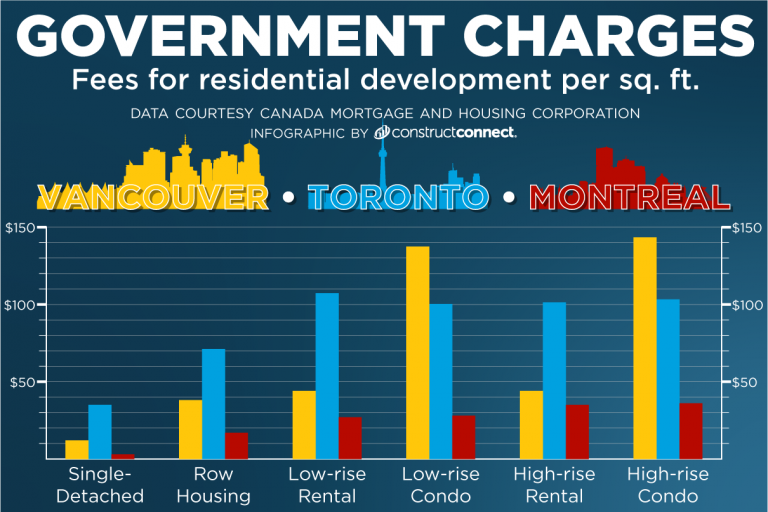
Another graphic on development fees and taxes. A further observation here is that detached housing and townhouses tend have lower fees per square foot.


Article here: https://canada.constructconnect.com/dcn/...ment-fees-crippling-housing-construction

These fees contribute to making incremental up-zoning plans infeasible.
In one chart we see the problem first hand. It should be reversed. My SFH development should be higher than the high rise.
     
     
  #19883  
Old Posted Jun 3, 2023, 9:03 PM
SpongeG's Avatar
SpongeG SpongeG is offline
Registered User
 
Join Date: Jun 2006
Location: Coquitlam
Posts: 40,118
an old coworker recently moved from a condo to a townhouse and she said her living costs have doubled, taxes are double and other things go up, heating a one bedroom condo vs a three level townhouse, multiple bathrooms etc. All add up. Many people don't seem to take that into account.
__________________
belowitall
     
     
  #19884  
Old Posted Jun 3, 2023, 9:40 PM
rbt rbt is offline
Registered User
 
Join Date: Jun 2006
Posts: 1,387
Quote:
Originally Posted by swimmer_spe View Post
In one chart we see the problem first hand. It should be reversed. My SFH development should be higher than the high rise.
Most of the fees are per unit, and since SFH have much larger sizes their fees per sqft (chart) are lower. Considering one of the complaints about condos is there aren't enough family sized units, I'm not sure switching to per-sqft fees would be advantageous as it further discourages large unit sizes.

There's some room to manoeuvre though, like changing some fees to be based on the length of lot frontage. A large condo or rental building would pay a single fee for the complex which is divided by however many units. Many city utilities have a capital-cost component by distance rather than by volume, so lot frontage makes sense.
     
     
  #19885  
Old Posted Jun 4, 2023, 2:27 AM
swimmer_spe swimmer_spe is offline
BANNED
 
Join Date: Apr 2014
Posts: 10,743
Quote:
Originally Posted by rbt View Post
Most of the fees are per unit, and since SFH have much larger sizes their fees per sqft (chart) are lower. Considering one of the complaints about condos is there aren't enough family sized units, I'm not sure switching to per-sqft fees would be advantageous as it further discourages large unit sizes.

There's some room to manoeuvre though, like changing some fees to be based on the length of lot frontage. A large condo or rental building would pay a single fee for the complex which is divided by however many units. Many city utilities have a capital-cost component by distance rather than by volume, so lot frontage makes sense.
Why not base it on number of units? The more legal units you have, the less you pay overall. It has been shown that for infrastructure costs, SFH developments are the more costly.
     
     
  #19886  
Old Posted Jun 4, 2023, 3:35 AM
theman23's Avatar
theman23 theman23 is offline
Registered User
 
Join Date: Apr 2007
Location: Ville de Québec
Posts: 6,345
Quote:
Originally Posted by someone123 View Post
As a side point, I wasn't trying to suggest this. I am just pointing out that taxes tend exacerbate affordability problems, plus there are some political factors at play.

As far as municipalities go, property taxes are one of the top things that councillors get pressured on from their constituents while development fees are noticed by a small portion of the population who in some cases can't or don't vote when the rate is being set (you might not even live in the city yet when purchasing).

Beyond this, there is a tendency in government for scale to cause inefficiency. Once you have a $10B budget or whatever a lot of stuff is "peanuts" in comparison and there tends to be a greater magnitude of miscellaneous spending (maybe a greater percent as well). If this is built off of some kind of ballooning price at its root then it can increase the cost burden a lot.

Let's say we put a 3% "eco fee" on clothing and then we had some kind of cost disease (the clothing safety board is established to protect us and decides that Canada will only be supplied by 4 fully accredited clothing factories) and t-shirts went up to $3,000 each. It's likelier in that case that you'd see a massive clothing eco fee bureaucracy than a drop in the fee to 0.03%. And you'd have a bunch of people saying it's only 3%, or only $90 per t-shirt which isn't too bad in the scheme of things as we're talking about a big ticket item and we have a lot of major ecological problems in the world like climate change.
I’m pretty sure we’ve seen people argue that exact same thing on this forum for housing and vehicles. You might even be quoting Casper or insertnamehere.
__________________
For entertainment purposes only. Not financial advice.
     
     
  #19887  
Old Posted Jun 4, 2023, 4:48 AM
casper's Avatar
casper casper is online now
Registered User
 
Join Date: Nov 2011
Location: Victoria
Posts: 12,973
Quote:
Originally Posted by theman23 View Post
I’m pretty sure we’ve seen people argue that exact same thing on this forum for housing and vehicles. You might even be quoting Casper or insertnamehere.
Not certain I am being quoted.

But yes, I agree development fees are out of control. They need to come down. I would even propose a reverse structure. If you build a new building that does not include your full zoning square footage you pay more.

I think environmental levies are us full to discourage bad behaviour but it has to be reasonable. For example in BC there is a 10cent environ fee on new cell phones or mobile devices. That discourages no one. The carbon tax on the other hand is a good tax that is starting to have an impact. Perhaps we need to increase it more, but that is a discussion for a different thread.
     
     
  #19888  
Old Posted Jun 4, 2023, 3:35 PM
swimmer_spe swimmer_spe is offline
BANNED
 
Join Date: Apr 2014
Posts: 10,743
The development rate differences has got me wondering about a way to fix it.

What if the property paid for the full cost of bringing those services to it? So, if the water main or sewer main has to be upgrades, that SFH development shares that cost. The same for that high rise. Also, base taxes such that new development pays for its own stuff due to the additional costs to the municipalities. I feel in the end, it may make housing development more equitable.
     
     
  #19889  
Old Posted Jun 4, 2023, 5:05 PM
Djeffery's Avatar
Djeffery Djeffery is offline
Registered User
 
Join Date: Oct 2017
Location: London
Posts: 6,335
^Isn't that what the development charges are for, is to pay for the development? If there was more infill and less sprawl, the fees wouldn't have to be so high because you would just be talking upgrades to infrastructure and services, not brand new miles away.
     
     
  #19890  
Old Posted Jun 4, 2023, 5:17 PM
casper's Avatar
casper casper is online now
Registered User
 
Join Date: Nov 2011
Location: Victoria
Posts: 12,973
Quote:
Originally Posted by Djeffery View Post
^Isn't that what the development charges are for, is to pay for the development? If there was more infill and less sprawl, the fees wouldn't have to be so high because you would just be talking upgrades to infrastructure and services, not brand new miles away.
Vancouver it goes to pay for civic art, enhancements to community centers and other services among a laundry list of things.
     
     
  #19891  
Old Posted Jun 4, 2023, 6:46 PM
Changing City's Avatar
Changing City Changing City is offline
Registered User
 
Join Date: Nov 2016
Posts: 8,318
Quote:
Originally Posted by casper View Post
Vancouver it goes to pay for civic art, enhancements to community centers and other services among a laundry list of things.
Not quite. The public art program is seperate, and only applies to rezonings. It can be included in the project, or a payment towards an art project initiated by the City.

Most new development in the City of Vancouver pay Development Cost Levies (DCLs). A DCL is paid by property developers based on square footage. It partially funds the cost of new or improved parks, childcare facilities, social and non-profit housing and engineering infrastructure, (mostly sewers and bike infrastructure).

In addition, where there's a rezoning (above the base zoning of the area) developers are expected to contribute a Community Amenity Contribution, based on a proportion of the added land value that the rezoning adds. CACs can be used for affordable housing, community centres, libraries, daycares, park improvements, neighbourhood houses, and more. Projects can either be delivered as in-kind facilities, or as payments in lieu. Details here.

Neither source of funding covers the spending on all the replacement and upgraded infrastructure, but they're added to the Capital Program to allow more work to take place - often necessary to allow the projects to go ahead (in the case of sewer upgrades, for example). The trunk sewers and water supply are provided by Metro Vancouver, and they've recently added their own payment on new development across the region, to help pay for those upgrades.

__________________
Contemporary Vancouver development blog, https://changingcitybook.wordpress.com/ Then and now Vancouver blog https://changingvancouver.wordpress.com/
     
     
  #19892  
Old Posted Jun 4, 2023, 9:20 PM
swimmer_spe swimmer_spe is offline
BANNED
 
Join Date: Apr 2014
Posts: 10,743
Quote:
Originally Posted by Djeffery View Post
^Isn't that what the development charges are for, is to pay for the development? If there was more infill and less sprawl, the fees wouldn't have to be so high because you would just be talking upgrades to infrastructure and services, not brand new miles away.
It is what it should be for, but it just goes into general revenue. Doing it this way would force some accountability into it. It would also mean taxes would go to existing services, not upgrades for new services.
     
     
  #19893  
Old Posted Jun 5, 2023, 4:58 AM
MonkeyRonin's Avatar
MonkeyRonin MonkeyRonin is offline
¥ ¥ ¥
 
Join Date: Sep 2006
Location: Vancouver
Posts: 10,666
Quote:
Originally Posted by Djeffery View Post
^Isn't that what the development charges are for, is to pay for the development? If there was more infill and less sprawl, the fees wouldn't have to be so high because you would just be talking upgrades to infrastructure and services, not brand new miles away.

Not sure how sprawl figures into it, when the PSF development charges are multiple times higher on multi-family than on single-family. Also these are the cities of Toronto, Montreal, and Vancouver we're talking about - they're fully built out, so any new development is infill (which also at least partly explains why SFH fees are lower, as they're replacement units rather than new units).

The bigger issue is how municipalities are using development fees as a cash cow, which has allowed them to keep property taxes artificially low for existing homeowners; and instead pass the burden on to new condo buyers. It's a lot more politically popular to keep taxes down for existing residents than for prospective future ones, but the consequence of this is that new housing units have become significantly more expensive (no coincidence of course that the two most expensive cities are the ones with the highest development fees - though that's only part of the overall equation).
__________________
     
     
  #19894  
Old Posted Jun 5, 2023, 5:03 AM
swimmer_spe swimmer_spe is offline
BANNED
 
Join Date: Apr 2014
Posts: 10,743
Quote:
Originally Posted by MonkeyRonin View Post
Not sure how sprawl figures into it, when the PSF development charges are multiple times higher on multi-family than on single-family. Also these are the cities of Toronto, Montreal, and Vancouver we're talking about - they're fully built out, so any new development is infill (which also at least partly explains why SFH fees are lower, as they're replacement units rather than new units).

The bigger issue is how municipalities are using development fees as a cash cow, which has allowed them to keep property taxes artificially low for existing homeowners; and instead pass the burden on to new condo buyers. It's a lot more politically popular to keep taxes down for existing residents than for prospective future ones, but the consequence of this is that new housing units have become significantly more expensive (no coincidence of course that the two most expensive cities are the ones with the highest development fees - though that's only part of the overall equation).
If I buy a new home today, it is assessed at today's price. 50 years from now, it will still keep a much lower assessment than a new build. Maybe it is time to base assessments more on retail rate for a similar property and not on what you paid for it. The other thing is that when you buy a used property, it retains the old value until a reassessment is done. The lawyer should be required to report the final sale price to the municipality for a reassessment of taxes.
     
     
  #19895  
Old Posted Jun 5, 2023, 5:05 AM
MonkeyRonin's Avatar
MonkeyRonin MonkeyRonin is offline
¥ ¥ ¥
 
Join Date: Sep 2006
Location: Vancouver
Posts: 10,666
Quote:
Originally Posted by hipster duck View Post
^The more I think about it, the more I realize that Canada does basically everything wrong in the book when it comes to housing. Doesn't matter which level of government, or whether it's supply, demand, macro or micro policy. It all just adds fuel to a raging fire, and is very difficult to get out of.

Housing is to Canada what healthcare is to the United States.

Good observation, and sad, but probably true. I just wonder when we reach the breaking point, and what that looks like. Will lower-income Canadians just live in shanty towns? Or do things Hong Kong-style subdivided apartments become the norm? We've already seen a bit of this sort of thing in instances of people renting out closets, curtained-off hallways, etc.; but I mean as a more formalized, commonplace occurrence as in HK.

• Video Link
__________________
     
     
  #19896  
Old Posted Jun 5, 2023, 5:13 AM
swimmer_spe swimmer_spe is offline
BANNED
 
Join Date: Apr 2014
Posts: 10,743
Quote:
Originally Posted by MonkeyRonin View Post
Good observation, and sad, but probably true. I just wonder when we reach the breaking point, and what that looks like. Will lower-income Canadians just live in shanty towns? Or do things Hong Kong-style subdivided apartments become the norm? We've already seen a bit of this sort of thing in instances of people renting out closets, curtained-off hallways, etc.; but I mean as a more formalized, commonplace occurrence as in HK.
The breaking point will be when professionals who can make $100k a year decide to live where it is cheaper. That includes people like health care workers or trades. What you may end up seeing is the reverse fly in/fly out where a company has an apartment complex that they house workers there for a few weeks at a time. So, picture a "camp" in Toronto that the in demand people stay in while they live hundreds or even thousands of km away.
     
     
  #19897  
Old Posted Jun 5, 2023, 1:23 PM
Coldrsx's Avatar
Coldrsx Coldrsx is offline
Community Guy
 
Join Date: Dec 2003
Location: Edmonton, AB
Posts: 69,132
As Canmore, Alta., faces housing crisis, debate stirs over employee housing in industrial area

Bow Valley developer says employers have had to make difficult decisions

Jade Markus, Paula Duhatschek · CBC News ·
https://www.cbc.ca/news/canada/calgary/canmore-alberta-housing-crisis-1.6864866
__________________
"The destructive effects of automobiles are much less a cause than a symptom of our incompetence at city building" - Jane Jacobs 1961ish

Wake me up when I can see skyscrapers
     
     
  #19898  
Old Posted Jun 5, 2023, 4:16 PM
hipster duck's Avatar
hipster duck hipster duck is offline
Registered User
 
Join Date: Oct 2014
Location: Toronto
Posts: 4,946
Quote:
Originally Posted by MonkeyRonin View Post
Good observation, and sad, but probably true. I just wonder when we reach the breaking point, and what that looks like. Will lower-income Canadians just live in shanty towns? Or do things Hong Kong-style subdivided apartments become the norm? We've already seen a bit of this sort of thing in instances of people renting out closets, curtained-off hallways, etc.; but I mean as a more formalized, commonplace occurrence as in HK.
My cynical prediction is that there will be a bunch of piecemeal little fixes here and there that don't fundamentally 'solve' the problem, but kind of control the fire in sub-optimal and inefficient ways.

I don't think there will be shantytowns, not because I think our government will be able to provide our poorest citizens with adequate housing, but because our governments enforces property rights and can rally the police with such effectiveness that squatters would not be able to organize, set up camp, tap into sources of electricity and drinking water and eventually get city services. The Hong Kong path seems more plausible. I think I remember reading about how tens of thousands of renters in London (UK) live in garages or in illegal secondary suites hastily built at the back of existing properties.

My guess is that things will begin to change once we hear grumbling from the top of the class pyramid, not the bottom. These are the people who have more of a direct line to governments.

We're almost at the point now that affluent boomers can't help their children with good jobs buy the homes they want. Like, how many people can dip into their retirement and fork over $1 million cash to their offspring? Even with that, your kids are on the hook for another $1 million mortgage at 5%, since your average detached home in Toronto or Vancouver is pushing $2 million. Just doing some back of the envelope math, that would be a monthly payment of almost $6,000 over a 25 year amortization. Even if both people are highly-paid professionals, few households can afford to pay $72k/year just in mortgage payments.
     
     
  #19899  
Old Posted Jun 5, 2023, 4:22 PM
thurmas's Avatar
thurmas thurmas is offline
Registered User
 
Join Date: Apr 2002
Location: Winnipeg, MB
Posts: 7,598
Quote:
Originally Posted by Coldrsx View Post
As Canmore, Alta., faces housing crisis, debate stirs over employee housing in industrial area

Bow Valley developer says employers have had to make difficult decisions

Jade Markus, Paula Duhatschek · CBC News ·
https://www.cbc.ca/news/canada/calgary/canmore-alberta-housing-crisis-1.6864866
This is ridiculous we used to have housing on upper floors and business or light industrial on floors below. Ugh
     
     
  #19900  
Old Posted Jun 5, 2023, 4:38 PM
whatnext whatnext is offline
Registered User
 
Join Date: Feb 2009
Location: Vancouver
Posts: 28,047
Quote:
Originally Posted by SpongeG View Post
my BF's condo is barely just over 300, and there are smaller units in the building, its a tight squeeze but with good organization it can work and having a large balcony is a great help. When first built the units started at $97,000 about 8 years ago, they are now starting to put them on the market at around $300,000+, as most of them were bought by investors.
While it's great that your BF can make 300 sq ft work, we have to ask 'is this the future we want for Canada"? We're slipping back to developing world standards of living.
     
     
This discussion thread continues

Use the page links to the lower-right to go to the next page for additional posts
 
 
Closed Thread

Go Back   SkyscraperPage Forum > Regional Sections > Canada
Forum Jump


Forum Jump


All times are GMT. The time now is 7:21 AM.


Powered by vBulletin® Version 3.8.7
Copyright ©2000 - 2026, vBulletin Solutions, Inc.