| |
 Posted Apr 28, 2023, 7:20 PM
|
 |
Moderator
|
|
Join Date: Mar 2012
Location: Ottawa
Posts: 29,116
|
|
From two weeks ago, video posted by the TOH.
• Video Link
And some website "newsroom" updates.
Quote:
A hospital for everyone: Building one of Canada’s most accessible hospitals
Feb 27, 2023
Going to a hospital for care or to visit a loved one can be stressful. The Ottawa Hospital wants to make getting to, navigating and using the facilities at our new hospital and new hospital campus as easy and comfortable as possible for everyone.
“One of the priorities from the beginning as we plan the new hospital and campus is to make it as efficient and as easy as possible for everyone to get where they’re going,” said Karen Stockton, Executive Director of Planning and Development at The Ottawa Hospital. “We want the new facility to be welcoming for people with a wide range of abilities and for patients and their families to be as comfortable as possible whether they’re staying in hospital, visiting or here for outpatient services or clinics.”
Well connected to public transit, and with easy to understand and predictable wayfinding, the goal is to make navigating and moving around the 2.5 million square foot facility efficient for everyone.
The new hospital will be accessible by foot, bike, public transit, or car with ample parking spaces for cars and bikes.
Para Transpo, private vehicles, taxis and rideshare services can all drop patients off at the main entrance, and accessible bike parking will be available for people who ride adapted bicycles or tricycles. The four-storey parking garage will include 72 accessible spaces and 144 limited mobility spaces located close to elevator banks. Additional accessible spots will be located at the main entrance and at the emergency entrance, one floor below grade.
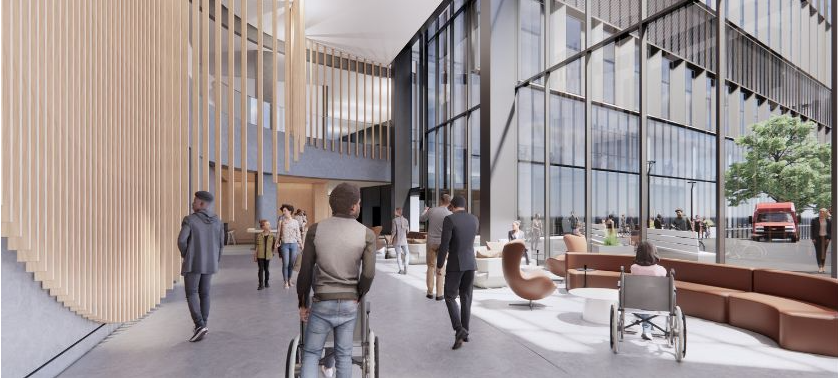
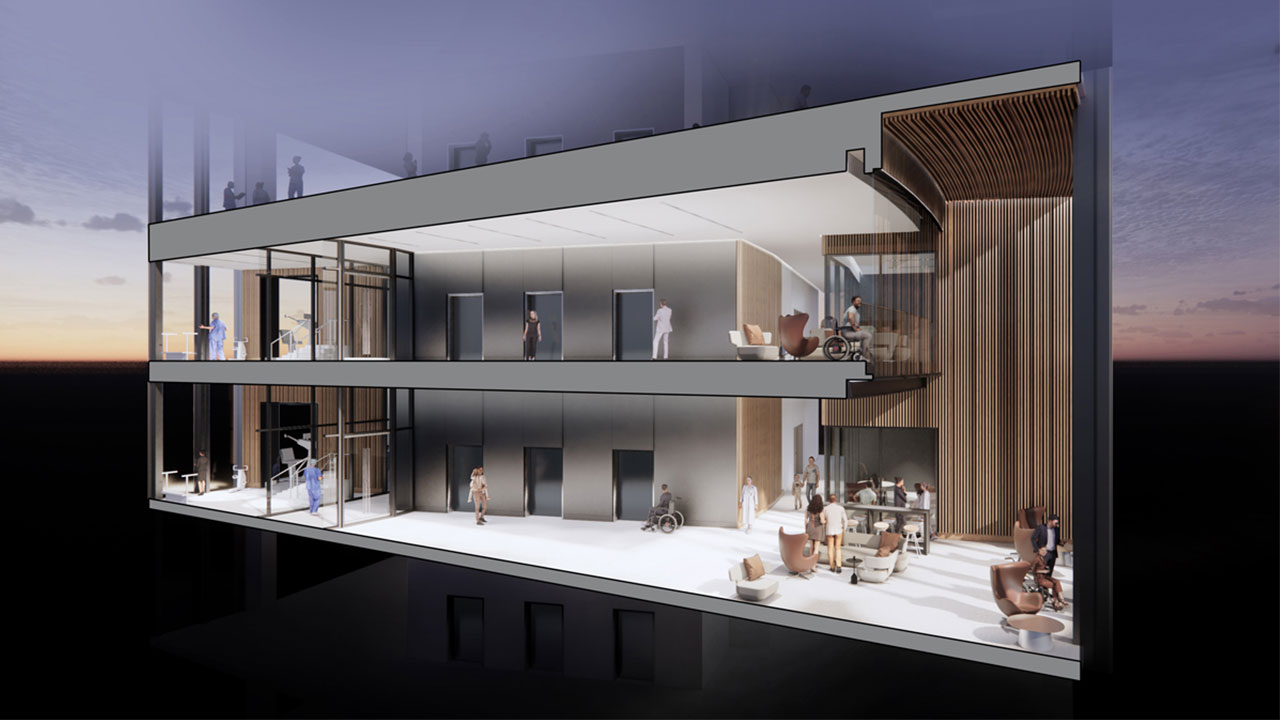
People who take transit or park in the parking garage can access the hospital through a direct, indoor walkway to the hospital accessible from the parking garage and the LRT station. The walkway is also accessible from street level through elevator banks and stairs located in two areas along the route. The route will be open and spacious with seating and rest spots and with large windows overlooking a park.
Moving sidewalks will increase accessibility and overall mobility and help people to get to their destinations quickly and comfortably.
Designing spaces that work for everyone
We’ve all been there – late for an appointment, rushing to find a parking spot and frantic to find the elevator that will take us to the correct floor.
If the hospital isn’t accessible, these feelings can be elevated for many people, says Marnie Peters, an accessibility expert working with The Ottawa Hospital on the new campus.
“Being in hospital can be inherently stressful,” said Marnie. “And then, when the exam table is a little too high, or the bathroom isn’t quite large enough, or the floor patterns give you a migraine – your experience becomes even more difficult.”
With a focus on patient experience and as work to design the state-of-the-art new hospital moves ahead, The Ottawa Hospital is working with stakeholders and experts to ensure the hospital and the surrounding site is compliant with the goals and principles of the Accessibility for Ontarians with Disabilities Act (AODA), to achieve a barrier-free Ontario by 2025.
And in many areas TOH is going above and beyond minimum code requirements to incorporate best practices of universal accessibility, a design approach that assumes people will come to the hospital with a range of abilities that will be accommodated by a wide range of accessible building features and equipment that is universally accessible and able to be used by everyone.
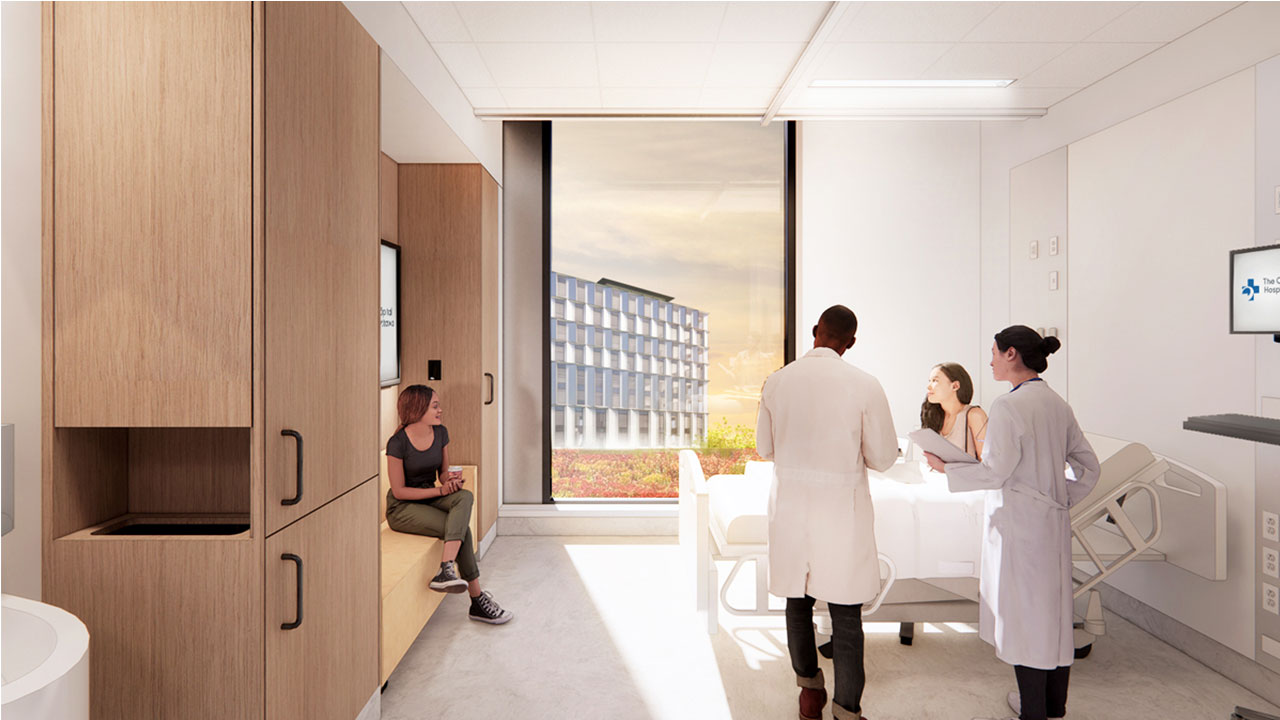
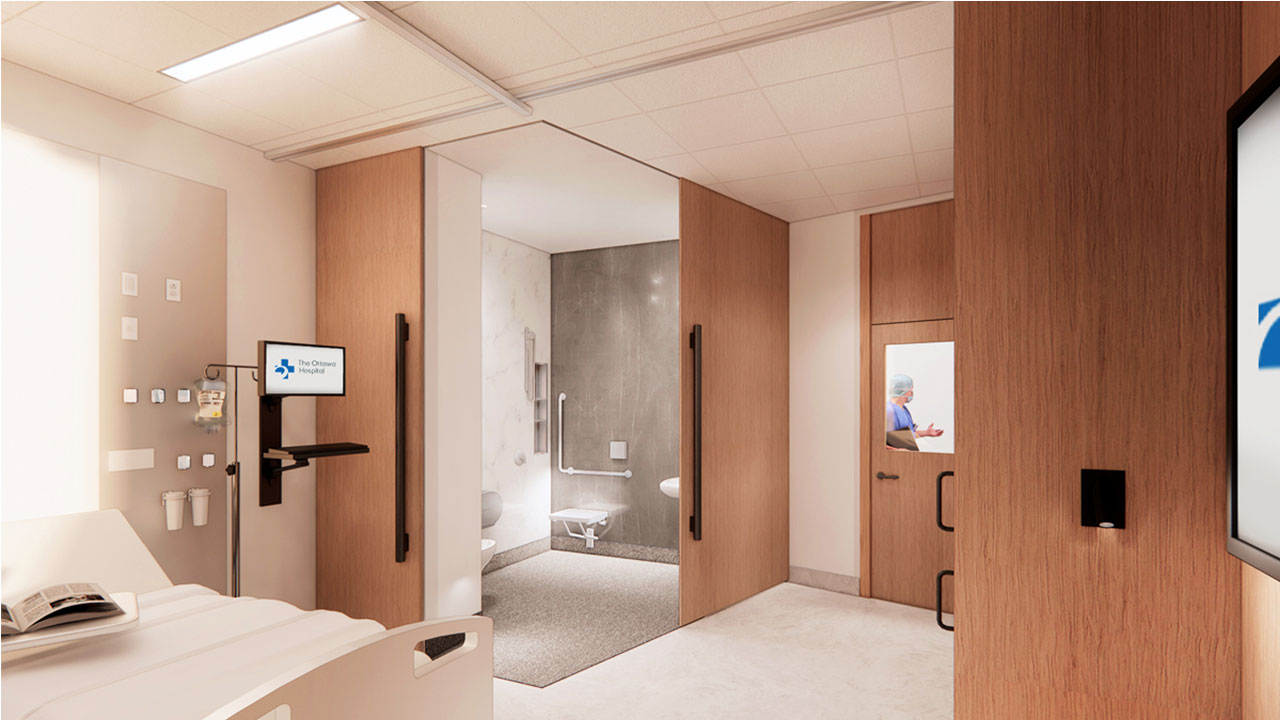
Every patient room will have extra space to allow patients or visitors who use wheelchairs or other mobility aids to move through the room easily. Patients can access their private washroom through double sliding doors that meet on a corner to allow for a direct route from the bed to the toilet or to the roll-in shower, and which can be fully closed to ensure privacy.
Read more about how The Ottawa Hospital is planning the inpatient room of the future
Most outpatient clinics in the hospital will be in easy-to-find areas, intuitively located on the main floor to reduce travel distances and times.
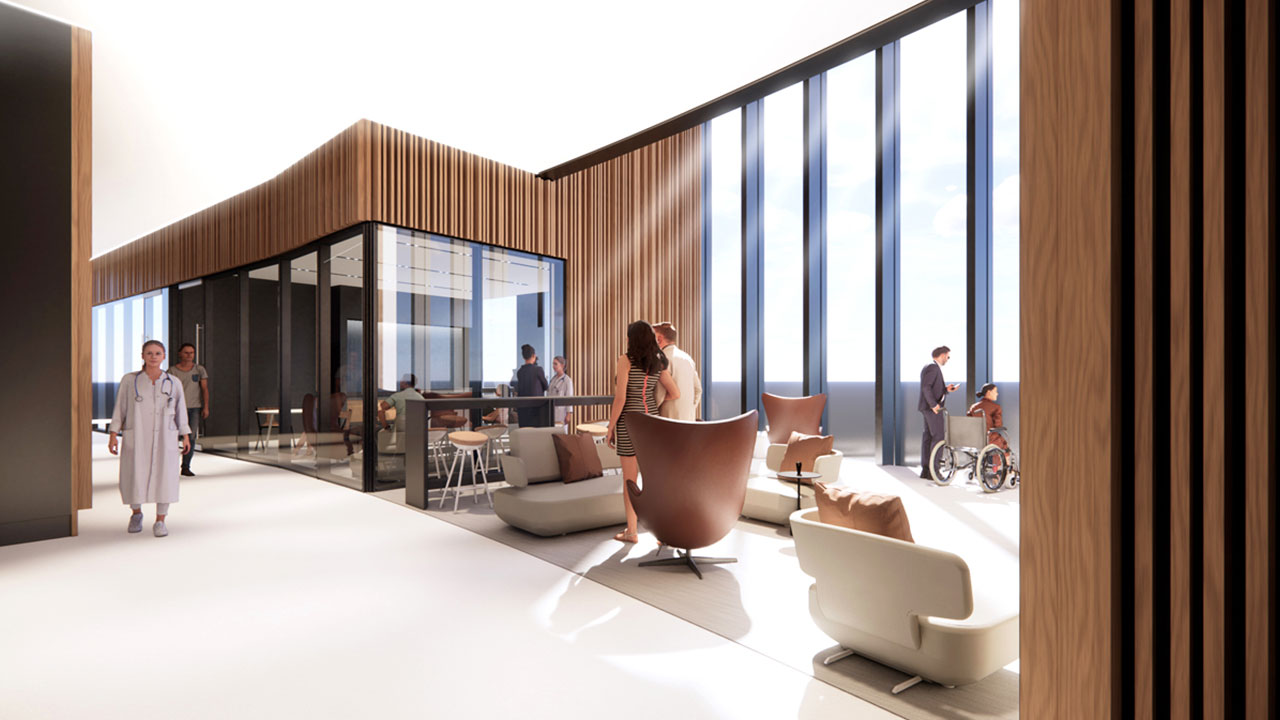
Rest areas and patient lounges with a variety of seating options will be located throughout the building so that no matter where they are, patients and visitors can find a place to rest when they need it. Handrails will be placed to provide support as people move throughout the building.
Washrooms throughout the hospital will go beyond building code requirements to be fully accessible for all users. While there will be a small number of multi-user washrooms in the building, in addition to being fully wheelchair accessible, all individual washrooms will be “All-Access.” At least one washroom on every floor will have an adult changing table and accommodate a larger turning radius.
“We want to make washrooms for people,” said Marnie. “The concept of an ‘All-Access’ washroom means anyone can use it regardless of gender identity or mobility. Everyone who comes into the hospital will be able to use a washroom without worrying about finding the right one for them, or having to take an elevator to find one that is accessible.”
Accessibility is a priority across TOH
As work on the detailed design of the new hospital continues, accessibility will continue to be a priority for The Ottawa Hospital as a whole. The hospital’s internal Accessibility Office works to create an accessible environment at The Ottawa Hospital and ensure compliance with the AODA by raising awareness, training staff members, and identifying and removing barriers to accessibility. The office is closely involved with planning the new hospital and reviews designs at every stage of planning.
“Our accessibility team remains deeply committed to and engaged in the process of planning the new campus, while at the same time working to ensure all our sites are meeting requirements – and going beyond them wherever we can,” said Manon Laliberté, the manager responsible for TOH’s Accessibility Office. “The new campus gives us such a great opportunity to build in accessibility from the beginning of the planning process, and to create a great experience for our patients, visitors and staff.”
TOH has also established an accessibility consultative committee dedicated to reviewing new campus development project updates and providing feedback. TOH has presented to the City of Ottawa’s Accessibility Committee and held a public town hall on accessibility at the new campus in June 2022.
|
https://newcampusdevelopment.ca/newsroom...ne-of-canadas-most-accessible-hospitals/
Quote:
Modern sustainability in a new state-of-the-art hospital
Apr 20, 2023
Sustainability is at the forefront of all design considerations for The Ottawa Hospital’s new campus and will integrate into the design of the buildings, landscape and social spaces.
The Ottawa Hospital’s approach to sustainability is to think about the design of the new campus not just within the walls of the hospital. The landscape and existing climate of the entire campus are critical factors in creating a site that promotes health and healing – for the individual and for the environment.
“We do a deep site analysis to look at the climate that is present in Ottawa, the wind direction, solar positioning and more,” says Peter Duckworth-Pilkington, Sustainable Design Lead at HDR Architecture Associates Inc, a global health care design firm that is working with The Ottawa Hospital to develop the new campus. “Then we explore how to adapt the design to take advantage of that. Things like using the sun to passively heat the building or planting trees to provide shade in the summer.”
On target to be one of the most modern hospitals in the country, an important part of the sustainability strategy of the new campus is to reduce its carbon footprint. “Health care operations produce about 4.6% of Canada’s overall greenhouse gas emissions,” Peter adds. “We’re looking at ways to reduce the amount of energy that needs to be put in, as well as the amount of carbon being produced.”
Environmental benefits of the new hospital will include reduced energy demand as well as the use of renewable energy technology and low-carbon fuel sources.
Improving wellness with a naturalized landscape
Caring for the environment and planet can have a profound effect on a hospital’s care of patients and the wellness of staff, families and other visitors. This is why the design of The Ottawa Hospital’s new campus is a hybrid approach that is fundamentally guided by both the health of people and the health of our planet.
‘Biophilia’ refers to the human tendency or desire to interact with or be closer to natural environments. In simpler terms: people feel better when they connect with nature.
Building on this concept, biophilic design elements will be integrated throughout the new campus to help reduce stress and improve the quality of life for patients, families and staff. Access to natural lighting, interior features made of natural materials, and views of the natural surroundings are all ways to connect people to nature and create harmony between the buildings and spaces on site.
The landscape of the new campus will feature pollinator gardens and natural habitats, with native plant communities that have similar sun, water, and soil requirements to develop an ecological succession over time.
“Looking at sustainability, one of the things we’re trying to do is reduce the amount of mowing and other types of traditional grounds maintenance,” says Jeff Fahs, Director of Landscape Architecture at HDR Architecture Associates Inc. “We’re also supported by the NCC (National Capital Commission) and the City of Ottawa in developing a 40% tree canopy over 40 years, which is a reforestation approach to sustainability.”
The Ottawa Hospital is working closely with partners and arborists on a tree conservation plan that aims to preserve as many trees as possible. Trees that are in good condition, native species and are an appropriate size will be relocated on the site.
Protecting biodiversity at the new campus
Birds are critical to our ecosystem and an important part of the biodiversity strategy of the new campus. The Ottawa Hospital is incorporating bird-friendly standards that adhere to Bird Safe Design Guidelines outlined by the City of Ottawa and the NCC. These guidelines help minimize the risks to birds and bird collisions with buildings.
“It’s important that we’re providing a space to attract native species of birds, but we don’t want to bring them into a place that is dangerous for them,” explains Peter Duckworth-Pilkington. “One of the key issues is glass; you must have some kind of measure that allows bird to see it. You also have to make sure that during nesting seasons, you’re not blasting bright lights on nesting areas, especially for ground nesting birds.”
As part of a bird safe design, The Ottawa Hospital’s new campus development team is exploring high-contrast patterns on glass and glazed surfaces, as well as bird-friendly landscaping and controlled lighting with automatic shutoff systems.
The Ottawa Hospital’s commitment to sustainability and the environment
Leadership in Energy and Environmental Design (LEED) is an international standard of sustainability excellence and green building leadership. The Ottawa Hospital’s new campus development project is adhering to LEED standards to build a climate-resilient hospital that will reduce carbon emissions, save water, conserve energy, and reduce waste.
LEED certification provides independent, third-party verification that projects are designed and built to achieve high performance in six key areas of human and environmental health. These include energy efficiency, sustainable site development, selection of materials with minimal impact to the environment and more.
“The Ottawa Hospital is committed to environmental responsibility and sustainability and to promoting a healthy environment and reduced carbon footprint,” says Elena Pascuet, Manager of Planning and Development at The Ottawa Hospital and Co-Chair of the TOH Sustainability Council, which serves to continually improve its sustainability initiatives and reduce the environmental impacts of hospital operations activities and services.
The design of the new campus aspires to be Net Zero Ready, with a full plan in place to eventually transition to Net Zero. This means the hospital would use renewable energy systems to produce as much clean energy as it consumes. A vital component of Net Zero Readiness is the reduction of thermal demand using improved air sealing, continuous insulation and high-performance windows and doors.
A central utility plant on the site of the new campus will be an important step in achieving The Ottawa Hospital’s goal of becoming one of the most sustainable health care facilities in the world. Using innovative utilities technology, this plant will manage power, renewables, and back-up power generation to achieve high levels of efficiency in energy use and redundancy of supply. Other services under the scope of the central utility plant that are essential to the new campus include thermal systems for heating and cooling, natural gas and domestic water management.
|
https://newcampusdevelopment.ca/newsroom/modern-sustainability-in-a-new-state-of-the-art-hospital/

|
|
|





 Prev
Prev























 Linear Mode
