HomeDiagramsDatabaseMapsForum About
     

Go Back   SkyscraperPage Forum > Regional Sections > Canada


Closed Thread

 
Thread Tools Display Modes
     
     
  #18521  
Old Posted Apr 1, 2023, 6:18 AM
Changing City's Avatar
Changing City Changing City is offline
Registered User
 
Join Date: Nov 2016
Posts: 8,221
Quote:
Originally Posted by swimmer_spe View Post

Thank you for being honest. What would happen if you were forced to have, say 10% of your units "affordable"

What would happen if all new development had to have at least 10% of the units be considered affordable? Would that not start to put a dent in the problem?

There is "affordable" and ""geared to income" housing. Affordable is something that an average citizen can afford. Geared to Income is priced to match the individual's income
It's likely it would make the situation much worse. If every condo project, and every market rental had to include 10% of the units built as 'affordable' rental, then many developers would chose to not develop. It would also adversely affect the pro forma, making some projects just not worth building.

It's beyond belief that every municipality would chose to introduce that requirement anyway, and many developers would just concentrate on building where they didn't have to provide affordable rental units.

There's no such thing as an 'average citizen'. There's a continuum from having no income at all (on welfare, or disability for example) to having billions of wealth and millions in income. Housing affordability is generally defined in relation to household income. That's the only meaningful way to allocate subsidized or less-than-market rentals to try to reduce housing need.
__________________
Contemporary Vancouver development blog, https://changingcitybook.wordpress.com/ Then and now Vancouver blog https://changingvancouver.wordpress.com/
     
     
  #18522  
Old Posted Apr 1, 2023, 7:51 AM
Nite's Avatar
Nite Nite is offline
Registered User
 
Join Date: Dec 2007
Location: Toronto
Posts: 3,381
Quote:
Originally Posted by Truenorth00 View Post


https://twitter.com/charliebilello/status/1641544638484959233?t=PDYajBJgJ3E2IoLdrjiGsg&s=19

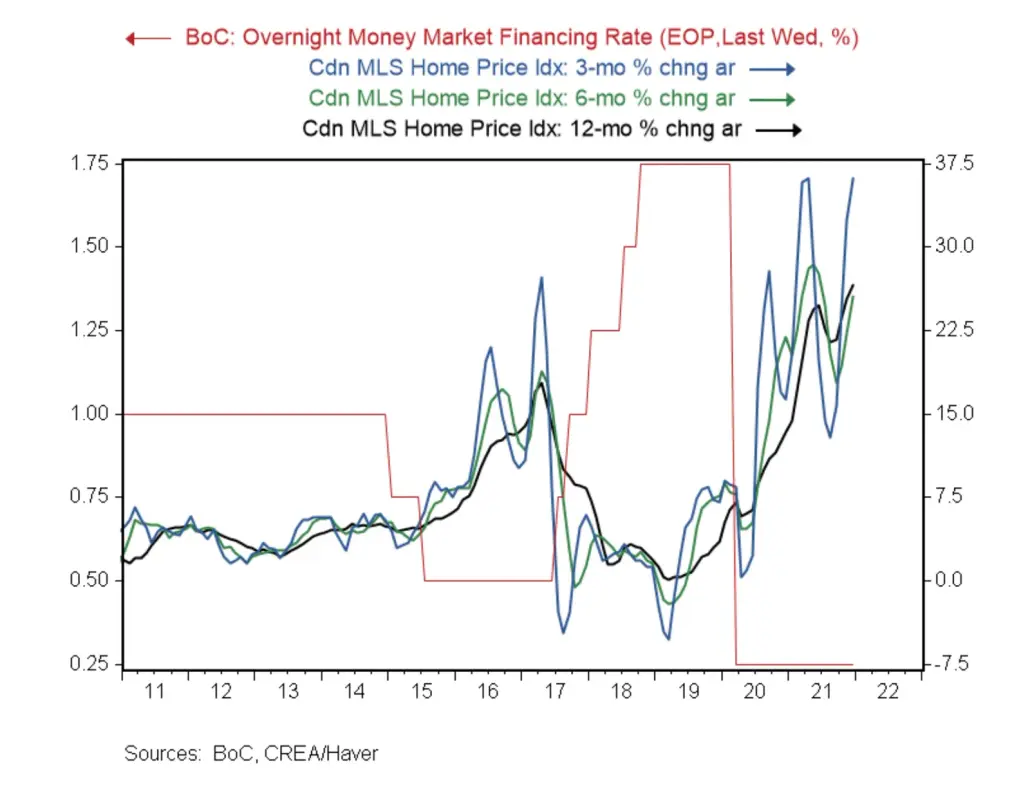
It always amazing to me that so many Canadians think it's perfectly normal, for housing prices to go up 300% in two decades, when inflation is up 49%. Like the proverbial frog in the pot of water. Foreigners can see our bubble for what it is.

low inflation leads to low interest rates which fuel asset bubbles like housing and the stock markets.
Higher inflation and the corresponding high interest rates is what keeps home prices stable.
This is one of the downsides of trying to keep inflation below 2% no matter what when a high inflation target maybe healthier for the economy.

Canadian Real Estate Price Growth Vs Interest Rates

https://betterdwelling.com/bank-of-canad...hikes-will-reduce-real-estate-froth-bmo/
     
     
  #18523  
Old Posted Apr 1, 2023, 7:56 AM
Nite's Avatar
Nite Nite is offline
Registered User
 
Join Date: Dec 2007
Location: Toronto
Posts: 3,381
Quote:
Originally Posted by casper View Post
So if your a developer building a new home you have a choice you can build an affordable home or you can make more margin building a more expensive home.
until the market at the high end is saturated and you are force to address other parts of the market.
     
     
  #18524  
Old Posted Apr 1, 2023, 12:29 PM
Innsertnamehere's Avatar
Innsertnamehere Innsertnamehere is offline
Registered User
 
Join Date: Jan 2010
Location: Hamilton
Posts: 12,861
Quote:
Originally Posted by Nite View Post
until the market at the high end is saturated and you are force to address other parts of the market.
Yup.

Toronto’s high end condo market is very saturated right now for example. A lot of super-luxury projects in Yorkville are stalled out and new proposals in the area are going more mid-market instead with smaller units.

Low rise stuff is almost all upper market as that’s where the money is in the GTA right now, but in Hamilton, developers are building tons and tons of townhouses and relatively little detached stock right now. Why? $800k towns fly off the shelf while detached start at $1.2-$1.3 million and sit on the market.
     
     
  #18525  
Old Posted Apr 1, 2023, 2:45 PM
whatnext whatnext is offline
Registered User
 
Join Date: Feb 2009
Location: Vancouver
Posts: 27,785
Quote:
Originally Posted by Nite View Post
low inflation leads to low interest rates which fuel asset bubbles like housing and the stock markets.
Higher inflation and the corresponding high interest rates is what keeps home prices stable.
This is one of the downsides of trying to keep inflation below 2% no matter what when a high inflation target maybe healthier for the economy.
Everywhere in the world has had the same low interest rates yet only Canada, with a mediocre economic performance. has had such a huge run-up in prices.

It is crystal clear that Trudeau's runaway immigration figures are the differentiator that is to blame. It always amazes me that the same people who prattle on about "supply" won't acknowledge the devastating effects of this demand generator. It's also mind-boggling they will trot out the same tired kumbaya sentiments while their kids are being priced out of the housing market.
     
     
  #18526  
Old Posted Apr 1, 2023, 4:19 PM
swimmer_spe swimmer_spe is offline
BANNED
 
Join Date: Apr 2014
Posts: 10,743
Quote:
Originally Posted by Changing City View Post
It's likely it would make the situation much worse. If every condo project, and every market rental had to include 10% of the units built as 'affordable' rental, then many developers would chose to not develop. It would also adversely affect the pro forma, making some projects just not worth building.

It's beyond belief that every municipality would chose to introduce that requirement anyway, and many developers would just concentrate on building where they didn't have to provide affordable rental units.

There's no such thing as an 'average citizen'. There's a continuum from having no income at all (on welfare, or disability for example) to having billions of wealth and millions in income. Housing affordability is generally defined in relation to household income. That's the only meaningful way to allocate subsidized or less-than-market rentals to try to reduce housing need.
When the census is done, a medium income is calculated. It could be based off of those metrics.

But, your issue is not that, it is the fact you think developers will only build high end real estate. My question is whether you think they would risk going out of business over it. My guess is, they would meet that minimum requirement and that would be all. They would likely even publish that price as a "Starting from $X" on their billboards and other advertising.
     
     
  #18527  
Old Posted Apr 1, 2023, 4:31 PM
suburbanite's Avatar
suburbanite suburbanite is online now
Registered User
 
Join Date: Apr 2011
Location: Toronto & NYC
Posts: 5,647
Ultimately affordable housing requirements just flow through to underlying development land prices. If your projected top line revenue decreases then the residual land value goes down proportionately.

It mostly screws over people who bought land under a valuation that assumed 100% market priced units, and then had inclusionary zoning policies dropped on said land after the fact. Anyone buying land in municipalities with these requirements now will have an affordable housing component included in their pro forma, and instead of being able to pay $200 per buildable square foot for the land it will be $170 or something.
__________________
Discontented suburbanite since 1994

Last edited by suburbanite; Apr 1, 2023 at 5:13 PM.
     
     
  #18528  
Old Posted Apr 1, 2023, 6:24 PM
Nite's Avatar
Nite Nite is offline
Registered User
 
Join Date: Dec 2007
Location: Toronto
Posts: 3,381
Quote:
Originally Posted by whatnext View Post
Everywhere in the world has had the same low interest rates yet only Canada, with a mediocre economic performance. has had such a huge run-up in prices.

It is crystal clear that Trudeau's runaway immigration figures are the differentiator that is to blame. It always amazes me that the same people who prattle on about "supply" won't acknowledge the devastating effects of this demand generator. It's also mind-boggling they will trot out the same tired kumbaya sentiments while their kids are being priced out of the housing market.
Everywhere in the world did have a housing bubble though.
Canada added 1 million more people last year and saw home prices fell by around 15%
Immigration is not the determinate factor in house prices. interest rates are


  #18529  
Old Posted Apr 1, 2023, 6:31 PM
lio45 lio45 is offline
BANNED
 
Join Date: Aug 2007
Location: Quebec
Posts: 44,901
Again: the one thing that immigration totally and directly increases is "the cost of housing", not "nominal real estate prices in dollars".

If you can't understand the difference, see my previous posts directed to you. They are super clear.

Housing is currently the priciest it's ever been in Canada, and that's because we import way too many people every year for housing to keep up. It's called supply and demand. Look it up.
     
     
  #18530  
Old Posted Apr 1, 2023, 6:33 PM
swimmer_spe swimmer_spe is offline
BANNED
 
Join Date: Apr 2014
Posts: 10,743
Quote:
Originally Posted by lio45 View Post
Again: the one thing that immigration totally and directly increases is "the cost of housing", not "nominal real estate prices in dollars".

If you can't understand the difference, see my previous posts directed to you. They are super clear.

Housing is currently the priciest it's ever been in Canada, and that's because we import too many people every year. It's called supply and demand. Look it up.
As a landlord, you set it at a rate you can get for it. You don't set it at what an immigrant is willing to pay do you?
     
     
  #18531  
Old Posted Apr 1, 2023, 6:44 PM
Changing City's Avatar
Changing City Changing City is offline
Registered User
 
Join Date: Nov 2016
Posts: 8,221
Quote:
Originally Posted by swimmer_spe View Post
When the census is done, a medium income is calculated. It could be based off of those metrics.

But, your issue is not that, it is the fact you think developers will only build high end real estate. My question is whether you think they would risk going out of business over it. My guess is, they would meet that minimum requirement and that would be all. They would likely even publish that price as a "Starting from $X" on their billboards and other advertising.
I don't think they'd only build high end units, but they wouldn't build low end units. My issue is that requiring rental units that are affordable to an individual (or household?) earning the 'medium' income (mean? median?) doesn't address the need for those with significantly lower income, and those are the more likely to end up homeless, so are a higher priority. Those are who BC Housing have been targetting with new projects, and it's those programs and projects that are under scrutiny for how effective they have been.

Here's an article on how the some of the 'affordable' (below market) units are being built in BC by some of the not-for-profit developers. It explains all the ways rental units at below market rents are already being generated through a variety of zoning requirements, or incentives.

The biggest for profit developers wouldn't 'go out of business', but they probably take their business elsewhere - at least out of BC. Westbank, Bosa, Onni, Pinnacle, all Vancouver based, all have large development portfolios in Seattle, Toronto, Los Angeles, San Diego for example. There seems to be a view that the biggest problem is that we're not building enough housing (of all sorts, at all price points). Creating a policy that would ensure that less housing gets built would make things worse, not better.

__________________
Contemporary Vancouver development blog, https://changingcitybook.wordpress.com/ Then and now Vancouver blog https://changingvancouver.wordpress.com/
     
     
  #18532  
Old Posted Apr 2, 2023, 12:49 AM
lio45 lio45 is offline
BANNED
 
Join Date: Aug 2007
Location: Quebec
Posts: 44,901
Quote:
Originally Posted by swimmer_spe View Post
As a landlord, you set it at a rate you can get for it. You don't set it at what an immigrant is willing to pay do you?
Actually, the latter. If 18 South Asians on student visas are willing to pay ~$200 each to be in an unit that'd rent for ~$1000/month to a normal person, it's the South Asians who set the market rate for that unit, not the normal person.

(Not implying South Asians aren't normal--I'm pretty sure you guys get what I mean. But they're really THE poster boys for the concept of packing like sardines as renters.)

In fact, your statement makes no sense, because both parts are the same thing. The reality is "As a landlord, you set it at the rate you can get for it, which in practice is whatever an immigrant is willing to pay."
     
     
  #18533  
Old Posted Apr 2, 2023, 4:34 AM
swimmer_spe swimmer_spe is offline
BANNED
 
Join Date: Apr 2014
Posts: 10,743
Quote:
Originally Posted by Changing City View Post
I don't think they'd only build high end units, but they wouldn't build low end units. My issue is that requiring rental units that are affordable to an individual (or household?) earning the 'medium' income (mean? median?) doesn't address the need for those with significantly lower income, and those are the more likely to end up homeless, so are a higher priority. Those are who BC Housing have been targetting with new projects, and it's those programs and projects that are under scrutiny for how effective they have been.

Here's an article on how the some of the 'affordable' (below market) units are being built in BC by some of the not-for-profit developers. It explains all the ways rental units at below market rents are already being generated through a variety of zoning requirements, or incentives.

The biggest for profit developers wouldn't 'go out of business', but they probably take their business elsewhere - at least out of BC. Westbank, Bosa, Onni, Pinnacle, all Vancouver based, all have large development portfolios in Seattle, Toronto, Los Angeles, San Diego for example. There seems to be a view that the biggest problem is that we're not building enough housing (of all sorts, at all price points). Creating a policy that would ensure that less housing gets built would make things worse, not better.

I think mean is the term I meant.

The problem is housing across Canada has skyrocketed and have become unaffordable for all but the rich, or the ones with lots of money in their home that they sell. Low income housing can be as simple as not using granite counter tops and oak hardwood floors, for example. Maybe the term "luxury condo" should become a fowl word in the real estate market. A mean income family does not need them. They need something that is less than 40% of their income. The problem is, the solution is the one thing everyone wants to hate, government regulation.

Quote:
Originally Posted by lio45 View Post
Actually, the latter. If 18 South Asians on student visas are willing to pay ~$200 each to be in an unit that'd rent for ~$1000/month to a normal person, it's the South Asians who set the market rate for that unit, not the normal person.

(Not implying South Asians aren't normal--I'm pretty sure you guys get what I mean. But they're really THE poster boys for the concept of packing like sardines as renters.)

In fact, your statement makes no sense, because both parts are the same thing. The reality is "As a landlord, you set it at the rate you can get for it, which in practice is whatever an immigrant is willing to pay."
So, you are part of the problem, but also, honest about it. I get you need to cover the costs of the rental unit. However, the fact that rents have more than doubled in the last 5 years is bad. It does not matter if someone will pay it. What if to be protected by the tribunal which includes legal options of evictions, you had to show at the time of signing, those renting it had their housing costs at the same ~40% of their monthly income? Would you still be able to put it as high as you are? I am not saying you personally are the problem, but this new world of "everyone has rental income" is the problem.
     
     
  #18534  
Old Posted Apr 3, 2023, 12:44 PM
LightingGuy LightingGuy is offline
Closed account
 
Join Date: Jun 2022
Location: KW
Posts: 728
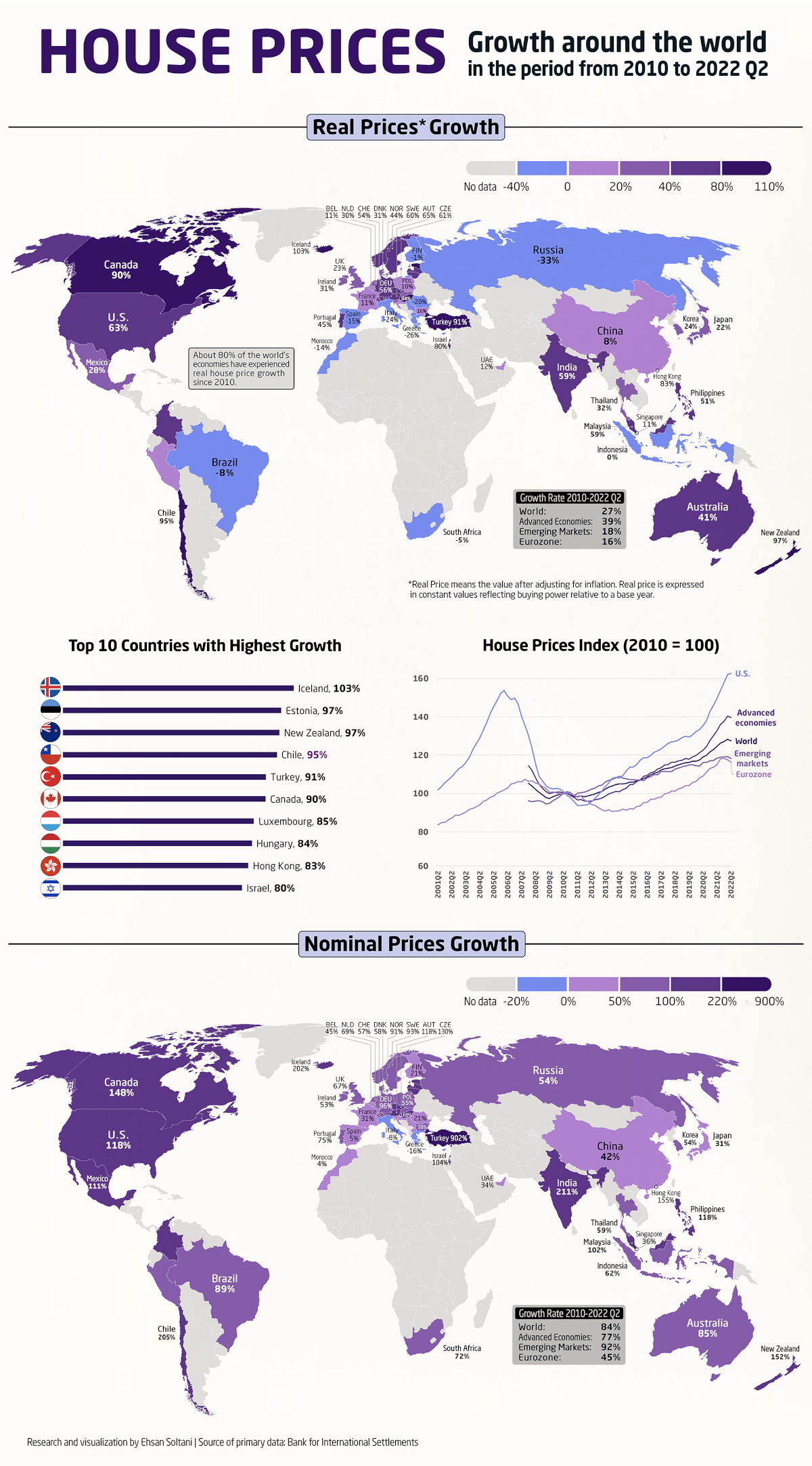
Mapped: How Global Housing Prices Have Changed Since 2010


https://www.visualcapitalist.com/cp/mapped-global-housing-prices-since-2010/
     
     
  #18535  
Old Posted Apr 3, 2023, 12:55 PM
yaletown_fella yaletown_fella is offline
Registered User
 
Join Date: Feb 2009
Location: Toronto
Posts: 3,423
Id like to see municpalities cut development charges and replace them with a vacant/ raw land tax thats exponentially higher.
__________________
Supporter of Bill 23
     
     
  #18536  
Old Posted Apr 3, 2023, 1:19 PM
LightingGuy LightingGuy is offline
Closed account
 
Join Date: Jun 2022
Location: KW
Posts: 728
^^ Not a terrible idea, but vacant/raw land isn't the main problem either. Some parcels of land are vacant for a reason though and no one wants to buy it, eg. if there was a gas station there before and the soil needs to recover. It also represents a very small percentage of the land within most cities.

The problem is that it takes municipalities far too long to approve projects.

The only solution is for higher tier governments to step in and strip many of the powers municipalities have in the reviewing of development permits, a trend which is already underway.

It took 25 years to get into this mess, it will probably take just as long for housing to become affordable again.
     
     
  #18537  
Old Posted Apr 3, 2023, 1:29 PM
suburbanite's Avatar
suburbanite suburbanite is online now
Registered User
 
Join Date: Apr 2011
Location: Toronto & NYC
Posts: 5,647
I'm in favour of a vacant land tax on land that is zoned or even just under a residential land use in the official plan that is not being developed within a prescribed timeframe. I still think it's a bit of a boogeyman at the end of the day though. The reality is there are very few large blocks of land available for greenfield development that are not proceeding through the planning and development process in some way or another.

The tax is only really a motivational tool in rare market circumstances like today, where you have a number of projects that worked through draft plan or site plan approval over the last several years, and then had the market fall out from underneath them as interest rates rose. This is the first time in a decade you've really seen developers sit on shovel-ready projects waiting for more favourable conditions. A tax may help kick them into gear regardless of the deteriorating fundamentals of the project, but long-term over the entire business cycle I don't really see it materially changing the amount of inventory brought to market.
__________________
Discontented suburbanite since 1994
     
     
  #18538  
Old Posted Apr 3, 2023, 1:31 PM
yaletown_fella yaletown_fella is offline
Registered User
 
Join Date: Feb 2009
Location: Toronto
Posts: 3,423
Quote:
Originally Posted by LightingGuy View Post
^^ Not a terrible idea, but vacant/raw land isn't the main problem either. Some parcels of land are vacant for a reason though and no one wants to buy it, eg. if there was a gas station there before and the soil needs to recover. It also represents a very small percentage of the land within most cities.

The problem is that it takes municipalities far too long to approve projects.

The only solution is for higher tier governments to step in and strip many of the powers municipalities have in the reviewing of development permits, a trend which is already underway.

It took 25 years to get into this mess, it will probably take just as long for housing to become affordable again.
Absolutely. There should never be a financial incentive for an individual or compnay to profit by buying and selling raw land or vacant buildings. The fact that it's more expensive or risky to develop than wait and hold is a huge problem. The incentives should be changed so its always a no brainer for corporations to get shovels in the ground regardless of whether we have a negative real rate bubble environment or somehow reach&stay at neutral real rates (rates equal to inflation)
__________________
Supporter of Bill 23
     
     
  #18539  
Old Posted Apr 3, 2023, 1:33 PM
LightingGuy LightingGuy is offline
Closed account
 
Join Date: Jun 2022
Location: KW
Posts: 728
Quote:
Originally Posted by suburbanite View Post
The tax is only really a motivational tool in rare market circumstances like today, where you have a number of projects that worked through draft plan or site plan approval over the last several years, and then had the market fall out from underneath them as interest rates rose. This is the first time in a decade you've really seen developers sit on shovel-ready projects waiting for more favourable conditions. A tax may help kick them into gear regardless of the deteriorating fundamentals of the project, but long-term over the entire business cycle I don't really see it materially changing the amount of inventory brought to market.
This makes sense.
     
     
  #18540  
Old Posted Apr 3, 2023, 2:46 PM
swimmer_spe swimmer_spe is offline
BANNED
 
Join Date: Apr 2014
Posts: 10,743
Quote:
Originally Posted by LightingGuy View Post
^^ Not a terrible idea, but vacant/raw land isn't the main problem either. Some parcels of land are vacant for a reason though and no one wants to buy it, eg. if there was a gas station there before and the soil needs to recover. It also represents a very small percentage of the land within most cities.

The problem is that it takes municipalities far too long to approve projects.

The only solution is for higher tier governments to step in and strip many of the powers municipalities have in the reviewing of development permits, a trend which is already underway.

It took 25 years to get into this mess, it will probably take just as long for housing to become affordable again.
If only those places were vacant there would not be as big of a problem.Here in Sudbury, for example, we have our old hospital that is vacant because the owner stretched themselves too thin. That tax would have seen the property sold and would now be full of residents.

We can get out of this mess in a few years, but the cities need to actually want to fix the problem.
     
     
This discussion thread continues

Use the page links to the lower-right to go to the next page for additional posts
 
 
Closed Thread

Go Back   SkyscraperPage Forum > Regional Sections > Canada
Forum Jump


Forum Jump


All times are GMT. The time now is 12:13 PM.


Powered by vBulletin® Version 3.8.7
Copyright ©2000 - 2026, vBulletin Solutions, Inc.