HomeDiagramsDatabaseMapsForum About
     

Go Back   SkyscraperPage Forum > Regional Sections > United States > Mountain West


Reply

 
Thread Tools Display Modes
     
     
  #13841  
Old Posted Dec 19, 2022, 5:08 PM
laniroj laniroj is offline
[sub]urbanite
 
Join Date: Jun 2015
Posts: 809
Quote:
Originally Posted by TakeFive View Post
...What I don't understand is why people [B]hyper-ventilate over "new sprawl" that is highly efficient including mixed-use walkable, bikeable neighborhoods?...
I would argue the opposite - that the vast majority of people including the important ones, elected public officials who vote on land use, are typically the ones hyperventilating about density! SFH is the lowest common denominator of land use and is seemingly what ALWAYS get approved in local zoning decisions, many times over other more dense uses.
Reply With Quote
     
     
  #13842  
Old Posted Dec 19, 2022, 5:15 PM
laniroj laniroj is offline
[sub]urbanite
 
Join Date: Jun 2015
Posts: 809
Quote:
Originally Posted by twalm View Post
Oh I love being told I am unfamiliar with the area WHERE I LIVE by someone who DOESN'T LIVE HERE.

You have absolutely no idea what you are talking about when it comes WHY suburbs are bad and how they are not sustainable. I literally grew up in the places you describe and I can tell you first hand that they are NOT the places that will be handling the growing population in the coming years. They are still single family homes with:
- giant green yards
- giant roads made for giant cars
- With No access to public transportation
- AND they are increasingly far from where people work

....
You should do a metro tour. MANY of those same places it sounds like where you grew up are actively reforming land use and making something of the UBUNDANT land they have available. It's a good thing. We don't just need a dense City center - we need density everywhere because TakeFive is right, the majority of the workforce doesn't work in the center, they are dispersed through the metro so we need housing, services, offices, healthcare everywhere.

I saw we carve out the area that is 3 miles north and south of C/E-470 and call that our boundary. It will take maybe 30 years to develop that space (assuming this homebuilding recession worsens). That gives one generation of time to 1) let the vast majority of anti-dense NIMBYs die off and 2) accommodate the generational change of thinking that is taking hold (the fires been lit but it's not yet burning). Plus, it takes 10 years to change anything and another 10 years to see that change implement itself.
Reply With Quote
     
     
  #13843  
Old Posted Dec 19, 2022, 5:35 PM
TakeFive's Avatar
TakeFive TakeFive is offline
Registered User
 
Join Date: Jun 2010
Posts: 8,428
Reasonable people can reasonably disagree
Quote:
Originally Posted by twalm View Post
You have absolutely no idea what you are talking about when it comes WHY suburbs are bad and how they are not sustainable.

They are still single family homes with:
- giant green yards
- giant roads made for giant cars
- With No access to public transportation
- AND they are increasingly far from where people work
Most people, let's say 90%, don't accept such arbitrary definitions of what is sustainable.

Green yards don't have to be green - with grass.

Most people don't believe cars are bad by definition. Most people don't feel roads are bad by definition.
--------------------------------

Thanks for this:
Quote:
Originally Posted by laniroj View Post
While what you are saying is absolutely true and much urban and financial research is available on the topic of municipal service cost by asset type, methinks you'd be shocked what most local zoning commission and city council members believe to be true. I won't group them all together, but most every voting member of the body politic believes apartments and trailer parks bankrupt their local coffers and single family homes, office buildings at the end of a bridge to nowhere, and strip center retail fills them up. They rely solely on police department metrics for service calls by address and associated cost allocations for that flawed metric. It's patently absurd and wholly disappointing.
Statistics usually tell an incomplete picture but they're not wrong depending on what conclusions are made.

With respect to police stats and btw the fire department is often the 1st to the scene, they do tell a story. To compensate the City of Phoenix charges a 2.4% transaction tax on all tenant payments to landlord.

There's no question but that homeowners pay the majority of a city's taxes including property taxes which help keep the schools open and parks maintained and sales taxes which pay for road maintenance etc. This especially true in Denver where cities collect a healthy local sales tax along with whatever else voters have approved.
---------------------

Quote:
Originally Posted by twalm View Post
- With No access to public transportation
- AND they are increasingly far from where people work
I'm still a BIG fan of transit but the reality is that since the Pandemic ridership is down significantly.

Where do you assume the jobs are?

Roughly 85% of the jobs are in the suburbs and the East I-70 corridor (including the airport) is a growing economic engine. The jobs may not be sexy but the 'nuts and bolts' people that work those jobs are vital to a functioning metro economy. Plus you'd be surprised how many 'nuts and bolt's' guys and gals make a lot of money. And if they want to live in a single family home that's a short commute from work, it should be their right to do so and it's hardly inefficient.
__________________
Cool... Denver has reached puberty.
Reply With Quote
     
     
  #13844  
Old Posted Dec 19, 2022, 6:03 PM
TakeFive's Avatar
TakeFive TakeFive is offline
Registered User
 
Join Date: Jun 2010
Posts: 8,428
Generally have to agree...
Quote:
Originally Posted by laniroj View Post
I don't wholly disagree with this, but I mainly do based solely upon #units produced in the mixed-use context and those outside of it. The VAST majority of suburban development in the last 20 years has not been mixed use and has far fewer housing options than the period before 2000. The 2010's were much worse than even the 2000's.

The very visible areas like Central Park and Southlands have terrible faux town centers which are basically modern malls, but these areas severely lack the diversity housing options we saw through even the mid 2000's.
South/southeast Aurora added a ton of 'missing middle' style housing in the 1980's. The arterial corridors have lots of attached and multifamily housing nearby.

Southlands kind of sucks. In many respects they've done a better job in the desert with 'lifestyle retail/entertainment centers' being surrounded by multifamily (not that there aren't lots of single family homes also). Central Park where people drive created what would be expected EXCEPT they really could have benefited from one larger retail/entertainment center as a magnet for activity.

After the Great Recession builders quit building entry level homes for reasons previously discussed. The demand driven development was more upscale as a result. But to some extent the densification of the city center has compensated.
__________________
Cool... Denver has reached puberty.
Reply With Quote
     
     
  #13845  
Old Posted Dec 19, 2022, 6:33 PM
TakeFive's Avatar
TakeFive TakeFive is offline
Registered User
 
Join Date: Jun 2010
Posts: 8,428
Change can happen; some change is happening
Quote:
Originally Posted by laniroj View Post
You should do a metro tour. MANY of those same places it sounds like where you grew up are actively reforming land use and making something of the UBUNDANT land they have available. It's a good thing. We don't just need a dense City center - we need density everywhere because TakeFive is right, the majority of the workforce doesn't work in the center, they are dispersed through the metro so we need housing, services, offices, healthcare everywhere.

I saw we carve out the area that is 3 miles north and south of C/E-470 and call that our boundary. It will take maybe 30 years to develop that space (assuming this homebuilding recession worsens). That gives one generation of time to 1) let the vast majority of anti-dense NIMBYs die off and 2) accommodate the generational change of thinking that is taking hold (the fires been lit but it's not yet burning). Plus, it takes 10 years to change anything and another 10 years to see that change implement itself.
Englewood could be Exhibit A for current change. I also read where the Streets of SouthGlenn are now asking for more multifamily since demand for office space in the suburbs is Not Good.

A lot of this will be driven by economics

For example, Aurora had craved for dense 'downtown' development but nobody was interested in building new office space there, etc.

OTOH, Zocalo had a hell of a time getting approval for a new Senior housing project right on Littleton Blvd. You're right that the long-timers threw a hissy fit over the density of a 5-story project. They eventually won approval for a four story.

One obstacle could be that Millennial residents as they grow older become more protective of their neighborhood - but likely not to the same extent that many current elders do.
__________________
Cool... Denver has reached puberty.
Reply With Quote
     
     
  #13846  
Old Posted Dec 19, 2022, 7:25 PM
mhays mhays is offline
Never Dell
 
Join Date: Jul 2001
Posts: 21,214
Quote:
Originally Posted by TakeFive View Post
True Story

I happened to mention our 'urban blog' and that a guy from Seattle was going to show me how make a place more affordable. And he said: "Tell the guy he's doing a lousy job because Seattle and San Francisco have to be two of the worst cities when it comes to affordability"

It's amazing what I can learn on a 5-minute trip.
Do you think Seattle is doing what I said? Can people can only recommend solutions if their own city does everything right?

Seattle isn't doing the key element of my suggestion. Zoned capacity is much too tight. Every municipality has to allow growth but only to a moderate point. The result is very high land costs per unit.

Further, we make mistakes I didn't even get to. Development fees are huge, and processes are lengthy.
Reply With Quote
     
     
  #13847  
Old Posted Dec 19, 2022, 7:54 PM
mr1138 mr1138 is offline
Registered User
 
Join Date: Nov 2004
Posts: 1,166
Quote:
Originally Posted by laniroj View Post
While what you are saying is absolutely true and much urban and financial research is available on the topic of municipal service cost by asset type, methinks you'd be shocked what most local zoning commission and city council members believe to be true. I won't group them all together, but most every voting member of the body politic believes apartments and trailer parks bankrupt their local coffers and single family homes, office buildings at the end of a bridge to nowhere, and strip center retail fills them up. They rely solely on police department metrics for service calls by address and associated cost allocations for that flawed metric. It's patently absurd and wholly disappointing.

Folks believe what they want to and big tech hasn't yet figured out how to scorn them for mis and dis information.

PS: most large homebuilders carry profit margins (during boom times) in the high teens or low 20 percent range. That's WAY higher than most typical large development opportunities. The very few who develop on the front side of an expansion blow these returns out of the water because they build low sell very high, but it's not typical or widespread. An office building or grocery anchored retail center or apartment building would be ecstatic with a 10-12% return. Hotels can do better, but that's really because of the business model, not the real estate so it's not really apples to apples.
What is really mind-blowing is when a city's Comprehensive Plan actually calls for more density than developers are wanting to build. Then the developers come forward with Site Development Plans and PUD zoning (that they and their own consultants wrote) that is actually less dense and not as mixed-use than the Comp Plan is calling for. This makes me suspect the profit margins you mention are the driving factor for new neighborhoods, and cultural resistance to density really becomes a factor only after a community is established. And because most PUDs (and traditional zoning) only allot enough density for the current proposal, there is no room for increased density in the future without going back and asking City Council for more. What's further, many suburbs treat zoning as something that landowners apply for, and not as a tool that the city is willing to use proactively.

What is really ironic is that Council might actually be willing to approve higher-density developments in greenfield locations, because there are fewer established residents there to push back, and cities need the revenue. Once baked though, this zoning becomes incredibly difficult to change. No city council member wants to be perceived as the one voting to "change the neighborhood."

This is why I've always been intruiged by the idea of every rezoning allowing for the "next increment" of density immediately (credit goes to StrongTowns for this idea). What if every new neighborhood actually allowed more density by-right than what the developer thinks is profitable today? Then it wouldn't be such a big fight when the economics are right to begin redeveloping. I don't think there's any way to deny that zoning capacity in pretty much EVERY desireable US city is tighter than market demand.
Reply With Quote
     
     
  #13848  
Old Posted Dec 19, 2022, 8:09 PM
wong21fr's Avatar
wong21fr wong21fr is offline
Reluctant Hobbesian
 
Join Date: Feb 2002
Location: Denver
Posts: 13,123
Quote:
Originally Posted by laniroj View Post
IThe very visible areas like Central Park and Southlands have terrible faux town centers which are basically modern malls, but these areas severely lack the diversity housing options we saw through even the mid 2000's. Cottages, townhomes, small homes, large homes, town homes, apartments, senior living - ALL of these options are in nearly every large area neighborhood built up to the 1980's, most through the 1990's even, but I can only think of maybe two suburban spots where they captured all of this since the yeeeeeeeear 2000 - Central Park and Lone Tree.
Confused at the contradiction here- are you saying that Central Park did build a variety of housing or that it did not?

I don't think that anyone in Central Park considers Northfield to be the faux town center of the neighborhood. It's an open-air mall where moms go for yoga and barre and to do Target runs. Even the southsiders who poo-poo anything north of I-70 because they live in the "real" Central Park.
__________________
"You don't strike, you just go to work everyday and do your job real half-ass. That's the American way!" -Homer Simpson

All of us who are concerned for peace and triumph of reason and justice must be keenly aware how small an influence reason and honest good will exert upon events in the political field. ~Albert Einstein

Reply With Quote
     
     
  #13849  
Old Posted Dec 20, 2022, 7:16 AM
TakeFive's Avatar
TakeFive TakeFive is offline
Registered User
 
Join Date: Jun 2010
Posts: 8,428
For fans of urbanism

Nathaniel Minor/Denverite has an in-depth look at the history of Colorado Blvd from the romantic days of the 1920's and 1930's through all the changes up to today.

I'm aware that stretches of the Blvd have the highest traffic counts in the city.

I had previously campaigned for light rail to run from the the Colorado Station on the south up to the 40th & Colorado Station on the north. But that train has left the station.

Nathan correctly mentions the stretch north of I-25 is the busiest. There's a lot of interaction between Colorado Blvd at Leetsdale and at intersections with Cherry Creek Dr. and Alameda. South of I-25, it's not nearly as busy. North of Leetsdale it's not quite as busy.

mr1138 may enjoy this reference:
Quote:
Transportation planners have long called thoroughfares like Colorado Boulevard “urban arterials” — roads that are designed to move lots of traffic quickly through busy areas. Urban and sustainable transportation advocates now dub them “stroads,” a grotesque combination of a high-speed road and a street packed with homes and businesses.
That description does not accurately apply to Colorado Blvd. For one thing there's way too much traffic to be 'high speed' except after dark perhaps but there's no shortage of traffic lights for controlling speed.

Nathan also adds this flourish:
Quote:
That wide new boulevard attracted development — miles of gas stations, steak houses, strip malls and more — which induced a flood of new cars to the area.
What Nathan somehow, strangely overlooks is that during the 1970's into the 1980's that stretch of Colorado Blvd north of I-25 became the hot new address for office space outside of the Denver Tech Center in the SE. New mid-rise office buildings sprouted mostly along the west side while the east side north of Arkansas Ave in Glendale contained both retail and office buildings.

Point being: Colorado Blvd was an important arterial in accessing all the commercial office space as well as retail between I-25 and Cherry Creek Dr.
__________________
Cool... Denver has reached puberty.
Reply With Quote
     
     
  #13850  
Old Posted Dec 20, 2022, 3:53 PM
i4isoar i4isoar is offline
Registered User
 
Join Date: Jun 2020
Posts: 53
Quote:
Originally Posted by TakeFive View Post
For fans of urbanism

Nathaniel Minor/Denverite has an in-depth look at the history of Colorado Blvd from the romantic days of the 1920's and 1930's through all the changes up to today.
Interesting read, thanks for sharing. On a somewhat related note, someone did an op-ed piece at Colorado Sun about many of the issues that have been discussed over the last few pages.

Some interesting things I learned:
  1. Starting salary for DPS teacher is just barely over $50k. Assuming that most rental properties adhere strictly to the "minimum income = 3x rent" requirement, this means that DPS teachers can't afford most places in Denver.
  2. Only 20 % of the land area of Denver is zoned to allow multi-family units.

After reading the article, I had some thoughts:
  1. What if DPS and other municipal services (police, fire, paramedics, etc.) provided housing for their employees? Cost of providing employee housing could be deducted from salary, but I imagine that the City of Denver, as a large customer, would be in a better bargaining position to negotiate lower rents or other discounts or benefits from landlords (like how the govt. in single-payer healthcare systems can negotiate for lower drug prices, thereby greatly lowering costs for the individual). This would mainly benefit City employees, but I imagine there would be other social benefits for having teachers, police officers, etc. live in the community they serve.
  2. We could probably house more people in just Denver alone if we changed the laws to add just another 20 % of the land area for multi-family. Allowing multi-family dwellings on only a fifth of a major city's surface area seems like an incredibly inefficient use of land to me.

Last edited by i4isoar; Dec 21, 2022 at 3:43 AM.
Reply With Quote
     
     
  #13851  
Old Posted Dec 21, 2022, 6:19 AM
TakeFive's Avatar
TakeFive TakeFive is offline
Registered User
 
Join Date: Jun 2010
Posts: 8,428
Nice Post
Quote:
Originally Posted by i4isoar View Post
On a somewhat related note, someone did an op-ed piece at Colorado Sun about many of the issues that have been discussed over the last few pages.
It's a tough topic. That editorial while well done is basically boilerplate and zoning has been discussed many times here in recent years.

As mentioned above Ken/DenverInfill and others have argued for upzoning to fourplexes to at least create some 'missing middle' housing. Initially I wanted to preserve the 'character' of historical neighborhood homes - but I ultimately realized it wouldn't be a problem. It wouldn't be economical to buy an $800,000 home, sell it for scrap and try to build a fourplex. There's likely some opportunities at the margin though.

laniroj mentioned Englewood. Builders have taken advantage of industrial land that was rezoned and/or there were either misc vacant lots and/or crummy houses. A lot of Englewood isn't necessarily that desirable which has helped to make redevelopment for new modest density viable from reasonable land costs.

Yes, It's a NIMBY problem

I'd guess that outside of Denver, none of the other counties would even dare to bring up a blanket rezoning for fear of a voter backlash. Even in Denver that could be a tough sell to city councilors. But Denver has been doing neighborhood plans and creating overlays in some areas so there's opportunity - but it's a slow slog.

A few shining examples

My favorite would be Belmar by Continuum Partners. They did such a nice job that somebody paid too much for the property and ended up gifting the property back to the lenders. Oh well, at least the project was built.

It was a painfully slow process but Westminster stayed the course and while their New Downtown is not yet a raging success it has been successful and is still going. But it also points out how important location is. This location is not bad but it's not 'hot' either.

The Streets of SouthGlenn was reasonably successful. Unfortunately density was limited but they've recently applied for added multifamily zoning.

With respect to brand new development

it has taken many years but a farm in the heart of Westminster was finally rezoned for homes including lots of missing middle units. It's called Uplands and they may be able to break ground next summer.

__________________
Cool... Denver has reached puberty.
Reply With Quote
     
     
  #13852  
Old Posted Dec 21, 2022, 6:28 PM
TakeFive's Avatar
TakeFive TakeFive is offline
Registered User
 
Join Date: Jun 2010
Posts: 8,428
Making Google Your Friend

City/County of Denver

Learning about neighborhood or area plans

The most recent approved plan was the East Colfax or East Area Plan.

Learn about Design Overlay Zones

The Denver North Star (West Side) has a couple of interesting pieces from their POV on Overlays: One and Two.

Most of what Denver has done or is doing is based off of Blueprint Denver which finally finalized in 2019.
__________________
Cool... Denver has reached puberty.
Reply With Quote
     
     
  #13853  
Old Posted Dec 21, 2022, 11:56 PM
gopokes21 gopokes21 is offline
Registered User
 
Join Date: Jan 2021
Posts: 169
Quote:
Originally Posted by i4isoar View Post
Interesting read, thanks for sharing. On a somewhat related note, someone did an op-ed piece at Colorado Sun about many of the issues that have been discussed over the last few pages.

Some interesting things I learned:
  1. Starting salary for DPS teacher is just barely over $50k. Assuming that most rental properties adhere strictly to the "minimum income = 3x rent" requirement, this means that DPS teachers can't afford most places in Denver.
  2. Only 20 % of the land area of Denver is zoned to allow multi-family units.

After reading the article, I had some thoughts:
  1. What if DPS and other municipal services (police, fire, paramedics, etc.) provided housing for their employees? Cost of providing employee housing could be deducted from salary, but I imagine that the City of Denver, as a large customer, would be in a better bargaining position to negotiate lower rents or other discounts or benefits from landlords (like how the govt. in single-payer healthcare systems can negotiate for lower drug prices, thereby greatly lowering costs for the individual). This would mainly benefit City employees, but I imagine there would be other social benefits for having teachers, police officers, etc. live in the community they serve.
  2. We could probably house more people in just Denver alone if we changed the laws to add just another 20 % of the land area for multi-family. Allowing multi-family dwellings on only a fifth of a major city's surface area seems like an incredibly inefficient use of land to me.
I just have to push back on this a little because this is such a stupid, yet pervasive narrative. That's a $50K salary for someone fresh out of college with ZERO experience, and they're hiring more folks from Metro State or CSU-Pueblo than Ivy League. It's not like there is another profession offering much better. You can be a medical doctor if you want to be a student until you're in your 30s, and even then your pay ramps up gradually.

When I finished my bachelor's at OK State in 2010 I got to do unpaid internships because that was life back then. When I finished my master's at Michigan I briefly earned in the upper 40s (*gasp*) before it got a lot better, and then I worked my tail off through my 20s and into my 30s in order to afford my first home in Denver.

I'll be honest that it makes me a little sick to hear this overwhelming narrative about these poor teachers who can't afford to buy a home right out of college with ZERO experience. The fact is that's anyone with ZERO experience. DPS actually ramps up their pay pretty quickly compared to other professions (such as architecture, to be honest). The avg DPS teacher is making around $80K, while the avg DPS admin is making 6 figures.

None of this is to say we shouldn't have more rental affordable housing stock to allow young professionals to get a foothold and build a life in our city. But give me a break with these intellectually lazy arguments that basically amount to entitlement. And I say that as a fairly reliable progressive voter who actually wants to see DPS do well and our neighborhoods accommodate more people.

Anyway, get ready for the next teacher strike in the new year when the CDC returns to mask guidance and teachers don't want to teach anymore. It's always something. DPS gets everything they ever ask for and not once do they really sound grateful, which annoys me because I've never seen a better-funded school district.
Reply With Quote
     
     
  #13854  
Old Posted Dec 22, 2022, 3:01 AM
DenverInfill's Avatar
DenverInfill DenverInfill is offline
mmmm... infillicious!
 
Join Date: Jan 2004
Location: Lower Highland, Denver
Posts: 3,357
Quote:
Originally Posted by gopokes21 View Post
I'll be honest that it makes me a little sick to hear this overwhelming narrative about these poor teachers who can't afford to buy a home right out of college with ZERO experience. The fact is that's anyone with ZERO experience. DPS actually ramps up their pay pretty quickly compared to other professions (such as architecture, to be honest). The avg DPS teacher is making around $80K, while the avg DPS admin is making 6 figures.

None of this is to say we shouldn't have more rental affordable housing stock to allow young professionals to get a foothold and build a life in our city. But give me a break with these intellectually lazy arguments that basically amount to entitlement. And I say that as a fairly reliable progressive voter who actually wants to see DPS do well and our neighborhoods accommodate more people.

The author didn't say entry-level teachers making $50k aren't able to afford to buy a home in Denver. He said these teachers can't afford to rent most places in Denver.
__________________
~ Ken

DenverInfill Blog
DenverUrbanism
Reply With Quote
     
     
  #13855  
Old Posted Dec 22, 2022, 3:03 PM
mojiferous mojiferous is offline
Landbarge Captain
 
Join Date: Nov 2005
Location: Denver
Posts: 478
Quote:
Originally Posted by gopokes21 View Post
Anyway, get ready for the next teacher strike in the new year when the CDC returns to mask guidance and teachers don't want to teach anymore. It's always something. DPS gets everything they ever ask for and not once do they really sound grateful, which annoys me because I've never seen a better-funded school district.
I think you're confusing DPS with the DPD.

And DPS is way under-funded and understaffed. They only appear better funded because most public school systems in this country have spent the better part of the last 70 years being dismantled and defunded.
__________________
Mojferous Industries
Reply With Quote
     
     
  #13856  
Old Posted Dec 22, 2022, 4:29 PM
laniroj laniroj is offline
[sub]urbanite
 
Join Date: Jun 2015
Posts: 809
Quote:
Originally Posted by mr1138 View Post
...This is why I've always been intruiged by the idea of every rezoning allowing for the "next increment" of density immediately (credit goes to StrongTowns for this idea). What if every new neighborhood actually allowed more density by-right than what the developer thinks is profitable today? Then it wouldn't be such a big fight when the economics are right to begin redeveloping. I don't think there's any way to deny that zoning capacity in pretty much EVERY desirable US city is tighter than market demand.
^^^Next increment zoning is something I've been advocating for a long time. What's sad is that our form based zoning was originally viewed akin to next increment - at least that was the original intent. Then city planners got carried away as they always do and threw a gigaton of regulations on top of that instead of just letting the market get creative. It's not possible to build creative products at scale in today's regulatory environment.

You're right about profit margins - that's what drives everything, the risk reward return, My personal belief is that the Great Recession put out of business a giant number of the smaller local boutique home builders who had the niche market of cottages, townhomes, and small lot SFH. They've just never come back and at the same time, the large homebuilders said screw it, we're not doing that stuff anymore either. As a result, land developers stopped designing those products into their communities...
Reply With Quote
     
     
  #13857  
Old Posted Dec 22, 2022, 5:32 PM
laniroj laniroj is offline
[sub]urbanite
 
Join Date: Jun 2015
Posts: 809
Quote:
Originally Posted by wong21fr View Post
Confused at the contradiction here- are you saying that Central Park did build a variety of housing or that it did not?

I don't think that anyone in Central Park considers Northfield to be the faux town center of the neighborhood. It's an open-air mall where moms go for yoga and barre and to do Target runs. Even the southsiders who poo-poo anything north of I-70 because they live in the "real" Central Park.
I'm moreso talking about mixed use from a housing perspective in Central Park - not northfield. I'm not talking about other "mixed" uses like neighborhood services and such. Central Park has decent multifamily (getting better now) but really has token project or two of other uses - not nearly enough housing diversity - but it's better than most recent suburban developments.

Ps: folks today think mixed use is segregated uses adjacent to each other. There is hardly any vertical mixed use in the suburbs. Very difficult to make that work without real density to support the ground retail in those suburban locations. My take is that mixed use is a bar on a corner or a flower shop mid block with a 10 story senior tower and single family plus townhomes all on the same block!
Reply With Quote
     
     
  #13858  
Old Posted Dec 22, 2022, 7:05 PM
TakeFive's Avatar
TakeFive TakeFive is offline
Registered User
 
Join Date: Jun 2010
Posts: 8,428
Quote:
Originally Posted by gopokes21 View Post
I just have to push back on this a little because this is such a stupid, yet pervasive narrative. That's a $50K salary for someone fresh out of college with ZERO experience...
I had to laugh at myself for being behind the times. It seems it wasn't that long ago that teachers achieved a starting salary of $30,000. Now it's $50,000... Holy Cow!

So a married couple of teachers make easily over a $100,000?

Quote:
Originally Posted by mojiferous View Post
I think you're confusing DPS with the DPD.

And DPS is way under-funded and understaffed. They only appear better funded because most public school systems in this country have spent the better part of the last 70 years being dismantled and defunded.
Denver area teachers make about 50% more than the national average.

Arizona schools/teachers are some of the worst funded yet they also have some of the highest rated schools in the country. Go figure! I guess (more) money doesn't necessarily equal quality?

Arizona follows a 'Southern' or Texas model of focusing on funding Higher Education. Arizona has ramped up their university STEM and engineering schools over the last decade albeit including a lot of private donations. Point Being: a company like TSCM who wants to invest $40 billion notices something like this. Anecdotally, I recently picked up a brand new engineering graduate who just went to work there. TSMC prefers new graduates due their processes being so unique that they'd rather train new graduates as apposed to experienced engineers.

Doing more with less and doing it better is the American Way.
__________________
Cool... Denver has reached puberty.
Reply With Quote
     
     
  #13859  
Old Posted Dec 22, 2022, 7:44 PM
TakeFive's Avatar
TakeFive TakeFive is offline
Registered User
 
Join Date: Jun 2010
Posts: 8,428
It's all in the economics
Quote:
Originally Posted by laniroj View Post
Ps: folks today think mixed use is segregated uses adjacent to each other. There is hardly any vertical mixed use in the suburbs. Very difficult to make that work without real density to support the ground retail in those suburban locations. My take is that mixed use is a bar on a corner or a flower shop mid block with a 10 story senior tower and single family plus townhomes all on the same block!
You've said yourself how much cheaper it is to build in the suburbs; so of course suburban mixed use will be much less dense. Where land is plentiful it only makes good economic sense to build suburban density that is 3 to 5 stories.

Otoh, In Scottsdale where the economics are very different builders (like LMC) buy one/two story office and retail buildings, scrape them and build 5-story apartments near Kierland Commons or Scottsdale Quarter. Tempe is much the same with redevelopment but the market supports (even higher) density in Tempe. In either case people flock to dense, well-done retail areas which are then surrounded by new redevelopment of apartment or condo projects.

For more mundane retail it still makes sense to cluster the retail and add multifamily or missing middle units adjacent to the retail. Lone Tree will have the best mixed use master plan but again it's the economics.
__________________
Cool... Denver has reached puberty.
Reply With Quote
     
     
  #13860  
Old Posted Dec 22, 2022, 9:34 PM
TakeFive's Avatar
TakeFive TakeFive is offline
Registered User
 
Join Date: Jun 2010
Posts: 8,428
We have a December Groundbreaking in Denver

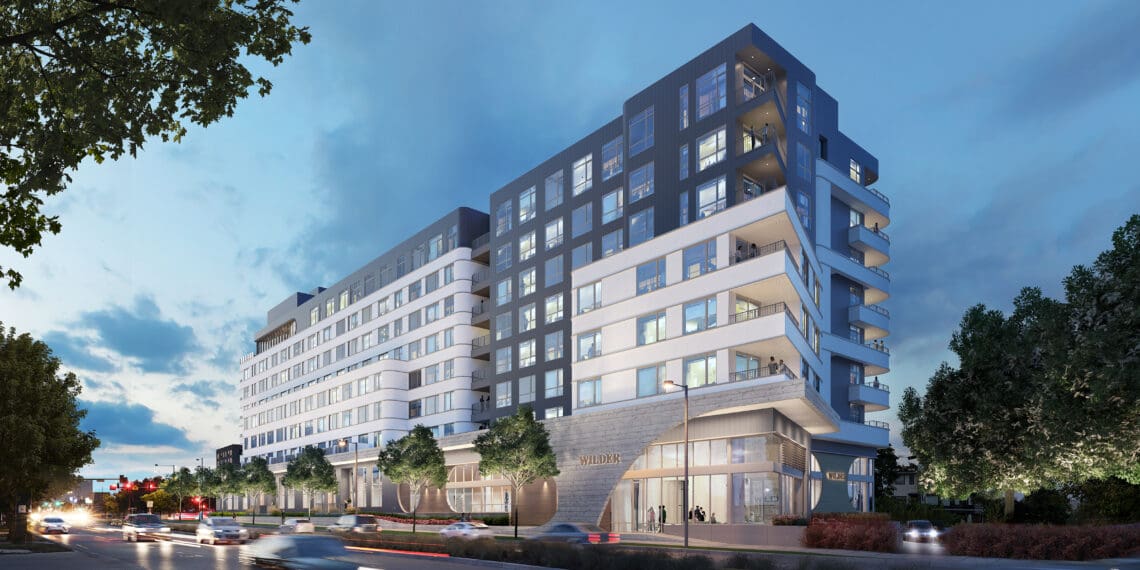
196-Unit Apartment Project Breaks Ground Near Sloan’s Lake
December 21, 2022 - Mile High CRE

Wilder Apartments
1521 Hooker Street


Image courtesy Davis Partnership Architects

Quote:
Cleveland-based real estate developer The Max Collaborative and Denver-based real estate developer and investment firm NAVA Real Estate Development (NAVA) recently broke ground on Wilder, a ground-up 196-unit apartment building at 1521 Hooker Street, located just one mile west of downtown Denver at the edge of the Sloan’s Lake and West Colfax neighborhoods. Saunders Construction is serving as the general contractor.

Completion is slated for late 2024.
__________________
Cool... Denver has reached puberty.
Reply With Quote
     
     
This discussion thread continues

Use the page links to the lower-right to go to the next page for additional posts
 
 
Reply

Go Back   SkyscraperPage Forum > Regional Sections > United States > Mountain West
Forum Jump


Forum Jump


All times are GMT. The time now is 1:52 PM.


Powered by vBulletin® Version 3.8.7
Copyright ©2000 - 2026, vBulletin Solutions, Inc.