A note regarding why infill alone isn't enough to solve the housing crisis, and why it is absolutely necessary to expand our urban boundary in the GTA.
From 2006 to 2021 the GTA's population increased by ~1.375M people - an average of 91,600 people per year.
The Places to Grow Act requires 40% of all development to be infill - basically up until recently municipalities have not been allowed to build more than 60% of new housing units on farmland. If you do the math, that means that (since 2006) 550,000 more people have been expected to find housing somewhere within the existing urban boundaries.
Assuming the infill gets built at a European density level of 5000/sqkm (which is being generous, since this includes the housing and all the supporting businesses/schools/services that they would require, and we don't have the public transit to support this density for that many people), that equals
110 sqkm of land that would've had to be redeveloped over the past 15 years in order for our market to have maintained affordability.
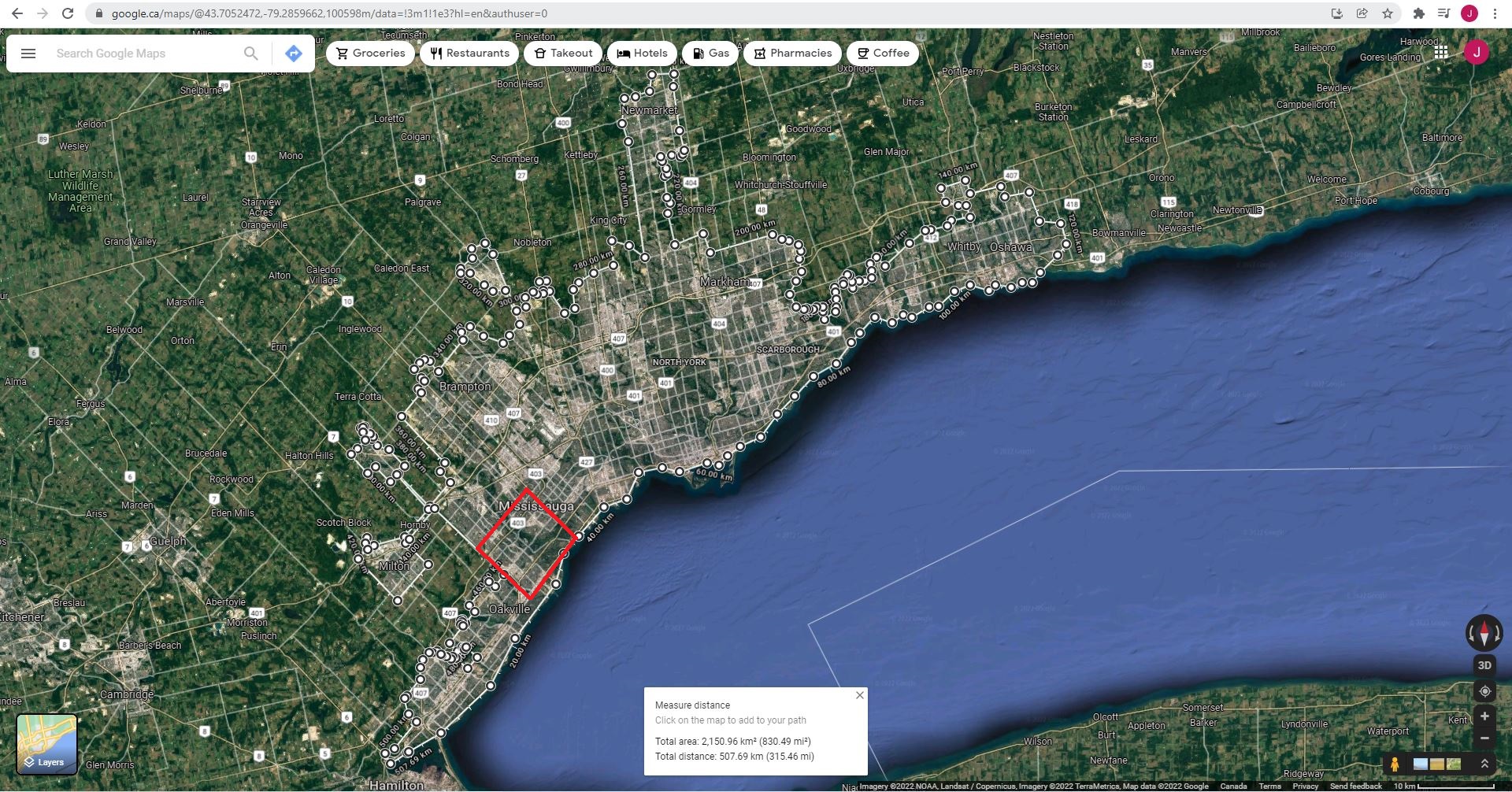
The image below is the approximate current urban boundary of the GTA. (Places to Grow is based on 2006 boundaries, but this is what I have access to). As you can see, the approximate urban boundary of the GTA is
~2150 sqkm. The red square is what 110 sqkm looks like.
110 sqkm = 5.1%
In order for our market to have remained affordable, we would've had to redevelop 5.1% of all existing urban land over the past 15 years.
As a fraction, that is saying that 1 out of every 20 existing urban properties uses would have had to have been redeveloped over the past 15 years.
The problem with this is that you have to actually find land that:
1. Is in a location that people would actually want to live
2. Is in a location that can be rezoned for much higher density housing
3. Have an owner willing to sell you that land
This was doomed to fail from the start. There is no way that we could've redeveloped that much land in only 15 years. I don't know the actual number, but by simply driving around and using your eyes, ask yourself if 1 out of every 20 properties you see has been redeveloped in the past 15 years, within the 2006 urban boundary.
And, since the the Places to Grow Act says that no more than 60% of new housing units can be built on rural land, we're effectively limited to whatever pace infill can happen at. We can't develop more rural land, even if it's in the whitebelt and available, until a certain amount of infill has occurred.
That is why we have a housing shortage in the GTA, and why prices are what they are.





 Prev
Prev


 The renovation was excellent - it's a bit too farmhouse (especially sink and light fixtures, pipe-style shelving supports, etc.), the curtains are too short but, otherwise, it's perfect for my tastes (excluding the traditional furnishings, of course lol). Even the same colour kitchen cabinets as me lol


 Linear Mode
