HomeDiagramsDatabaseMapsForum About
     

Go Back   SkyscraperPage Forum > Regional Sections > Canada > Ontario > Ottawa-Gatineau > Urban, Urban Design & Heritage Issues


Reply

 
Thread Tools Display Modes
     
     
  #741  
Old Posted Nov 2, 2022, 4:07 AM
Uhuniau Uhuniau is offline
Registered User
 
Join Date: Jan 2010
Posts: 9,058
Quote:
Originally Posted by Harley613 View Post
Bye Bye Tabletop! Good Riddance! NIMBY BANANAs are going to lose their collective shit when this city finally starts growing in a way that makes sense fiscally and environmentally....UP!
Saying bye-bye tabletop will not have nearly the same beneficial impact as finally allowing the suburbs to start growing in and up.

The kids have left home. In 1993. They have grandkids of their own. Gloucester and Nepean can handle infill.
__________________
___
Enjoy my taxes, Orleans (and Kanata?).
Reply With Quote
     
     
  #742  
Old Posted Nov 2, 2022, 1:38 PM
waterloowarrior's Avatar
waterloowarrior waterloowarrior is offline
National Capital Region
 
Join Date: Nov 2005
Location: Eastern Ontario
Posts: 9,254
Quote:
Originally Posted by Proof Sheet View Post
Hopefully Tewin is totally off the table. Even if it were to be approved I predict it will be 15 + years before a house is built there that is on full municipal services.
Judging from Steve Clark's comments earlier this year, I think it will be Tewin plus a whole lot more.

https://www.thepublicrecord.ca/2022/03/a...vernment-calls-hamilton-boundary-freeze/

Quote:
“The Official Plans that I’ve seen like Hamilton and Ottawa don’t maximize the housing outcomes for Ontarians and instead prioritize anti-growth and anti-housing ideology,” Clark stated.
Reply With Quote
     
     
  #743  
Old Posted Nov 2, 2022, 1:43 PM
OTSkyline OTSkyline is online now
Registered User
 
Join Date: Jun 2012
Posts: 2,825
The city agrees to intensification and sets out these targets yet keeps making decisions that go against these goals & policies (like rejecting new developments because of style, design, traffic, shadows) and continuously limiting heights (god forbid a project next to LRT should be over 30 stories for a metro of over 1.5 million people)
Reply With Quote
     
     
  #744  
Old Posted Nov 2, 2022, 9:00 PM
rocketphish's Avatar
rocketphish rocketphish is online now
Planet Ottawa and beyond
 
Join Date: Feb 2009
Location: Greater Ottawa
Posts: 14,610
Public hearings for the province's new housing legislation are coming soon—just not to Ottawa
Public consultation on the "More Homes Built Faster" Act closes Nov. 17 after four hearings in the GTA

Taylor Blewett, Ottawa Citizen
Nov 02, 2022 • 16 minutes ago • 3 minute read


The committee of MPPs studying the province’s sweeping and contentious new housing legislation has scheduled four days of public hearings, though without a single date in Ottawa.

Instead, the hearings will take place exclusively around the Greater Toronto Area, before public consultation on the “More Homes Built Faster” Act closes Nov. 17.

That Ottawa isn’t on the committee’s itinerary is “very disappointing” said Orléans Liberal MPP Stephen Blais, the party’s housing and municipal affairs critic. He said his caucus colleagues share his frustration.

“It is a substantial bill that changes the way that cities will be built,” said Blais, in an interview. “I think it’s fundamentally important that they travel the bill and that we have an opportunity in Ottawa to provide our feedback.”

There’s no shortage of reasons to include the nation’s capital, the MPP points out. Ottawa is the province’s second-largest city. Its new mayor has just been granted “strong mayor” powers by the provincial government in the name of getting more housing built. Meanwhile, among housing targets the governing Progressive Conservatives are now setting for Ontario municipalities, Ottawa is supposed to deliver the second-highest number of new homes.

The implications of Bill 23 are far-reaching, from planning to conservation to heritage. A number of its provisions have generated considerable concern, such as plans to reduce the development-related charges cities collect from builders to pay for growth-related infrastructure — with no clear plan to account for the resulting shortfall — and how the bill would limit the work of the province’s 36 conservation authorities.

City councillors, staff, and groups in the community having been racing to unpack the hulking omnibus legislation since its unveiling last week and make their voices heard ahead of its passage. The provincial government has moved it through the first and second reading debate. It’s now in the hands of the standing committee on heritage, infrastructure and cultural policy, before it will return to the House for third reading and a final vote.

Chaired by Laurie Scott, PC MPP for Haliburton—Kawartha Lakes—Brock, the committee has released notice of its plans to hold hearings on Bill 23 in Markham on Nov. 9 and Brampton on Nov. 10. People who want to make an oral presentation to the committee will have to appear in-person.

There will also be two hearing days that allow virtual presentations at Queen’s Park on Nov. 16 and 17.

Holding a committee meeting in Ottawa could allow for locals from a range of backgrounds – elected officials, builders, community groups and beyond – to address the committee directly over the course of the day, said Blais.

“You would have an entire day focused on Ottawa as opposed to, you know, being lucky if we get a couple of people in, competing with everyone else.”

When asked by this newspaper why Ottawa was not included in the scheduled hearings, Scott said “it was a decision of the committee.”

However, Liberal committee member Mary-Margaret McMahon, MPP for Toronto’s Beaches—East York, said that’s not the decision she wanted to see. Beyond just Ottawa, she believes more municipalities should have received hearing dates.

“We need to represent our more rural areas–– Ontario’s a big province,” said McMahon, who noted her particular concern about the bill’s effects on the work of conservation authorities and green building standards introduced by local governments.

Cities across the province are in something of a transition period at present, with outgoing mayors and councillors still in office while new councils elected last month begin their terms on Nov. 15.

The committee’s eight PC, three NDP and one Liberal member will go over the bill, clause-by-clause, and consider any amendments once public consultation has concluded. Blais encouraged people with thoughts they want to share to contact their MPP and provide a written submission to the committee, which is accepting these until 7 p.m. on Nov. 17.

Last week, in response to questions from council’s planning committee, city director of economic development and long-range planning David Wise said city staff had “some very significant concerns” regarding the bill he described as “an absolutely enormous piece of legislation that touches nearly every aspect of functioning of our organization.”

https://ottawacitizen.com/news/local-new...ation-are-coming-soon-just-not-to-ottawa
Reply With Quote
     
     
  #745  
Old Posted Nov 3, 2022, 9:59 PM
Uhuniau Uhuniau is offline
Registered User
 
Join Date: Jan 2010
Posts: 9,058
Quote:
Originally Posted by rocketphish View Post
[B]Public hearings for the province's new housing legislation are coming soon—just not to Ottawa
Secession now.
__________________
___
Enjoy my taxes, Orleans (and Kanata?).
Reply With Quote
     
     
  #746  
Old Posted Nov 4, 2022, 11:42 AM
rocketphish's Avatar
rocketphish rocketphish is online now
Planet Ottawa and beyond
 
Join Date: Feb 2009
Location: Greater Ottawa
Posts: 14,610
Greenspace groups fear housing legislation will gut conservation authorities

Joanne Laucius, Ottawa Citizen
Nov 04, 2022 • 1 hour ago • 5 minute read


What happened to the beaver pond in Kanata North this summer is an example of why Ontario’s conservation authorities matter, says Barbara Ramsay.

Over the course of late spring and into the summer, the area was hit by three major storms — the derecho of May 21, another storm on June 21 and a third that spanned Aug. 6 and 7, said Ramsay, the chair of the Community Associations for Environmental Sustainability (CAFES), a network of community groups and residents.

In the wake of the August storm, the Kanata North beaver pond, which had been modified in the 1980s and forms part of the Kizell drain, flooded to a level never seen before, said Ramsay. The ground, already saturated, couldn’t soak up any more water. There was erosion downstream. One homeowner, who had his rear property line filled with soil in 2020, lost almost all of it.

“We’re getting larger storms more frequently. The land is not able to catch up to deal with stormwater,” said Ramsay. “Ontario has so many ponds, streams and rivers that urban areas have developed. Our natural landscape is important. We have to respect it.”

Bill 23, introduced by the Ontario government last week, announced numerous changes to housing-related legislation in an effort to meet the governing PCs pledge of building 1.5 million homes in 10 years.

That includes changes to conservation authorities. And that has community groups concerned not just for development on the floodplains of Ottawa’s rivers, but also about how Bill 23 will affect development near the creeks, streams and other smaller bodies of water.

The conservation authorities are concerned that the province proposes to prevent municipalities from entering into agreements with them to review planning applications on their behalf.

“It’s about being at the table early in the process, and how development in one area will affect another area. There are costs to making incorrect decisions,” said Angela Coleman, the general manager of Conservation Ontario, which represents Ontario’s 36 conservation authorities.

When downloading these responsibilities to municipalities, there’s also the need to consider how development in one jurisdiction can impact adjacent or downstream municipalities, she said.

As it stands, when a developer application comes forward, the local conservation authority would usually be at the table. In Ottawa’s case, there was a memorandum of understanding going back 22 years. Now, the city would have to do all of that work in-house or hire a consultant, said Coleman.

“That responsibility has moved from 36 conservation authorities to 440 municipalities. Some have the staff to do the work. But others do not,” she said. “It could cause unintended costs and delays.”

Created under the Conservation Authorities Act of Ontario of 1947, conservation authorities are watershed management agencies unique to Ontario. About two per cent of conservation authority budgets across Ontario comes from the province, with the remainder coming from municipalities, donors and user fees, said Coleman.

One of the conservation authorities’ most important responsibilities is flood protection. The Ottawa region has three authorities that oversee the Mississippi, Rideau and Nation River watersheds.

There are examples that conservation authorities are far ahead of municipalities, said Ramsay. For example, the Mississippi Valley Conservation authority, which is responsible for Ottawa’s west end, is mapping 350-year floods. That’s a step ahead of mapping of 100-year floods, and shows that conservation authorities “have been moving the needle forward in the past few years,” she said.

Conservation authorities also own about 147,000 hectares of land across the province, including wetlands, forests, moraines and ecologically sensitive lands, often located in floodplains, which help to prevent flooding and erosion.

“While conservation authorities are known for their work on floodplain control and mitigation, they have grown into a more extensive reach including water quality and supporting wetlands and wildlife habitats,” said Jakob Mueller, chair of the conservation committee of the Ottawa Field Naturalists’ Club.

Watersheds don’t work according to municipal boundaries. Conservation authorities encompass numerous municipalities and see watersheds as a whole. It’s impossible to separate the health of a watershed from the health of an ecological system, said Mueller.

“The system has made it better here. This isn’t the time to take step back in terms of conservation.”

Paul Johanis, chair of the Greenspace Alliance of Canada’s Capital, is concerned that the new legislation means development proponents will be able to ask that portions of larger wetlands be evaluated for development.

“It’s a way of chipping away at provincially-significant wetlands,” he said. “It’s a big concern.”

Alice Irene Whittaker, executive director of Ecology Ottawa, an environmental group that keeps an eye on city council decisions, agrees. Wetlands reduce flooding, process nutrients and provide habitats for species at risk. All of this is interconnected, she said.

“It’s great to be addressing the housing, but we have to look at environmental well-being and human well-being, or we will be paying the price in the future,” she said.

“This could be transformative. It could be an opportunity to address not just housing, but also the environment.”

Under another proposal, conservation authority development fees can be frozen, which concerns Coleman. The fees are based on cost recovery, and no other mechanism has been suggested to ensure that these costs are covered, she said.

“Development has to pay for development,” she said.

There are also fears that the province will tap into conservation lands to build housing.

“We want to make sure that no conservation lands in Ottawa are turned over to housing,” said Johanis.

Coleman thinks this is unlikely. The South Nation Conservation Authority, for example, has over 5,200 hectares of land, she said. Conservation authorities are the second-biggest landowners in the province. They hold titles to these lands, and there are a lot of environmental designations on these lands, some of which were donated.

“There’s a lot that would have to be lined up for this to happen,” she said.

Watchdog groups like the Greenspace Alliance and CAFES have sometimes been disappointed by decisions made by conservation authorities, which have not prevented development on floodplains and sensitive land.

The Rideau Valley Conservation Authority, for example, approved a cut and fill permit, allowing massive amounts of earth to be moved in the floodplain of a bend in the Jock River in south Barrhaven, making way for development, said Johais.

Just last week, the city’s planning committee approved a zoning amendment that would allow for four towers from 24 to 32 storeys tall to be built near Petrie Island in the east end.

“In both cases, fill that they allowed on the floodplains pre-empted the city’s review of development applications on these altered floodplains,” said Johanis.

“The new proposed regulations and processes seem to further restrict the scope of conservation authorities’ purview. So chances are, more of this could, in fact, be in the offing.”

Ramsay fears that Bill 23 is addressing not just the amount of land available for development, but also the speed.

“Bill 23 is about hurry up, hurry up and hurry up faster,” she said. “I don’t know why we have to put four towers on the river’s edge. These spaces will be harder and harder to protect.”

https://ottawacitizen.com/news/local-new...lation-will-gut-conservation-authorities

Reply With Quote
     
     
  #747  
Old Posted Nov 4, 2022, 8:18 PM
Proof Sheet Proof Sheet is offline
Registered User
 
Join Date: May 2009
Posts: 2,985
Ottawa OP coming down the pipe?

https://twitter.com/PlannerSean/status/1588612713860808706

Sean Galbraith a toronto area consultant has been a good source on Bill 23. Friday afternoon data dump?
Reply With Quote
     
     
  #748  
Old Posted Nov 4, 2022, 9:39 PM
Williamoforange's Avatar
Williamoforange Williamoforange is offline
Registered User
 
Join Date: Sep 2020
Location: Ottawa
Posts: 865
Quote:
Originally Posted by Proof Sheet View Post
Ottawa OP coming down the pipe?

https://twitter.com/PlannerSean/status/1588612713860808706

Sean Galbraith a toronto area consultant has been a good source on Bill 23. Friday afternoon data dump?
Two things, 1. I think Ford is going to scrap Tewin and put back staff recomendations because 2. of the same rules that they are applying to possible land swaps on the greenbelt (GTA only).

https://torontosun.com/opinion/columnist...-greenbelt-with-new-land-added-elsewhere

Either way neither the greenbelt nor Ottawa Urban boundary expansion would be required if either Ottawa or Toronto actually allowed enough housing inside of its current borders. Instead we've got/had a city councils that thinks 6 stories on minor corridors is too much height....

In the end council can choose sprawl or infill to meet the real demand.
Reply With Quote
     
     
  #749  
Old Posted Nov 4, 2022, 10:28 PM
waterloowarrior's Avatar
waterloowarrior waterloowarrior is offline
National Capital Region
 
Join Date: Nov 2005
Location: Eastern Ontario
Posts: 9,254
Reply With Quote
     
     
  #750  
Old Posted Nov 4, 2022, 10:34 PM
Proof Sheet Proof Sheet is offline
Registered User
 
Join Date: May 2009
Posts: 2,985
Quote:
Originally Posted by waterloowarrior View Post
Beat me to it. Is Tewin in or out?
Reply With Quote
     
     
  #751  
Old Posted Nov 4, 2022, 10:41 PM
LRTeverywhere LRTeverywhere is offline
Registered User
 
Join Date: Oct 2018
Posts: 326
Quote:
Originally Posted by Proof Sheet View Post
Beat me to it. Is Tewin in or out?
Tewin is in, along with additional urban boundary expansions
Reply With Quote
     
     
  #752  
Old Posted Nov 4, 2022, 10:49 PM
LRTeverywhere LRTeverywhere is offline
Registered User
 
Join Date: Oct 2018
Posts: 326
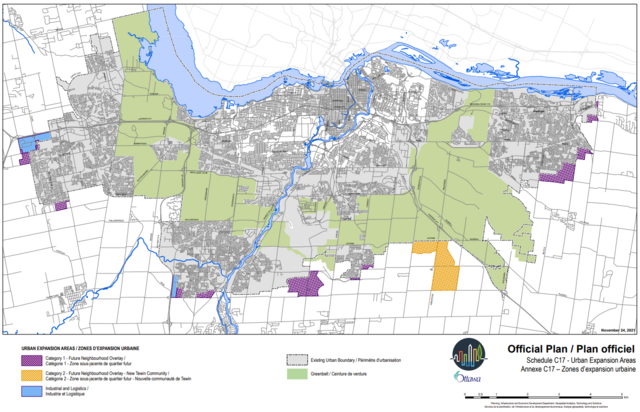
Ottawa submitted boundaries:


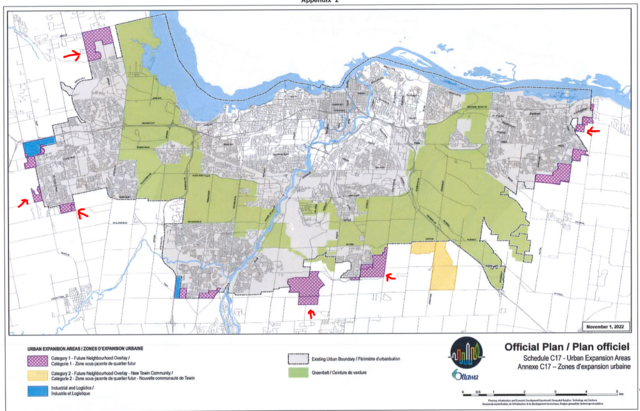
Decision from Province:

Reply With Quote
     
     
  #753  
Old Posted Nov 4, 2022, 10:51 PM
Williamoforange's Avatar
Williamoforange Williamoforange is offline
Registered User
 
Join Date: Sep 2020
Location: Ottawa
Posts: 865
Quote:
Originally Posted by waterloowarrior View Post
Well I was sort of wrong, Tewin was not removed but was bumped with what looks like the original land staff suggested being put forth first and Tewin being a possible future future expansion. (though not sure on that)

Secondly, it looks like Brockingtons last minute change on minor corridors was not only reversed but increased in the core with Minor corridors will allow 9 stories. Roads like Sommerset and booth as examples.
Reply With Quote
     
     
  #754  
Old Posted Nov 5, 2022, 12:59 PM
J.OT13's Avatar
J.OT13 J.OT13 is online now
Moderator
 
Join Date: Mar 2012
Location: Ottawa
Posts: 28,892
Quote:
Originally Posted by LRTeverywhere View Post
Ottawa submitted boundaries:


Decision from Province:

So, more sprawl. Nice. Right on brand for Ford.
Reply With Quote
     
     
  #755  
Old Posted Nov 5, 2022, 1:06 PM
Fading Isle Fading Isle is offline
Registered User
 
Join Date: Aug 2022
Posts: 149
Quote:
Originally Posted by LRTeverywhere View Post
Ottawa submitted boundaries:


Decision from Province:

I wonder who owns all that land and how much they donated to Ford. Just a suspicion given the pattern of cronyism and corruption when it comes to GTA developer pals.
Reply With Quote
     
     
  #756  
Old Posted Nov 5, 2022, 2:24 PM
rocketphish's Avatar
rocketphish rocketphish is online now
Planet Ottawa and beyond
 
Join Date: Feb 2009
Location: Greater Ottawa
Posts: 14,610
Ottawa's new official plan has finally been approved, with the urban boundary pushed further out by the provincial government
Under provincial law, the provincial decision on the official plan is final and can't be appealed, and it's now in effect as modified

Taylor Blewett, Ottawa Citizen
Nov 04, 2022 • 11 hours ago • 3 minute read


The City of Ottawa’s new official plan has been approved by the provincial housing minister — with some major changes imposed.

These include further expansion of Ottawa’s urban boundary in the city’s east, west, and south; higher height provisions for buildings along minor corridors; and the removal of policies intended to protect existing rental housing.

The city’s urban boundary defines the area in which urban development — with major roads, transit and piped sewer and water service — is permitted, and its expansion is a high-stakes decision for developers and landowners.

The new official plan will guide the city’s development through 2046. It was approved by city council in a 21-2 vote more than a year ago and submitted to the province for final sign-off shortly afterwards.

A total of 30 changes were made to the plan before Housing and Municipal Affairs Minister Steve Clark approved it on Friday, with the decision statement noting that measures were taken “to address matters related to the protection of provincial highways, wetland protection, monitoring of affordable housing and increasing housing supply.”

A 175-hectare parcel in the Kanata North-South March area, which was swapped out of the staff-proposed urban boundary expansion by councillors back in 2021 to make room for the controversial Tewin community, has been added back in. Tewin stays, despite some speculation that it would be rejected by the province.

The other new expansion lands are in the areas of Stittsville (31 hectares), Riverside South (106 hectares), Findlay Creek (200 hectares) and North Orleans (37 hectares).

In a statement released Friday, the Greater Ottawa Home Builders’ Association (GOHBA) said the move to expand the urban boundary by an additional 550 hectares and the expansion of height permissions along minor corridors were “necessary and welcome moves to increase Ottawa’s housing supply.”

A 2020 council decision to expand the urban boundary by 1,281 hectares of residential land was a contentious one, so this provincial choice to push it out even further is likely to attract considerable criticism from those concerned about the economic and environmental costs of sprawl.

There is, however, no formal route for critics to do anything about it.

Under provincial law, the minister’s decision on the official plan is final and can’t be appealed, and it’s now in effect as modified.

GOHBA president David Renfroe called the City of Ottawa’s population growth projection of 400,000 people within the 25-year timeline of the new official plan “unrealistically low.” Between closing the gap between the city and province’s population projections through 2046, and a new housing target the province announced for Ottawa (and 28 other municipalities) last week, the additional urban boundary expansion was a “natural outcome,” said Renfroe.

As for more generous height allowances along what are called “minor corridors,” the amended official plan allows for up to nine storeys in the downtown core and six in the inner and outer urban area within the Greenbelt.

Among the other changes penned into the plan by Clark is the erasure of an entire portion devoted to setting conditions on the destruction of rental housing, including space for the city to adopt a framework requiring replacement of such housing when it is taken down, which council has been contemplating and Toronto has had in place for years.

The province is currently consulting on options to “standardize and clarify” municipal powers to regulate rental demolition and conversion, “in order to provide consistency and streamline the construction and revitalization of new housing supply.”

It’s part of a larger package of controversial legislative and regulatory changes, unveiled by the provincial government last week, to address what Clark has described as a “housing supply crisis” in Ontario.

https://ottawacitizen.com/news/local-new...further-out-by-the-provincial-government
Reply With Quote
     
     
  #757  
Old Posted Nov 5, 2022, 3:01 PM
YOWetal YOWetal is offline
Registered User
 
Join Date: Oct 2006
Posts: 7,704
Quote:
Originally Posted by Fading Isle View Post
I wonder who owns all that land and how much they donated to Ford. Just a suspicion given the pattern of cronyism and corruption when it comes to GTA developer pals.
It seems the landowning developers donate to Ford as they know he'll be pro development but the actual added land seems beaucratically determined. Tewin aside.
Reply With Quote
     
     
  #758  
Old Posted Nov 5, 2022, 4:24 PM
Ottawacurious Ottawacurious is offline
Registered User
 
Join Date: Mar 2022
Location: Ottawa
Posts: 565
In quebec, it's quite easy to look up who owns each lot. Is there a similar page/site for Ontario?
Reply With Quote
     
     
  #759  
Old Posted Nov 5, 2022, 5:50 PM
waterloowarrior's Avatar
waterloowarrior waterloowarrior is offline
National Capital Region
 
Join Date: Nov 2005
Location: Eastern Ontario
Posts: 9,254
Quote:
Originally Posted by Ottawacurious View Post
In quebec, it's quite easy to look up who owns each lot. Is there a similar page/site for Ontario?
It cost $30+ a property and you might just get a numbered company. But I think the City did an ownership map at some point during the OP process
Reply With Quote
     
     
  #760  
Old Posted Nov 6, 2022, 5:56 AM
Ottawacurious Ottawacurious is offline
Registered User
 
Join Date: Mar 2022
Location: Ottawa
Posts: 565
Quote:
Originally Posted by waterloowarrior View Post
It cost $30+ a property and you might just get a numbered company. But I think the City did an ownership map at some point during the OP process
It's free in Quebec. Definitely comes in handy!
Here's the one for Val des monts region:
https://carto.mrcdescollinesdeloutaouais.qc.ca/SIG_public_82015/
Link isn't working for me at the moment but usually does.
Reply With Quote
     
     
This discussion thread continues

Use the page links to the lower-right to go to the next page for additional posts
 
 
Reply

Go Back   SkyscraperPage Forum > Regional Sections > Canada > Ontario > Ottawa-Gatineau > Urban, Urban Design & Heritage Issues
Forum Jump


Forum Jump


All times are GMT. The time now is 9:18 PM.


Powered by vBulletin® Version 3.8.7
Copyright ©2000 - 2026, vBulletin Solutions, Inc.