Quote:
Originally Posted by gaviscon

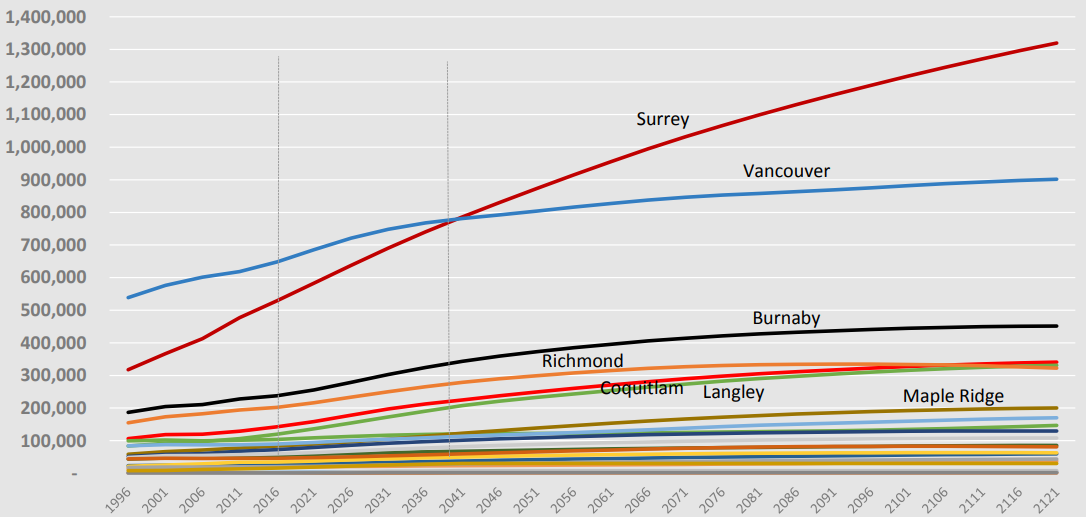
While I'm all for the idea of Vancouver maintaining a dominant presence in the LM, the population growth you mentioned can't really be used to argue that "Burnaby is growing slower than Vancouver" because populous cities will always gain more population in numbers much like a larger snowball adding on more snow than a smaller snowball running downhill. What's more significant is the rate at which Burnaby is growing, and perhaps the change in Burnaby's population growth rate broken down by certain periods of time.
As you said, Burnaby added 103,964 people over the same period, relative to its original population. If you see it that way, a growth of 229,863 should be compared to Vancouver's original population 35 years ago rather than a direct side-by-side comparison to Burnaby, which suddenly makes it seem like Vancouver is the one growing slower than Burnaby.
Once Burnaby adds on an economy and population of scale, we will see its population will begin to grow faster in actual numbers relative to Vancouver.
|
I think growth rates can be very misleading. A huge percentage increase in a tiny population will still only mean there a few more people living there. Just because Dogpatch grew by 50% in five years from 200 people to 300, doesn't mean that now there's going to be enough demand for transit, or a viable Dogpatch General Store. But the City of Granville, with a population of 500,000, growing by only 5% means there are 25,000 more people - so that does mean more transit, and potentially all sorts of new businesses could be viable.
As Burnaby is only slightly smaller (in area) than Vancouver, has been around pretty much for as long as Vancouver, but has less than half the population, and under half the population density, it could be argued that it has greater potential to grow than Vancouver. It certainly ought to be easier without disrupting existing development. As Migrant_Coconut correctly notes - Surrey has easily the highest rate of growth (as they should - they have a much bigger potential development area, even allowing for the ALR areas that are off-limits).
To be clear, I'm not dismissing Burnaby's achievement in continuing to grow, (and their policies to add more rental units is long-overdue, and badly needed) but it's just not true to argue that Burnaby's population growth is greater than that of Vancouver.
If you look at employment, Vancouver is even more successful at attracting growth. The employment data for 2016 showed over 400,000 jobs in Vancouver, and about 125,000 in Burnaby. Vancouver added 50,000 jobs in 10 years, and Burnaby added 10,000. (Surrey added about 40,000 in the same period to reach about 180,000, so it's more successful at adding population than it is employment).





 Prev
Prev






 Linear Mode
