Quote:
Originally Posted by Tesladom

Did Ottawa's CMA boundaries change from 2016?
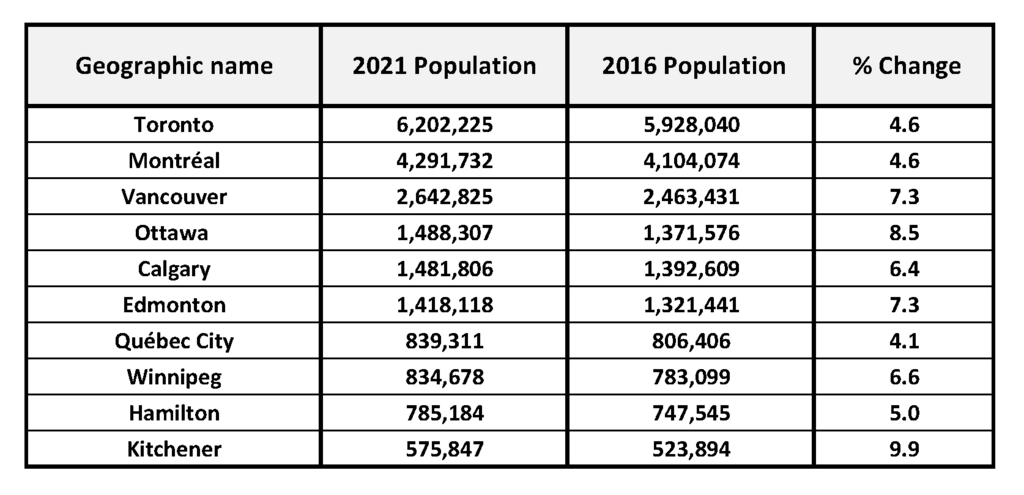
Also The Toronto CMA is not really accurate since there are separate CMA for cities that are linked by continuous urban development adjacent to Toronto's CMA, such as Oshawa or Hamilton. Which CMA do Ajax Whitby or Burlington end up in?
They should have a Super CMA for GTA (ie. Golden Horseshoe) for a more accurate number IMO
|
I think that this definition helps explain why Hamilton and Oshawa are separate CMAs:
"A census metropolitan area (CMA) or a census agglomeration (CA) is formed by one or more adjacent municipalities centred on a population centre (known as the core). A CMA must have a total population of at least 100,000 of which 50,000 or more must live in the core. A CA must have a core population of at least 10,000. To be included in the CMA or CA, other adjacent municipalities must have a high degree of integration with the core, as measured by commuting flows derived from previous census place of work data."
I think that Hamilton in particular is the clear population centre for its area. While eastern Burlington runs together with Toronto suburbs, the degree of integration between Hamilton and Toronto is pretty limited. There is some commuting for sure, but not to the extent that Hamilton is anything close to a suburb of Toronto. Likewise, Burlington is much more closely linked to Hamilton than it is to Toronto, so that's why it is part of the Hamilton CMA.
Oshawa, while smaller, was still a well-defined independent city before the Toronto sprawl made its way that far. And even now, there is a pretty clear break in development around Whitby.
The issue of metropolitan areas running together happens more frequently in the U.S. Certainly Riverside, California is more integrated with L.A. in the traditional sense of a suburb than Hamilton is with Toronto, but it is its own metropolitan area.





 Prev
Prev




 Linear Mode
