Quote:
Originally Posted by Vin

I'm sure back in 1900 if you were to tell a resident living along East Hastings what the future would hold for their neighbourhood, he would probably sneer at you like what Warren_C12 is doing now.
|
Well, there weren't many residents because there were almost no residential buildings until past Dunlevy, and the area you have issues with were all hotels, theatres, and other retail or restaurant businesses.
The very few residents you might find were living across the lane (called Market Alley) from Dupont Street, which today we call East Pender. In 1900 there were three (legal) opium processing plants and a lot of Chinese merchants, some with opium dens and others with illegal gambling rooms in the back.
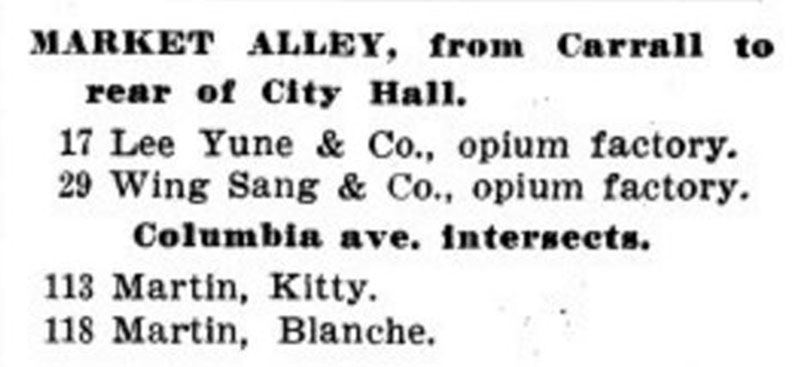
[1905 street directory]
The
100 block of Dupont had a lot of residents, some like Kitty and Blanche Martin on Market Alley. The
1901 census shows they were mostly female, many came from the USA but some were French, Belgian, Dutch, German and Irish. The census clerk initially wrote 'sport' for their occupation, then crossed it out, but many of the owners had prosecutions for owning a house used for prostitution. The police of the day would carry out raids, but were wary of patrolling the area.
Once opium production was made illegal in 1908, it didn't disappear. The Irving Hotel in the
100 block of E Hastings was known as a
source of narcotics in the 1920s. In 1921 the Vancouver's Sun's reporter was able to buy 'dope' openly
A young drug addicted woman introduced Wilson to bandleader LC Fernandez, who then sold Wilson $7 worth of cocaine. The detectives later pinched Fernandez, who still had $2 in marked bills on him and claimed the other five went to “higher-ups.”
It hadn't changed in the 1950s "Police Magistrate Oscar Orr was quoted that “It is just as easy to buy drugs at this hotel as it is for a child to buy candy at a store.”





 Prev
Prev


 Do you see lots of businesses setting up there?









 Linear Mode
