HomeDiagramsDatabaseMapsForum About
     

Go Back   SkyscraperPage Forum > Regional Sections > United States > Mountain West


Reply

 
Thread Tools Display Modes
     
     
  #11421  
Old Posted Oct 9, 2021, 5:28 PM
laniroj laniroj is offline
[sub]urbanite
 
Join Date: Jun 2015
Posts: 809
Quote:
Originally Posted by SirLucasTheGreat View Post
That's a fair point. There seems to also be a balancing act between delivering an infrastructure project of great quality on an elongated timescale vs a lesser quality product in a more abbreviated time scale. For some of RTD's rail, it seems that there might have been an overemphasis on delivering something quick rather delivering something of high quality.
LRT in Denver metro was a compromise. Denver needed the suburbs to pay for it all and the suburbs wanted their train to the Rockies. What we got was a compromise that was spot on for the thinking of the time period. Denver was a drastically different place in the 1990's. In case some of you don't know (not being condescending here) but Downtown Denver in the 1990's was still kind of in a spinning daze from the shit show of the 1980's oil bust - most of LoDo was still full of empty warehouses and office buildings were still running at >30% vacancy. Not many people back then were thinking there was going to be a return to the Center City in 10-15 years. The LRT we voted on was never meant to be a center city system, it was meant to be a system that allowed for growth along existing high capacity transit corridors in the first and second ring suburbs of Denver. The result, while it may not fit what we see as adequate today, is turning out to be exactly what was voted for 2 (and now 3) decades ago.
Reply With Quote
     
     
  #11422  
Old Posted Oct 9, 2021, 7:15 PM
TakeFive's Avatar
TakeFive TakeFive is offline
Registered User
 
Join Date: Jun 2010
Posts: 8,436
Quote:
Originally Posted by laniroj View Post
Not sure what you're insinuating here, but I don't disagree with any of this; I merely point out where our decisions are being sourced from and how negligent data inputs greatly effect our built environment - like, such, as creating "arterial" roads.

I'd love to continue the streets conversation, but I'll keep this to development and just point you to something you should read if you're interested in really understanding how much parking and transportation consume in our cities. Hint, it's drastically more than a stadium civil engineer would even consider reasonable. Simply put, we spend too much time thinking about cars and where they should go when we should be prioritizing housing for people and associated services. It's the village mindset vs the 1980's mall developer.

https://www.bloomberg.com/news/articles/2018-07-24/the-overparked-states-of-america

You'll want to click the link for the "study" in the second sentence. I don't just point to this one "study" because there are a great many of them, but this one gets more into the data science of the issue. Despite what politics and emotions might point to, I'm a big believer in data and facts and think they tell the story better than I ever could...
Partly, I was just trying to yank your chain.

I am thoroughly familiar with Urban propaganda. I really don't care for Donald Shoup's shtick but that has been previously discussed at length on this site so not worth revisiting. Richard Florida is okay; ofc Toronto has 6.7 million people. It was Richard Florida's surveys that indicated people living in urban centers were not nearly as happy as people living outside of city centers or in suburbs or even rural areas.

You may not understand how valuable parking lots are?

Coming out of the Great Recession and after investing along the coasts, developers started looking around for nice places to invest. Consider how many projects in Denver over the last decade were built on vacant-parking lots. BTW, today's parking lots are often yesterday's already assembled land waiting for development.

One Big reason for RiNo's success as bunt points out above was the easy availability of cheap land whether vacant or with low-value industrial etc buildings creating opportunities to assemble larger sites to build on.

Have things changed over time?

Obviously a rhetorical question and while urbanists love to expend lots of energy whining about the past it's a total waste of time to bemoan what happened 30, 50, 70 years ago.

Whether sprawl is good or bad depends on who you ask but the point is that regardless of one's view... in the context of the past it was considered smart development. For Denver, it made entry-level housing very affordable at that time. The beauty of large parking lots is that they're easy to redevelop.

Land used for streets is also invaluable whether for car, truck, bus, bike/ped use, it's a good thing to have all that ROW. That's the reason for Scottsdale being a Gold Level city for biking & pedestrians; they often had the ROW to create a lot of off-street bike paths. Same is true for Chandler a newer tech-driven city where parkways were often sited along arterial roads and included nice wide bike/ped paths. It's a cold, hard fact that when bikes share the road with vehicles (especially commercial vehicles) there will be conflicts; separation saves lives.
__________________
Cool... Denver has reached puberty.
Reply With Quote
     
     
  #11423  
Old Posted Oct 9, 2021, 9:12 PM
Robert.hampton Robert.hampton is offline
Registered User
 
Join Date: Jul 2015
Posts: 491
Quote:
Proposed residential development at the southeast corner of N. Pearl Street and E. 16th Avenue in the Uptown Neighborhood with approximately 165 dwelling units.
Sad news for the all the self storage apologists on here but looks like that project has been replaced by apartments. Guess it’s hard to get a storage shed through review when you have a design overlay.

Across the street looks like bespoke uptown has been sold to AMLI.

Last edited by Robert.hampton; Oct 10, 2021 at 2:43 AM.
Reply With Quote
     
     
  #11424  
Old Posted Oct 10, 2021, 4:06 AM
bunt_q's Avatar
bunt_q bunt_q is offline
Provincial Bumpkin
 
Join Date: Aug 2002
Location: Denver, CO
Posts: 13,203
Quote:
Originally Posted by laniroj View Post
LRT in Denver metro was a compromise. Denver needed the suburbs to pay for it all and the suburbs wanted their train to the Rockies. What we got was a compromise that was spot on for the thinking of the time period. Denver was a drastically different place in the 1990's. In case some of you don't know (not being condescending here) but Downtown Denver in the 1990's was still kind of in a spinning daze from the shit show of the 1980's oil bust - most of LoDo was still full of empty warehouses and office buildings were still running at >30% vacancy. Not many people back then were thinking there was going to be a return to the Center City in 10-15 years. The LRT we voted on was never meant to be a center city system, it was meant to be a system that allowed for growth along existing high capacity transit corridors in the first and second ring suburbs of Denver. The result, while it may not fit what we see as adequate today, is turning out to be exactly what was voted for 2 (and now 3) decades ago.
While it’s true Denver in the 90s was a different place, I think you’re very wrong to say that the system we voted in 2004 was somehow a reflection of
people now realizing downtown would become what it has become. By 2004 downtown had the highest hotel occupancy rates in the metro, office vacancy below 5%, and we were starting to get the big proposals (Hines at 15th and Arapahoe). Sure it was early, but the bleak years were already in the rearview.

Fastracks looks the way it does because of how RTD is structured, nothing more nothing less. If we were planning and voting that system
today I doubt it would look any different. There are limits to how much RTD can focus on Denver proper. That hasn’t changed one bit.
Reply With Quote
     
     
  #11425  
Old Posted Oct 10, 2021, 9:56 PM
TakeFive's Avatar
TakeFive TakeFive is offline
Registered User
 
Join Date: Jun 2010
Posts: 8,436
laniroj comes pretty close...
although I'd agree that downtown had nicely stabilized.

When I think of the period between (say) 1995-2005, metro Denver was largely a suburban story and mindset. One critical key however was that Central Denver was also the center of the metro universe. laniroj hints to this with his "Rockies" reference. But the central city was also the center for cultural arts and primary visitor attractions. The Rockies are emblematic that the city center was also the heart for all professional sports. It was also the place where most of the state government functions were located. Downtown even had the Federal Reserve building and the Denver Mint.

Quote:
Originally Posted by bunt_q View Post
Fastracks looks the way it does because of how RTD is structured, nothing more nothing less. If we were planning and voting that system today I doubt it would look any different. There are limits to how much RTD can focus on Denver proper. That hasn’t changed one bit.
While logical and beneficial it doesn't tell the FasTracks story which is pretty simple. It is fair to say we'll never know what else might have been.

First
there was the live TV coverage of jam-packed trains and overflowing parking lots once the Mineral Station opened. Nobody believed that Highlands Ranch cowboy residents et al would ride a choo choo train into downtown. But live TV coverage doesn't lie.

Second
After Gov Owens was elected he wanted to expand I-25 along the SE Corridor catering to the Tech Center and SE suburban influence. The "environmentalists of the day" wanted light rail; it also seemed like the ideal corridor for rail transit and so the T-REX project was born.

Strange Bedfellows
FasTracks would never have happened w/o the enthusiastic support from conservative areas and their Republican mayors wanting their share of the action - given that the 1st two lines went south and southeast. It was a suburban mindset that demanded to be pleased.

RTD
It's certainly true about RTD's governance and they were conveniently available to serve as the operator but they weren't the the catalyst for FasTracks; RTD just went along for The Ride.

The Metro Mindset
of Republican/conservatives along with liberal environmentalists that wanted to take cars off the road is the reason for the successful FasTracks vote.

Back to the center of the metro universe
along with natural corridors into downtown is why it was totally natural to create a Hub and Spoke system into downtown, the center of government, cultural arts and sports for the whole metro area.

__________________
Cool... Denver has reached puberty.
Reply With Quote
     
     
  #11426  
Old Posted Oct 11, 2021, 2:57 PM
laniroj laniroj is offline
[sub]urbanite
 
Join Date: Jun 2015
Posts: 809
Quote:
Originally Posted by bunt_q View Post
While it’s true Denver in the 90s was a different place, I think you’re very wrong to say that the system we voted in 2004 was somehow a reflection of
people now realizing downtown would become what it has become. By 2004 downtown had the highest hotel occupancy rates in the metro, office vacancy below 5%, and we were starting to get the big proposals (Hines at 15th and Arapahoe). Sure it was early, but the bleak years were already in the rearview.

Fastracks looks the way it does because of how RTD is structured, nothing more nothing less. If we were planning and voting that system
today I doubt it would look any different. There are limits to how much RTD can focus on Denver proper. That hasn’t changed one bit.
Not sure where you're getting your timeline. LRT opened in 1994, 2000, and 2002 (Broadway to DUS and the branch to five points). Those were planned years before their openings and coincided with our lovely Coors Field. Then came T-Rex in 2004 where we voted for the large expansion we enjoy today.

The core of the system, Five Points and DUS to Broadway then Littleton and Lone Tree was absolutely marketed and voted on as a suburban amenity and hope for growth along the lines - it was never proposed to serve the Center City transportation needs, it was meant to move suburbanites and grow TODs in the suburbs. To each their own though, we all see it differently. Totally agreed about the part on how RTD is structured though. It was a predictable result, but that's not terrible because Denver could never have accomplished it alone. Not back then at least.

I'm also not sure where you're taking your office vacancy rate from. I think we maybe hit 5% vacancy for 30 days right before the tech bubble and 9/11. Otherwise, Downtown has never really broken that 10% vacancy benchmark since our friends from canada built dtown in the 1980's...
Reply With Quote
     
     
  #11427  
Old Posted Oct 11, 2021, 4:03 PM
DenvertoLA DenvertoLA is offline
Registered User
 
Join Date: Mar 2014
Posts: 389
Quote:
Originally Posted by SirLucasTheGreat View Post
That's a fair point. There seems to also be a balancing act between delivering an infrastructure project of great quality on an elongated timescale vs a lesser quality product in a more abbreviated time scale. For some of RTD's rail, it seems that there might have been an overemphasis on delivering something quick rather delivering something of high quality. The W line I think would have functioned much better as a commuter rail with 50-60% as many stops making a trip from the Taj to Union station in 30 minutes rather than the 45 minutes I believe that it actually takes. Also, RTD's emphasis on delivering something quickly I think caused much of the rail service to rely on using freight ROW, causing the lines to not serve residential and office corridors as well as it could have.
I think their biggest mistake was the 'park and ride' concept. If your locations require people to drive to them, that's a failure IMO. Why even ride? It's just adding extra steps to someones commute.

The locations of the rail stations should have been right in the center of where people are. Harder to build and more expensive, but convenience is king.
Reply With Quote
     
     
  #11428  
Old Posted Oct 11, 2021, 4:25 PM
seventwentyone seventwentyone is offline
Registered User
 
Join Date: Apr 2021
Posts: 26
Quote:
Originally Posted by laniroj View Post
Not sure where you're getting your timeline. LRT opened in 1994, 2000, and 2002 (Broadway to DUS and the branch to five points). Those were planned years before their openings and coincided with our lovely Coors Field. Then came T-Rex in 2004 where we voted for the large expansion we enjoy today.

The core of the system, Five Points and DUS to Broadway then Littleton and Lone Tree was absolutely marketed and voted on as a suburban amenity and hope for growth along the lines - it was never proposed to serve the Center City transportation needs, it was meant to move suburbanites and grow TODs in the suburbs. To each their own though, we all see it differently. Totally agreed about the part on how RTD is structured though. It was a predictable result, but that's not terrible because Denver could never have accomplished it alone. Not back then at least.

I'm also not sure where you're taking your office vacancy rate from. I think we maybe hit 5% vacancy for 30 days right before the tech bubble and 9/11. Otherwise, Downtown has never really broken that 10% vacancy benchmark since our friends from canada built dtown in the 1980's...

t rex was approved in 1999. FasTracks was 2004
Reply With Quote
     
     
  #11429  
Old Posted Oct 11, 2021, 6:14 PM
jhwk jhwk is offline
Registered User
 
Join Date: Feb 2016
Posts: 101
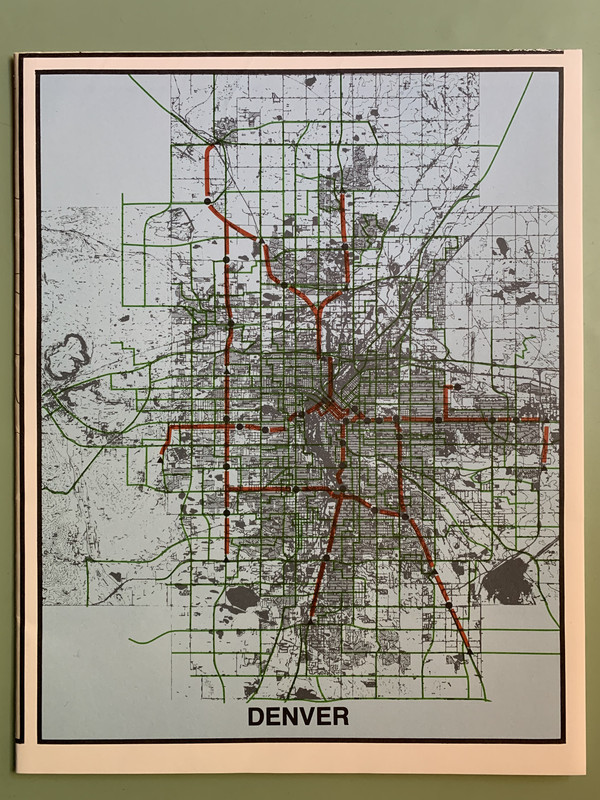
While the LRT was built in chunks with various motivations (i.e, the T-Rex corridor bribe to help with voter approval for highway expansion) the overall design of the rail system we built broadly follows the 1973 proposal:


Source: Photo of map insert in “A Public Transportation Plan for Colorado’s Regional Transportation District Summary Report, March 1973”, public domain.

The 1973 plan, however, has the Colfax and Broadway lines which would have been nice to start with. I believe there were two reasons for the change - this was all planned as an elevated PRT, which is of course a technology that didn’t work at scale. Businesses on Broadway fought against street running LRT when that technology was selected in the late 80’s proposal. Also, Phil Anschutz gave RTD a good deal on the Rio Grande right-of-way and it was a lot easier to build the light rail there than deal with opposition. Anschutz’s Southern Pacific was basically bankrupt and had nothing else to do with the ROW - when UP bought Southern Pacific they stopped cooperating.
Reply With Quote
     
     
  #11430  
Old Posted Oct 11, 2021, 6:14 PM
coolmandan03 coolmandan03 is offline
Registered User
 
Join Date: Nov 2019
Posts: 89
Quote:
Originally Posted by DenvertoLA View Post
I think their biggest mistake was the 'park and ride' concept. If your locations require people to drive to them, that's a failure IMO. Why even ride? It's just adding extra steps to someones commute.

Uh... i drive 6 blocks to take the rail downtown to not fight traffic or pay for parking. I would hate for the rail to be right next to my house...
Reply With Quote
     
     
  #11431  
Old Posted Oct 11, 2021, 6:58 PM
TakeFive's Avatar
TakeFive TakeFive is offline
Registered User
 
Join Date: Jun 2010
Posts: 8,436
To a degree, I disagree
Quote:
Originally Posted by laniroj View Post
Not sure where you're getting your timeline. LRT opened in 1994, 2000, and 2002 (Broadway to DUS and the branch to five points). Those were planned years before their openings and coincided with our lovely Coors Field. Then came T-Rex in 2004 where we voted for the large expansion we enjoy today.
Yes, the 1st sight of light rail opened in 1994, that's correct.

https://www.rtd-denver.com/reports-and-policies/facts-figures/central-corridor-light-rail-line
Quote:
RTD light rail began revenue service on October 7, 1994. RTD’s first light rail line, the Central Corridor, runs from 30th Avenue and Downing through the Five Points Business District and downtown Denver to I-25 & Broadway (along the railroad right-of-way).
SW Corridor
Quote:
Southwest Light Rail Line groundbreaking occurred on January 21, 1997... The Southwest Light Rail Line opened to the public on July 14, 2000...
Project cost for the 8.7 mile line from I-25 & Broadway to Mineral Avenue was only $177.7 million. This line was mostly funded by Federal grants and RTD used their own working capital to pay the small balance not paid by grants.

SE Corridor: The classic Conservative versus Liberal dilemma

Background for transit
Quote:
In 1995, Colorado Department of Transportation (CDOT), Regional Transportation Distrct (RTD) and the Denver Regional Council of Governments (DRCOG) began conducting a Major Investment Study (MIS) in an effort to find the best solution to the ever-growing problem of congestion in the southeast corridor
Conservative Bill Owens was elected Governor in 1998 and in 1999 quickly moved to expand the I-25 southeast corridor. As seventwentyone points out this was voter approved in 1999.

But liberal environmentalists lobbied hard for light rail along the SE Corridor. It didn't matter where these liberals lived ie in Denver versus outside of Denver; the issue was to NOT rely solely on expanding auto-dependent roads; it was important to look to light rail as a partial answer to both congestion and the environment.
__________________
Cool... Denver has reached puberty.
Reply With Quote
     
     
  #11432  
Old Posted Oct 11, 2021, 7:25 PM
TakeFive's Avatar
TakeFive TakeFive is offline
Registered User
 
Join Date: Jun 2010
Posts: 8,436
Great Post; I had forgotten (or never knew) many of this specific background detail
Quote:
Originally Posted by jhwk View Post
While the LRT was built in chunks with various motivations (i.e, the T-Rex corridor bribe to help with voter approval for highway expansion) the overall design of the rail system we built broadly follows the 1973 proposal:

The 1973 plan, however, has the Colfax and Broadway lines which would have been nice to start with. I believe there were two reasons for the change - this was all planned as an elevated PRT, which is of course a technology that didn’t work at scale. Businesses on Broadway fought against street running LRT when that technology was selected in the late 80’s proposal. Also, Phil Anschutz gave RTD a good deal on the Rio Grande right-of-way and it was a lot easier to build the light rail there than deal with opposition. Anschutz’s Southern Pacific was basically bankrupt and had nothing else to do with the ROW - when UP bought Southern Pacific they stopped cooperating.
It's fair to say that by the time the FasTracks vote occurred this was largely a suburban amenity-mindset vote but easily approved by City of Denver voters since all (but one) of the lines came into downtown Denver.

Consider the context

Downtown Denver boomed in the early 1980's prior to the ensuing Oil & Gas bust. I'll assume that by the turn of the century all of the previous see-thru buildings had been leased up.

I'd guess that even through the early 2000's everybody that worked downtown commuted from the suburbs. Eh, a bit of an exaggeration but I'd say outside of a 5-mile radius to downtown (almost) everybody commuted. So why would it be any surprise that since everybody commuted by car that they would like the idea of suburb to city light rail?

DenverInfill has covered infill starting in 2000. Aside from Riverfront Park and a few scattered projects there was scarcely any residential development downtown... but interest in residential development was growing and 2008 'feels' like a pivotal year to me for accelerating residential growth.
__________________
Cool... Denver has reached puberty.
Reply With Quote
     
     
  #11433  
Old Posted Oct 11, 2021, 7:51 PM
TakeFive's Avatar
TakeFive TakeFive is offline
Registered User
 
Join Date: Jun 2010
Posts: 8,436
Quote:
Originally Posted by DenvertoLA View Post
I think their biggest mistake was the 'park and ride' concept. If your locations require people to drive to them, that's a failure IMO. Why even ride? It's just adding extra steps to someones commute.

The locations of the rail stations should have been right in the center of where people are. Harder to build and more expensive, but convenience is king.
This harkens back to 'old school' thinking. There are indeed 'traditionalists' that would argue that outside of Boston, NYC, D.C., Chicago and San Francisco that no other cities 'deserve' to have light rail. Seattle would now be close to qualifying I'd think.

The beauty of Denver's system is density is now planned and happening nearby to a dozen different rail stations. DUS neighborhood is ofc the poster child for this.

Denver didn't, still doesn't have the density for natural rail corridors like those cities but they will create the density over time. Park N Rides can be very successful and in fact the FTA required that FasTracks have Park N Rides and many of them are indeed very successful.

Generally, rail transit should have infrequent stops which is why IMO BRT is a much better choice along East Colfax

The real question now is what will be the post-covid normalized demand?
__________________
Cool... Denver has reached puberty.
Reply With Quote
     
     
  #11434  
Old Posted Oct 12, 2021, 1:01 AM
SirLucasTheGreat SirLucasTheGreat is offline
Registered User
 
Join Date: Nov 2017
Posts: 782
How much of a factor does labor supply play into construction delays? I was driving up 19th Street and thinking of all the massive proposed projects along that corridor (19th and Lawrence, Greyhound, Amacon, etc...). I was wondering whether there are simply enough workers in the area to be pull off projects of that scale simultaneously.
Reply With Quote
     
     
  #11435  
Old Posted Oct 12, 2021, 2:19 AM
SirLucasTheGreat SirLucasTheGreat is offline
Registered User
 
Join Date: Nov 2017
Posts: 782
Also, it looks like the Carmel project at 3900 Brighton has broken ground.
Reply With Quote
     
     
  #11436  
Old Posted Oct 12, 2021, 3:19 PM
Sam Hill's Avatar
Sam Hill Sam Hill is offline
Registered User
 
Join Date: Jun 2012
Location: Denver
Posts: 875
Quote:
Originally Posted by SirLucasTheGreat View Post
How much of a factor does labor supply play into construction delays? I was driving up 19th Street and thinking of all the massive proposed projects along that corridor (19th and Lawrence, Greyhound, Amacon, etc...). I was wondering whether there are simply enough workers in the area to be pull off projects of that scale simultaneously.
I read an article recently about how there are a ton of projects in the pipeline that have yet to break ground due to labor shortages, but unfortunately it didn’t specify which projects. I’d love to know. I also wonder if certain builders have close-knit relationships with certain contractors, so maybe they’re better able to avoid delays?

I really have no idea how the industry works but I’m super curious.

Anyway, the sense I have from the little bit I have read is, no there’s not enough labor for all those big projects simultaneously.

Housing demand is greater than ever but Colorado is building fewer homes than expected. Here’s why.

Last edited by Sam Hill; Oct 12, 2021 at 3:33 PM.
Reply With Quote
     
     
  #11437  
Old Posted Oct 12, 2021, 9:26 PM
TakeFive's Avatar
TakeFive TakeFive is offline
Registered User
 
Join Date: Jun 2010
Posts: 8,436
Once upon a time...

The Way It is
Standing in line, marking time
Waiting for the welfare dime
'Cause they can't buy a job
The man in the silk suit hurries by
As he catches the poor old ladies' eyes
Just for fun he says, "get a job"

(Bruce Hornsby)

My how times have changed.

How many apartment developers are waiting on their order for kitchen appliances to arrive?

LA, Long Beach port congestion could disrupt $90B in trade:
Sept. 9, 2021 By Alejandra Salgado, Associate Editor - Supply Chain Dive

Essentially, there's hundreds of Cargo Ships with thousands of cargo containers sitting off the coast waiting to be unloaded. Not enough labor to unload; not enough labor/drivers to move the containers out of the ports, and so on.

The resurgence of affordable housing in the suburbs
which is needed and so a good thing but these mixed-use more affordable homes are easier/quicker to build and are competing for labor with urban developers.

The Pandemic Pendulum
The overly generous unemployment benefits for too long enabled too many to not have to work and even worse not 'want' to work. While a generalization that doesn't apply to everybody everywhere, certainly in growing areas of the country labor shortages are acute.

No sense of urgency
I suspect that many developers are slow-walking projects waiting for improvement in supply chains as well as for inflation caused by supply chains and labor shortages to improve.

It's a Mexican Conspiracy - (tongue-in-cheek)
It's fascinating how many shows on Netflix have cartel themes as a part of the story. A couple of what I'd call docudramas like El Chapo and Narcos are quite enlightening. Mexico and Columbia do not have addiction problems. Instead addiction problems are exported to the U.S of A. How many could-be worker are out there that instead are strung out on drugs?
__________________
Cool... Denver has reached puberty.
Reply With Quote
     
     
  #11438  
Old Posted Oct 12, 2021, 9:48 PM
laniroj laniroj is offline
[sub]urbanite
 
Join Date: Jun 2015
Posts: 809
Quote:
Originally Posted by Sam Hill View Post
I read an article recently about how there are a ton of projects in the pipeline that have yet to break ground due to labor shortages, but unfortunately it didn’t specify which projects. I’d love to know. I also wonder if certain builders have close-knit relationships with certain contractors, so maybe they’re better able to avoid delays?

I really have no idea how the industry works but I’m super curious.

Anyway, the sense I have from the little bit I have read is, no there’s not enough labor for all those big projects simultaneously.

Housing demand is greater than ever but Colorado is building fewer homes than expected. Here’s why.
I've seen several of these stories lately, including in our morning/evening news (yikes). The position that projects aren't moving forward because of a lack of workers is puzzling because permits and starts are now at a five year high that is significantly beyond our 2010's cycle high and multifamily in particular is basically at an all time high. These data points would suggest there is not a shortage of workers, at least not to the point that it's delaying a meaningful amount of projects from starting. If you look at how quickly permits and starts picked up after August 2020, it's pretty remarkable and all those starts needed workers on them...

https://www.census.gov/construction/nrc/pdf/newresconst.pdf

What's most certain is that pretty much anyone you talk to says they have a labor shortage in the construction biz. If this were multiple choice, I'd fill in every blank.
Reply With Quote
     
     
  #11439  
Old Posted Oct 12, 2021, 10:57 PM
mhays mhays is offline
Never Dell
 
Join Date: Jul 2001
Posts: 21,237
Absolutely, certain developers have relationships with certain general contractors and get served before others. That's for both one-contractor developers (there are many) and others who might keep a few contractors on their preferred list. The first-time and unknown developers get whatever is left, and often pay a construction-terms premium to reflect the added risk and effort.

PS, contractors are often called "builders." Developers don't build things and I wouldn't use that term for them. Even some general contractors differentiate as "true builders" because they have in-house tradespeople that perform key scopes, vs. others who mostly just manage subs.

As for the labor shortage, I'd say a busy construction market does jibe with the idea that labor is limiting things. It wouldn't happen in a slow market.
Reply With Quote
     
     
  #11440  
Old Posted Oct 13, 2021, 2:47 PM
rds70 rds70 is offline
Registered User
 
Join Date: Jul 2001
Location: Denver, CO
Posts: 2,811
The Paradise Land Company site at Speer and Market is back in play.

A new concept plan has been submitted to the City for a 37 story, 139 unit building. Not sure who the developer is this time, as the plan was submitted by the engineer - HKS.

I’m sure more information will be coming in the next few days in the media.
Reply With Quote
     
     
This discussion thread continues

Use the page links to the lower-right to go to the next page for additional posts
 
 
Reply

Go Back   SkyscraperPage Forum > Regional Sections > United States > Mountain West
Forum Jump


Forum Jump


All times are GMT. The time now is 1:05 PM.


Powered by vBulletin® Version 3.8.7
Copyright ©2000 - 2026, vBulletin Solutions, Inc.