HomeDiagramsDatabaseMapsForum About
     

Go Back   SkyscraperPage Forum > Regional Sections > United States > Mountain West


Reply

 
Thread Tools Display Modes
     
     
  #11381  
Old Posted Oct 6, 2021, 1:17 PM
SirLucasTheGreat SirLucasTheGreat is offline
Registered User
 
Join Date: Nov 2017
Posts: 782
It was pretty crazy driving by Brighton blvd and seeing both 2900 and 3100 bulldozed. I love seeing more housing but part of me is skeptical that Brighton blvd is ever going to become a super interesting neighborhood. I mean it doesn't seem like there is much retail outside of the Source and Source Hotel. It also just feels sprawling with a bunch of land barge apartment buildings. I think LoDo and Golden Triangle are much more interesting neighborhoods to walk around in.
Reply With Quote
     
     
  #11382  
Old Posted Oct 6, 2021, 3:12 PM
Ndj Ndj is offline
Registered User
 
Join Date: Dec 2019
Posts: 44
Yeah giant lots don't usually make for an engaging and cohesive neighborhood. Will be interested to see how it ends up.
Reply With Quote
     
     
  #11383  
Old Posted Oct 6, 2021, 4:33 PM
The Dirt The Dirt is offline
Registered User
 
Join Date: Dec 2007
Posts: 3,215
Brighton has as much charm as a wet sock. I get that they were going for an industrial feel when they reconfigured the road, but it feels stark and desolate. It's a place you drive through to get to downtown or to get to the airport from downtown. Perhaps, one day there will be enough mature trees planted and some common sense pedestrian improvements done, but it feels at least 20 years out.
Reply With Quote
     
     
  #11384  
Old Posted Oct 6, 2021, 5:57 PM
SirLucasTheGreat SirLucasTheGreat is offline
Registered User
 
Join Date: Nov 2017
Posts: 782
I think trees might help but you need a lot of them. It feels as ped friendly as Colorado Boulevard. I do like the elevated bicycle tracks though. Those are cool and I wish they extended from Brighton, all the way down Broadway to the I25 and Broadway station
Reply With Quote
     
     
  #11385  
Old Posted Oct 6, 2021, 9:43 PM
laniroj laniroj is offline
[sub]urbanite
 
Join Date: Jun 2015
Posts: 809
Quote:
Originally Posted by SirLucasTheGreat View Post
I think trees might help but you need a lot of them. It feels as ped friendly as Colorado Boulevard. I do like the elevated bicycle tracks though. Those are cool and I wish they extended from Brighton, all the way down Broadway to the I25 and Broadway station
We have the City's all powerful DOTI to thank for this treatment. "Cars rule" is a bumper sticker they have at their front desk (kidding). If the people want nice Cities, they're going to have to eliminate transportation departments because they're probably the most narrow-minded, least creative, biggest obstacle to livable places in Denver and virtually every other municipality. These departments are using iterations of the original highway transportation standards to continue guiding urban development. To say it's disingenuous would be a massive understatement, it's basically criminal neglect.
Reply With Quote
     
     
  #11386  
Old Posted Oct 6, 2021, 10:29 PM
SirLucasTheGreat SirLucasTheGreat is offline
Registered User
 
Join Date: Nov 2017
Posts: 782
I hear you. However, to give DOTI credit, they have added some nice bike lanes downtown during the pandemic along with the bus only lanes. I just wish our bike/microtransit system was better connected and safer because there's a large reservoir of people that would bike if they thought it was safe. In addition, I wish we could really move a lot faster on expanding BRT to Colfax, Broadway, Colorado, University, Speer, and other high traffic corridors. I suppose the market will go where the market will go but it 🞵🞵🞵🞵🞵 that so much development is funneling toward what I think is easily Denver's most sprawling downtown district. I understand that being able to market your new apartment building with an "at RiNo" suffix might be more appealing than a "downtown" suffix if the first option ties you to a trendy neighborhood whereas the latter is associated with crime, drugs, and bodily waste. Nonetheless, RiNo seems to be MASSIVELY in control of much of the new residential units and I am just not as excited about that as I would be in downtown, Golden Triangle, Arapahoe Square, or even River Mile.
Reply With Quote
     
     
  #11387  
Old Posted Oct 6, 2021, 11:17 PM
mr1138 mr1138 is offline
Registered User
 
Join Date: Nov 2004
Posts: 1,166
It was pretty revealing two weeks ago when the local press reported on this quote from interim DOTI director: "Ideally, we'd separate the bike lane and dedicate mobility to just bikes away from traffic... Where it is cost-prohibitive to do that, where we would have to do a property take and reduce our housing inventory to do that, we then look at alternatives."

It is always interesting to me when a complex situation is presented as a false choice such as this. It is kind of shocking to jump to the conclusion that condemning property would be the only way to make space for new bike lanes, even while DOTI simultaneously engages in traffic-calming projects like the removal of an entire travel lane on Santa Fe. This statement seemed especially egregious considering that local pedestrian advocates, organizations like NACTO, and the Vision Zero campaign all point to the benefits of using traffic calming to make streets safer - including something as simple as narrowing travel lanes from 12' down to 10', which could buy an entire bike lane's worth of ROW on a 4-lane road while also reducing the road's design-speed.

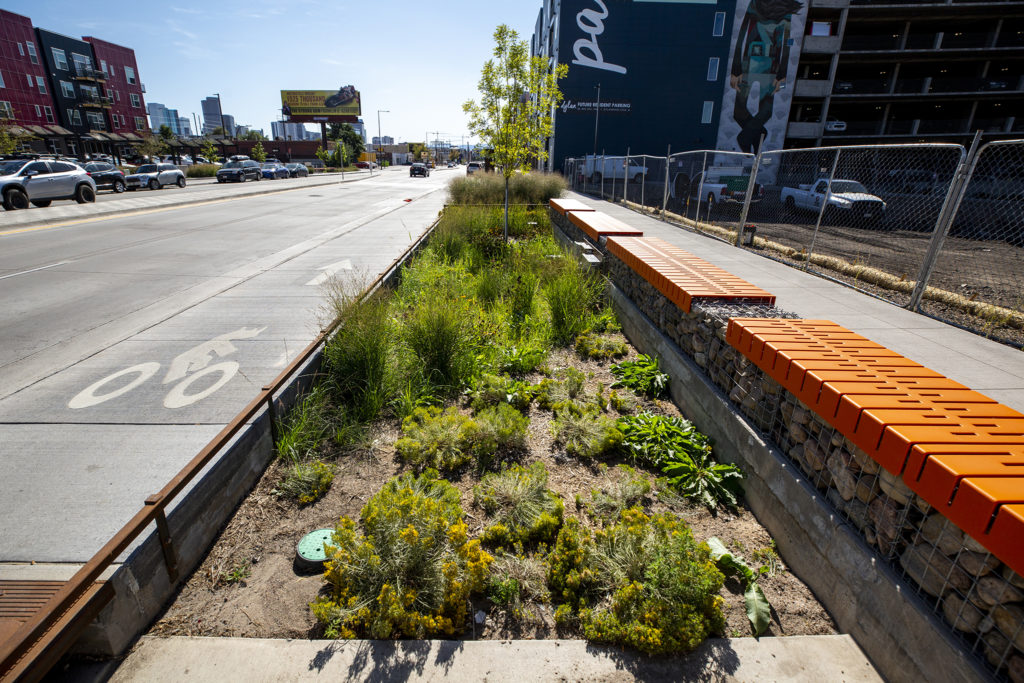
But I have to give credit where it is due - I think Brighton Boulevard turned out pretty well. It is awesome to see permanently-constructed protected bike lanes, rain garden planters, and hundreds of new trees (they are still small saplings, but they are there). That said, the sidewalks are TINY in many places and the city does seem to be relying on redevelopments having larger setbacks to create more generously-sized sidewalks. Travel lanes are also still 11'-12' wide (complete with associated vehicle speeds). And I'm not really a fan of the river-rock-in-chicken-wire aesthetic of the benches they added, but I guess that's part of the whole "industrial look" thing.
Reply With Quote
     
     
  #11388  
Old Posted Oct 7, 2021, 3:07 PM
Sam Hill's Avatar
Sam Hill Sam Hill is offline
Registered User
 
Join Date: Jun 2012
Location: Denver
Posts: 875
Ordinance 301

When I go on my runs I usually run from Pennsylvania to Colorado Blvd and back, taking different streets to get there and back each time. Anyway, I’ve noticed all through Cap Hill, Cheesman Park, and Congress Park, there are pro-301 signs everywhere. They say very little but what little they do say could be compelling to many people: “Green vs Concrete.”

I haven’t noticed any visible trace of support for 302.

I have a bad feeling about this.

If I had a magic wand I’d dump about a hundred thousand housing units in Denver and shift that supply curve off to the right somewhere.
Reply With Quote
     
     
  #11389  
Old Posted Oct 7, 2021, 3:45 PM
laniroj laniroj is offline
[sub]urbanite
 
Join Date: Jun 2015
Posts: 809
Quote:
Originally Posted by mr1138 View Post
Travel lanes are also still 11'-12' wide (complete with associated vehicle speeds).
To put this statement into perspective, when the federal highway standards manual was initially adopted for an 18 foot long and 7 foot wide coupe, a 12' travel lane was deemed necessary. Cars are MUCH smaller than they were 70 yeas ago, but travel lanes are the same size (or larger) on highways. The real issue here is that the same highway standards were used to adopt local road standards.

If there is industrial anywhere nearby, DOTI will insist on oversized 11' travel lanes even if it's an area like RINO where the transition is to residential because they still have to accommodate semi trucks (apparently).

The entirety of Europe generally uses 10.5' travel lanes for highways, except the autoban where there is no speed limit, they use 12'4". Local roads in europe are lucky if they are 6' travel lanes and a giant portion of those roads are shared 8'-10' travel lanes in residential areas (this is also why their vehicles are smaller than ours).

Our transportation cottage industry in this country is probably unbreakable. I see no scenario where this country (or this city) adopts transportation policies that are generally desirable for pedestrians and bikes at a scale that really moves the needle and ultimately creates better livable urban centers. Case in point, do you know how EASY it would be to close public parking on one side of a residential street and put a protected bike lane in it? We could have multi-mobility throughout the City of Denver within the next 3 years if we had leadership willing to take public parking away from private single family home owners. I'm not saying we should do that as the lanes would be woefully underutilized because we're not near dense enough for that yet, but it could be done pretty easily. Outside of downtown (where we ACTUALLY need street parking for retail, vendors, loading/unloading, etc), I'd be shocked if DOTI had the courage to close residential parking lanes of any sort.
Reply With Quote
     
     
  #11390  
Old Posted Oct 7, 2021, 4:06 PM
SirLucasTheGreat SirLucasTheGreat is offline
Registered User
 
Join Date: Nov 2017
Posts: 782
It seems that both residents and store owners will likely object to us getting rid of almost any street parking, which I imagine is a big reason why the Colfax BRT will be in the center lanes.. However, would it be that difficult to add this concept elsewhere in the city? Essentially, finding ways of allowing sidewalks to be used for both bikes and pedestrians. Seems like this could be really useful on Buchtel, Park Avenue, 20th street, and many other places. It also seems relatively cheap when you factor in how much it would increase bike ridership.

Reply With Quote
     
     
  #11391  
Old Posted Oct 7, 2021, 4:18 PM
mr1138 mr1138 is offline
Registered User
 
Join Date: Nov 2004
Posts: 1,166
Quote:
Originally Posted by laniroj View Post
To put this statement into perspective, when the federal highway standards manual was initially adopted for an 18 foot long and 7 foot wide coupe, a 12' travel lane was deemed necessary. Cars are MUCH smaller than they were 70 yeas ago, but travel lanes are the same size (or larger) on highways. The real issue here is that the same highway standards were used to adopt local road standards.

If there is industrial anywhere nearby, DOTI will insist on oversized 11' travel lanes even if it's an area like RINO where the transition is to residential because they still have to accommodate semi trucks (apparently).

The entirety of Europe generally uses 10.5' travel lanes for highways, except the autoban where there is no speed limit, they use 12'4". Local roads in europe are lucky if they are 6' travel lanes and a giant portion of those roads are shared 8'-10' travel lanes in residential areas (this is also why their vehicles are smaller than ours).

Our transportation cottage industry in this country is probably unbreakable. I see no scenario where this country (or this city) adopts transportation policies that are generally desirable for pedestrians and bikes at a scale that really moves the needle and ultimately creates better livable urban centers. Case in point, do you know how EASY it would be to close public parking on one side of a residential street and put a protected bike lane in it? We could have multi-mobility throughout the City of Denver within the next 3 years if we had leadership willing to take public parking away from private single family home owners. I'm not saying we should do that as the lanes would be woefully underutilized because we're not near dense enough for that yet, but it could be done pretty easily. Outside of downtown (where we ACTUALLY need street parking for retail, vendors, loading/unloading, etc), I'd be shocked if DOTI had the courage to close residential parking lanes of any sort.
I have to agree with you on all of this. The lane-width thing is something that I think most people don't ever stop for two seconds to really think about - heck I never even thought to check that vehicle lanes weren't always the same width until I got my first internship in transportation planning. This insistence on 12' travel lanes (on city streets) is something that seems to go completely unexamined and ignores the reality that MANY of our busiest city streets use much narrower lanes. Just doing a quick check using the ruler in Google Earth - it looks like Speer Boulevard uses 8'-9' lanes, Broadway's are about 9' in front of the State Capitol, and I know that Boulder's Broadway has 10' lanes where it passes in front of CU Boulder (used every day by Flatiron Flyer buses and tons of truck traffic)... there are plenty more examples (outside lanes are often a bit wider because of the gutter pan).

A few years ago when Arvada was getting ready to begin the reconstruction of Ralston Road, I posted on local social media that I was concerned about lanes going from 9' to 12'. A couple of the responses I received were to "let engineers do their jobs" and from people saying "my truck would never fit inside a 10' lane" (downright laughable since any vehicle over 8.5' wide requires 'wide load' signage). I think most people, honestly, have no concept of how wide their vehicles or the lanes on the road actually are. And CDOT is even willing, under the right circumstances, to green-light narrower lanes on state highways where they come through an urban area (Boulder is currently planning to reduce lane widths to 10'-11' on SH7/Arapahoe Avenue for future BRT). I personally feel it's ridiculous to continue to design 11'-12' lanes on city streets while simultaneously claiming to have a goal of "vision zero." The effect of lane width on vehicle speed is VERY well understood at this point.

And you're right again about the issue of on-street parking. There are places in Denver where real ROW limitations do exist - for example it would be pretty difficult to figure out how to fit a bike lane on Wazee St. But the VAST majority of streets in the city do not face these kinds of limitations. It shouldn't be so controversial to talk about removing a lane of on-street parking in a residential area to complete a missing bike link. Or that streets like Kalamath, Speer, or Lincoln could all accommodate facilities for different modes and don't necessarily need to have FOUR continuous vehicle lanes in a single direction.
Reply With Quote
     
     
  #11392  
Old Posted Oct 7, 2021, 4:47 PM
mr1138 mr1138 is offline
Registered User
 
Join Date: Nov 2004
Posts: 1,166
Quote:
Originally Posted by SirLucasTheGreat View Post
It seems that both residents and store owners will likely object to us getting rid of almost any street parking, which I imagine is a big reason why the Colfax BRT will be in the center lanes.. However, would it be that difficult to add this concept elsewhere in the city? Essentially, finding ways of allowing sidewalks to be used for both bikes and pedestrians. Seems like this could be really useful on Buchtel, Park Avenue, 20th street, and many other places. It also seems relatively cheap when you factor in how much it would increase bike ridership.
IIRC, Colfax already doesn't have much on-street parking as it is - I think the choice to go center-running has more to do with operational details. But I don't honestly know the full story there. Boulder looked at center-running for Arapahoe but opted for BAT lanes on the outside instead because it is very difficult to allow left-hand turns across a center-running BRT (I will be interested to see if they in fact ban all left-hand turns on Colfax).

And thanks for the visual reference! That picture shows all of the things I described above - rain gardens, new tree saplings, chicken-wire benches, and bike facilities. I do feel compelled to point out that the bike lane is not, in fact, a part of the sidewalk at all but rather a completely separate facility. Lots of places already try the "multi-use path" approach, but I don't feel this ever works as well as separated facilities like on Brighton. I think the main cost associated with this strategy is in rebuilding the curb-and-gutter, which I have learned is INSANELY expensive. Someone once told me that "streets are engineered to move water, not vehicles." I'm not sure it makes sense to narrow the curb-to-curb dimension just to do a bike project. But doing so makes a lot of sense as a component of a larger roadway reconstruction project - especially when one considers how narrower curbs further reduce vehicle speeds.

Meanwhile, in Paris, the city is planning to remove 72% of its on-street parking, and in Amsterdam, they are planning to remove on-street parking from much of the famous "canal zone." Granted those cities are LIGHT YEARS ahead of us in already having alternative modes of travel that can serve the public. But it shows that this conversation is a global one (it is politically controversial there too). And even as we in the US talk about wanting our cities to "be walkable like in Europe," Europe goes on and barrels even further ahead into their own future.

Last edited by mr1138; Oct 7, 2021 at 5:15 PM.
Reply With Quote
     
     
  #11393  
Old Posted Oct 7, 2021, 5:34 PM
SirLucasTheGreat SirLucasTheGreat is offline
Registered User
 
Join Date: Nov 2017
Posts: 782
Sorry I was speculating on the purpose of the center running BRT lanes. You are probably right on that. I am ignorant on the engineering challenges involved with rebuilding the curb and gutter. I think that the principal benefit of the Brighton Blvd model is there being grade separation from vehicle travel. I think DOTI did a survey as part of Denver Moves and found that maybe somewhere around 60% of respondents indicated that they would be interested in biking to work but did not think it was safe. Painted bike lanes and shared streets are better than nothing but I would love to see new bike infrastructure become as physically protected from vehicle traffic as possible. Boulder and Fort Collins are some of the best bike towns in the country. If we had half of their commitment to building a connected system, it could really drive dramatic positive change.

With work from home, the experience of FasTracks, and a relative lack of density, I imagine that we will not likely see much capitally-intensive transit infrastructure but I think we can go a long way with microtransit, BRT, and urban infill.
Reply With Quote
     
     
  #11394  
Old Posted Oct 7, 2021, 5:40 PM
gopokes21 gopokes21 is offline
Registered User
 
Join Date: Jan 2021
Posts: 169
Quote:
Originally Posted by SirLucasTheGreat View Post
It seems that both residents and store owners will likely object to us getting rid of almost any street parking, which I imagine is a big reason why the Colfax BRT will be in the center lanes.. However, would it be that difficult to add this concept elsewhere in the city? Essentially, finding ways of allowing sidewalks to be used for both bikes and pedestrians. Seems like this could be really useful on Buchtel, Park Avenue, 20th street, and many other places. It also seems relatively cheap when you factor in how much it would increase bike ridership.

The 5280 Trail accomplishes much of this. It just needs political support.

I agree, as do probably most Denverites, that we really need to bolster critical linkages in the bike network to get ACROSS downtown.

Quote:
Originally Posted by mr1138 View Post
IIRC, Colfax already doesn't have much on-street parking as it is - I think the choice to go center-running has more to do with operational details. But I don't honestly know the full story there. Boulder looked at center-running for Arapahoe but opted for BAT lanes on the outside instead because it is very difficult to allow left-hand turns across a center-running BRT (I will be interested to see if they in fact ban all left-hand turns on Colfax).

And thanks for the visual reference! That picture shows all of the things I described above - rain gardens, new tree saplings, chicken-wire benches, and bike facilities. I do feel compelled to point out that the bike lane is not, in fact, a part of the sidewalk at all but rather a completely separate facility. Lots of places already try the "multi-use path" approach, but I don't feel this ever works as well as separated facilities like on Brighton. I think the main cost associated with this strategy is in rebuilding the curb-and-gutter, which I have learned is INSANELY expensive. Someone once told me that "streets are engineered to move water, not vehicles." I'm not sure it makes sense to narrow the curb-to-curb dimension just to do a bike project. But doing so makes a lot of sense as a component of a larger roadway reconstruction project - especially when one considers how narrower curbs further reduce vehicle speeds.

Meanwhile, in Paris, the city is planning to remove 72% of its on-street parking, and in Amsterdam, they are planning to remove on-street parking from much of the famous "canal zone." Granted those cities are LIGHT YEARS ahead of us in already having alternative modes of travel that can serve the public. But it shows that this conversation is a global one (it is politically controversial there too). And even as we in the US talk about wanting our cities to "be walkable like in Europe," Europe goes on and barrels even further ahead into their own future.


Not to jumpstart another 10-page debate on subway for Denver, but this is the critical difference between having grade-separated mass transit versus having expensive transit toys stuck in the same traffic as everyone in single-occupancy vehicles. We have so much of the latter already, what's the point of more?
Reply With Quote
     
     
  #11395  
Old Posted Oct 7, 2021, 5:59 PM
SirLucasTheGreat SirLucasTheGreat is offline
Registered User
 
Join Date: Nov 2017
Posts: 782
I would love a subway but I just have next to zero confidence that it is financially feasible. Even if you remove the 1/3 of Denver's land that is the airport, we are still less dense than NYC, SF, Boston, DC, Miami, Chicago, Philadelphia, Seattle, LA, Minneapolis, Oakland, and Baltimore.

I was just in Boston and loved how effective their subway was but unfortunately, they have triple our density and a street system that is significantly less attractive for driving than Denver's. Can you identify any comparable city to Denver that has pulled off a well functioning subway? Again, I would love one and hope that my cynicism is misplaced.
Reply With Quote
     
     
  #11396  
Old Posted Oct 7, 2021, 6:03 PM
mr1138 mr1138 is offline
Registered User
 
Join Date: Nov 2004
Posts: 1,166
Quote:
Originally Posted by SirLucasTheGreat View Post
Sorry I was speculating on the purpose of the center running BRT lanes. You are probably right on that. I am ignorant on the engineering challenges involved with rebuilding the curb and gutter. I think that the principal benefit of the Brighton Blvd model is there being grade separation from vehicle travel. I think DOTI did a survey as part of Denver Moves and found that maybe somewhere around 60% of respondents indicated that they would be interested in biking to work but did not think it was safe. Painted bike lanes and shared streets are better than nothing but I would love to see new bike infrastructure become as physically protected from vehicle traffic as possible. Boulder and Fort Collins are some of the best bike towns in the country. If we had half of their commitment to building a connected system, it could really drive dramatic positive change.

With work from home, the experience of FasTracks, and a relative lack of density, I imagine that we will not likely see much capitally-intensive transit infrastructure but I think we can go a long way with microtransit, BRT, and urban infill.
No need to be sorry! These things can be... opaque, but probably for good reason - the city has no reason to air its dirty laundry about conflicts with individual business owners about on-street parking removal. I think Colfax has some on-street parking that may need to be removed, but I don't recall any of the press releases specifically mentioning this. Broadway still has on-street parking next to its side-running bus lane, so those things aren't mutually exclusive.

I'm completely with you on separated bike facilities. They feel leaps and bounds safer than on-street or shared facilities (anyone who has ever visited and biked in The Netherlands instantly recognizes this reality). Streets can be engineered to effectively drain water whether the roadway is 180' wide or 80' wide, but curbs and grading are just very expensive to reconstruct. From my observation, even the most bike-progressive cities out there don't spend that kind of money just to get the bike lane off the street. I tend to be more of a pedestrian advocate than a "bicycle person," so I'm mostly attracted to the vehicle-speed reducing effect of narrower lanes and narrower curbs. But doing so kind of has to be done when the entire street is being reconstructed for other reasons (like the recent Brighton rebuild).

I grew up in Boulder, and it's true that it is a great place to bike, but Boulder still experiences the same challenges as Denver when it comes to building separated bike lanes and usually opts to do paint-and-bollards unless it is time for a major roadway reconstruction project. Boulder's bike-friendliness seems to stem from its many creek-path greenways, but these all run generally East-West while North-South bike travel in the city usually involves riding along a busy street that may or may not even have a multi-use path. There are plans for separated bike facilities along Folsom, 30th Street, Arapahoe, Canyon, and elsewhere that may all have to wait decades until roadway reconstruction projects allow for implementation. A notable exception to this is the fantastic Broadway Bikeway alongside CU, which was actually constructed by CDOT in the 1970s and later improved during a 1990s reconstruction of the street. I should add (since I am proud to have helped with the design) that the city just wrapped up construction on a partial "protected intersection" (Dutch style) at Colorado and Regent on the CU Campus - I actually think it might be the first example of one in Colorado. A full, four-way "protected intersection" is now also under construction at 30th and Colorado.

Quote:
Originally Posted by gopokes21 View Post
Not to jumpstart another 10-page debate on subway for Denver, but this is the critical difference between having grade-separated mass transit versus having expensive transit toys stuck in the same traffic as everyone in single-occupancy vehicles. We have so much of the latter already, what's the point of more?
Isn't there still middle ground between these two options though? Colfax BRT is a fantastic example. Getting mass transit out of traffic and into its own dedicated space doesn't have to mean going underground. I could easily imagine a Speer Boulevard light rail between Downtown and Cherry Creek if the city had the courage to reduce it from being an 8-lane highway to simply a 6-lane highway.

Last edited by mr1138; Oct 7, 2021 at 9:38 PM.
Reply With Quote
     
     
  #11397  
Old Posted Oct 7, 2021, 8:02 PM
Agent Orange Agent Orange is offline
Registered User
 
Join Date: Sep 2004
Location: Denver, CO
Posts: 1,821
Quote:
Originally Posted by SirLucasTheGreat View Post
Can you identify any comparable city to Denver that has pulled off a well functioning subway? Again, I would love one and hope that my cynicism is misplaced.
Edmonton built a subway for its LRT through downtown in the 1970s when the metro area had less than 650k people. I doubt Edmonton then, today being half the size of Denver, was denser than we are now. Of course, costs have risen substantially since then.

Another example is Vancouver. Their metro area is 2.7m to Denver's 3.0m. They've had a subway since 1986. They definitely have a higher weighted density than Denver and they have significant land constraints we don't have, however when they built the Skytrain I don't think most of the city was considerably urban and dense outside of their downtown peninsula. Most of the high rise clusters outside of downtown in the Vancouver region have sprouted up since the opening and expansion of the Skytrain. And outside of a few areas, the region is largely SFHs with very dense TODs, something we could do in Colorado if we wanted to.

There are also lots of examples in Europe of course, harder to compare to North America. Then there's Australian cities which, while they tend to have much stronger and healthier cores, aren't exactly leaps denser than American metros. Yet both Sydney and Melbourne are building true subways currently (having existing highly frequent commuter rail infrastructure already, and tons of streetcars in Melbourne's case). Yeah, Sydney and Melbourne are both 60% larger than Denver MSA, but they're not exactly Tokyo.
Reply With Quote
     
     
  #11398  
Old Posted Oct 7, 2021, 9:04 PM
mhays mhays is online now
Never Dell
 
Join Date: Jul 2001
Posts: 21,248
Vancouver has never had freeways within city limits aside from one tiny edge. That's been a huge impetus to both transit use, transit investment, and of course downtown housing.
Reply With Quote
     
     
  #11399  
Old Posted Oct 7, 2021, 9:13 PM
bunt_q's Avatar
bunt_q bunt_q is offline
Provincial Bumpkin
 
Join Date: Aug 2002
Location: Denver, CO
Posts: 13,203
Quote:
Originally Posted by Agent Orange View Post
Edmonton built a subway for its LRT through downtown in the 1970s when the metro area had less than 650k people. I doubt Edmonton then, today being half the size of Denver, was denser than we are now. Of course, costs have risen substantially since then.

Another example is Vancouver. Their metro area is 2.7m to Denver's 3.0m. They've had a subway since 1986. They definitely have a higher weighted density than Denver and they have significant land constraints we don't have, however when they built the Skytrain I don't think most of the city was considerably urban and dense outside of their downtown peninsula. Most of the high rise clusters outside of downtown in the Vancouver region have sprouted up since the opening and expansion of the Skytrain. And outside of a few areas, the region is largely SFHs with very dense TODs, something we could do in Colorado if we wanted to.

There are also lots of examples in Europe of course, harder to compare to North America. Then there's Australian cities which, while they tend to have much stronger and healthier cores, aren't exactly leaps denser than American metros. Yet both Sydney and Melbourne are building true subways currently (having existing highly frequent commuter rail infrastructure already, and tons of streetcars in Melbourne's case). Yeah, Sydney and Melbourne are both 60% larger than Denver MSA, but they're not exactly Tokyo.
The difference is in terms of dollars. The transit we build isn't good enough - it doesn't go where it needs to, and isn't fast enough - to do what transit does in those cities. Grade separated transit isn't even on the radar here, let alone enough of it to move the needle.

Are there any U.S. cities that have tried to build real high-quality transit, analogous to those non-U.S. cities recent times? The answer is - very, very few. Honolulu is a great example - one line, $9 billion, but it is one line that would actually go where it should, entirely grade separated, truly competitive. And it has been a disaster... and is struggling to find funding for the last segment. There's a real chance it is never completed, and they will have spent $5 billion on a train from nowhere to nowhere.

It's really hard to build multi-billion infrastructure in this country. Really hard. (Without the 1950s and 60s investment in roads, we actually wouldn't have the ability to build new roads either - it's just much easier to expand than it is to create from scratch, and roads got a head start in most U.S. cities.) And it's really hard to have transit that is worth a 🞵🞵🞵🞵 without spending billions.

So, it's not really fair to say "we could do this in Colorado if we really wanted to." No, we actually couldn't. We would need massive federal investment, which doesn't exist (even with the infrastructure bill). CDOT's and RTD's combined annual budgets are barely $2.5 billion, and there's a lot of existing stuff to continue to operate and maintain. We could never build REAL transit without a national commitment, nobody can. Look at LA, look at NYC, nobody is build new capital projects that are comparable to what we see in other countries. If they were, I'd be a lot busier than I am at the moment!

Reply With Quote
     
     
  #11400  
Old Posted Oct 7, 2021, 9:15 PM
bunt_q's Avatar
bunt_q bunt_q is offline
Provincial Bumpkin
 
Join Date: Aug 2002
Location: Denver, CO
Posts: 13,203
Quote:
Originally Posted by mr1138 View Post
Isn't there still middle ground between these two options though? Colfax BRT is a fantastic example. Getting mass transit out of traffic and into its own dedicated space doesn't have to mean going underground. I could easily imagine a Speer Boulevard light rail between Downtown and Cherry Creek if the city had the courage to reduce it from being an 8-lane highway to simply a 6-lane highway.
I agree this is the answer. I am not sure it moves a material number of people out of cars, though, unless we do a LOT of BRT. But I agree BRT is the only viable answer in the U.S.
Reply With Quote
     
     
This discussion thread continues

Use the page links to the lower-right to go to the next page for additional posts
 
 
Reply

Go Back   SkyscraperPage Forum > Regional Sections > United States > Mountain West
Forum Jump


Forum Jump


All times are GMT. The time now is 11:38 PM.


Powered by vBulletin® Version 3.8.7
Copyright ©2000 - 2026, vBulletin Solutions, Inc.