HomeDiagramsDatabaseMapsForum About
     

Go Back   SkyscraperPage Forum > Discussion Forums > City Discussions


Reply

 
Thread Tools Display Modes
     
     
  #101  
Old Posted Aug 24, 2021, 11:31 PM
ChiSoxRox's Avatar
ChiSoxRox ChiSoxRox is offline
Registered User
 
Join Date: Mar 2007
Location: Boston, MA
Posts: 2,509
Quote:
Originally Posted by yuriandrade View Post
I have San Francisco done. Massive work as census tracts don't match perfectly with neighbourhoods and there are some overlaps (North Beach/Telegraph Hill).

I put together Financial District and Embarcadero as it was impossible to split them, Chinatown, North Beach, Russian Hill, Nob Hill, Tenderloin, Civic Center, Rincon Hill/South Beach and South of Market.

Pretty much the entire northeast quarter of the city. And I called "Downtown" everything minus North Beach and Russian Hill.
I'm looking forward to San Francisco, especially if it's the highest density for any downtown you're tracking.
__________________
Like the pre-war masonry skyscrapers? Then check out my list of the tallest buildings in 1950.
Reply With Quote
     
     
  #102  
Old Posted Aug 24, 2021, 11:45 PM
Yuri's Avatar
Yuri Yuri is online now
Registered User
 
Join Date: Sep 2008
Posts: 5,594
Quote:
Originally Posted by ChiSoxRox View Post
I'm looking forward to San Francisco, especially if it's the highest density for any downtown you're tracking.
ChiSox, I'll leave this superb work tracking densities for you.

I don't want to open this can of worms trying to come up with a coherent definition for completely different metro areas.

I was just curious about how was the Financial District really. But then, a census tract doesn't match exactly, a bit of Chinatown here, some parts out together with the Embarcadero, and one thing led to another, and when I saw I was at Wikipedia reading articles after articles on SF districts and adding them up to my table.

My approach on San Francisco is similar to New York or Chicago: cities that have a great urban fabric for ages, and the story here is how their tiny Financial Districts suddenly became residential, and as such, they have their place in ths thread.

But anyway, the highest density goes to Tenderloin. Census tracts matched rather good there and we have 29,638 people living in 0.697 km² for an astounding density of 42,500 inh./km² (multiply for 2.59 for miles).

And then Chinatown boxed up between Financial District, Telegraph Hill, Russian Hill and Nob Hill. Census tracts didn't match perfectly, but it works: 10,821 people, 0.299 km², 26,200 inh./km².

I'll make the San Francisco post soon.
__________________
London - São Paulo - Rio de Janeiro - Londrina - Frankfurt
Reply With Quote
     
     
  #103  
Old Posted Aug 24, 2021, 11:50 PM
Yuri's Avatar
Yuri Yuri is online now
Registered User
 
Join Date: Sep 2008
Posts: 5,594
Downtown Denver


---------------------------------- 2020 ------ 2010 ------ 2000 ------ 1990 ------ Growth ------ Density

Downtown ---------------------- 15,198 ------- 7,998 ------ 4,181 ------ 2,795 ---- 90.0% ---- 91.3% --- 49.6% ------- 2.3 km² --- 6,736.7 inh./km²

Central Denver ----------------- 74,256 ----- 49,710 ----- 38,836 ----- 33,612 ---- 49.4% ---- 28.0% --- 15.5% ------ 15.4 km² --- 4,872.1 inh./km²

Denver CSA ---------------- 3,623,560 -- 3,090,874 -- 2,610,343 -- 2,008,684 ---- 17.2% ---- 18.4% --- 30.0% -- 33,815 km²


Not so much here in SSP, but one of the most hyped cities around. I worked with two definitions here, one more strict (Union Station + CBD), that serves better the purpose of this thread, and a broader one (CBD, Union Station, Auraria, Lincoln Park, Civic Center, Capitol Hill, North Capitol Hill and Five Points. As census tracts match perfectly with the official neighbourhoods, we have pretty exact figures.

Downtown (CBD + Union) is growing at insane rates, following the national trend. I imagine there are lots of infill going on, maybe parking lots turned into highrises, etc.

For the broader area, we have some traditional residential districts (Capitol Hill, N. Capital Hill) where density was already high from the beginning, so growth doesn't seem that spectacular. On the other hand, Five Points (according to Google and Wikipedia it's "the coolest district"), growth is like fire, specially on the census tract where the railyards are. This one had 8 (!!!) people in 1990, 140 in 2000, 1,257 in 2010 and 5,167 in 2020.

I said I'd avoid to make comparisons, but it caught my attention how this broader definition for Central Denver have so many similarities with Downtown Los Angeles (regarding numbers only). They have the same size, pretty much the same population in 2000, 2010 and 2020 and the same growth rates. Obviously, on the ground, things are completely different as they have distinct weight and function inside their metro areas.
__________________
London - São Paulo - Rio de Janeiro - Londrina - Frankfurt
Reply With Quote
     
     
  #104  
Old Posted Aug 25, 2021, 12:49 AM
isaidso isaidso is offline
North of Gilead
 
Join Date: Dec 2008
Location: North of Gilead
Posts: 11,007
Quote:
Originally Posted by yuriandrade View Post
ChiSox, I'll leave this superb work tracking densities for you.

I don't want to open this can of worms trying to come up with a coherent definition for completely different metro areas.
Wise move as it is a can of worms.

Quote:
Originally Posted by yuriandrade View Post
My approach on San Francisco is similar to New York or Chicago: cities that have a great urban fabric for ages, and the story here is how their tiny Financial Districts suddenly became residential, and as such, they have their place in ths thread.

But anyway, the highest density goes to Tenderloin. Census tracts matched rather good there and we have 29,638 people living in 0.697 km² for an astounding density of 42,500 inh./km² (multiply for 2.59 for miles).

And then Chinatown boxed up between Financial District, Telegraph Hill, Russian Hill and Nob Hill. Census tracts didn't match perfectly, but it works: 10,821 people, 0.299 km², 26,200 inh./km².

I'll make the San Francisco post soon.
To save you some time and effort, the corresponding figures for Toronto's financial district are a little meaningless. It was strictly an office zone up till very recently. The Financial District is Census Tract 0014.00 and 0.47 sq km.

Around 15 years ago, a decision was made to create a permanent residential population in the financial district. By 2011 there were 644 people living there which roughly equates to 1 large residential building. By the 2016 Census, the number had reached 1,242 or roughly 2 large residential buildings. There really aren't many places one can put a big condo tower as its pretty much all built out. I suspect the number has risen to about 2,000 today though.

The only residential I can think of are the following: St. Regis (formerly Trump), 1 King West, Shangri-La, INDX, Empire Plaza Apartments, and some random residential building east of Roy Thompson Hall. So it's really just a few buildings.
__________________
ELBOWS UP CANADA, ELBOWS UP UKRAINE, ELBOWS UP GREENLAND
CANADA, EUROPE, NZ, AUSTRALIA, JAPAN, MEXICO STRONG

US REPUBLICANS/MAGA/ICE NOT WELCOME HERE, STAY OUT

Last edited by isaidso; Aug 25, 2021 at 1:00 AM.
Reply With Quote
     
     
  #105  
Old Posted Aug 25, 2021, 1:04 AM
Crawford Crawford is online now
Registered User
 
Join Date: Nov 2003
Location: Brooklyn, NYC/Polanco, DF
Posts: 34,411
An argument in favor of Chicago over San Francisco re. relative urban density - Chicago's densest tracts are (arguably) its best neighborhoods; SF's densest tracts are (arguably) its worst neighborhoods. This means the attributes urbanists most value are more evident in Chicago's top tracts. Tenderloin and Gold Coast are quite distinct.
Reply With Quote
     
     
  #106  
Old Posted Aug 25, 2021, 1:14 AM
Yuri's Avatar
Yuri Yuri is online now
Registered User
 
Join Date: Sep 2008
Posts: 5,594
Quote:
Originally Posted by isaidso View Post
To save you some time and effort, the corresponding figures for Toronto's financial district are a little meaningless. It was strictly an office zone up till very recently. The Financial District is Census Tract 0014.00 and 0.47 sq km.

Around 15 years ago, a decision was made to create a permanent residential population in the financial district. By 2011 there were 644 people living there which roughly equates to 1 large residential building. By the 2016 Census, the number had reached 1,242 or roughly 2 large residential buildings. There really aren't many places one can put a big condo tower as its pretty much all.
What would it be this tract? I checked on Google Maps 3D and I noticed a very clear square formed by University, Front, Yonge and Queen streets. Is that the case?

Toronto, as a very big North American city, is a relatively recent phenomenon, so it's only natural its traditional Financial District to be smaller than New York or Chicago, and that's why it looks smallish.

San Francisco's is quite tiny as well (0.75 km²), although much denser than Toronto's. It only got bigger because I added two tracts of Embarcadero and one immediately south of Market St., totalling 2.2 km². And the bulk of growth took place in those extra tracts where it seems there are plenty of new buildings.


Quote:
Originally Posted by Crawford View Post
An argument in favor of Chicago over San Francisco re. relative urban density - Chicago's densest tracts are (arguably) its best neighborhoods; SF's densest tracts are (arguably) its worst neighborhoods. This means the attributes urbanists most value are more evident in Chicago's top tracts. Tenderloin and Gold Coast are quite distinct.
For what I learned on my research, Nob Hill is wealthy and very dense.
__________________
London - São Paulo - Rio de Janeiro - Londrina - Frankfurt
Reply With Quote
     
     
  #107  
Old Posted Aug 25, 2021, 1:20 AM
Yuri's Avatar
Yuri Yuri is online now
Registered User
 
Join Date: Sep 2008
Posts: 5,594
Downtown Boston


Landslides Aerial Photographies


------------------------------ 2020 ------ 2010 ------ 2000 ------ 1990 ------ Growth ------ Density

Downtown -------------------- 47,825 ----- 39,046 ----- 33,151 ----- 28,800 ---- 22.5% ---- 17.8% ---- 15.1% ------- 3.9 km² -- 12,332.4 inh./km²

Boston* --------------------- 997,384 ---- 902,871 ---- 868,758 ---- 835,597 ---- 10.5% ----- 3.9% ----- 4.0% ----- 178.1 km² --- 5,598.9 inh./km²

Boston** ------------------ 4,496,567 -- 4,134,036 -- 4,001,752 -- 3,783,817 ----- 8.8% ----- 3.3% ----- 5.8% --- 6,277 km²

Boston*** ----------------- 6,095,791 -- 5,628,532 -- 5,410,915 -- 5,075,440 ----- 8.3% ----- 4.0% ----- 6.6% -- 14,621 km²

* Suffolk County, Cambridge and Sommerville
** The five core counties
*** The five counties plus Worcester, Hillsborough and Rockingham counties


Another Downtown that doesn't get lots of attention here in SSP, but I guess everybody is aware that it's a very healthy (and wealthy) area.

High density (12,300 inh./km²) from the very beginning, but that hasn't stopped growth, reaching 22.5% last decade.

About Downtown definition, it's that peninsula, formed by 18 census tracts, including not only the Financial District, but traditional neighbourhoods as well (Beacon Hill and North End).

And Boston itself is one of the stars of this Census, with its metro area growing above national average (I haven't checked, but it might be the first time since 19th century) and faster than it grew on the previous intercensus comparison.
__________________
London - São Paulo - Rio de Janeiro - Londrina - Frankfurt
Reply With Quote
     
     
  #108  
Old Posted Aug 25, 2021, 2:20 AM
Pedestrian's Avatar
Pedestrian Pedestrian is offline
Elite Member
 
Join Date: Dec 2016
Location: San Francisco
Posts: 24,128
Quote:
Originally Posted by yuriandrade View Post
I have San Francisco done. Massive work as census tracts don't match perfectly with neighbourhoods and there are some overlaps (North Beach/Telegraph Hill).

I put together Financial District and Embarcadero as it was impossible to split them, Chinatown, North Beach, Russian Hill, Nob Hill, Tenderloin, Civic Center, Rincon Hill/South Beach and South of Market.

Pretty much the entire northeast quarter of the city. And I called "Downtown" everything minus North Beach and Russian Hill.
The Chronicle took a look at it somewhat the same way:


https://www.sfchronicle.com/projects...sf-population/

Quote:
Originally Posted by Crawford View Post
An argument in favor of Chicago over San Francisco re. relative urban density - Chicago's densest tracts are (arguably) its best neighborhoods; SF's densest tracts are (arguably) its worst neighborhoods. This means the attributes urbanists most value are more evident in Chicago's top tracts. Tenderloin and Gold Coast are quite distinct.
Much more comparable to Cicago's Gold Coast is the recently carved out and named "East Cut":

Quote:
Technically part of SOMA, the East Cut, which includes areas formerly known as Rincon Hill and the Transbay Transit district, has forged a new identity in recent years.

The neighborhood was officially named in 2017, and includes several of San Francisco’s most luxurious glass condominium towers, many offering 24-hour doormen, swimming pools, elaborate gyms and concierges. There are also several designated affordable-housing complexes and income-restricted middle-class housing . . . .

In 2019, the median sale price for a home in the East Cut was $1.506 million, with 211 home sales, according to the San Francisco Association of Realtors. That’s a climb from the 166 sales recorded in 2016, but not so much from the $1.494 million median sales price that year.

The median rent for a one-bedroom apartment in the area was $4,317 a month in 2019, up 4.7 percent from 2016, according to rental data from Apartment List. That compares with a median San Francisco rent of $2,475 for a one-bedroom, which grew 2.2 percent over the same period. (Apartment List calculated median rents for the San Francisco ZIP code that includes most of the East Cut.)

There are buildings like 181 Fremont, an 800-foot tower that includes offices for Facebook on the lower floors and 55 luxury condos on the higher floors, including a $46 million penthouse with interiors by Mary Ta and Lars Hypko of Los Angeles-based MASS Beverly.

With newly designed pedestrian plazas and streetscapes, the East Cut feels a little like an architectural rendering of a futuristic city. There’s a newness to everything.

https://www.nytimes.com/2020/03/31/r...kes-a-bow.html


Google Earth

Since this area is almost all high rises, it should be quite dense but I really don't know how dense. Maybe yuriandrade can tell us.

Last edited by Pedestrian; Aug 25, 2021 at 2:39 AM.
Reply With Quote
     
     
  #109  
Old Posted Aug 25, 2021, 5:47 AM
isaidso isaidso is offline
North of Gilead
 
Join Date: Dec 2008
Location: North of Gilead
Posts: 11,007
Quote:
Originally Posted by yuriandrade View Post
What would it be this tract? I checked on Google Maps 3D and I noticed a very clear square formed by University, Front, Yonge and Queen streets. Is that the case?

Toronto, as a very big North American city, is a relatively recent phenomenon, so it's only natural its traditional Financial District to be smaller than New York or Chicago, and that's why it looks smallish.

San Francisco's is quite tiny as well (0.75 km²), although much denser than Toronto's. It only got bigger because I added two tracts of Embarcadero and one immediately south of Market St., totalling 2.2 km². And the bulk of growth took place in those extra tracts where it seems there are plenty of new buildings.
Those boundaries for Census Tract 0014.00 are pretty much correct. Online gives the boundaries you mentioned while Statistics Canada uses Simcoe instead of University. It's literally a square only 50m wider.

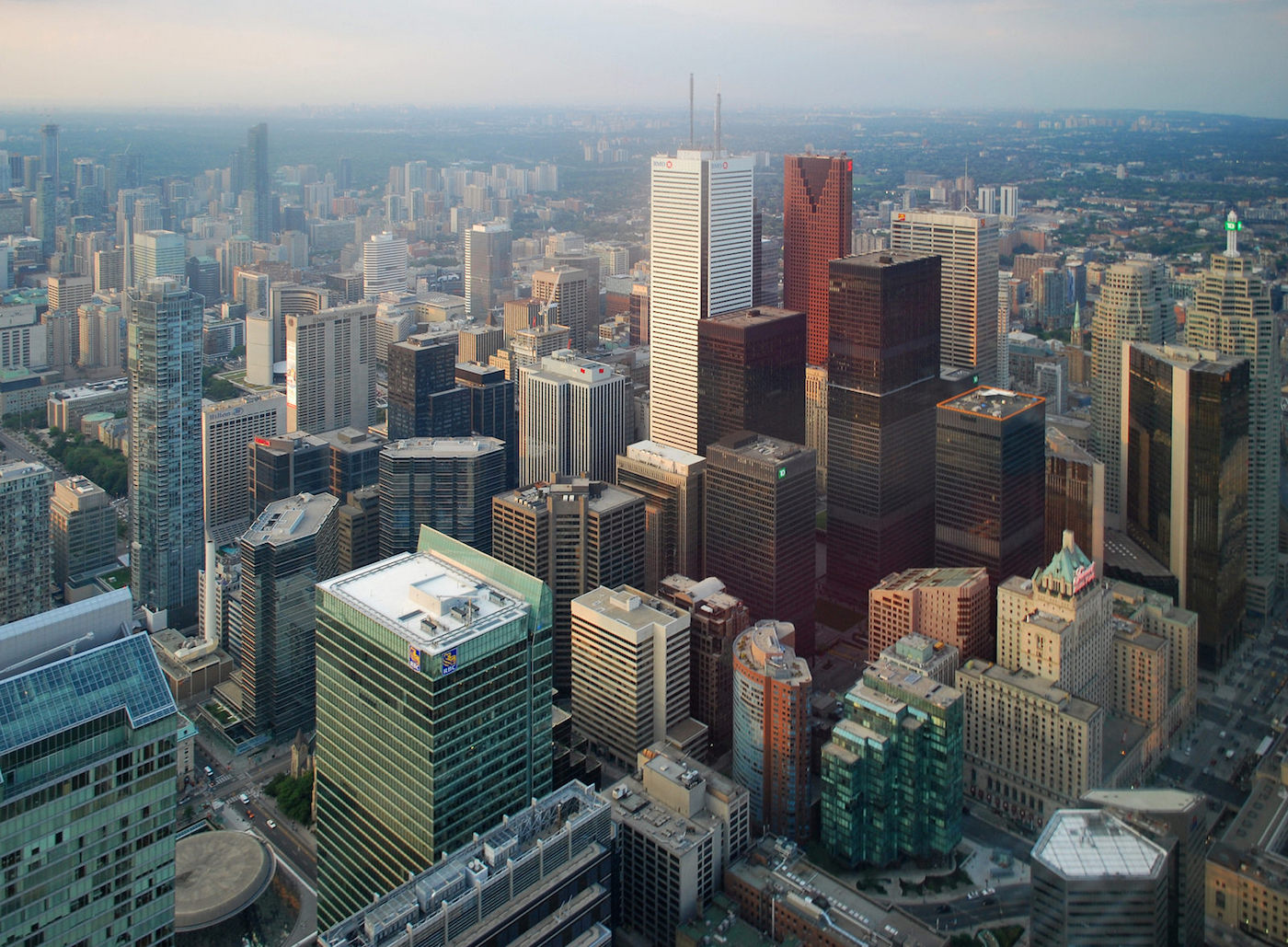
You're right that Toronto as a big North American city is relatively recent but Toronto has always had a big financial services sector. It's grown but from a substantially large base: those black bank towers in the photo were built in the 1960s. The sector moved from 5th biggest in North America to 2nd biggest after NYC. The footprint is tiny because it's incredibly tightly packed. Every usable lot has a tower on it. Due to those constraints, the financial services sector has had to expand beyond its historic borders. You're not going to see much residential growth in Census Tract 0014.00 because there's nowhere to put a tower.

In the photo that road on the right in front of the Royal York Hotel is Front Street (southern boundary), the bank tower with the green logo on the spire is Yonge Street (eastern boundary), between City Hall and the Sheraton Centre is Queen Street (northern boundary), and you can see Front Street curve north and become University Avenue (western boundary). Practically every building is a bank, insurance company, or other financial services firm. The photo shows that it's completely built out. The only way to add residential is to knock a sizeable office building down.

If you wanted to add tracts to gauge residential growth for people looking to move to the financial services core I'd add tracts directly east, west, and south of Census Tract 0014.00 but exclude the one to the north of it. To the north is City Hall, government buildings, a big shopping mall, and a hospital helicopter flight path that limits how tall one can go. There's not alot of residential being built directly north of the financial district for these reasons. There's lots being built in the other 3 directions.


Financial District: Census Tract 0014.00


https://skyrisecities.com/news/2016/...iness-district


The space constrained Financial District has expanded south of Front Street to this area in the 2nd photo below. That new tower with the diamond shaped facade is CIBC, Canada's #5 bank. Royal Bank and Sun Life just built new towers here too. This area (Census Tract 0013.01 and Census Tract 0013.02) has seen its residential population explode. It was all vacant land just 15 years ago. The area to the east and west of the old Financial District have seen huge spikes in residential too. There's some office as well but I think its tech. To get your bearings, the building on the extreme right in both photos is the same building.


Financial District has expanded south to this area


https://urbantoronto.ca/forum/thread...e.674/page-457


Population: Census Tract 0014.00 (0.47 sq km)
2006: 550
2011: 644
2016: 1,242

Population: Census Tract 0013.01 (0.34 sq km)
2006: zero
2011: 4,739
2016: 6,290

Population: Census Tract 0013.02 (0.42 sq km)
2006: zero
2011: 5,862
2016: 8,126

These 3 tracts had 15,658 people in 2016 or 12,730 inhabitant per sq km. Mind you, alot of the condos in the photo above were built in 2016 or later so won't show up in these numbers. That said, I can't see these tracts ever going much beyond 30,000 inhabitants per sq km. Census Tract 0014.00 has no space to build anything, rail infrastructure makes up almost half of Census Tract 0013.01 while boardwalk and parks make up about half of Census Tract 0013.02.

https://www.citypopulation.de/en/can...1__ct_0013_01/
https://www.citypopulation.de/en/can...2__ct_0013_02/
https://www.citypopulation.de/en/can...toronto/admin/
__________________
ELBOWS UP CANADA, ELBOWS UP UKRAINE, ELBOWS UP GREENLAND
CANADA, EUROPE, NZ, AUSTRALIA, JAPAN, MEXICO STRONG

US REPUBLICANS/MAGA/ICE NOT WELCOME HERE, STAY OUT

Last edited by isaidso; Aug 25, 2021 at 8:57 AM.
Reply With Quote
     
     
  #110  
Old Posted Aug 25, 2021, 1:35 PM
Chisouthside Chisouthside is online now
Registered User
 
Join Date: Jul 2018
Location: Silicon Valley/Chicago
Posts: 529
Most of the high rises in the gold coast chicago are older, I think the eastcut is more similar to Streeterville in Chicago as both have alot of shiny newer skyrises.
Reply With Quote
     
     
  #111  
Old Posted Aug 25, 2021, 3:20 PM
mcgrath618's Avatar
mcgrath618 mcgrath618 is offline
Moderator
 
Join Date: Jan 2017
Location: Clark Park, Philadelphia, PA
Posts: 3,962
Quote:
Originally Posted by yuriandrade View Post
Downtown Philadephia


Philadelphia is often discussed here in this section, but not its City Center specifically. I used a 29 census tract definition, roughky the area between South St., Spring Garden St. and the two rivers.


-------------------- 2020 ------ 2010 ------ 2000 ------ 1990

City Center --------- 91,510 ----- 68,836 ----- 57,552 ----- 51,302 ----- 32.9% --- 19.6% --- 12.2%

Philadelphia ----- 1,603,797 -- 1,526,006 -- 1,517,550 -- 1,585,577 ---- 5.1% ---- 0.6% --- -4.3%


The area has 8.92 km² and a density of 10,300 inh./km². Growth has been insane, with population almost doubling in the past 20 years. It's even more impressive as the area is pretty much built up for ages.

For comparison, Chicago Loop & Near North Side (posted above), with a much higher profile, is not so far ahead, with 148k inh. in a 10.7 km² area. Or Downtown LA, often discussed, with 74k inh. in a 14.9 km² area.

P.S. Guys, to convert the area and density to sq miles, just multiply by 2.59
Could you expand the limits of Center City to include everything from Girard to Tasker (with the same E/W borders)? Philadelphia City Hall defines this as “Greater Center City,” and in 2018 estimated it to be more dense than Chicago (or for that matter, anywhere outside of Manhattan). It had ~174K residents in 2010.
__________________
Philadelphia Transportation Thread: http://forum.skyscraperpage.com/showthread.php?t=164129
Reply With Quote
     
     
  #112  
Old Posted Aug 25, 2021, 6:44 PM
Yuri's Avatar
Yuri Yuri is online now
Registered User
 
Join Date: Sep 2008
Posts: 5,594
Quote:
Originally Posted by Pedestrian View Post
The Chronicle took a look at it somewhat the same way:

(...)
I went only to Van Ness Avenue, and they went further, Fillmore maybe?. And for Downtown, I excluded Russian Hill and North Beach, keep the districts neighbouring the Financial District.


Quote:
Originally Posted by Pedestrian View Post
Much more comparable to Cicago's Gold Coast is the recently carved out and named "East Cut":

(...)

Since this area is almost all high rises, it should be quite dense but I really don't know how dense. Maybe yuriandrade can tell us.
My "Financial District" took the traditional Triangle, most of Embarcadero and this rectangle immediatelly south of Market St. where Salesforce Tower and all new buildings are being built.

I promise I'll include San Francisco in today's evening updates.
__________________
London - São Paulo - Rio de Janeiro - Londrina - Frankfurt
Reply With Quote
     
     
  #113  
Old Posted Aug 25, 2021, 6:59 PM
Yuri's Avatar
Yuri Yuri is online now
Registered User
 
Join Date: Sep 2008
Posts: 5,594
Quote:
Originally Posted by isaidso View Post
(...)


Population: Census Tract 0014.00 (0.47 sq km)
2006: 550
2011: 644
2016: 1,242

Population: Census Tract 0013.01 (0.34 sq km)
2006: zero
2011: 4,739
2016: 6,290

Population: Census Tract 0013.02 (0.42 sq km)
2006: zero
2011: 5,862
2016: 8,126

These 3 tracts had 15,658 people in 2016 or 12,730 inhabitant per sq km. Mind you, alot of the condos in the photo above were built in 2016 or later so won't show up in these numbers. That said, I can't see these tracts ever going much beyond 30,000 inhabitants per sq km. Census Tract 0014.00 has no space to build anything, rail infrastructure makes up almost half of Census Tract 0013.01 while boardwalk and parks make up about half of Census Tract 0013.02.

https://www.citypopulation.de/en/can...1__ct_0013_01/
https://www.citypopulation.de/en/can...2__ct_0013_02/
https://www.citypopulation.de/en/can...toronto/admin/
We have the same pattern in San Francisco, south of Market Street, where the new towers are up, and even in Chicago. They still have room for conversions on the Loop and the southern portions of Near North Side, but plenty of those condos are popping up on the borders, near rail yards, the lake, the river, etc.


Quote:
Originally Posted by mcgrath618 View Post
Could you expand the limits of Center City to include everything from Girard to Tasker (with the same E/W borders)? Philadelphia City Hall defines this as “Greater Center City,” and in 2018 estimated it to be more dense than Chicago (or for that matter, anywhere outside of Manhattan). It had ~174K residents in 2010.
I'll try to put it together later. Center City, the way it is, had almost 30 census tracts to sum up. It's very time consuming.

I prefer to take one of those Downtowns on Sunbelt, with only one or two tracts. Make my life easier.
__________________
London - São Paulo - Rio de Janeiro - Londrina - Frankfurt
Reply With Quote
     
     
  #114  
Old Posted Aug 25, 2021, 10:13 PM
Yuri's Avatar
Yuri Yuri is online now
Registered User
 
Join Date: Sep 2008
Posts: 5,594
Downtown San Francisco


------------------------------------- 2020 ------ 2010 ------ 2000 ------ 1990 ------ Growth ------ Density

Financial District/Embarcadero ---- 10,991 ------ 8,512 ------ 6,369 ----- 11,734 ---- 29.1% ---- 33.6% -- -45.7% ------- 2.2 km² --- 5,030.2 inh./km²

Downtown San Francisco --------- 134,974 ---- 110,719 ----- 97,737 ----- 88,944 ---- 21.9% ---- 13.3% ---- 9.9% ------- 8.0 km² -- 16,886.5 inh./km²

Downtown Oakland ---------------- 21,616 ----- 18,547 ----- 13,652 ----- 11,357 ---- 16.5% ---- 35.9% --- 20.2% ------- 3.6 km² --- 6,044.7 inh./km²

Downtown San Jose --------------- 14,589 ----- 10,656 ----- 10,145 ------ 9,249 ---- 36.9% ----- 5.0% ---- 9.7% ------- 5.7 km² --- 2,549.2 inh./km²

San Francisco --------------------- 873,965 ---- 805,235 ---- 776,733 ---- 723,959 ----- 8.5% ----- 3.7% ---- 7.3% ----- 121.5 km² --- 7,193.1 inh./km²

Oakland-Alam-Pied-Emer --------- 543,101 ---- 485,387 ---- 489,509 ---- 462,473 ---- 11.9% ---- -0.8% ---- 5.8% ----- 179.7 km² --- 3,022.3 inh./km²

San Francisco Metro Area ----- 8,036,501 -- 7,413,121 -- 7,039,362 -- 6,253,311 ----- 8.4% ----- 5.3% --- 12.6% -- 19,943 km²


As we've discussed the last few pages, here we have San Francisco. The strict definition, matches almost perfectly with the skyscrapers zone on the Pedestrian's post above. Density is relatively low because there are plenty of office towers in this area while the bulk of the growth is happening south of Market Street, around Salesforce Tower up to the docks.

Downtown San Francisco, the broader definition, also encompasses Chinatown, Nob Hill, Tenderloin, Civic Center, Rincon Hill/South Beach and South of Market. Very dense and populated area, comparable to Chicago's Loop + Near North Side, posted on Page 2.

And as a bonus, Downtowns of Oakland and San Jose. Their performance, compared to the boom everywhere and the very strong performance of the metro area, it's relatively underwhelming.

__________________
London - São Paulo - Rio de Janeiro - Londrina - Frankfurt
Reply With Quote
     
     
  #115  
Old Posted Aug 25, 2021, 10:38 PM
homebucket homebucket is online now
你的媽媽
 
Join Date: Jan 2012
Location: The Bay
Posts: 11,313
^ Thanks for putting this together! Looks like SF is still solidly holding on to a very distant 2nd place (behind only NYC).

In terms of just California cities, it's also interesting to see that DTSD and DT Oakland, as well as SF as a whole are more dense than DTLA.
Reply With Quote
     
     
  #116  
Old Posted Aug 25, 2021, 10:40 PM
mhays mhays is online now
Never Dell
 
Join Date: Jul 2001
Posts: 20,926
Underwhelming maybe, but remember we're talking history here.

A building fully occupied on 4/1/20 was probably completed by mid-2019, and broke ground in 2017 or in some cases 2016.

On SSP we watch groundbreakings and sometimes get ahead of ourselves in our expectations. Or at least I do.
Reply With Quote
     
     
  #117  
Old Posted Aug 25, 2021, 11:25 PM
Yuri's Avatar
Yuri Yuri is online now
Registered User
 
Join Date: Sep 2008
Posts: 5,594
Quote:
Originally Posted by homebucket View Post
^ Thanks for putting this together! Looks like SF is still solidly holding on to a very distant 2nd place (behind only NYC).

In terms of just California cities, it's also interesting to see that DTSD and DT Oakland, as well as SF as a whole are more dense than DTLA.
I posted Downtown San Diego on Page 5. One of the biggest surprises to me.


Quote:
Originally Posted by mhays View Post
Underwhelming maybe, but remember we're talking history here.

A building fully occupied on 4/1/20 was probably completed by mid-2019, and broke ground in 2017 or in some cases 2016.

On SSP we watch groundbreakings and sometimes get ahead of ourselves in our expectations. Or at least I do.
Yes, but comparing to other Downtowns I posted, I expected more of them, specially Oakland, which is more urban and taking full advantage of San Francisco's booming economy.
__________________
London - São Paulo - Rio de Janeiro - Londrina - Frankfurt
Reply With Quote
     
     
  #118  
Old Posted Aug 26, 2021, 12:56 AM
streetscaper streetscaper is offline
Registered User
 
Join Date: May 2004
Location: New York
Posts: 2,939
Would be interesting to see the numbers for Downtown Brooklyn or Downtown Jersey City
__________________
hmmm....
Reply With Quote
     
     
  #119  
Old Posted Aug 26, 2021, 1:33 AM
SFBruin SFBruin is offline
Registered User
 
Join Date: Sep 2015
Location: Seattle, WA
Posts: 1,190
Quote:
Originally Posted by Pedestrian View Post
The Chronicle took a look at it somewhat the same way:


https://www.sfchronicle.com/projects...sf-population/
That is interesting. It looks like the densest part of SF grew the fastest.

Somewhat reminiscent of the incredible growth of NYC.
__________________
Pretend Seattleite.
Reply With Quote
     
     
  #120  
Old Posted Aug 26, 2021, 1:40 AM
LA21st LA21st is online now
Registered User
 
Join Date: Jul 2002
Posts: 7,945
Quote:
Originally Posted by homebucket View Post
^ Thanks for putting this together! Looks like SF is still solidly holding on to a very distant 2nd place (behind only NYC).

In terms of just California cities, it's also interesting to see that DTSD and DT Oakland, as well as SF as a whole are more dense than DTLA.
Probably due to that bit industrial area in la where nobody lives.
For now anyway.
At some point it will be bulldozed
Reply With Quote
     
     
This discussion thread continues

Use the page links to the lower-right to go to the next page for additional posts
 
 
Reply

Go Back   SkyscraperPage Forum > Discussion Forums > City Discussions
Forum Jump


Forum Jump


All times are GMT. The time now is 9:38 PM.

     
SkyscraperPage.com - Privacy Statement - Top

Powered by vBulletin® Version 3.8.7
Copyright ©2000 - 2026, vBulletin Solutions, Inc.