HomeDiagramsDatabaseMapsForum About
     

Go Back   SkyscraperPage Forum > Regional Sections > Canada > Ontario > Ottawa-Gatineau > Transportation


View Poll Results: Electric Vehicle Ownership Poll
I own a BEV (Battery Electric Vehicle) 7 21.88%
I own a PHEV (Plug-in Hybrid Electric Vehicle) 2 6.25%
I own an HEV (Hybrid Electric Vehicle) 2 6.25%
I'm considering a BEV (Tesla, LEAF, Bolt, etc.) 6 18.75%
I'm considering a PHEV (Volt, etc.) 6 18.75%
I'm considering a HEV (Prius, etc.) 3 9.38%
I would only buy a non-electric gas or diesel car 3 9.38%
I don't want a car 4 12.50%
Multiple Choice Poll. Voters: 32. You may not vote on this poll

Reply

 
Thread Tools Display Modes
     
     
  #721  
Old Posted Jul 14, 2021, 4:21 PM
Truenorth00 Truenorth00 is online now
 
Join Date: May 2017
Posts: 29,141
Realistically, now that the industry is centering around CCS, the number of Chademo points will fall, relative to CCS.

If OEM funded networks like Electrify Canada really want to play hardball, they can drop Chademo completely. Force Tesla to completely carry the burden of its own infrastructure.
Reply With Quote
     
     
  #722  
Old Posted Jul 14, 2021, 4:29 PM
roger1818's Avatar
roger1818 roger1818 is offline
 
Join Date: Feb 2016
Posts: 6,610
Another option is to standardize on a wireless rapid charging standard. While it is true that the SAE J2954 wireless charging standard only works up to 11 kilowatts, there is preliminary talk of another standard that could replace DC fast charging.

https://www.greencarreports.com/news/113...ndard-will-harmonize-systems-up-to-11-kw
Reply With Quote
     
     
  #723  
Old Posted Jul 14, 2021, 4:35 PM
roger1818's Avatar
roger1818 roger1818 is offline
 
Join Date: Feb 2016
Posts: 6,610
Quote:
Originally Posted by Truenorth00 View Post
If OEM funded networks like Electrify Canada really want to play hardball, they can drop Chademo completely. Force Tesla to completely carry the burden of its own infrastructure.
There are too many Nissan LEAFs on the road for them to do that yet. They are the main users of CHAdeMO since most Tesla owners don't have a CHAdeMO adapter.

Also, while Electrify Canada is OEM funded, it is operated independently. Their objective it to become self sufficient when money from VW stops coming in (2028 I think?).
Reply With Quote
     
     
  #724  
Old Posted Jul 14, 2021, 5:23 PM
Truenorth00 Truenorth00 is online now
 
Join Date: May 2017
Posts: 29,141
Quote:
Originally Posted by roger1818 View Post
There are too many Nissan LEAFs on the road for them to do that yet. They are the main users of CHAdeMO since most Tesla owners don't have a CHAdeMO adapter.
There's only about half a million Nissan Leafs delivered globally. About 120k in North America. With Nissan moving to CCS, realistically this market really isn't relevant for a charging network. There will be a point at which those charging stations are worth more with a CCS outlet than Chademo. I give it about 5-7 yrs before some of these networks go all in on CCS. Paradoxically, the only thing that would slow that down would be a lot more Teslas using those Chademo bays.
Reply With Quote
     
     
  #725  
Old Posted Jul 14, 2021, 6:04 PM
roger1818's Avatar
roger1818 roger1818 is offline
 
Join Date: Feb 2016
Posts: 6,610
Quote:
Originally Posted by Truenorth00 View Post
There's only about half a million Nissan Leafs delivered globally. About 120k in North America. With Nissan moving to CCS, realistically this market really isn't relevant for a charging network. There will be a point at which those charging stations are worth more with a CCS outlet than Chademo. I give it about 5-7 yrs before some of these networks go all in on CCS. Paradoxically, the only thing that would slow that down would be a lot more Teslas using those Chademo bays.
Don't forget the Nissan LEAF was the best selling BEV in the USA (and presumably Canada) until 2015 and the best selling non-Tesla BEV until 2017 (when it was passed by the Chevy Bolt). I did some analysis with data from this website, and in the USA, up until the end of 2019 (the last year of data), 43% (141,888 of 333,610) of all non-Tesla BEVs (PHEVs don't usually support DCFC) sold, were Nissan LEAFs.

Also, the Kia Soul BEVs had CHAdeMO connectors in the 2016-2019 model years, though that only represents 6,507 (or 2% of non-Tesla) vehicles sold in the USA.

I agree that percentage will get smaller over time, but it is too soon for charging stations to stop supporting CHAdeMO now.
Reply With Quote
     
     
  #726  
Old Posted Jul 20, 2021, 10:10 PM
rocketphish's Avatar
rocketphish rocketphish is online now
 
Join Date: Feb 2009
Posts: 14,725
Driving Concerns: If I buy an electric car, do I need to install a 240-volt outlet?

Jason Tchir | Special to The Globe and Mail
July 20, 2021 | Published 6 hours ago


Question: Do all EVs and PHEVs need a special 240-volt outlet to charge? Or, can they be charged at a normal 120-volt outlet? – Lawrence

Answer: That 120-volt plug-in will charge every electric car. But if you drive long distances every day, it might become an outlet for frustration.

“Every electric vehicle, whether it’s a plug-in hybrid [PHEV] or full EV [electric vehicle]. comes with a Level 1 charging cord that plugs into a normal outlet,” said Michael Stanyer, program coordinator with Plug In BC. “I’ve found that I’ve gotten by quite well with Level 1 charging.”

Charging can seem confusing, but it’s basically pretty simple. There are three levels of charging, from slowest to fastest.

Level 1 is a standard 120-volt outlet. That’s the standard voltage in North America. It takes the longest of all three.

For instance, if you plug a 2021 Chevy Bolt, which has a 417 km range, into a 120-volt outlet, it’ll gain about 8 km in range per hour.

So, charging from empty to full at Level 1 could take a couple of days.

Level 2 uses a 240-volt outlet. Depending on the car, you can get back about 30 to 40 km per hour.

So, you can plug in after dinner and go from empty to full overnight.

If you’re installing a Level 2 charger at home, you’d need an electrician to install a 240-volt outlet, the kind used for dryers. Then you’d buy a dedicated Level 2 charger that you’d mount on the wall or a cheaper plug-in adapter.

“I’d say think about a $2,000 budget just in case there’s extra electrical work on the house that needs to be done,” Stanyer said. “Some manufacturers are starting to include a home charging package with vehicle purchase and sometimes dealerships will throw in a charger as a bonus.”

Level 3 is also called Direct Current Fast Charge. These are public chargers that can, generally, get your battery up to 80 per cent full in 30 to 40 minutes.

Depending on the size of the battery and the speed of the charger, it might take another 60 to 90 minutes, or longer, to get to 100 per cent.

Fast chargers are best for times when you need a full charge, well, fast. They make sense for a road trip. Or if you’re near empty and don’t want to sit at a public Level 2 charger for a couple of hours.

But using one daily could shorten the life of your battery.

If you’re charging at home, you’d use a Level 1 or, if you have one, a Level 2 charger. Public chargers are Level 2 or Level 3.

Most of us need less range than we think we do. Most new EVs have around 400 km of range. Unless you’re on a road trip, you might not drive 400 km in one day – or even in one week.

For most people, the average commute is around 30 or 40 km a day, Stanyer said.

“If you’re thinking of switching to an EV, just maybe keep a journal for a couple of weeks to see how much you actually drive,” Stanyet said.

So, if you drive shorter distances all week, plugging into a 120-volt outlet every few days should be more than enough.

Even if you only gain 100 km in one night, you’d still have plenty of range for normal driving.

“If you’re driving a little more that, you end up topping up as you sleep in on the weekend,” Stanyer said.

If you occasionally need a faster charge, you can find a public charger.

But if you’re regularly driving long distances, or if you have an older EV with lower range, splurging on a Level 2 charger might make sense.

That way, you’re not stuck at home waiting for enough juice to go somewhere.

But what if you have a PHEV and want to drive it without the gas kicking in? Is 120 volts enough?

PHEVs have smaller batteries – typically with battery-only ranges between 25 and 80 km. With most of them, you can charge to full overnight with a 120-volt outlet.

If you want a full charge in an hour or two, then a home Level 2 charger might make sense.


https://www.theglobeandmail.com/drive/mo...-do-i-need-to-install-a-240-volt-outlet/

Reply With Quote
     
     
  #727  
Old Posted Jul 21, 2021, 12:50 AM
Truenorth00 Truenorth00 is online now
 
Join Date: May 2017
Posts: 29,141
You know what —? When you talk to be developers and they think providing a 110V standard outlet in the garage is good enough. I can understand for existing housing. But it's ridiculous that we aren't mandating NEMA 14-50 in all new low rise homes. Yeah, nobody strictly needs 240V and 50A. But it's $500 to do provision that at the time of construction. And it's just ridiculous not to build it in at this point.
Reply With Quote
     
     
  #728  
Old Posted Jul 21, 2021, 2:14 AM
roger1818's Avatar
roger1818 roger1818 is offline
 
Join Date: Feb 2016
Posts: 6,610
Quote:
Originally Posted by Truenorth00 View Post
You know what —? When you talk to be developers and they think providing a 110V standard outlet in the garage is good enough. I can understand for existing housing. But it's ridiculous that we aren't mandating NEMA 14-50 in all new low rise homes. Yeah, nobody strictly needs 240V and 50A. But it's $500 to do provision that at the time of construction. And it's just ridiculous not to build it in at this point.
I tend to agree though I understand why builders don’t want to pay to install them. At an absolute bare minimum they should install a NEMA 14-20 with the option for owner to upgrade it to a NEMA 14-30 or 14-50.

BTW, I wouldn’t count on a NEMA 14-50 having a 50A breaker. Code allows it to be connected to a 40A breaker (with 40A wire). Most stove outlets are wired that way these days.

Last edited by roger1818; Jul 21, 2021 at 3:21 AM.
Reply With Quote
     
     
  #729  
Old Posted Jul 21, 2021, 1:39 PM
CanadaGoose CanadaGoose is offline
 
Join Date: Sep 2014
Posts: 260
Quote:
Originally Posted by Truenorth00 View Post
You know what —? When you talk to be developers and they think providing a 110V standard outlet in the garage is good enough. I can understand for existing housing. But it's ridiculous that we aren't mandating NEMA 14-50 in all new low rise homes. Yeah, nobody strictly needs 240V and 50A. But it's $500 to do provision that at the time of construction. And it's just ridiculous not to build it in at this point.
The most affordable program to ensure there is enough chargers for everyone:
- Adjust all municipal zoning codes to mandate:
  • Minimum one 240V 50 amp outlet in the garage in new homes
  • Mandate all new commerical buildings require charging at X% of parking spots.
  • Mandate all new hotels to have all parking spots with an EV Charging station or plug.

Government seems to like spending money on 50 thousand dollars fast chargers instead of telling construction companies to include L2 chargers.
Reply With Quote
     
     
  #730  
Old Posted Jul 21, 2021, 3:14 PM
roger1818's Avatar
roger1818 roger1818 is offline
 
Join Date: Feb 2016
Posts: 6,610
Quote:
Originally Posted by CanadaGoose View Post
The most affordable program to ensure there is enough chargers for everyone:
- Adjust all municipal zoning codes to mandate:
I am not sure that the city has the authority to make this change. AFAIK, building codes are set by the province, but your point is well taken (sorry for nitpicking).

Interestingly, O. Reg. 139/17: BUILDING CODE (May 17, 2017) had a whole section on Electric Vehicle Charging (Section 3.1.21), which was a pretty good first step. Unfortunately the entire section was revoked by O. Reg. 88/19: BUILDING CODE (May 2, 2019). Thanks Doug.

It seems to have gone through a few revisions, but prior to it being revoked, Section 3.1.21 was as follows:
Quote:
3.1.21. Electric Vehicle Charging

3.1.21.1. Electric Vehicle Charging System
s

(1) Except as provided in Sentences (2.1) and (3), where vehicle parking spaces are located in a building, other than an apartment building, not less than 20% of the parking spaces shall be provided with electric vehicle supply equipment installed in accordance with Section 86 of the Electrical Safety Code adopted under Ontario Regulation 164/99 (Electrical Safety Code) made under the Electricity Act, 1998.

(2) The remaining parking spaces located in a building described in Sentence (1) shall be designed to permit the future installation of electric vehicle supply equipment that conforms to Section 86 of the Electrical Safety Code.

(2.1) Parking spaces located in a building need not comply with Sentence (1) where,
(a) before January 1, 2018,
(i) an agreement was entered into between the owner of the land on which the building is to be constructed and a distributor, as defined in subsection 2 (1) of the Electricity Act, 1998, that sets out the conditions for the connection of the building to a distribution system, as defined in subsection 2 (1) of that Act, or

(ii) a plan for the land on which the building is to be constructed respecting the siting and sizing of lines, transformers or other equipment used for conveying electricity was approved by a distributor, as defined in subsection 2 (1) of the Electricity Act, 1998, and
(b) an application for a permit to construct the building was made before January 1, 2020.
(3) Except as provided in Sentences (6) and (7), where a house is served by a garage, carport or driveway, the following shall be installed to permit the future installation of electric vehicle supply equipment that conforms to Section 86 of the Electrical Safety Code:
(a) a minimum 200 amp panelboard,

(b) a conduit that is not less than 27 mm trade size and is equipped with a means to allow cables to be pulled into the conduit, and

(c) a square 4-11/16 in. trade size electrical outlet box.
(4) The electrical outlet box described in Clause (3)(c) shall be installed in the garage or carport or adjacent to the driveway.

(5) The conduit and electrical outlet box described in Clauses (3)(b) and (c) shall provide an effective barrier against the passage of gas and exhaust fumes.

(6) A house need not comply with Sentence (3) where it,
(a) is not connected to a distribution system, as defined in subsection 2 (1) of the Electricity Act, 1998, or

(b) is used or intended to be used as a seasonal recreational building described in Section 9.36.
(7) A house need not comply with Sentence (3) where,
(a) before January 1, 2018,
(i) an agreement was entered into between the owner of the land on which the house is to be constructed and a distributor, as defined in subsection 2 (1) of the Electricity Act, 1998, that sets out the conditions for the connection of the house to a distribution system, as defined in subsection 2 (1) of that Act, or

(ii) a plan for the land on which the house is to be constructed respecting the siting and sizing of lines, transformers or other equipment used for conveying electricity was approved by a distributor, as defined in subsection 2 (1) of the Electricity Act, 1998, and
(b) an application for a permit to construct the house was made before January 1, 2020.
Quote:
Originally Posted by CanadaGoose View Post
  • Minimum one 240V 50 amp outlet in the garage in new homes
I kind of like the way Section 3.1.21 required a conduit and box from the panel to the garage, carport or driveway as that provides a level of future proofing.

Quote:
Originally Posted by CanadaGoose View Post
  • Mandate all new commerical buildings require charging at X% of parking spots.
  • Mandate all new hotels to have all parking spots with an EV Charging station or plug.
Section 3.1.21 had that covered as well, though there wasn't a distinction for hotels and apartment buildings were excluded (with no apparent separate regulation for them).

Quote:
Originally Posted by CanadaGoose View Post
Government seems to like spending money on 50 thousand dollars fast chargers instead of telling construction companies to include L2 chargers.
We need both, but I agree there seems to be a lack of understanding on what types of charging are needed.
Reply With Quote
     
     
  #731  
Old Posted Jul 21, 2021, 7:33 PM
SidetrackedSue SidetrackedSue is offline
 
Join Date: Jun 2019
Posts: 399
Quote:
Originally Posted by CanadaGoose View Post

Government seems to like spending money on 50 thousand dollars fast chargers instead of telling construction companies to include L2 chargers.
My L1 at home handles my use case almost 100% of the time.

I've rented a cottage 250km away. Just 40km further is an L3 so while I'm up there I'm set since I usually make at least one trip to that town while up at the cottage. BUT, in the middle of my trip, I have to make a 440km round day trip. I can detour through the L3 town but that will add 40 minutes plus charging time.

The two L2s along the shorter route do me no good, I'd need about 100km of range so they'd take ~3 - 4 hours of charging time. The goal is to be away from the cottage as short a time as possible.

So I emailed the cottage owner and asked if she had a policy about EVs. Turns out her daughter has a Bolt so there's a place I can park the car to plug into the 110V outlet she put in for her daughter. That means I'll be leaving on the trip at 100% and if I drive really, really, carefully, I should make it there and back (my theoretical range is 520). I won't be able to go anywhere for at least another 24 hours (distances are long up there) but at least I'll be able to minimize my time away from the cottage.

The promised L3 in Renfrew would have been perfect but it has been put on hold for now. It was the L1 that makes the side-trip possible.
Reply With Quote
     
     
  #732  
Old Posted Jul 27, 2021, 6:38 PM
roger1818's Avatar
roger1818 roger1818 is offline
 
Join Date: Feb 2016
Posts: 6,610
Quote:
StatsCan data for Q1 2021 shows rise in EV adoption to 4.6 per cent, as sales of hybrids double

Quebec and B.C. continue to lead Canada in overall ZEV registrations, but a host of second-tier EV markets — Ontario, Saskatchewan, Manitoba, New Brunswick and PEI — saw the biggest Q1 increases


New data from Statistics Canada shows Canadians from coast-to-coast are continuing their steady adoption of electric vehicles and hybrids.

In the first quarter of this year, Canadians registered 11.8 per cent more new motor vehicles than in the same quarter in 2020. New zero-emission vehicle registrations — which combines plug-in hybrids and battery electric — saw a 1.1 per cent jump from the same quarter last year to 4.6 per cent (from 3.5 per cent). Double the number of hybrid vehicles were registered across Canada compared to Q1 2020, while battery electric vehicles saw a 0.9 per cent increase from last year’s first quarter.

Statistics Canada does breakdown the different fuel types and differentiates between battery electric and hybrid or plug-in hybrid vehicles, however its umbrella percentage figures consider both plug-in hybrid and battery electric to be “zero-emission vehicles.” This grouping does not reflect Electric Autonomy Canada‘s usual method, but we have maintained StatsCan’s definitions and data breakdown for continuity.

In total across Canada 12,693 battery electric, 14,278 hybrid and 4,592 plug-in hybrid vehicles were registered from January 1 to March 31 this year.

Province-by-province
While more combustion engine vehicles were registered in the first quarter of 2021 versus last year, the total market share of gasoline-powered vehicles fell — to 86.8 per cent of new registrations from 90.1 per cent in Q1 2020.

Over three-quarters of new zero-emission vehicles were registered in Quebec (6,901) and British Columbia (6,119). B.C.’s provincial numbers are combined with data from the territories.
Region                Battery Electric  All Vehicles  BEVs as %
Vehicles (BEVs) of Total Sales

CANADA 12,693 375,826 3.34%
British Columbia 4,826 50,973 9.48%
Quebec 4,708 85,486 5.51%
Ontario 2,568 141,788 1.81%
Prince Edward Island 12 1,759 0.68%
Saskatchewan 70 11,506 0.61%
New Brunswick 37 8,105 0.45%
Manitoba 53 11,697 0.45%
Table shows vehicle sales in provinces where data is available
Ontario saw the greatest overall market share increase for ZEVs and even those provinces historically lagging in adoption — Saskatchewan, Manitoba, New Brunswick and Prince Edward Island — all saw an marked increase in ZEV registrations.

StatsCan data from Q1 2021 does not reflect registrations from Newfoundland and Labrador, Nova Scotia, and Alberta due to, “contractual limitations of the existing data sharing agreement,” but the government body confirms they are included in the Canadian total.

First look at local data
For the first time, StatsCan compiled local breakdowns of ZEV registrations across Canada, which gives a clearer picture of where adoption is excelling and which communities still need assistance.

The most new battery electric registrations in the first quarter were in Vancouver, with 4,500 vehicles, followed by Montreal with 3,633 and Toronto with 1,875.

Outside of those three key metropolitan areas in Canada, adoption drops off precipitously. Ottawa-Gatineau, for example, only saw 213 new battery electric registrations in the same period.

Even in B.C., adoption outside of Vancouver was lacklustre. The next-leading community in the province is Victoria, with 432 new registrations. And in Quebec, outside of Montreal, Quebec City logged just 598 new registrations.

However, in jurisdictions like Winnipeg, Saskatoon and Regina, relatively speaking to the existing EV market-share, adoption was robust with 76, 59 and 23 new registrations, respectively.

In total, there were 13 new registration in municipal jurisdictions measured in the Territories — 12 in Whitehorse and one in Yellowknife. These communities can be viewed at a local data breakdown level and seen as separate from the B.C. provincial data.
https://electricautonomy.ca/2021/07/27/canadian-ev-sales-data-q1-2021/
Reply With Quote
     
     
  #733  
Old Posted Jul 27, 2021, 6:45 PM
roger1818's Avatar
roger1818 roger1818 is offline
 
Join Date: Feb 2016
Posts: 6,610
One oversite in this article is that when evaluation EV sales in cities, they aren't taking population (or better yet total vehicle sales) into account. Using Estimated CMA population from Wikipedia, the ranking of vehicle sales per 100,000 people are:
Vancouver       164
Victoria 106
Montreal 83
Quebec City 72
Toronto 46
Saskatoon 18
Ottawa–Gatineau 15
Winnipeg 9
Regina 9
Reply With Quote
     
     
  #734  
Old Posted Jul 27, 2021, 7:28 PM
roger1818's Avatar
roger1818 roger1818 is offline
 
Join Date: Feb 2016
Posts: 6,610
Quote:
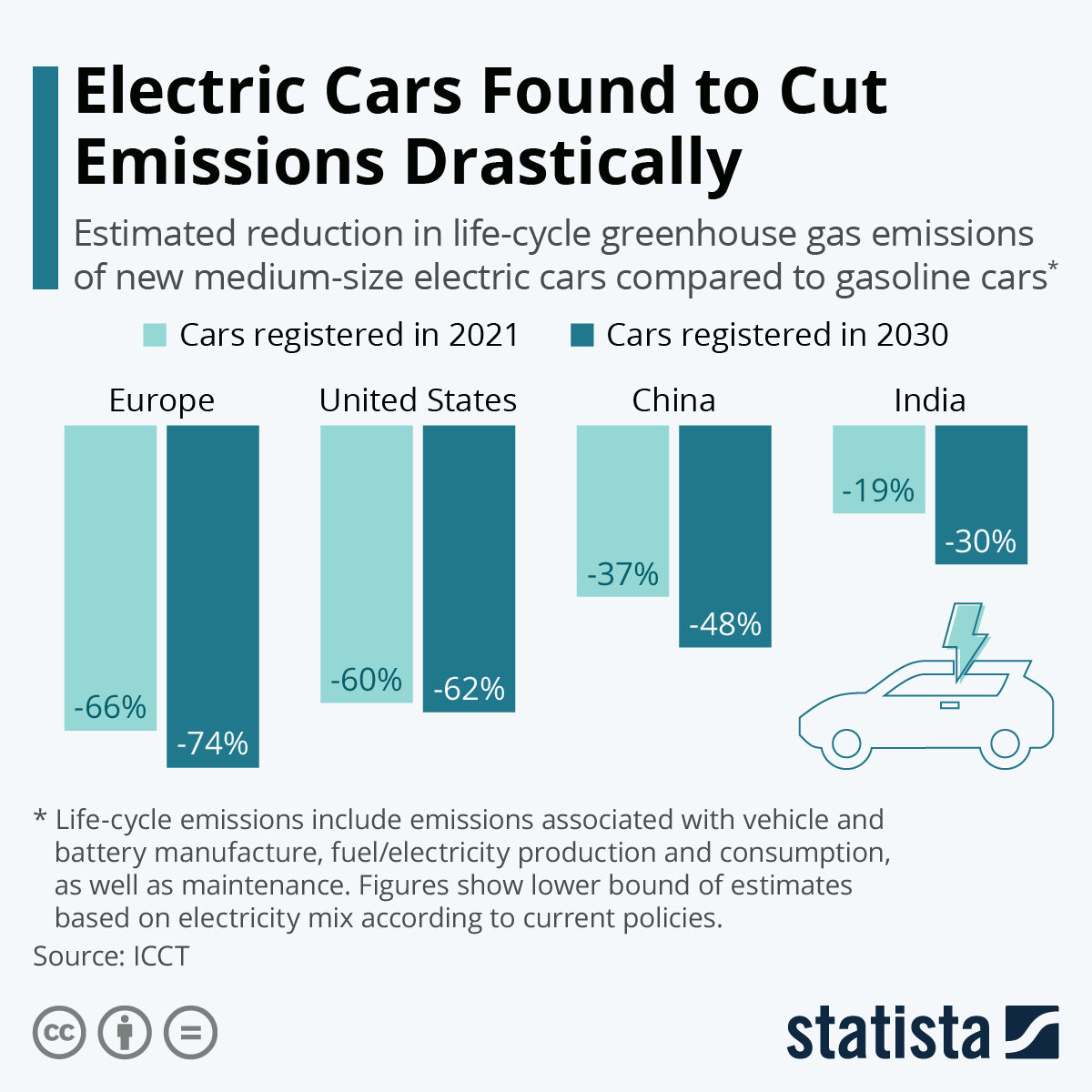
Electric Cars Found to Cut Emissions Drastically


by Felix Richter, Jul 27, 2021


One argument often brought up against the transition to electric cars is the assertion that, all things considered, electric vehicles aren’t that much cleaner than internal combustion engines. Once you take into account battery production and electricity generation, the emissions savings of electric vehicles are minimal at best, so the popular argument goes.

To tackle this argument, the International Council on Clean Transportation (ICCT) published a white paper this month, comparing life-cycle greenhouse gas emissions of combustion engine and electric passenger cars. Taking into account emissions associated with vehicle and battery manufacture, maintenance, fuel consumption and fuel/electricity production, the study finds that electric cars do in fact cut emissions significantly, even in countries where the transition to renewable energy in the electricity mix is still in the early stages.

As illustrated in the following chart, emissions over the lifetime of a mid-sized electric passenger car registered today are already considerably lower than those of a comparable gasoline car. Depending on the current electricity mix and its evolution over the lifetime of the vehicle, emissions savings range from 19-34 percent in India to 66-69 percent in Europe. Moreover, as the decarbonization of energy generation progresses further, the emissions gap between BEVs and cars with combustion engines is expected to widen substantially for cars registered in 2030.

Widening the scope to consider other fuel types as well, the report finds that battery electric vehicles and fuel cell electric vehicles, powered by renewable electricity and green hydrogen, respectively, are the only technologies capable of achieving the emissions reduction in global road transport needed to meet the goals set in the Paris Agreement. Hybrids and plug-in hybrids, the report finds, could be used to reduce fuel consumption during the transition, “but neither provide the magnitude of reduction in greenhouse gas emissions needed in the long term.”

https://www.statista.com/chart/25412/life-cycle-emissions-savings-of-electric-cars/
Reply With Quote
     
     
  #735  
Old Posted Jul 28, 2021, 1:21 PM
CanadaGoose CanadaGoose is offline
 
Join Date: Sep 2014
Posts: 260
Quote:
Originally Posted by roger1818 View Post
One oversite in this article is that when evaluation EV sales in cities, they aren't taking population (or better yet total vehicle sales) into account. Using Estimated CMA population from Wikipedia, the ranking of vehicle sales per 100,000 people are:
Vancouver       164
Victoria 106
Montreal 83
Quebec City 72
Toronto 46
Saskatoon 18
Ottawa–Gatineau 15
Winnipeg 9
Regina 9
The top 4 seem to have a lot in common.

Must be the hundreds of public L2 (no further than 1km apart from eachother) and L3 chargers laying around the city.


I guess putting chargers in the public eye encourages people to think: hmm, I can charge my EV here if i get one.

For me, I did purchase mine because I saw Tesla Superchargers near my extended family's home.


----

Well, I hope those on-street EV chargers with Envari happen before Winter begins this year.
Reply With Quote
     
     
  #736  
Old Posted Jul 28, 2021, 4:03 PM
roger1818's Avatar
roger1818 roger1818 is offline
 
Join Date: Feb 2016
Posts: 6,610
Quote:
Originally Posted by CanadaGoose View Post
The top 4 seem to have a lot in common.

Must be the hundreds of public L2 (no further than 1km apart from eachother) and L3 chargers laying around the city.
That is certainly one factor. The fact that both BC and Quebec have incentives (in addition to the federal one) for buying an EV helps a lot as well.
Reply With Quote
     
     
  #737  
Old Posted Jul 28, 2021, 9:11 PM
CanadaGoose CanadaGoose is offline
 
Join Date: Sep 2014
Posts: 260
Better late than never. This was post to be built in 2018-2019.

Now, i wonder what the word "fastest" means.

https://twitter.com/mflalonde/status/1420460421375479815

Last edited by CanadaGoose; Jul 28, 2021 at 9:30 PM.
Reply With Quote
     
     
  #738  
Old Posted Jul 29, 2021, 1:35 AM
Virplex Virplex is offline
 
Join Date: Sep 2020
Posts: 4
Quote:
Originally Posted by CanadaGoose View Post
Better late than never. This was post to be built in 2018-2019.

Now, i wonder what the word "fastest" means.

https://twitter.com/mflalonde/status/1420460421375479815
Given that all the other City owned chargers are Level 2, I believe (including the ones scheduled to be installed at the Lois Kemp Arena this year), it wouldn't take much for these to be the "fastest" ones owned by the city.
Reply With Quote
     
     
  #739  
Old Posted Jul 29, 2021, 2:35 AM
roger1818's Avatar
roger1818 roger1818 is offline
 
Join Date: Feb 2016
Posts: 6,610
Quote:
Originally Posted by CanadaGoose View Post
Better late than never. This was post to be built in 2018-2019.

Now, i wonder what the word "fastest" means.

https://twitter.com/mflalonde/status/1420460421375479815
Seems silly to me to be installing a DC Fast charger at a recreation complex. Do they expect you to run out in your bathing suit or skates to move your car once it is finished charging? Yes Orleans needs DC fast charging but there has to be a better location, and one charger is hardly enough.

Quote:
Originally Posted by Virplex View Post
Given that all the other City owned chargers are Level 2, I believe (including the ones scheduled to be installed at the Lois Kemp Arena this year), it wouldn't take much for these to be the "fastest" ones owned by the city.
I guess it depends on how you define city owned. Off the top of my head (there may be others), there are DC Fast chargers at the following city owned locations (though they are all 50kW and managed by Electric Circuit):All of them are silly locations for DCFCs (Level 2 charging would make far more sense at those locations).

Last edited by roger1818; Jul 29, 2021 at 3:29 AM.
Reply With Quote
     
     
  #740  
Old Posted Jul 29, 2021, 4:42 AM
CanadaGoose CanadaGoose is offline
 
Join Date: Sep 2014
Posts: 260
They aren’t silly locations.

Terry Fox is beside the 417 and is perfect for those in Perth, and beyond.

Fallowfield serves people coming from the 416.

Chinatown serves Uhm Uhm… people who don’t have a Tesla.

Dalhousie served as the place… people go to when the Chinatown charger is being used.
Reply With Quote
     
     
This discussion thread continues

Use the page links to the lower-right to go to the next page for additional posts
 
 
Reply

Go Back   SkyscraperPage Forum > Regional Sections > Canada > Ontario > Ottawa-Gatineau > Transportation
Forum Jump


Forum Jump


All times are GMT. The time now is 12:11 AM.


Powered by vBulletin® Version 3.8.7
Copyright ©2000 - 2026, vBulletin Solutions, Inc.