HomeDiagramsDatabaseMapsForum About
     

Go Back   SkyscraperPage Forum > Regional Sections > Canada


Reply

 
Thread Tools Display Modes
     
     
  #2261  
Old Posted Jun 9, 2021, 11:15 AM
J.OT13's Avatar
J.OT13 J.OT13 is offline
Moderator
 
Join Date: Mar 2012
Location: Ottawa
Posts: 27,641
Quote:
Originally Posted by Truenorth00 View Post
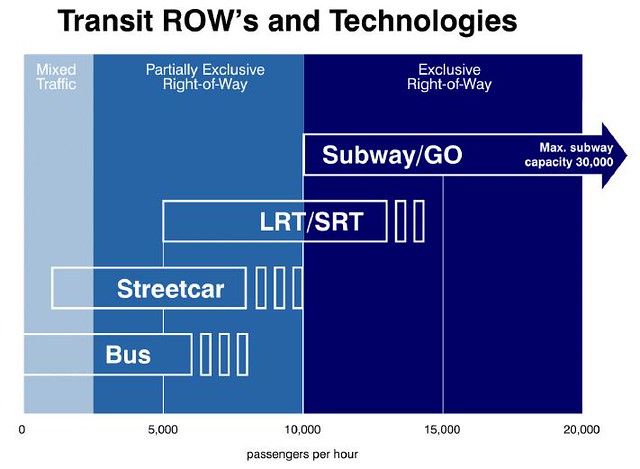
See the diagram below. So in your estimate, 20-30 years from now, Ottawa will need a Trillium line at 10-20k pphpd and a Bank St subway at 20-30k pphpd, 2 km away? Are you envisioning Bank St becoming like Broadway in Manhattan?


No one is advocating a heavy rail subway of 30k phpd. We're presenting Canada Line as an example of what would be feasible for Bank, wit a max capacity of 15k phpd. Both corridors have a lot in common (denser urban core, mid-century suburban stretch, airport, modern suburb). Canada Line might serve more people, Bank has a major sports and entertainment complex.

Canada Line's initial capacity when built in 2010 was 6,100 phpd. In 2016, it carried 5,500 phpd. Capacity has just recently been increased to 8,000 phpd.

No one would argue Canada Line was overbuilt. In fact, many argue its underbuilt. Everyone agrees that an initial proposal for surface LRT would not have been adequate.

https://dailyhive.com/vancouver/shor...aring-capacity

https://dailyhive.com/vancouver/cana...uency-skytrain

As for capacity on Trillium, it's only 1,300 phpd, set to increase to 2,500 phpd. I anticipate that capacity will be eaten-up in no time once Stage 2 opens. Best case scenario to increase capacity further without shutting down the line, which would mean double tracking everything but the Dow's Lake tunnel and Rideau River Bridge, would be 6 to 8 minute frequencies, so 5,000 to 3,750 phpd. At that point, transfers at Bayview become problematic.

EDIT: for comparison, Confederation Line has a max capacity of 24,000 phpd and currently (pre-Covid) of 10,000 phpd or so. And that as the spine of the system. Expo Line operates with a capacity of approximately 15,000 pphpd, while the Millennium Line operates with roughly 5,000 pphpd.

Last edited by J.OT13; Jun 9, 2021 at 11:27 AM.
Reply With Quote
     
     
  #2262  
Old Posted Jun 9, 2021, 11:22 AM
Truenorth00 Truenorth00 is offline
Registered User
 
Join Date: May 2017
Posts: 28,371
Quote:
Originally Posted by Beedok View Post
My simple solution to improve transit to the Glebe: run a bus down O’Conner and/or Percy.
There's buses today. Down Bank St. And they have lower ridership than just avenues in Toronto. But yet here we are debating why they should get billion dollar subways underneath.

If Bank has a case for a subway, so does Lawrence, Finch, Bathurst, Spadina, St. Clair, etc. in Toronto. We should be handing out billion dollar subways Oprah style. "You get a subway! You get a subway! Everybody gets a subway!"

The funny part is that a Bank subway is only ever pushed by internet railfans. No planners would ever embarrass themselves putting it in an official document. This is entirely different from debates over say the Downtown Relief Line or Scarborough Subway Extension in Toronto. Those have been debated among planners, politicians and voters and have had public proponents on both sides for decades, with ridership analysis to support them. And they were still controversial.
Reply With Quote
     
     
  #2263  
Old Posted Jun 9, 2021, 11:34 AM
Beedok Beedok is offline
Exiled Hamiltonian Gal
 
Join Date: Jun 2012
Posts: 6,829
Quote:
Originally Posted by Truenorth00 View Post
There's buses today. Down Bank St. And they have lower ridership than just avenues in Toronto. But yet here we are debating why they should get billion dollar subways underneath.

If Bank has a case for a subway, so does Lawrence, Finch, Bathurst, Spadina, St. Clair, etc. in Toronto. We should be handing out billion dollar subways Oprah style. "You get a subway! You get a subway! Everybody gets a subway!"

The funny part is that a Bank subway is only ever pushed by internet railfans. No planners would ever embarrass themselves putting it in an official document. This is entirely different from debates over say the Downtown Relief Line or Scarborough Subway Extension in Toronto. Those have been debated among planners, politicians and voters and have had public proponents on both sides for decades, with ridership analysis to support them. And they were still controversial.
Oh, yeah, for my money I think the area is fine for buses (slow at rush hour, but fine otherwise good). But, if the population does grow somewhat more, I could see another bus route or two in the area would handle any demand increase for the next couple decades.

Also, like, if they’re concerned about the South Keys area, there’s already two rapid transit lines that connect to Line 1 providing easy access to downtown (both Line 2 and the Transitway). Those two transfer points will surely be able to handle any demand Ottawa’s growth can throw at them any time soon.
Reply With Quote
     
     
  #2264  
Old Posted Jun 9, 2021, 11:40 AM
Truenorth00 Truenorth00 is offline
Registered User
 
Join Date: May 2017
Posts: 28,371
Quote:
Originally Posted by J.OT13 View Post
No one is advocating a heavy rail subway of 30k phpd. We're presenting Canada Line as an example of what would be feasible for Bank, wit a max capacity of 15k phpd.
The exact form is irrelevant. It's grade separation that drives cost. Particularly tunneling, which is what most Bank St. subway advocates prefer. I haven't seen a lot of advocacy for an elevated train.

Quote:
Originally Posted by J.OT13 View Post
Both corridors have a lot in common (denser urban core, mid-century suburban stretch, airport, modern suburb). Canada Line might serve more people, Bank has a major sports and entertainment complex.
1) A major sports and entertainment complex is not justification for billion dollar transit lines since they aren't used daily.

2) As you point out the Canada Line serves more people which is what drives the requirement to grade separate. This isn't exactly some minor detail to gloss over.

Quote:
Originally Posted by J.OT13 View Post
As for capacity on Trillium, it's only 1,300 phpd, set to increase to 2,500 phpd. I anticipate that capacity will be eaten-up in no time once Stage 2 opens. Best case scenario to increase capacity further without shutting down the line, which would mean double tracking everything but the Dow's Lake tunnel and Rideau River Bridge, would be 6 to 8 minute frequencies, so 5,000 to 3,750 phpd. At that point, transfers at Bayview become problematic.
Trillium is a fully segregated, grade separated, heavy rail corridor. There's GO corridors in Toronto which haven't achieved this. So it most certainly can be upgraded to substantial capacity if needed.

I agree that Bayview will eventually max out. But there's zero evidence that a Canada Line style line with 15 000 pphpd is needed to provide relief. Depending on where development lands in the next 20-30 years (and I'm deeply skeptical a lot of it will be on Bank), a tramway on Bank, upgraded Trillium (twin tracked and electrified), and capacity boosted Confederation Line would be enough capacity for decades.

The kind of capacity you're advocating for (on par with Scarborough Subway Extension), would require all the growth Ottawa gets to end up on Bank. I have my doubts that is going to happen with so many TOD sites along the Trillium and Confederation Line opening up.
Reply With Quote
     
     
  #2265  
Old Posted Jun 9, 2021, 12:05 PM
Beedok Beedok is offline
Exiled Hamiltonian Gal
 
Join Date: Jun 2012
Posts: 6,829
Quote:
Originally Posted by J.OT13 View Post
As for capacity on Trillium, it's only 1,300 phpd, set to increase to 2,500 phpd. I anticipate that capacity will be eaten-up in no time once Stage 2 opens. Best case scenario to increase capacity further without shutting down the line, which would mean double tracking everything but the Dow's Lake tunnel and Rideau River Bridge, would be 6 to 8 minute frequencies, so 5,000 to 3,750 phpd. At that point, transfers at Bayview become problematic.

EDIT: for comparison, Confederation Line has a max capacity of 24,000 phpd and currently (pre-Covid) of 10,000 phpd or so. And that as the spine of the system. Expo Line operates with a capacity of approximately 15,000 pphpd, while the Millennium Line operates with roughly 5,000 pphpd.
And the South West Transitway, as a grade separated BRT line with passing lanes, surely has a capacity in excess of 10,000pphpd (I haven’t found hard numbers for Ottawa, but similar systems around the world can push 30,000pphpd), with only a single transfer to downtown. The BRT system outside of downtown has never really pushed capacity, and can serve the south end’s transit needs for the foreseeable future. (Even if the bus shelters at Hurdman could have been nicer...)
Reply With Quote
     
     
  #2266  
Old Posted Jun 9, 2021, 12:16 PM
Truenorth00 Truenorth00 is offline
Registered User
 
Join Date: May 2017
Posts: 28,371
Quote:
Originally Posted by Beedok View Post
If Hamilton can plan to put surface LRT down a stretch like this, then Ottawa can have surface LRT on Bank.
Thank you. I would love to have someone tell me what the difference is between King St in Hamilton and Bank in Ottawa. And why the former can only do LRT, while the latter "needs" a subway.

Quote:
Originally Posted by biguc View Post
One other point; some people seem worried about deliveries on Bank if it closed to cars. There's no reason delivery vehicles can't travel onto a closed street to make deliveries.

https://www.google.com/maps/@52.5210...m1!1e3!5m1!1e2
Berlin Alexanderplatz is a big pedestrianized area. Trams run through it (a benefit of trams over busses) but no cars. Delivery vehicles, however, are free to simply drive into the platz.
There's plenty that can be done. But it requires a willingness to give up space for cars. As you can see in these discussions, people will twist themselves into pretzels to justify just why Bank St is so special that it can't take roadspace away from cars here.

Quote:
Originally Posted by biguc View Post
I assume something similar must happen on Sparks street.
Sparks is designed for deliveries. Cross streets have bollards. They lower them and let delivery vans through every morning. Used to see it Pre-Covid on my commute. You'll also see plenty of deliveries just park on the cross street and just cart it in. None of this is rocket surgery. But when you start out with the idea that it can't be done, that's the conclusion you'll get to.

I would love Bank and Elgin to be closed to traffic. I believe that will help them fullfill their full potential.
Reply With Quote
     
     
  #2267  
Old Posted Jun 9, 2021, 12:39 PM
jamincan jamincan is offline
Registered User
 
Join Date: Jul 2020
Location: KW
Posts: 1,812
It would be interesting to see how far you can improve surface-transit without an exclusive ROW. B-line in Vancouver and King St streetcar in Toronto would be good case-studies, but I think there are some key differences from Bank Street that could lead to much better service on Bank.

There's no reason that you even need rail to address shortcomings, but one nice side-effect of the vehicle choice for the Confederation Line is that they could easily use the same vehicles for surface trams if they so desired.
Reply With Quote
     
     
  #2268  
Old Posted Jun 9, 2021, 12:47 PM
Truenorth00 Truenorth00 is offline
Registered User
 
Join Date: May 2017
Posts: 28,371
Till Aylmer posted it, I would never have guessed that Bank has that much active transport. Might be even easier to get rid of cars on Bank than we think. The community might actually support this.
Reply With Quote
     
     
  #2269  
Old Posted Jun 9, 2021, 1:02 PM
hipster duck's Avatar
hipster duck hipster duck is offline
Registered User
 
Join Date: Oct 2014
Location: Toronto
Posts: 4,749
Quote:
Originally Posted by jamincan View Post
It would be interesting to see how far you can improve surface-transit without an exclusive ROW. B-line in Vancouver and King St streetcar in Toronto would be good case-studies, but I think there are some key differences from Bank Street that could lead to much better service on Bank.

There's no reason that you even need rail to address shortcomings, but one nice side-effect of the vehicle choice for the Confederation Line is that they could easily use the same vehicles for surface trams if they so desired.
I’m quite familiar with both. King street in Toronto is a bit more analogous to Bank St, since Broadway in Vancouver is a 6 lane road with long block lengths. When I was riding it in the weekday rush out of the Financial district, the main impediment seemed to be block lengths and the length of the streetcars. The block between York and University could squeeze in one 30m streetcar, and all streetcars behind it had to queue up behind the intersection and miss light cycles.

You basically had crush-load streetcars lined up one after another moving in a convoy. It’s effective and quite speedy for trips under 3 km (west of Bathurst, the streetcar lightened up considerably), but it maxed out at 84,000 riders/day.

The other problem with streetcars is the ability to deploy vehicles in the event of a surge in demand or an incident. Toronto kind of attempts to solve this with short turns, but there aren’t many places where a streetcar can just sit to the side and be called into action like a bus can. But that’s a problem inherent to rail, regardless of whether it’s grade separated or not.
Reply With Quote
     
     
  #2270  
Old Posted Jun 9, 2021, 2:13 PM
Nouvellecosse's Avatar
Nouvellecosse Nouvellecosse is online now
Volatile Pacivist
 
Join Date: Aug 2005
Location: Nova Scotia
Posts: 10,950
Quote:
Originally Posted by biguc View Post
Some good, deep discussion in this thread. Some of you are getting heated but there seems to be a general consensus that Bank should have higher-order transit and traffic restrictions. Sounds great!

Just to spitball an idea to that effect: I don't know why we don't do cut-and-cover tunnelling anymore. Unnecessarily spending billions on tunnelling to not disrupt traffic for a year or two is the ultimate in foolhardy concessions to drivers.

To me it seems like a great opportunity for a road diet. Give people a break from using a route by digging it up. Install a metro line (it could be something small, even like Budapest's dinky line 1, which is basically an underground tram), and cap over it with a narrower street with more space for pedestrians and cyclists.
I remember reading about this outcomes of the Canada line cut and cover process. It seems the major issue is less about driver and more about local businesses who would be affected by both disruption to car traffic and bus traffic. This article sums things up nicely.

Quote:
Because of the negative community sentiment that often accompanies "cut and cover" construction, almost all new subway construction is done using the "deep bore" method. One exception was Vancouver B.C.'s recently opened Canada Line and proves to be an excellent example of problems caused by the disruptive nature of the "cut and cover" method. One merchant has already won a lawsuit for C$600,000 - since overturned on appeal - due to damages caused by construction disruption, and 41 additional plaintiffs filed suit last year to recover damages. Interestingly, the amount of money they wish to receive is equal to the savings realized by building the line using the "cut and cover" method instead of the "deep bore".

It is likely that uproar over the temporary disruptions that accompany "cut and cover" construction will mean that almost all subway construction in the future, at least in the United States and Canada, will be of the "deep bore" variety, with the exception that soil conditions may mandate "cut and cover" construction.
https://www.liveabout.com/methods-of...uction-2798523
__________________
"The reasonable man adapts himself to the world; the unreasonable one persists in trying to adapt the world to himself. Therefore all progress depends on the unreasonable man." - George Bernard Shaw
Don't ask people not to debate a topic. Just stop making debatable assertions. Problem solved.
Reply With Quote
     
     
  #2271  
Old Posted Jun 9, 2021, 2:19 PM
Truenorth00 Truenorth00 is offline
Registered User
 
Join Date: May 2017
Posts: 28,371
Those impacts are there elsewhere too. Governments just don't care and push through. Listen to NIMBYs and nothing will get built our it comes in at double the price.
Reply With Quote
     
     
  #2272  
Old Posted Jun 9, 2021, 2:31 PM
milomilo milomilo is offline
Registered User
 
Join Date: Dec 2013
Location: Calgary
Posts: 10,498
Yeah, a lot of the time when there is a negative reaction to cut and cover or surface LRT, the accusation is made that it's because people care about cars too much, but it often isn't the case. As said, cut and cover is hugely disruptive and governments care more now about whether it destroys businesses. In the case of surface LRT, IMO it often has little advantage over buses so it does not provide good cost benefit, and the more you try and improve the LRT by removing crossings, increasing separation etc the worse the experience on the rest of the road gets, especially if it's a narrow road.
Reply With Quote
     
     
  #2273  
Old Posted Jun 9, 2021, 2:55 PM
Aylmer's Avatar
Aylmer Aylmer is offline
Still optimistic
 
Join Date: Nov 2007
Location: Montreal (C-D-N) / Ottawa (Aylmer)
Posts: 5,407
Quote:
Originally Posted by biguc View Post

That's really, really good to see. It'll be easier than I thought!

I do mean all trips though, not just commutes that originate there. There's a difference in how Europe and Canada measure these things and it's pretty meaningful on the ground. When you're in Copenhagen and 50% of trips are bike bike, you're in a serene cyclist's paradise. When you're in Vancouver and 50% of trips are by bike, you're very much not. You're still bombarded by car traffic from the suburbs, or from people not commuting at that moment but driving around for other reasons.

Ideally, you want to bring all trips in that area down bellow 50%. That's a bit tougher. Especially when a highway runs through it. But if you saturate the area with good transit, and prioritize that transit's place on streets, it will happen.


That map is really nice, by the way. Where did you find it?
It's Census Mapper, the armchair planner's friend.

And you're entirely right about the distinction between commute mode share and total mode share. Unfortunately, we don't have good non-commute statistics. The best we have is 2011's Origin-Destination Survey.
__________________
I've always struggled with reality. And I'm pleased to say that I won.
Reply With Quote
     
     
  #2274  
Old Posted Jun 9, 2021, 9:08 PM
J.OT13's Avatar
J.OT13 J.OT13 is offline
Moderator
 
Join Date: Mar 2012
Location: Ottawa
Posts: 27,641
Quote:
Originally Posted by Truenorth00 View Post
Thank you. I would love to have someone tell me what the difference is between King St in Hamilton and Bank in Ottawa. And why the former can only do LRT, while the latter "needs" a subway.
Well, King Street is one many crosstown east-west streets through downtown Hamilton. Bank is one of only two crosstown north-south streets through downtown Ottawa. I know that's not going to convince you, but that is my argument.

If the conversation was about shutting down one of Ottawa's east-west streets between the Trillium Line and the Canal, I'd be all for it. Plenty to spare.

There's also that conversation with the STO tram and Wellington at the moment. I would raise a similar argument as with Bank as it's only one of two crosstown east-west streets north of the Queensway however, for the sake of the loop, which is absolutely essential for the STO's long term capacity through Ottawa, because it's not a traditional main street and because it would provide more public space for celebrations, protests and gatherings, I'm supportive of shutting it down for trams and active transportation.

Quote:
Originally Posted by milomilo View Post
IMO it often has little advantage over buses so it does not provide good cost benefit, and the more you try and improve the LRT by removing crossings, increasing separation etc the worse the experience on the rest of the road gets, especially if it's a narrow road.
I agree. Streetcars provided little more capacity or speed for the cost. If the choices are spending $1B for minor improvements by building a streetcar, or $3B for a far higher capacity and faster light metro, then it's worth the extra $2B.

As I've said, I would support bus priority measures at rush hour and during Lansdowne events along Bank. If ever we're ready for a major infrastructure upgrade, then we're better to take the leap to light metro and solve multiple issues (such as Bayview and Hurdman transfer capacity, should they arise) at once.

That said, streetcars or tramways are the right choice in certain cases. Gatineau and Quebec City tramways are good examples. Carling, where we can easily sacrifice two out of six-eight lanes and there are few traffic lights to slow down the streetcar.

Reply With Quote
     
     
  #2275  
Old Posted Jun 9, 2021, 9:25 PM
Truenorth00 Truenorth00 is offline
Registered User
 
Join Date: May 2017
Posts: 28,371
Quote:
Originally Posted by J.OT13 View Post
Well, King Street is one many crosstown east-west streets through downtown Hamilton. Bank is one of only two crosstown north-south streets through downtown Ottawa. I know that's not going to convince you, but that is my argument.
Yeah. I don't see that as a valid argument. And it speaks to exactly what I was talking about with Hybrid24/7 when I said a lot of the arguments for grade separation are based on facilitating vehicular traffic. Thanks for at least being more explicit about that.

With Bronson and Bank traffic being able to flow into QED, I just doing this closures are that big an issue. Closed to car traffic north of Lansdowne or Billings Bridge. Median running like Finch or Eglinton East for the rest.


Quote:
Originally Posted by J.OT13 View Post
I agree. Streetcars provided little more capacity or speed for the cost. If the choices are spending $1B for minor improvements by building a streetcar, or $3B for a far higher capacity and faster light metro, then it's worth the extra $2B.

As I've said, I would support bus priority measures at rush hour and during Lansdowne events along Bank. If ever we're ready for a major infrastructure upgrade, then we're better to take the leap to light metro and solve multiple issues (such as Bayview and Hurdman transfer capacity, should they arise) at once.

That said, streetcars or tramways are the right choice in certain cases. Gatineau and Quebec City tramways are good examples. Carling, where we can easily sacrifice two out of six-eight lanes and there are few traffic lights to slow down the streetcar.

It's not so much the rolling stock that determines capacity. It's the level of segregation and exclusivity of the corridor. And that is actually what most of the spending is going towards in any project. Be it a tramway or a subway. If all you want to do is put tracks and run streetcars down Bank, just like a bus today, that isn't going to be that expensive.

A tram is appropriate here because it needs less room than a bus. And throughput can be higher.
Reply With Quote
     
     
  #2276  
Old Posted Jun 9, 2021, 10:16 PM
jamincan jamincan is offline
Registered User
 
Join Date: Jul 2020
Location: KW
Posts: 1,812
While I don't actually think Ottawa should build a subway under Bank, I think it would be a mistake to look at current transit usage along Bank and conclude that it wouldn't support a higher level of transit. The current alignment of the Confederation Line had no ridership at all when the Transitway was built, after all, nor did the Trillium Line when the O-Train was trialed.

Any argument for a subway under Bank presupposes a pretty major rejigging of transportation patterns, and so it's entirely reasonable to assume much higher use of a subway compared to the local bus service that exists now.

In a different world where Ottawa was bigger 20-30 years earlier, subways probably would have been built under Bank Street and Rideau/Albert or Somerset or something. Instead, transit patterns direct people away from main streets to their detriment. Unfortunately Ottawa will likely live with the legacy of the NCC ripping up the railways and the city building Transitways along the old corridors for the rest of it's existence.
Reply With Quote
     
     
  #2277  
Old Posted Jun 9, 2021, 10:25 PM
Truenorth00 Truenorth00 is offline
Registered User
 
Join Date: May 2017
Posts: 28,371
I agree that the city will be different in 20-30 years. I struggle to see how this works in favour of Bank. Development is really starting to favour sites close to the existing rail lines. So 20-30 years of that and Ottawa will be very different, and Bank relatively less important.

Moreover, Bank has a lot of "stable" neighbourhoods that would be highly resistant to the intensification happening elsewhere.

So basically the case for a Bank St subway boils down to a commuter line from the south to downtown that skips the transfer at Bayview. That capacity can be provided in different ways. It shouldn't be automatically assumed that tunneling under Bank is the only solution.
Reply With Quote
     
     
  #2278  
Old Posted Jun 10, 2021, 1:02 AM
Beedok Beedok is offline
Exiled Hamiltonian Gal
 
Join Date: Jun 2012
Posts: 6,829
Quote:
Originally Posted by J.OT13 View Post
Well, King Street is one many crosstown east-west streets through downtown Hamilton. Bank is one of only two crosstown north-south streets through downtown Ottawa. I know that's not going to convince you, but that is my argument.
If we ignore Prince of Wales feeding into Preston and the QED. And Smyth to Main to several options. And the Riverside+Vanier Parkways feeding into the Queensway to connect you to downtown.

It’s also worth noting that there are certain choke points where Hamilton’s B-Line is going to be running. The Chedoke Expressway only really has three streets crossing it between Westdale (where McMaster is, basically like Hamilton’s equivalent of Old Ottawa South) and Downtown, while the Red Hill Valley Parkway likewise only has three streets connecting Stoney Creek (a rather dense part of the urban area) to the core. The western choke point will see a new bridge built for the LRT, but it’s still going to be taking up lanes right near that bridge. The eastern one will just have LRT running along the street the whole way. It’s not too dissimilar of a situation.
Reply With Quote
     
     
  #2279  
Old Posted Jun 10, 2021, 3:11 AM
lrt's friend lrt's friend is offline
Registered User
 
Join Date: Dec 2006
Posts: 12,605
Now on the Canada board, the same tired arguments about Ottawa's Bank Street. Talk about airing our dirty laundry.

The assumption is made that only reason to build rapid transit to the south end is to serve Riverside South as if nobody lives elsewhere and there are no prospects of intensification at those other locations.

The current situation with the new Confederation Line and the again closed Trillium Line (and yes, there will be another lengthy closure in the future) is just fabulous when you have to deal with two transfers since the opening of the Confederation Line. No wonder I have not used transit from my home since it opened in 2019. It is too unreliable and unpredictable. But we all know that rapid transit in Ottawa is designed not to serve modest income neighbourhoods. Hence the embarrassment of designing the Confederation Line to preclude a station at Jasmine Crescent.

I can hardly wait for the opening of the airport spur white elephant, and the zero improvement in service for those living inside the Greenbelt near the Trillium Line, all for just $600M.
Reply With Quote
     
     
  #2280  
Old Posted Jun 10, 2021, 3:16 AM
Hybrid247 Hybrid247 is offline
Registered User
 
Join Date: Oct 2009
Posts: 1,312
Quote:
Originally Posted by jamincan View Post
While I don't actually think Ottawa should build a subway under Bank, I think it would be a mistake to look at current transit usage along Bank and conclude that it wouldn't support a higher level of transit. The current alignment of the Confederation Line had no ridership at all when the Transitway was built, after all, nor did the Trillium Line when the O-Train was trialed.

Any argument for a subway under Bank presupposes a pretty major rejigging of transportation patterns, and so it's entirely reasonable to assume much higher use of a subway compared to the local bus service that exists now.
That's pretty much my thoughts on it, at least in part. I find we often underestimate people's willingness to take transit in this country when higher quality modes are implemented. We've seen it with Canada Line and even more recently with Trillium Line. In Canada Line's case, ridership forecasts not only severely underestimated day 1 ridership but also the rate of growth, making it a victim of its own success in some ways.

After Trillium Line's huge ridership jump in 2019 (after confed line opened), I suspect planners might be rethinking how to move forward with double-tracking it due to the prospect of it bringing substantially higher peak hour transfers to Bayview than expected. If you look at the ridership forecasts from the Stage 2 Project Agreement, you can see they only anticipated 624 EB peak hour boardings in 2048, which I suspect was actually surpassed in 2019.

Reply With Quote
     
     
This discussion thread continues

Use the page links to the lower-right to go to the next page for additional posts
 
 
Reply

Go Back   SkyscraperPage Forum > Regional Sections > Canada
Forum Jump


Forum Jump


All times are GMT. The time now is 10:47 PM.

     
SkyscraperPage.com - Privacy Statement - Top

Powered by vBulletin® Version 3.8.7
Copyright ©2000 - 2026, vBulletin Solutions, Inc.