HomeDiagramsDatabaseMapsForum About
     

Go Back   SkyscraperPage Forum > Regional Sections > Canada


Closed Thread

 
Thread Tools Display Modes
     
     
  #15761  
Old Posted May 17, 2021, 5:30 PM
someone123's Avatar
someone123 someone123 is offline
hähnchenbrüstfiletstüc
 
Join Date: Nov 2001
Location: Vancouver
Posts: 35,643
There is a staff report from 2020 and I think this was essentially approved by council:
https://www.halifax.ca/sites/default/files/documents/city-hall/regional-council/200526rc917.pdf

Around page 45 they show detailed maps. Looks like around 2/3 of the BRT routes will be in 2-way transit lanes. I would guess that these lanes will generally have signal priority where it makes sense, plus some stretches beyond would have it too.
     
     
  #15762  
Old Posted May 17, 2021, 5:42 PM
hipster duck's Avatar
hipster duck hipster duck is online now
Registered User
 
Join Date: Oct 2014
Location: Toronto
Posts: 4,834
Quote:
Originally Posted by swimmer_spe View Post
You had me up to your last paragraph. The problem is, right now, there is zero budget for it. The city has not announced anything. Neither has the province or federal governments. We are assuming what would be a budget. What if the budget was tied with metrics? What if instead of what can be afforded, it is based on reducing congestion and increasing ridership? Surface LRT would go out the window quite quickly.
I wasn't thinking about a plan that fit the city's existing budget. I was thinking about what kind of higher-order transit would probably offer the best solution for Halifax's transportation issues.

I don't think rail is feasible off the downtown peninsula unless it's lower-cost commuter rail or low investment "rapid transit" like the Trillium Line in Ottawa along the CNR line that goes along the west side of Bedford Basin.

At the same time, I don't think a bus solution is ideal for the Halifax peninsula, given the dense, urban built form and narrow right of ways.

And, finally, I think extensive grade separation is too hard to justify from a cost perspective.

So, I think the best solution is a circular LRT that is a mix of at-grade LRT along urban corridors, use of the grade-separated CNR ROW as much as possible on the western leg, and some strategically placed elevated or short cut and cover tunnel sections to get past heavily-trafficked intersections.

This isn't cheap, but given the rate at which Halifax is growing and the fact that it is pushing a lot of that growth into a dense urban core with few transportation links of any kind, this is the kind of investment that will have to be made eventually.

PS: Express ferries are a great idea, and very low hanging fruit, although they don't get people from downtown to all the trip generators that are a bit inland.

     
     
  #15763  
Old Posted May 17, 2021, 6:10 PM
biguc's Avatar
biguc biguc is online now
Registered User
 
Join Date: Mar 2003
Location: pinkoland
Posts: 11,846
Quote:
Originally Posted by hipster duck View Post

I don't think rail is feasible off the downtown peninsula unless it's lower-cost commuter rail or low investment "rapid transit" like the Trillium Line in Ottawa along the CNR line that goes along the west side of Bedford Basin.


This is exactly how I've thought of the CNR ROW. I think VIA offered to run commuter service along it, which is not a bad idea. That said, the ferries should pick off a lot of the riders that would use that service (and I agree, the ferries are a great idea). Anything more involved than that or something Trillium-esque, and Halifax isn't ready. But down the line, service to Sackville and the airport, even around the Basin will look awful good using that ROW.

Your peninsula circle line, though, is an interesting idea. If I had my druthers I'd probably build a few tram lines now, plan for some kind of commuter rail on the CNR ROW in the medium term, and in the long run turn it into a real metro ring. Other than a new rail bridge to Dartmouth, I have a hard time seeing Halifax ever needing much more.
__________________
no
     
     
  #15764  
Old Posted May 17, 2021, 6:21 PM
biguc's Avatar
biguc biguc is online now
Registered User
 
Join Date: Mar 2003
Location: pinkoland
Posts: 11,846
Quote:
Originally Posted by swimmer_spe View Post
The problem I see is that from Day One of the construction, for the rest of existence, the congestion will not get better, and will get worse. No, it comes down to either building what we have, or what is best. In my Billion dollar figure would be both. We don't have that kind of money. If Halifax went with Surface LRT, I am not saying it would be bad, but it would not do the best to move transit riders better and improve congestion. If you are ignoring the congestion, then, surface LRT is the way to go. However, if you want to fix both, get transit underground. Part of the problem was the buses stopping; holding up traffic.A surface LRT may solve that, but you loose a lane of either on street parking, or a travel lane. Neither of those solves congestion.

Many people like to compare Halifax and Boston. I have ridden the MBRA subway/LRT lines. They are great. None of them are at grade or on the surface in the downtown core. The streetscape of Boston is wonderful.They have buses on the surface. They have on street parking. Congestion is at an expected amount with the size of the city. Let's follow Boston's method. It has worked.

This is it for me: I am ignoring congestion. The point should be moving people, period. If some people want to sit around in cars, going nowhere, that's their problem. We can't build our way out of congestion by worrying about drivers--they'll just drive more. So, take away road space and use it for more efficient transportation.

This has serious knock-on effects: cities get quieter, cleaner, safer, more spacious, more prosperous. For everyone whose identity isn't wrapped up in a steel box, it's nothing but a win.

Boston is a fine American city, but it's a bit big and American for direct Halifax inspo. I'd go for Rostock.
__________________
no
     
     
  #15765  
Old Posted May 17, 2021, 7:23 PM
someone123's Avatar
someone123 someone123 is offline
hähnchenbrüstfiletstüc
 
Join Date: Nov 2001
Location: Vancouver
Posts: 35,643
Quote:
Originally Posted by hipster duck View Post
I wasn't thinking about a plan that fit the city's existing budget. I was thinking about what kind of higher-order transit would probably offer the best solution for Halifax's transportation issues.

I don't think rail is feasible off the downtown peninsula unless it's lower-cost commuter rail or low investment "rapid transit" like the Trillium Line in Ottawa along the CNR line that goes along the west side of Bedford Basin.

At the same time, I don't think a bus solution is ideal for the Halifax peninsula, given the dense, urban built form and narrow right of ways.

And, finally, I think extensive grade separation is too hard to justify from a cost perspective.

So, I think the best solution is a circular LRT that is a mix of at-grade LRT along urban corridors, use of the grade-separated CNR ROW as much as possible on the western leg, and some strategically placed elevated or short cut and cover tunnel sections to get past heavily-trafficked intersections.

This isn't cheap, but given the rate at which Halifax is growing and the fact that it is pushing a lot of that growth into a dense urban core with few transportation links of any kind, this is the kind of investment that will have to be made eventually.

PS: Express ferries are a great idea, and very low hanging fruit, although they don't get people from downtown to all the trip generators that are a bit inland.

For what it's worth I follow the city's transit in a bit of detail (though haven't been back in a few years) and this is my take too.

While the CN ROW is promising I don't think it'll work out in the near term, though you never know what might happen years down the line, and we don't really know why the recent commuter rail discussions fell apart because all of the CN stuff was in camera. I also think it's relatively politically challenging for Halifax to implement a peninsula-specific transit strategy (transit discussion there traditionally went down a bizarre "what about Truro and Musquodoboit?" blind alley), even though it makes complete sense, but that could change too. The 2020 transit plan is not something I would have predicted in 2018. The population on the peninsula is going up a lot and the metro are is becoming more urban-focused over time. The extreme suburban focus has diminished over time since amalgamation. I tend to think that the metro should try to support different lifestyles, whether that's people living in quasi-rural areas with no transit or urban areas where transit is important. Trying to provide the same services levels everywhere is not going to work well. Hopefully people can accept that an area that pays 100x more taxes per acre might have better transit.
     
     
  #15766  
Old Posted May 17, 2021, 7:30 PM
MalcolmTucker MalcolmTucker is online now
Registered User
 
Join Date: May 2007
Posts: 11,578
It would be interesting to see the top 4 destinations, and how if everyone going to those could be intercepted at the bus exchanges and be forced to transfer, onto an extremely high frequency short train metro, if it would help or hinder. As others have said, the destinations in Halifax seem to be spaced perfectly impertfectly for minimizing the number of stations, or only having either 1 circle line, or 1 linear line.


Something like this:


  #15767  
Old Posted May 17, 2021, 7:50 PM
someone123's Avatar
someone123 someone123 is offline
hähnchenbrüstfiletstüc
 
Join Date: Nov 2001
Location: Vancouver
Posts: 35,643
Yes, I think that blue loop more or less ticks the boxes.

One thing that BRT map doesn't show is how all the other bus routes would be realigned to feed into the main lines, so many people would already have to transfer. There is a whole belt of transit service outside of this BRT area. The transfers are basically unavoidable for outer suburbanites given the layout, and the current system only gives an illusion of good coverage ("we'll give you Tantallon to SMU, or Cole Harbour to the dockyards, but if you want Tantallon to dockyards or Cole Harbour to SMU you have to transfer between 2 lines that run at 20 minute frequencies").
     
     
  #15768  
Old Posted May 17, 2021, 7:51 PM
swimmer_spe swimmer_spe is offline
BANNED
 
Join Date: Apr 2014
Posts: 10,743
Quote:
Originally Posted by someone123 View Post
There is a staff report from 2020 and I think this was essentially approved by council:
https://www.halifax.ca/sites/default/files/documents/city-hall/regional-council/200526rc917.pdf

Around page 45 they show detailed maps. Looks like around 2/3 of the BRT routes will be in 2-way transit lanes. I would guess that these lanes will generally have signal priority where it makes sense, plus some stretches beyond would have it too.
Thank you for the link. I am trying to figure out what they will do for Robie and Chebucto roads as they were 3 lanes, last I remembered. They want to take 2 lanes away. It'll be interesting how they do it.

Quote:
Originally Posted by hipster duck View Post
I wasn't thinking about a plan that fit the city's existing budget. I was thinking about what kind of higher-order transit would probably offer the best solution for Halifax's transportation issues.

I don't think rail is feasible off the downtown peninsula unless it's lower-cost commuter rail or low investment "rapid transit" like the Trillium Line in Ottawa along the CNR line that goes along the west side of Bedford Basin.

At the same time, I don't think a bus solution is ideal for the Halifax peninsula, given the dense, urban built form and narrow right of ways.

And, finally, I think extensive grade separation is too hard to justify from a cost perspective.

So, I think the best solution is a circular LRT that is a mix of at-grade LRT along urban corridors, use of the grade-separated CNR ROW as much as possible on the western leg, and some strategically placed elevated or short cut and cover tunnel sections to get past heavily-trafficked intersections.

This isn't cheap, but given the rate at which Halifax is growing and the fact that it is pushing a lot of that growth into a dense urban core with few transportation links of any kind, this is the kind of investment that will have to be made eventually.

PS: Express ferries are a great idea, and very low hanging fruit, although they don't get people from downtown to all the trip generators that are a bit inland.
Outside of downtown, and except for a few roads, surface LRT could work. It are those spots that it won't that will only make traffic worse.

Quote:
Originally Posted by biguc View Post
This is exactly how I've thought of the CNR ROW. I think VIA offered to run commuter service along it, which is not a bad idea. That said, the ferries should pick off a lot of the riders that would use that service (and I agree, the ferries are a great idea). Anything more involved than that or something Trillium-esque, and Halifax isn't ready. But down the line, service to Sackville and the airport, even around the Basin will look awful good using that ROW.

Your peninsula circle line, though, is an interesting idea. If I had my druthers I'd probably build a few tram lines now, plan for some kind of commuter rail on the CNR ROW in the medium term, and in the long run turn it into a real metro ring. Other than a new rail bridge to Dartmouth, I have a hard time seeing Halifax ever needing much more.
3rd Harbour crossing?
This is where I can agree with most of it. I am still stuck on surface LRT on those tight areas.

Quote:
Originally Posted by biguc View Post
This is it for me: I am ignoring congestion. The point should be moving people, period. If some people want to sit around in cars, going nowhere, that's their problem. We can't build our way out of congestion by worrying about drivers--they'll just drive more. So, take away road space and use it for more efficient transportation.

This has serious knock-on effects: cities get quieter, cleaner, safer, more spacious, more prosperous. For everyone whose identity isn't wrapped up in a steel box, it's nothing but a win.

Boston is a fine American city, but it's a bit big and American for direct Halifax inspo. I'd go for Rostock.
If I were to ignore congestion, sure, LRT galore.... But this is not Toronto downtown where that is feasible. I am working in the real world where politicians are going to try to get voted in with the plan.

I'll give you that the port is about the same length, but it appears the downtown cores are at opposite ends of the port. That makes any bridge or tunnel that much harder.

Quote:
Originally Posted by someone123 View Post
For what it's worth I follow the city's transit in a bit of detail (though haven't been back in a few years) and this is my take too.

While the CN ROW is promising I don't think it'll work out in the near term, though you never know what might happen years down the line, and we don't really know why the recent commuter rail discussions fell apart because all of the CN stuff was in camera. I also think it's relatively politically challenging for Halifax to implement a peninsula-specific transit strategy (transit discussion there traditionally went down a bizarre "what about Truro and Musquodoboit?" blind alley), even though it makes complete sense, but that could change too. The 2020 transit plan is not something I would have predicted in 2018. The population on the peninsula is going up a lot and the metro are is becoming more urban-focused over time. The extreme suburban focus has diminished over time since amalgamation. I tend to think that the metro should try to support different lifestyles, whether that's people living in quasi-rural areas with no transit or urban areas where transit is important. Trying to provide the same services levels everywhere is not going to work well. Hopefully people can accept that an area that pays 100x more taxes per acre might have better transit.
I agree. However, I also feel that getting some commuter rail going on existing lines, and future planning new lines on old ROW or on new ROW is something that should be planned and started in the next 20 years.
     
     
  #15769  
Old Posted May 17, 2021, 7:54 PM
swimmer_spe swimmer_spe is offline
BANNED
 
Join Date: Apr 2014
Posts: 10,743
Quote:
Originally Posted by someone123 View Post
Yes, I think that blue loop more or less ticks the boxes.

One thing that BRT map doesn't show is how all the other bus routes would be realigned to feed into the main lines, so many people would already have to transfer. There is a whole belt of transit service outside of this BRT area. The transfers are basically unavoidable for outer suburbanites given the layout, and the current system only gives an illusion of good coverage ("we'll give you Tantallon to SMU, or Cole Harbour to the dockyards..").
Reading the report, it seems buses that follow those routes are going to be cut and go to the nearest terminal. They are not following the Ottawa transit way of doing things.
     
     
  #15770  
Old Posted May 17, 2021, 7:58 PM
someone123's Avatar
someone123 someone123 is offline
hähnchenbrüstfiletstüc
 
Join Date: Nov 2001
Location: Vancouver
Posts: 35,643
Quote:
Originally Posted by swimmer_spe View Post
I agree. However, I also feel that getting some commuter rail going on existing lines, and future planning new lines on old ROW or on new ROW is something that should be planned and started in the next 20 years.
The city declared that they wanted to do it, then VIA's CEO said he thought VIA could operate it and thought their municipal study was out of whack and it was actually a much better proposition than originally thought. Then it went into the black hole when CN got involved. Was it incompatible with freight schedules? Did they want too much money? Or a reasonable amount but the city or VIA wouldn't pay? Or is CN just intransigent for no good reason? Nobody has released enough info publicly to say.
     
     
  #15771  
Old Posted May 17, 2021, 8:50 PM
davidivivid davidivivid is online now
Registered User
 
Join Date: Jul 2010
Location: Ville de Québec City
Posts: 3,045
Video Link


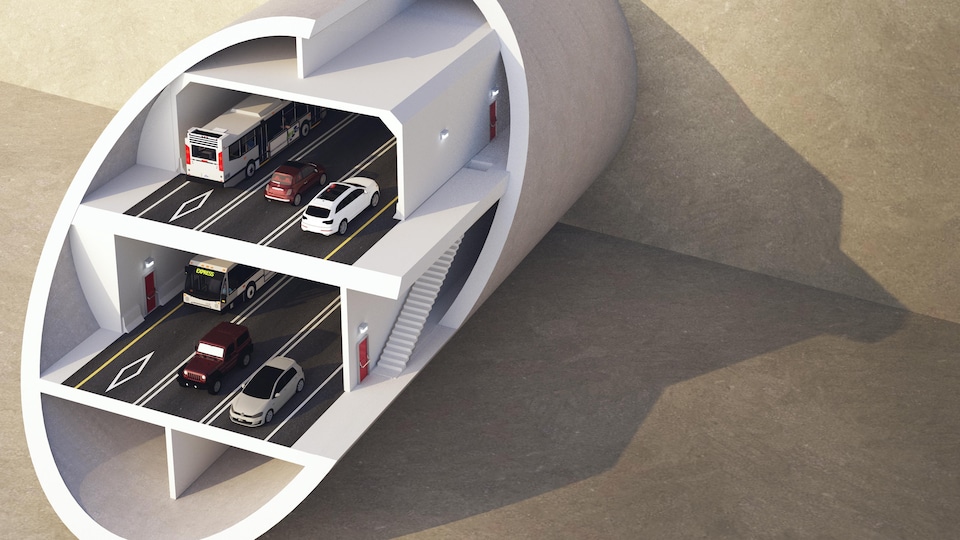
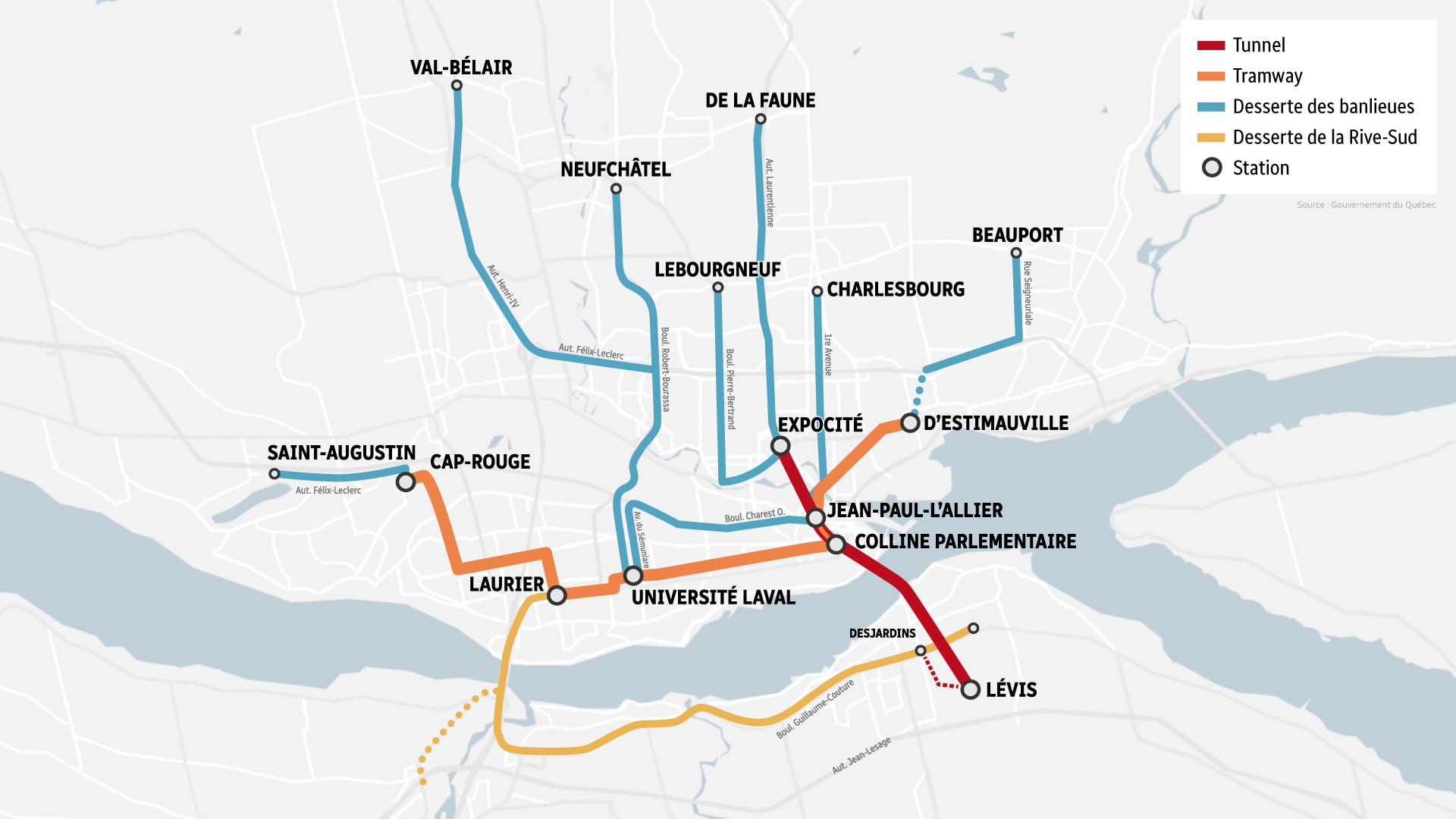
The Government of Quebec presented its vision for Quebec City's future transit masterplan this afternoon. The biggest piece of this vision is an 8,3km tunnel linking Lévis to downtown Quebec City.

The tunnel will have reserved lanes for electric buses in both directions and will have two underground stations with direct links to the tramway system. The first station will be on the Colline Parlementaire and the second in St-Roch, two important employment nods. A first exit will allow motorists to access the Dufferin-Montmorency highway going eastward. The tunnel will then exit near Expocité, where Vidéotron Center is situated. Since the tunnel will exit a little bit further from downtown than previously envisionned, it will allow the Laurentienne highway to be converted into an urban boulevard between Expocité and St-Roch. The cost is estimated at between 6 and 7 billion dollars (though it could and will vary between 10% to 30%) and it will take 10 years to complete.


https://ici.radio-canada.ca/nouvelle/179...IZlA5F99fXEcEPXo7dimdUXs2wN9qAOGpWZWgdOs
__________________
"I went on a diet, swore off drinking and heavy eating, and in fourteen days I lost two weeks" Joe E. Lewis

Last edited by davidivivid; May 17, 2021 at 9:10 PM.
     
     
  #15772  
Old Posted May 17, 2021, 9:12 PM
swimmer_spe swimmer_spe is offline
BANNED
 
Join Date: Apr 2014
Posts: 10,743
Quote:
Originally Posted by someone123 View Post
The city declared that they wanted to do it, then VIA's CEO said he thought VIA could operate it and thought their municipal study was out of whack and it was actually a much better proposition than originally thought. Then it went into the black hole when CN got involved. Was it incompatible with freight schedules? Did they want too much money? Or a reasonable amount but the city or VIA wouldn't pay? Or is CN just intransigent for no good reason? Nobody has released enough info publicly to say.
So, it isn't dead or a live? Kinda like Schrodinger's Transit? Neither planned or cancelled?

Armchair thoughts - It is in the process of being planned, but there are some hurdles to make it happen.

Quote:
Originally Posted by davidivivid View Post
Video Link


The Government of Quebec presented its vision for Quebec City's future transit masterplan this afternoon. The biggest piece of this vision is an 8,3km tunnel linking Lévis to downtown Quebec City.

The tunnel will have reserved lanes for electric buses in both directions and will have two underground stations with direct links to the tramway system. The first station will be on the Colline Parlementaire and the second in St-Roch, two important employment nods. A first exit will allow motorists to access the Dufferin-Montmorency highway going eastward. The tunnel will then exit near Expocité, where Vidéotron Center is situated. Since the tunnel will exit a little bit further from downtown than previously envisionned, it will allow the Laurentienne highway to be converted into an urban boulevard between Expocité and St-Roch. The cost is estimated at between 6 and 7 billion dollars (though it could and will vary between 10% to 30%) and it will take 10 years to complete.


https://ici.radio-canada.ca/nouvelle/179...IZlA5F99fXEcEPXo7dimdUXs2wN9qAOGpWZWgdOs
Cool video. I have questions....

1) will the tunnel be built so that a change to LRT can happen easily enough?

2) What will the grades be? That is not exactly a shallow area, and it isn't very flat on either end.
     
     
  #15773  
Old Posted May 17, 2021, 9:37 PM
FrAnKs's Avatar
FrAnKs FrAnKs is online now
Registered User
 
Join Date: Jul 2005
Location: Ville de Québec / Quebec city
Posts: 5,919
^ Both good questions! Personnaly, I don't know these answers yet.
__________________
PROVINCE OF QUEBEC ==> 9 050 000
MONTREAL METRO ==> 4 600 000
QUEBEC CITY METRO ==> 900 000
     
     
  #15774  
Old Posted May 17, 2021, 10:29 PM
foolworm foolworm is offline
Registered User
 
Join Date: Mar 2020
Posts: 162
Quote:
Originally Posted by FrAnKs View Post
I don't understand what you mean.
The original RS has been butchered to the point where it is unrecognizable and has been superseded by the vision imposed by the Province (the REC) instead -- not that it is bad, but I liked the original proposal.
     
     
  #15775  
Old Posted May 17, 2021, 10:32 PM
someone123's Avatar
someone123 someone123 is offline
hähnchenbrüstfiletstüc
 
Join Date: Nov 2001
Location: Vancouver
Posts: 35,643
Quote:
Originally Posted by swimmer_spe View Post
So, it isn't dead or a live? Kinda like Schrodinger's Transit? Neither planned or cancelled?
This iteration is cancelled and is no longer being pursued by the city. But it's been considered on and off for about 20 years so who knows?

There is a lot of development that has happened along the suburban part of that rail corridor and as the city grows it'll just become more and more attractive. It's hard to believe that the project is unworkable since CN is only using half of the potential track along this route.

There's also some kind of rail project that is funded and is meant to reduce truck traffic in the core. I wonder if that will have any impact. https://www.halifax.ca/transportation/tr...or-street-exchange-redevelopment-project
     
     
  #15776  
Old Posted May 17, 2021, 10:33 PM
Doady Doady is offline
SUSPENDED
 
Join Date: Apr 2004
Posts: 5,166
Quote:
Originally Posted by Beedok View Post
Ottawa has at least one bus within the Greenbelt that operates on an hourly schedule on weekdays. It adds needless stress to my commute during the winter.
I can understand adding a vehicle to an hourly bus route in Ottawa, maybe it would increase frequency by 30 minutes. But then the third vehicle would only increase frequency by 10 minutes, and fourth only by 5 minutes. Adding new vehicles starts to have negligible impact on travel times after a certain point.

I will say again, all of the features that people associate with rapid transit, whether it be high frequencies, limited stops, exclusive ROW, grade separation, it is not about increased speed, but increased capacity. When systems start thinking about rapid transit as a way to lure riders, as a way to fix low ridership instead as a way to fix high ridership, it never works. You see that all over the US. Even in Canada you can see an example of that in York Region Transit and its VIVA BRT system. So much money spent for increased frequencies, all door boarding scheme, fancy stations, transitways, but it didn't make a difference.

That's why all the debates about BRT vs. LRT vs. subway is just pointless. Waterloo made decision to built LRT instead of BRT because of concerns about capacity, and that should be only concern when building rapid transit or when setting the frequency of any route.
     
     
  #15777  
Old Posted May 17, 2021, 10:35 PM
swimmer_spe swimmer_spe is offline
BANNED
 
Join Date: Apr 2014
Posts: 10,743
Quote:
Originally Posted by someone123 View Post
This iteration is cancelled and is no longer being pursued by the city. But it's been considered on and off for about 20 years so who knows?

There is a lot of development that has happened along the suburban part of that rail corridor and as the city grows it'll just become more and more attractive. It's hard to believe that the project is unworkable since CN is only using half of the potential track along this route.

There's also some kind of rail project that is funded and is meant to reduce truck traffic in the core. I wonder if that will have any impact.
Has it actually been canceled, or has it been moved to the back burner till they can sort out the challenges of it. If no actual announcement of cancellation has been made, then it is stuck in transit purgatory - planning.
     
     
  #15778  
Old Posted May 17, 2021, 10:39 PM
Truenorth00 Truenorth00 is offline
Registered User
 
Join Date: May 2017
Posts: 28,729
Quote:
Originally Posted by jamincan View Post
Contrary to your assertion, they did not "want LRT" specifically. It was only 2011 when they finally settled the debate on whether they should build BRT or LRT, and the reason they settled on LRT (among others) is that they projected that BRT would be insufficient for demand within 20 years and they would likely need to replace it with LRT anyway.
Don't see how this is contrary to my assertion that LRT was picked primarily due to development. Not due to any focus on existing riders. The fact that they couldn't even bother buying a few extra LRVs to boost frequencies kinda shows where their priorities are.

I'd argue that frequency should be prioritized over most other factors because it vastly improves convenience. Waterloo chose capacity instead. I think it'll be at least a decade or more till they get to the frequencies they would have today with BRT. Whether that's a good decision for transit users is debatable. I won't deny that it's been great for getting a condo boom going in Waterloo.

Quote:
Originally Posted by jamincan View Post
More nonsense. KW *thought* they would get 2/3 funding from the province and 1/3 from the feds. The province ended up only ponying up 1/3 and the region committed to cover the shortfall. Metrolinx ownership of the line wasn't even considered or pushed at any point.
I think you misunderstood my point.

All the LRT lines in the GTA are owned by Metrolinx. Which is also why the province pays up for all of it.

My point was that nobody else is getting this deal. Even Waterloo which is just outside the GTA didn't get that deal. And was expected to and has contributed significantly to their system. And if Waterloo can't get Metrolinx to pay up for Ion, what hope does say OC Transpo 500 km away have for getting future LRT stages paid for?
     
     
  #15779  
Old Posted May 17, 2021, 10:49 PM
MalcolmTucker MalcolmTucker is online now
Registered User
 
Join Date: May 2007
Posts: 11,578
Quote:
Originally Posted by Doady View Post
Even in Canada you can see an example of that in York Region Transit and its VIVA BRT system. So much money spent for increased frequencies, all door boarding scheme, fancy stations, transitways, but it didn't make a difference.
Would be interesting to see a comparative: Why has Brampton been going up, but York flat or down?
     
     
  #15780  
Old Posted May 18, 2021, 12:35 PM
Mr. Blue Mr. Blue is offline
Registered User
 
Join Date: Feb 2021
Location: Toronto
Posts: 11
Quote:
Originally Posted by MalcolmTucker View Post
Would be interesting to see a comparative: Why has Brampton been going up, but York flat or down?
Because Brampton Transit switched to a grid system of buses and ran buses more frequently.

https://www.tvo.org/article/the-secret-behind-bramptons-transit-success

Last edited by Mr. Blue; May 18, 2021 at 2:32 PM.
     
     
This discussion thread continues

Use the page links to the lower-right to go to the next page for additional posts
 
 
Closed Thread

Go Back   SkyscraperPage Forum > Regional Sections > Canada
Forum Jump


Forum Jump


All times are GMT. The time now is 6:04 PM.

     
SkyscraperPage.com - Privacy Statement - Top

Powered by vBulletin® Version 3.8.7
Copyright ©2000 - 2026, vBulletin Solutions, Inc.