HomeDiagramsDatabaseMapsForum About
     

Go Back   SkyscraperPage Forum > Regional Sections > Canada


Closed Thread

 
Thread Tools Display Modes
     
     
  #15681  
Old Posted May 14, 2021, 5:39 PM
Doady Doady is offline
SUSPENDED
 
Join Date: Apr 2004
Posts: 5,166
Quote:
Originally Posted by goodgrowth View Post
Given the housing situation it's basically negligent/incompetent of the federal government to not require density near transit routes that are costing billions of dollars. This is literally where they could exert influence over local zoning.
You seriously think Justin Trudeau from Montreal and his transport minister from Mississauga should dictate what is the appropriate density from the King Street corridor in Hamilton?

1 King and 10 Beeline carried 20,107 passengers per weekday in 2016 and they currently operate at a combined 4.5 minute frequency during weekday rush hour. So chances are that low density is not a problem in Hamilton, especially along the King Street corridor. That is all the federal government needs to know, nothing else.

As for lack of density being the cause of high housing costs, the urban agglomeration that is Toronto-Hamilton-Oshawa has an urban density of 2797.48/sqkm, the highest in Canada and US, on par with European urban areas such as Berlin and Lisbon. Density is not the problem here. You can build thousands of high-rise apartment buildings in suburban GTA and it won't solve the problem (hint: the suburban GTA already has thousands of high-rise apartment buildings).

That's the problem with people associating the "rapid transit" with increased speed instead of increased capacity. For Hamilton's LRT and the other GTA projects like Ontario Line, Eglinton LRT, Scarborough Subway, it's a matter of increased capacity, not increased speed. To use these projects and the overcrowded transit corridors they are meant to relieve as an opportunity to highlight and criticize a lack of density in the GTA and Hamilton is just ridiculous.


Last edited by Doady; May 14, 2021 at 5:56 PM.
     
     
  #15682  
Old Posted May 14, 2021, 5:42 PM
someone123's Avatar
someone123 someone123 is offline
hähnchenbrüstfiletstüc
 
Join Date: Nov 2001
Location: Vancouver
Posts: 35,651
Quote:
Originally Posted by Truenorth00 View Post
I'm thinking of what they could do with buses immediately. In this regard, I think it's not a dissimilar situation to say London. Only it needs a few more corridors in the core.
I think London and Halifax are about as far apart as similar-sized Canadian cities can be for transit. One is hilly, the other is flat. They span close to the full range of ages possible in Canada for development. One has fairly wide and straight streets that go for long distances and the other does not. One has lots of water and the other has much less. They're both pretty different in terms of destinations and what the neighbourhoods are like. It's not Tulsa and Calcutta but they are not that similar despite what the CMA population number says.

One small difference in Halifax is that the buildings are built up to the street even fairly far out and even in some suburban areas, whereas London has bigger setbacks. There is less wiggle room to make changes and people are not so happy about having loud vehicles rumbling by practically on their doorstep.

This is what one bottleneck of Robie looks like. It is one of the few quasi-arterial routes on the peninsula that runs for more than 10 blocks. It already has somewhat uncomfortable sidewalks and setbacks between buildings and the street just to support 3 lanes. This is 1.5 km from downtown.


(Google streetview)

Here's Water Street. It is not much of a corridor in and out of downtown.
     
     
  #15683  
Old Posted May 14, 2021, 6:25 PM
ScreamingViking's Avatar
ScreamingViking ScreamingViking is offline
Ham-burgher
 
Join Date: Jun 2013
Location: Hamilton
Posts: 7,447
Quote:
Originally Posted by Doady View Post
That's the problem with people associating the "rapid transit" with increased speed instead of increased capacity. For Hamilton's LRT and the other GTA projects like Ontario Line, Eglinton LRT, Scarborough Subway, it's a matter of increased capacity, not increased speed. To use these projects and the overcrowded transit corridors they are meant to relieve as an opportunity to highlight and criticize a lack of density in the GTA and Hamilton is just ridiculous.
This is the fact that LRT opponents don't understand: they argue the LRT won't make travel any faster. Well, it's not actually meant to, not in terms of end-to-end travel time. It's the major capacity issues along Hamilton's main east-west transit corridor that will be alleviated.

And for transit users, it may very well mean a faster trip during peak periods, because they will not have to wait for the next bus that has room for them! Buses being too full that they have to bypass stops has been a key issue. But of course people who NEVER use transit don't understand that either.

The city has planned for higher density along the LRT corridor. And the LRT is integral to achieving that. Unfortunately the urban city councillors can only see the dollar signs from new development, and the suburban ones can only see that their wards are not benefitting at the expense of "downtown"
     
     
  #15684  
Old Posted May 14, 2021, 6:54 PM
goodgrowth goodgrowth is offline
Registered User
 
Join Date: Mar 2010
Posts: 2,226
Quote:
Originally Posted by Doady View Post
You seriously think Justin Trudeau from Montreal and his transport minister from Mississauga should dictate what is the appropriate density from the King Street corridor in Hamilton?

1 King and 10 Beeline carried 20,107 passengers per weekday in 2016 and they currently operate at a combined 4.5 minute frequency during weekday rush hour. So chances are that low density is not a problem in Hamilton, especially along the King Street corridor. That is all the federal government needs to know, nothing else.

As for lack of density being the cause of high housing costs, the urban agglomeration that is Toronto-Hamilton-Oshawa has an urban density of 2797.48/sqkm, the highest in Canada and US, on par with European urban areas such as Berlin and Lisbon. Density is not the problem here. You can build thousands of high-rise apartment buildings in suburban GTA and it won't solve the problem (hint: the suburban GTA already has thousands of high-rise apartment buildings).

That's the problem with people associating the "rapid transit" with increased speed instead of increased capacity. For Hamilton's LRT and the other GTA projects like Ontario Line, Eglinton LRT, Scarborough Subway, it's a matter of increased capacity, not increased speed. To use these projects and the overcrowded transit corridors they are meant to relieve as an opportunity to highlight and criticize a lack of density in the GTA and Hamilton is just ridiculous.
This only highlights that public transit capacity in cities lags even housing supply....which is saying something...

Again the feds stimulate demand with ambitious immigration targets so they are totally part of this.

The country needs to reform zoning and probably triple public transit funding to meet growth rates.
     
     
  #15685  
Old Posted May 14, 2021, 7:38 PM
MalcolmTucker MalcolmTucker is offline
Registered User
 
Join Date: May 2007
Posts: 11,578
You'd think it is city's jobs to plan for housing people whether they are born here or immigrate. We're not talking about unprecedented levels of population growth here. The provinces too induce a lot of immigration by pushing universities and colleges to maximize international student numbers.
     
     
  #15686  
Old Posted May 14, 2021, 8:45 PM
goodgrowth goodgrowth is offline
Registered User
 
Join Date: Mar 2010
Posts: 2,226
Quote:
Originally Posted by MalcolmTucker View Post
You'd think it is city's jobs to plan for housing people whether they are born here or immigrate. We're not talking about unprecedented levels of population growth here. The provinces too induce a lot of immigration by pushing universities and colleges to maximize international student numbers.
In the context of developable land and new housing supply it is. Look at the greenbelt and yellowbelt around the GTA.

Which is why Feds should tie transit funds to zoning reform requirements around the routes. Because we have one level of government controlling lever on population growth and the other on the lever of housing developments. Transit is one of the few areas where they directly intersect on anything capacity related in cities.
     
     
  #15687  
Old Posted May 14, 2021, 9:37 PM
FrAnKs's Avatar
FrAnKs FrAnKs is offline
Registered User
 
Join Date: Jul 2005
Location: Ville de Québec / Quebec city
Posts: 5,919
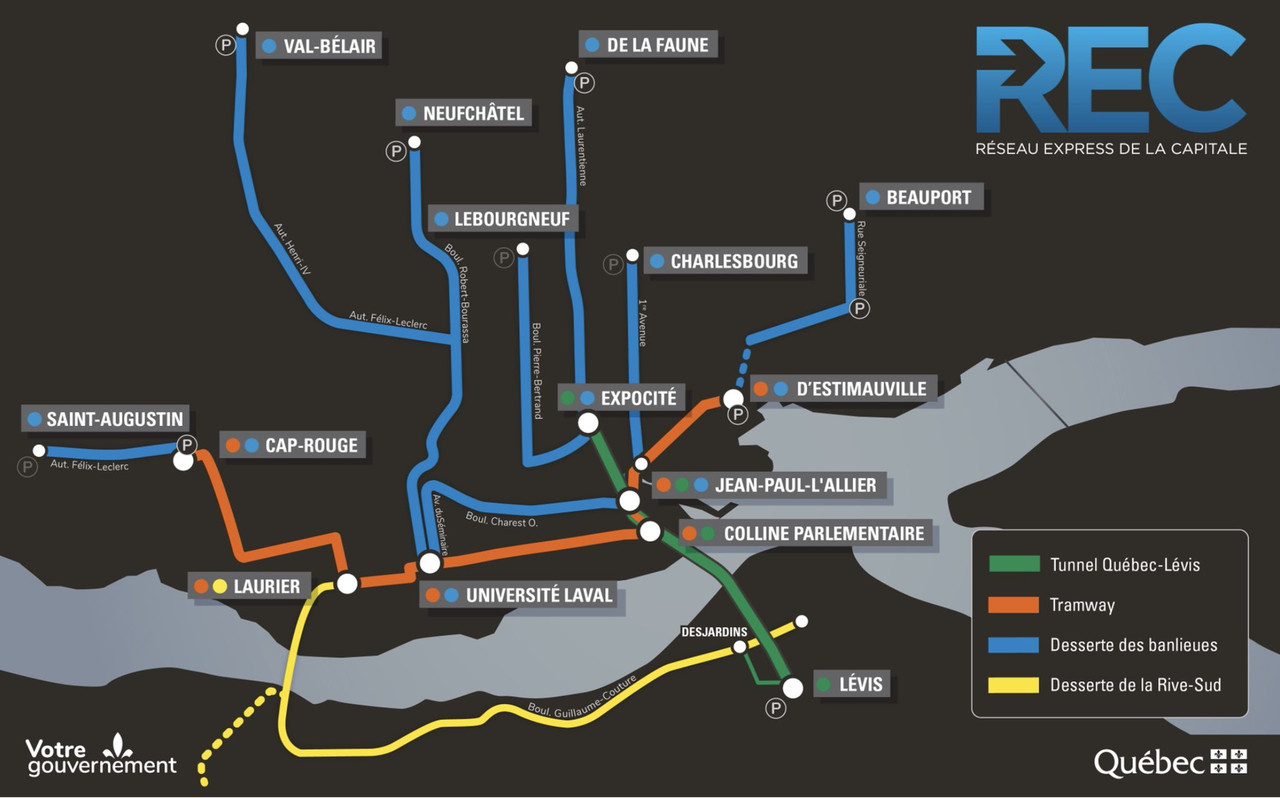
The brand new Greater Québec City's transit system that will be unveiled by the government of Québec next monday : The ''REC'' - Le Réseau Express de la Capitale

Source : https://www.fm93.com/nouvelles/politique/395595/primeur-voici-le-reseau-express-de-la-capitale

Yellow = Reserved bus lanes on the south shore
Blue = Reserved bus lanes on the north shore (±100km)
Orange = Tramway
Green = the 3rd link tunnel project = cars + transit system (to be determined yet)

__________________
PROVINCE OF QUEBEC ==> 9 050 000
MONTREAL METRO ==> 4 600 000
QUEBEC CITY METRO ==> 900 000
     
     
  #15688  
Old Posted May 14, 2021, 9:58 PM
MalcolmTucker MalcolmTucker is offline
Registered User
 
Join Date: May 2007
Posts: 11,578
Quote:
Originally Posted by goodgrowth View Post
In the context of developable land and new housing supply it is. Look at the greenbelt and yellowbelt around the GTA.

Which is why Feds should tie transit funds to zoning reform requirements around the routes. Because we have one level of government controlling lever on population growth and the other on the lever of housing developments. Transit is one of the few areas where they directly intersect on anything capacity related in cities.
Cities control how much land is develop-able, and through that, how much new housing supply exists. Cities shouldn't need to be dragged kicking and screaming to build new housing supply.
     
     
  #15689  
Old Posted May 14, 2021, 10:39 PM
goodgrowth goodgrowth is offline
Registered User
 
Join Date: Mar 2010
Posts: 2,226
Quote:
Originally Posted by MalcolmTucker View Post
Cities control how much land is develop-able, and through that, how much new housing supply exists. Cities shouldn't need to be dragged kicking and screaming to build new housing supply.
I think they literally need to be dragged kicking and screaming to build new housing supply.
     
     
  #15690  
Old Posted May 14, 2021, 11:53 PM
foolworm foolworm is offline
Registered User
 
Join Date: Mar 2020
Posts: 162
Well, out with the Reseau Structurant, in with the REC. We hardly knew ye...
     
     
  #15691  
Old Posted May 15, 2021, 12:39 AM
Truenorth00 Truenorth00 is offline
Registered User
 
Join Date: May 2017
Posts: 28,742
Quote:
Originally Posted by someone123 View Post
I think London and Halifax are about as far apart as similar-sized Canadian cities can be for transit. One is hilly, the other is flat. They span close to the full range of ages possible in Canada for development. One has fairly wide and straight streets that go for long distances and the other does not. One has lots of water and the other has much less. They're both pretty different in terms of destinations and what the neighbourhoods are like. It's not Tulsa and Calcutta but they are not that similar despite what the CMA population number says.
Wasn't so much the geography I was thinking off but the transit context. They have growing and sprawling suburbs that need to feed the core from every direction. And somewhat more limited support from higher level governments for any complex and expensive LRT systems. Though, yes Halifax has complexities (like a giant harbour in the middle).

Quote:
Originally Posted by someone123 View Post
One small difference in Halifax is that the buildings are built up to the street even fairly far out and even in some suburban areas, whereas London has bigger setbacks. There is less wiggle room to make changes and people are not so happy about having loud vehicles rumbling by practically on their doorstep.
This is exactly why I think curbside bus lanes are less useful in the core. Halifax is very European that way. And just like Europe, transit malls and woonerfs make sense. The curbside bus lanes only make sense on streets like Robie.

Quote:
Originally Posted by someone123 View Post
Here's Water Street. It is not much of a corridor in and out of downtown.
Note that I never suggested a transit mall on Lower Water Street. I suggested a Woonerf. I think a transit mall should be built on Hollis or Barrington.
     
     
  #15692  
Old Posted May 15, 2021, 12:46 AM
Truenorth00 Truenorth00 is offline
Registered User
 
Join Date: May 2017
Posts: 28,742
Quote:
Originally Posted by FrAnKs View Post
The brand new Greater Québec City's transit system that will be unveiled by the government of Québec next monday : The ''REC'' - Le Réseau Express de la Capitale

Source : https://www.fm93.com/nouvelles/politique/395595/primeur-voici-le-reseau-express-de-la-capitale
The one confusion I have with this plan. Are Southbank BRT riders required to transfer at Laurier? Can they continue to Laval?
     
     
  #15693  
Old Posted May 15, 2021, 1:12 AM
swimmer_spe swimmer_spe is offline
BANNED
 
Join Date: Apr 2014
Posts: 10,743
Quote:
Originally Posted by Truenorth00 View Post
There has to be a purpose to the tunnel. I don't see what Halifax would achieve with one, other than absolutely blowing capital and operating budgets building a shitty transit system that is not pedestrian friendly and has limited stops for transit users. We need to get away from the idea of just building expensive tunnels just to avoid difficult decisions on urban planning. In this case trying to eek out a tiny bit more throughput on downtown roads.

It's an old, small and dense downtown. It really can't accommodate more traffic anyway. But they have an amazing grid that they could build a really decent BRT system on that is both transit user and pedestrian friendly. It helps that they have a lot of parallel roads to do this. My pick would be a transit mall on Hollis with proper curbside bus lanes on Morris and Robie. Something like Züm in Brampton. This way they could funnel buses from all over to the core and they'd have a U-shaped loop to cover most of the core. Maybe another corridor on Chebucto/North.

It's a beautiful city that can and should have a decent high frequency transit system that connects to a very pedestrian friendly core.
This is an even better reason to build an underground LRT. When you start looking for places to put a transit mall in, you start to try to figure out where those cars will go. The only thing that might work would be a one way LRT on one way streets.

Quote:
Originally Posted by someone123 View Post
Halifax does not really have a street grid. It vaguely looks like it on Google Maps but if you plot out just about any practical route that's longer than say 1 km you will be see turns and potentially weird intersections (looks like an intersection but it's really two "T"s close to each other for example). The only street that runs for a long distance is Barrington and it's not a great alignment because there is water on one side of it (~1/2 population density). Then the streets around Barrington only run for 3-5 blocks and are not very useful as corridors, so if you cut Barrington off to mixed traffic not much is left. Barrington is about 15 m wide, from building facade to building facade.

The Barrington-SGR intersection (or Barrington-Cogswell) has a grade change and I am not sure how larger rail vehicles could handle that combined with the tight turning radius. This is supposedly why the city stuck with Birney cars for so long.

There was a proposal to connect Hollis up to the South End rail line and rail cut but CN controls that rail line and those negotiations are dead for now. Aside from that, I am skeptical that there could be some kind of LRT that would run through the city on the existing street network. Maybe there could be some kind of modern streetcar system on the peninsula but it would probably be hard to show why that is better than bus lanes.
Most people here suggesting things likely haven't been to Halifax. Not only do you have narrow streets, you also have the downtown built on a hill. I don't know of any rail transit in Canada that is as steep. Only thing I can think of as the cable cars in San Fransisco. However, they don't go very fast. A buried LRT line can be built on a much lower slope and not have much challenge traversing the line with normal equipment.

Quote:
Originally Posted by someone123 View Post
I think there are potential reasons for a downtown transit tunnel beyond not taking up space. One is that it's a way to remove tight corners and handle grade changes better. Another is that the destinations downtown don't follow along any particular street (the route you might call Halifax's "main street" downtown is shaped like a W and it does not connect up with the North End directly; so add another "S" on to it if you want more than 1-2 km of useful route). Then farther out you need to deal with one of relatively few points on or off the peninsula with steeps grades on the mainland Halifax side. Maybe that would be a place to use elevated track one day.
Halifax's terrain is a challenge on a good day. The terrain protected it from the Halifax Explosion. However, traversing it with a rail car isn't good. That is why both lines were built close to shore and with a cut. I could see some of the deepest stations in Canada being in Halifax.

Quote:
Originally Posted by Truenorth00 View Post
I'm thinking of what they could do with buses immediately. In this regard, I think it's not a dissimilar situation to say London. Only it needs a few more corridors in the core.

I can't see how LRT would work at all. Way too many destinations and diffuse a population spread.
The peninsula is about 4km across. If you started by putting major points on a map and then connected them to each other in a methodical manner, eventually a route would make sense. This is when using the grid would break down as it would be a nasty twisty route. A tunnel underneath it would work well.
     
     
  #15694  
Old Posted May 15, 2021, 1:13 AM
GreaterMontréal's Avatar
GreaterMontréal GreaterMontréal is offline
Registered User
 
Join Date: Dec 2013
Posts: 4,628
Quote:
Originally Posted by Truenorth00 View Post
The one confusion I have with this plan. Are Southbank BRT riders required to transfer at Laurier? Can they continue to Laval?
It looks like they will do the same as the REM and use bus lines as feeders to the tramway network. They probably want as less buses in the downtown core as possible.
     
     
  #15695  
Old Posted May 15, 2021, 1:19 AM
FrAnKs's Avatar
FrAnKs FrAnKs is offline
Registered User
 
Join Date: Jul 2005
Location: Ville de Québec / Quebec city
Posts: 5,919
Quote:
Originally Posted by GreaterMontréal View Post
It looks like they will do the same as the REM and use bus lines as feeders to the tramway network. They probably want as less buses in the downtown core as possible.
Exactly
__________________
PROVINCE OF QUEBEC ==> 9 050 000
MONTREAL METRO ==> 4 600 000
QUEBEC CITY METRO ==> 900 000
     
     
  #15696  
Old Posted May 15, 2021, 1:20 AM
FrAnKs's Avatar
FrAnKs FrAnKs is offline
Registered User
 
Join Date: Jul 2005
Location: Ville de Québec / Quebec city
Posts: 5,919
Quote:
Originally Posted by foolworm View Post
Well, out with the Reseau Structurant, in with the REC. We hardly knew ye...
I don't understand what you mean.
__________________
PROVINCE OF QUEBEC ==> 9 050 000
MONTREAL METRO ==> 4 600 000
QUEBEC CITY METRO ==> 900 000
     
     
  #15697  
Old Posted May 15, 2021, 4:47 AM
milomilo milomilo is offline
Registered User
 
Join Date: Dec 2013
Location: Calgary
Posts: 10,498
Quote:
Originally Posted by MalcolmTucker View Post
Cities control how much land is develop-able, and through that, how much new housing supply exists. Cities shouldn't need to be dragged kicking and screaming to build new housing supply.
They shouldn't, but they do. Cities do nothing to encourage housing supply, all they do is massively limit what can be built - in part because of ineptitude, and in part because that what their voters tell them to do. Furthermore, "cities" will never build housing supply (to any meaningful extent), this isn't the USSR. The private sector does.

The municipalities need some adults to clean up the messes they have all created.
     
     
  #15698  
Old Posted May 15, 2021, 7:15 AM
Chadillaccc's Avatar
Chadillaccc Chadillaccc is offline
ARTchitecture
 
Join Date: Feb 2011
Location: Cala Ghearraidh
Posts: 22,842
The biggest random nagging question in my head ever since the Hurontario Line was approved has been... why in the absolutely funnyf*ck hasn’t there been a proposed extension to the Kipling Line for an interchange station?
__________________
Strong & Free

Mohkínstsis — 1.6 million people at the Foothills of the Rocky Mountains, 400 high-rises, a 300-metre SE to NW climb, over 1000 kilometres of pathways, with 20% of the urban area as parkland.
     
     
  #15699  
Old Posted May 15, 2021, 11:33 AM
Innsertnamehere's Avatar
Innsertnamehere Innsertnamehere is offline
Registered User
 
Join Date: Jan 2010
Location: Hamilton
Posts: 12,809
Because that would cost billions and billions of dollars? That would be quite a long extension and wouldn’t be very high ridership.

There are old plans from the 90’s to extend the Bloor line to Sherway Gardens, but that’s it. And those are long discarded plans.
     
     
  #15700  
Old Posted May 15, 2021, 2:19 PM
Truenorth00 Truenorth00 is offline
Registered User
 
Join Date: May 2017
Posts: 28,742
Truthfully, it's valuable as a network building idea. But when we don't have money for the basics in this country, network completion comes across as frivolous.

This also speaks more broadly to how we build transit. We have smaller cities overbuilding LRT while they underfund all kinds of other transit. And big cities that can't build subways while their avenues are clogged with buses. This is how we get the bizarre situation of Waterloo building an LRT system with trams that run 10-15 mins apart while Toronto keeps adding to the bus parade on Sheppard because a subway there is seen as way too wasteful.
     
     
This discussion thread continues

Use the page links to the lower-right to go to the next page for additional posts
 
 
Closed Thread

Go Back   SkyscraperPage Forum > Regional Sections > Canada
Forum Jump


Forum Jump


All times are GMT. The time now is 5:43 PM.

     
SkyscraperPage.com - Privacy Statement - Top

Powered by vBulletin® Version 3.8.7
Copyright ©2000 - 2026, vBulletin Solutions, Inc.