Quote:
Originally Posted by bunt_q

Not sure where the discussion on state support comes from. The state has never supported stuff like we are talking about in any meaningful way, and never will. I will remind everybody, we just voted a statewide income tax decrease.
|
Taxation, government finance and budgets are hard to decipher, hard to wrap your brain around.
gopokes21 is not the first to have misperceptions; this has come up before.
Given Colorado/Denver residents come from many different states it's easy to bring your perceptions with you. Natives understandably don't understand how other states work.
The biggest confusion I've found in perceptions is the collection of sales taxes which is always a Big Item. Many states, like Texas or Arizona collect over twice as much sales tax as Colorado and then pass out candy to various "political subdivision." Because Colorado only collects (less than) half the sales tax rate of many states means they don't have the candy to pass out to "political subdivision" ie cities and counties.
Who Knew in such Pandemic Times
Fearing the worst in lost revenue, California instead reaped an historic tax haul, so much that they can't spend it all (by law) and will need to sock away a lot of it into their Rainy Day Fund.
Arizona also had an unexpected surplus although more modest. But looking ahead Governor Ducey is proposing a $1.2 billion income tax cut for individual earners and small businesses to be phased in over three years as part of an ongoing effort to become more competitive for jobs with the State of Texas.
I see where the State of Colorado projected "For the current 2020-21 fiscal year, revenue is expected to be anywhere from $542 million to $1.5 billion higher than prior forecasts were predicting."
Quote:
Originally Posted by gopokes21
Seattle.
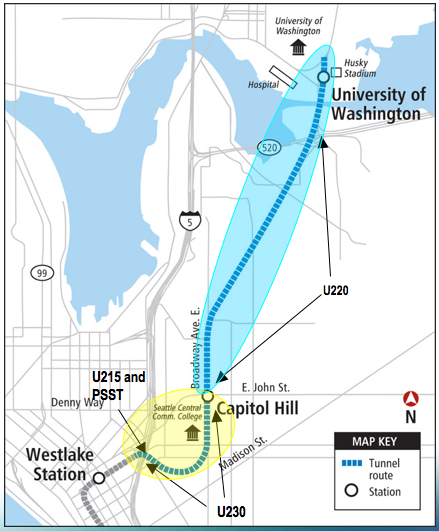
3.15 miles for $1.9 billion, of which half came from FTA. Doable. Highly worth it - when you consider the urban walkable neighborhoods opened up to mass transit that otherwise couldn't be served at grade. Interestingly, all (or should I hedge and say most of?) the Cap Hills are pretty similar. |
That's a fair example except
No they are not comparable.
Phoenix light rail has good ridership b/c it goes between downtown Phoenix and Tempe. Tempe is home to 55,000 ASU students and there's also an ASU extension of several studies in downtown Phoenix. The University of Washington has over 46,000 students. When that (tunnel) extension was opened ridership virtually doubled b/c of the University but to an extent the Cap Hill area. That will not even be close to reality in Denver.
Additionally you'd hardly be taking any "cars off streets" as you'd merely substitute bus riders for subway/light rail riders. "My" suburb to city light/commuter rail takes more cars off the street than this would.





 Prev
Prev





 Linear Mode
