HomeDiagramsDatabaseMapsForum About
     

Go Back   SkyscraperPage Forum > Regional Sections > Canada > Alberta & British Columbia > Vancouver > Transportation & Infrastructure


Reply

 
Thread Tools Display Modes
     
     
  #1961  
Old Posted Feb 8, 2020, 2:47 AM
Migrant_Coconut's Avatar
Migrant_Coconut Migrant_Coconut is offline
Registered User
 
Join Date: Oct 2015
Location: Kitsilano/Fairview
Posts: 10,184
Quote:
Originally Posted by lokyin View Post
Why not have a Hastings skytrain line from Waterfront going east until Kootenay Loop / Boundary, then turn north to cross second narrows at its narrowest point, and end the line at Phibbs Exchange?

A terminus at Phibbs would be great hub for all the bus traffic coming down from Lynn Valley, and be the transfer point to the new north shore rapidbus. This route would also alleviate bus demand for routes 209/210/211, and also the Hastings R-line, and serve PNE, and Burnaby will benefit from Kootenay as a station since their mayor has always wanted a station on the north.

It'd also potentially alleviate Lonsdale Quay seabus if there's less demand of Lynn Valley residents being diverted to Phibbs for skytrain to downtown.

Wouldn't this have much higher potential to densify (all along hastings and at phibbs) with more development? And also benefit more parts of metro van than just extending a connection to Lonsdale Quay?
Several reasons:
A) Lonsdale Direct is much more versatile for expansion. For example, you can extend it to Lynn, then run a new E-W line from Ambleside to Dollarton, and the Hastings Line can go straight to Lochdale or south to Brentwood and Metrotown, densifying those areas too. A Hastings-Phibbs-Lonsdale line would kill most potential south of Hastings or east of the TransCanada.

B) Most of the potential cross-inlet ridership is to and from the CNV area, the densest part of the NS. Not only does a "downtown via Second Narrows" option not attract anybody from the other two crossings, but it's not any faster than the SeaBus, which means fewer people wanting to switch to transit.

C) From TransLink's perspective, it's financially and logistically easier to funnel everybody onto one rapid transit crossing across the Inlet, then split them off. It also makes Phibbs less essential to the overall network.
Reply With Quote
     
     
  #1962  
Old Posted Feb 8, 2020, 3:30 AM
Migrant_Coconut's Avatar
Migrant_Coconut Migrant_Coconut is offline
Registered User
 
Join Date: Oct 2015
Location: Kitsilano/Fairview
Posts: 10,184
Quote:
Originally Posted by fredinno View Post
We have plenty of big exchanges. Like Metrotown. Ok, yeah, the suburbs have more of them, mostly because it's more important there.

You could make Waterfront more a hub and move more of the regional buses there if you put in the DT Streetcar/BRT. There's the proposed plaza on the parking lot next to Waterfront as is as well that could serve as a small bus loop (you just need enough space to drop and load people. Ditto the eventual redevelopment of the train tracks, since you'd need a lot more money for that. 200 Granville Street could provide space in its parkade for a bus loop as well. Obviously you'd need to buy that space. Assuming they want to sell.

But funny for you to imply Transit isn't revenue generating.
Not to mention I don't understand how that's somehow cheaper than cutting in a new station somehow. Clark and Boundary-Kingsway aren't that useful for bus transfers. Granville and City Center need a connection though.

I would have used Expo numbers too, if I had the possibility, I can’t find any (accurate) ones. Though it is consistent with pretty much everything else on the subject (like the TSPR).

I don’t know if connecting the Expo to Hastings would make a difference. It works on the Ellington-Ontario, but the line is actually longer and not faster to get to DT or the NS (the Hastings is roughly 2 sides of a triangle and the Expo is the Hypotenuse...) I want one because it connects to a lot of Burnaby’s important institutions (BCIT, Burnaby Gen.) and lets Brentwood and Metrotown merge, but it doesn’t seem to make sense from a relief perspective. Maybe people would take a longer ride if it’s less congested, but you can go from New West to DT via Hastings via the Millennium without a connection to the Expo.

The other option for relief is Tram-Train Commuter Rail for suburban and New West commuters. Whether that’d be cheaper is up to question. I’ll see what I can calculate for that in terms of relief later.

That dock is definitely too small for SeaBus. Maybe a smaller boat could work, more designed as a larger False Creek Ferry/ waterborne streetcar than a Seabus on Kits as well as Waterfront and Lonsdale.
Same thing with Kits- the Coast Guard Station and Burrard Bridge blocks the possibility for a large dock.
They're hubs now, but they weren't necessarily designed as such. Metrotown needed an upgrade just to handle existing traffic and the bus loops, and if a Willingdon Line or something is added, the place may or may not look just like Commercial.

Ditto Waterfront. Penn or Union, it is not. More stations might not be preferable from a capital perspective, but from a capacity perspective, it makes sense.
Not sure how pointing at one implies less of the other? The Waterfront eateries generate additional money - and a service to riders - on top of the trains' and SeaBuses' money. Removing that should be a close-to-last resort.

Yeah, the hope is that enough people aren't using the Expo to go to/from downtown per se, just as a stepping stone to somewhere else (e.g. Renfrew or Sunrise, because local service can be horrible at times). It's probably a bad idea if that's not the case.

It's more so the reason why there's docks there in the first place; they're clearly deep and calm enough for shallow-draft vessels, if hard to reach. Ambleside-Second Beach-Heritage Harbour may be worth a shot, given bus/tram connections at each terminal.
Reply With Quote
     
     
  #1963  
Old Posted Feb 8, 2020, 9:29 AM
Tvisforme's Avatar
Tvisforme Tvisforme is online now
Registered User
 
Join Date: Sep 2014
Location: Metro Vancouver
Posts: 2,179
Quote:
Originally Posted by Migrant_Coconut View Post
Several reasons:
A) Lonsdale Direct is much more versatile for expansion. For example, you can extend it to Lynn, then run a new E-W line from Ambleside to Dollarton, and the Hastings Line can go straight to Lochdale or south to Brentwood and Metrotown, densifying those areas too. A Hastings-Phibbs-Lonsdale line would kill most potential south of Hastings or east of the TransCanada.

B) Most of the potential cross-inlet ridership is to and from the CNV area, the densest part of the NS. Not only does a "downtown via Second Narrows" option not attract anybody from the other two crossings, but it's not any faster than the SeaBus, which means fewer people wanting to switch to transit.

C) From TransLink's perspective, it's financially and logistically easier to funnel everybody onto one rapid transit crossing across the Inlet, then split them off. It also makes Phibbs less essential to the overall network.
Thing is, the entire North Shore has less than 200 000 people (approx 182 000 as of the 2016 census) and it's spread out over a large area. The City is the most densely populated area, but they only had 53 000 people in 2016. As much fun as it might be, I just don't see a way to justify a multi-billion dollar SkyTrain line across the North Shore with that population. There's also no appetite for the kind of development that would make a line viable. The Hastings line, with a turn to Phibbs, would serve a larger number of people while still giving a North Shore connection. It could also be built so as to allow easy future expansion by splitting the line; Hastings can continue east into Burnaby, with a Richmond/Airport-type alternating train service for the Phibbs spur line, and then eventually the North Shore link could instead be extended south down Boundary to connect with the Millennium and Expo lines and the River District. On the western end, the Hastings line could go through the West End to Park Royal. That would give three rapid connections (Park Royal and Phibbs by train, the Quay by SeaBus) to key North Shore hubs.
Reply With Quote
     
     
  #1964  
Old Posted Feb 8, 2020, 8:57 PM
scryer scryer is offline
Registered User
 
Join Date: Feb 2014
Posts: 1,964
Quote:
Originally Posted by Tvisforme View Post
Thing is, the entire North Shore has less than 200 000 people (approx 182 000 as of the 2016 census) and it's spread out over a large area. The City is the most densely populated area, but they only had 53 000 people in 2016. As much fun as it might be, I just don't see a way to justify a multi-billion dollar SkyTrain line across the North Shore with that population. There's also no appetite for the kind of development that would make a line viable. The Hastings line, with a turn to Phibbs, would serve a larger number of people while still giving a North Shore connection. It could also be built so as to allow easy future expansion by splitting the line; Hastings can continue east into Burnaby, with a Richmond/Airport-type alternating train service for the Phibbs spur line, and then eventually the North Shore link could instead be extended south down Boundary to connect with the Millennium and Expo lines and the River District. On the western end, the Hastings line could go through the West End to Park Royal. That would give three rapid connections (Park Royal and Phibbs by train, the Quay by SeaBus) to key North Shore hubs.
Well I had a fantasy that extended the Hastings line across the Second Narrows to Phibbs exchange, and then west to connect to Lonsdale and terminating at Park Royal. The full idea was that the line would go from Park Royal > Langley Central/Production Way-University. Of course I would keep the Seabus in service as that's honestly the most convenient transit method to hop across the Burrard Inlet.

Personally any kind of West End skytrain falls extremely low on the priority list as the West End and the downtown Skytrain stations are walkable to each other for the average person honestly speaking.
Reply With Quote
     
     
  #1965  
Old Posted Feb 8, 2020, 11:23 PM
Migrant_Coconut's Avatar
Migrant_Coconut Migrant_Coconut is offline
Registered User
 
Join Date: Oct 2015
Location: Kitsilano/Fairview
Posts: 10,184
Right, but it's not necessarily a walkability problem, more so a station capacity problem (different from overall line capacity, which is fine for the next few decades); the Waterfront/Burrard/Granville loop is already having mild crowding issues. Additional stations further NW could help solve that.

Quote:
Originally Posted by Tvisforme View Post
Thing is, the entire North Shore has less than 200 000 people (approx 182 000 as of the 2016 census) and it's spread out over a large area. The City is the most densely populated area, but they only had 53 000 people in 2016. As much fun as it might be, I just don't see a way to justify a multi-billion dollar SkyTrain line across the North Shore with that population. There's also no appetite for the kind of development that would make a line viable. The Hastings line, with a turn to Phibbs, would serve a larger number of people while still giving a North Shore connection. It could also be built so as to allow easy future expansion by splitting the line; Hastings can continue east into Burnaby, with a Richmond/Airport-type alternating train service for the Phibbs spur line, and then eventually the North Shore link could instead be extended south down Boundary to connect with the Millennium and Expo lines and the River District. On the western end, the Hastings line could go through the West End to Park Royal. That would give three rapid connections (Park Royal and Phibbs by train, the Quay by SeaBus) to key North Shore hubs.
Sure, but then you remember that Burnaby was under 150,000 when the Expo opened. Transit shouldn't need to wait for the growth to arrive.

If this Hastings-North Shore hybrid can be converted into two perpendicular lines + interchange with minimal service disruption, and if there were a Lonsdale Line on the way some time after that, by all means.

Financially though, I'm not seeing an appetite in the short OR long term for more than one inlet RT crossing, so we'd have to pick a good one - ideally, close to the SeaBus, so that we're not forced to run it every six minutes or less in the future when the inevitable demand spike arrives.
Reply With Quote
     
     
  #1966  
Old Posted Feb 9, 2020, 1:31 AM
Tvisforme's Avatar
Tvisforme Tvisforme is online now
Registered User
 
Join Date: Sep 2014
Location: Metro Vancouver
Posts: 2,179
Quote:
Originally Posted by Migrant_Coconut View Post
Sure, but then you remember that Burnaby was under 150,000 when the Expo opened. Transit shouldn't need to wait for the growth to arrive.
(Emphasis added)
Burnaby is much, much smaller - about 40%(?) of the area of the North Shore municipalities - and the Expo Line was also serving Vancouver and New Westminster when it opened. That's a much larger population base, plus the whole area is significantly easier to develop (due to the terrain) and better suited to the kind of high-density development that tends to emerge around rapid transit stations. You could certainly double the population on the North Shore, but it would be a real mess to actually get anywhere without a wholesale redesign of the major and minor road systems. North-south movement is not too bad, but east-west is severely limited and there's really not likely to be any significant public support for adding new bridges across the Capilano, Lynn and Seymour waters since those would all go through established parks or residential neighbourhoods. There are definite feelings that development is going too fast, and yet the net population growth of all three municipalities from 2017 to 2018 was less than 1500 people. That's why I would suggest that for now, expanding and speeding up the bus network might be a more cost-effective approach. Get transit priority lanes on the highway and major east-west and north-south routes, add several RapidBus routes, get shuttles into the underserved neighbourhoods, and see what happens. If I had to pick only one SkyTrain crossing, I'd probably go with Phibbs and the Seymour area because it would add a new service rather than replacing an existing good one (the SeaBus), there's growth in that area, and even if one went to Park Royal, there's no guarantee that West Vancouver will do much with it given their aversion to even a B-Line.
Reply With Quote
     
     
  #1967  
Old Posted Feb 9, 2020, 2:41 AM
fredinno's Avatar
fredinno fredinno is offline
Registered User
 
Join Date: Jan 2012
Posts: 2,317
Quote:
Originally Posted by Tvisforme View Post
(Emphasis added)
Burnaby is much, much smaller - about 40%(?) of the area of the North Shore municipalities - and the Expo Line was also serving Vancouver and New Westminster when it opened. That's a much larger population base, plus the whole area is significantly easier to develop (due to the terrain) and better suited to the kind of high-density development that tends to emerge around rapid transit stations. You could certainly double the population on the North Shore, but it would be a real mess to actually get anywhere without a wholesale redesign of the major and minor road systems. North-south movement is not too bad, but east-west is severely limited and there's really not likely to be any significant public support for adding new bridges across the Capilano, Lynn and Seymour waters since those would all go through established parks or residential neighbourhoods. There are definite feelings that development is going too fast, and yet the net population growth of all three municipalities from 2017 to 2018 was less than 1500 people. That's why I would suggest that for now, expanding and speeding up the bus network might be a more cost-effective approach. Get transit priority lanes on the highway and major east-west and north-south routes, add several RapidBus routes, get shuttles into the underserved neighbourhoods, and see what happens. If I had to pick only one SkyTrain crossing, I'd probably go with Phibbs and the Seymour area because it would add a new service rather than replacing an existing good one (the SeaBus), there's growth in that area, and even if one went to Park Royal, there's no guarantee that West Vancouver will do much with it given their aversion to even a B-Line.
"Transportation is bad in the NS, which is why development is too much for the region"

"Let's cheap out improving transportation in the NS because there's so little development and population"


And no, Seabus —. It takes 12 min to get from DT to Vancouver and arrives every 10 min on peak. Frequencies are limited due to port traffic as well, and are still lower than Skytrain at peak.

Even if you keep the Seabus, there's still rationale for services to Upper Lonsdale/Lynn Valley and Marine Drive to improve connections to and from the Seabus

http://www.metrovancouver.org/services/r...ngPublications/RGSAdoptedbyGVRDBoard.pdf


Yes, the NS has low population growth. But that's a consequence of the bad infrastructure. The original RGS actually directly states that as the reason for discouraging development in the area. The RGS also gets updated every decade. If Skytrain went to the NS tomorrow, I guarantee the population and employment targets would go up.
I mean, the NS was one of the first parts of Metro Van to grow (other than Vancouver and New West), is dense (at least the CoNV) and is literally right across the inlet. Even the old-timey 70s Vancouver Rapid Transit plans wanted LRT/BRT to the NS (on the proposed freeway, that is)


2nd Narrows is only good for Suburban-Suburban Transfers. And you could mimic Skytrain with a 555-style service to Phibbs when the freeways get upgraded on that side (the Cassiar was designed with 6 lanes in mind for future highway expansions)
Finally, yeah, of course Burnaby is smaller. Remove the area taken up by everything above 1200ft and the Watersheds/Massive Regional Parks (Lynn Headwaters alone is larger than Burnaby Mtn), and that's your actual area of the NS munis.
In fact, when you do that, you get an area almost EXACTLY that of Burnaby. (97.32km2 for the NS, 98.610km2 for Burnaby.)


Last edited by fredinno; Feb 9, 2020 at 3:00 AM.
Reply With Quote
     
     
  #1968  
Old Posted Feb 9, 2020, 4:50 AM
fredinno's Avatar
fredinno fredinno is offline
Registered User
 
Join Date: Jan 2012
Posts: 2,317
Quote:
Originally Posted by Tvisforme View Post
Thing is, the entire North Shore has less than 200 000 people (approx 182 000 as of the 2016 census) and it's spread out over a large area. The City is the most densely populated area, but they only had 53 000 people in 2016. As much fun as it might be, I just don't see a way to justify a multi-billion dollar SkyTrain line across the North Shore with that population. There's also no appetite for the kind of development that would make a line viable. The Hastings line, with a turn to Phibbs, would serve a larger number of people while still giving a North Shore connection. It could also be built so as to allow easy future expansion by splitting the line; Hastings can continue east into Burnaby, with a Richmond/Airport-type alternating train service for the Phibbs spur line, and then eventually the North Shore link could instead be extended south down Boundary to connect with the Millennium and Expo lines and the River District. On the western end, the Hastings line could go through the West End to Park Royal. That would give three rapid connections (Park Royal and Phibbs by train, the Quay by SeaBus) to key North Shore hubs.
A 3- pronged line?
No.
Quote:
Originally Posted by Migrant_Coconut View Post
They're hubs now, but they weren't necessarily designed as such. Metrotown needed an upgrade just to handle existing traffic and the bus loops, and if a Willingdon Line or something is added, the place may or may not look just like Commercial.

Ditto Waterfront. Penn or Union, it is not. More stations might not be preferable from a capital perspective, but from a capacity perspective, it makes sense.
Not sure how pointing at one implies less of the other? The Waterfront eateries generate additional money - and a service to riders - on top of the trains' and SeaBuses' money. Removing that should be a close-to-last resort.

Yeah, the hope is that enough people aren't using the Expo to go to/from downtown per se, just as a stepping stone to somewhere else (e.g. Renfrew or Sunrise, because local service can be horrible at times). It's probably a bad idea if that's not the case.

It's more so the reason why there's docks there in the first place; they're clearly deep and calm enough for shallow-draft vessels, if hard to reach. Ambleside-Second Beach-Heritage Harbour may be worth a shot, given bus/tram connections at each terminal.
Ok, yeah, but neither was the entire Skytrain system either. We're running on capacities that would have entailed a Toronto/Montreal style conventional subway system had the Expo been built today.

Though the shape of Metrotown makes it difficult to get to Metrotown station from the north, so we might actually have no choice but to move everything to Patterson if we do add a Willingdon Line.

I'm not sure, but I think the Canada Line entrance was taken from a commercial area in the station proper.

We're already splitting bus service amongst the DT stops anyways. More capacity with more stations just doesn't work when there's no space for new stations.

Why'd they go to DT if they need to get to Sunrise or Renfew? Also, I'd imagine the B-Line plans would deal with a lot of that.

Yeah, but the False Creek Ferry is tiny. There's rationale to expand the service further (I'd think the existing ferry services would be less popular, but ), but I was thinking larger ships. Especially since we're talking about cross-inlet service.
Reply With Quote
     
     
  #1969  
Old Posted Feb 9, 2020, 6:26 AM
scottN scottN is offline
Registered User
 
Join Date: Mar 2019
Posts: 286
Quote:
Originally Posted by fredinno View Post
Though the shape of Metrotown makes it difficult to get to Metrotown station from the north, so we might actually have no choice but to move everything to Patterson if we do add a Willingdon Line.
Burnaby is presently planning a major redevelopment of the Metrotown core. They ought to be planning for a N-S rapid transit corridor to interchange at Metrotown station but sadly I don’t think anything is in the works
Reply With Quote
     
     
  #1970  
Old Posted Feb 9, 2020, 8:22 AM
fredinno's Avatar
fredinno fredinno is offline
Registered User
 
Join Date: Jan 2012
Posts: 2,317
Quote:
Originally Posted by scottN View Post
Burnaby is presently planning a major redevelopment of the Metrotown core. They ought to be planning for a N-S rapid transit corridor to interchange at Metrotown station but sadly I don’t think anything is in the works
It's not the Metropolis Mall that's the problem. It's Crystal Mall.
Reply With Quote
     
     
  #1971  
Old Posted Feb 9, 2020, 10:15 AM
Tvisforme's Avatar
Tvisforme Tvisforme is online now
Registered User
 
Join Date: Sep 2014
Location: Metro Vancouver
Posts: 2,179
Quote:
Originally Posted by fredinno View Post
A 3- pronged line?
No.
You misunderstood my suggestion, it was not a "3-pronged line". It was:

Phase 1: Build a Hastings Line from downtown Vancouver to near the Ironworkers Memorial Crossing, then cross over to Phibbs Exchange (or a similar bus/SkyTrain hub in that area). That gets rapid transit along Hastings and gives another connection from the North Shore, drawing on the population in the Seymour area, the rapidly developing Lynnmour area and the proposed Maplewood developments in addition to existing transit routes that feed into Phibbs.

Phase 2: Extend the Hastings Line further east to cover northern Burnaby, alternating trains between the North Shore and Burnaby as with the Richmond/Airport service.

Phase 3: Separate the North Shore spur from the Hastings Line and extend it to create a new line running north-south to connect with all three east-west lines (Hastings, Millenium and Expo).


Quote:
Originally Posted by fredinno View Post
"Transportation is bad in the NS, which is why development is too much for the region"

"Let's cheap out improving transportation in the NS because there's so little development and population"
That's only one small part of what I said. Burnaby, however, is far easier to build in and is a much more compact municipality. Even with the estimates you've made about the North Shore, it still stretches all the way from Horseshoe Bay to Deep Cove - with lots of hard-to-build bits. Obviously the targets would increase, but you're not likely to ever see the same sort of density as with other municipalities. I'm not saying SkyTrain will never be needed, but when you look at projections in that RGS that have 2021 Burnaby, Tri-Cities, and Delta/Richmond/Tsawwassen all having larger populations than the entire North Shore two decades from now, one has to question what the most effective use of limited transit dollars might be. Again, I'm not saying "no" to higher-capacity transit, just arguing that there are more viable interim measures before a SkyTrain-level service is built.
Reply With Quote
     
     
  #1972  
Old Posted Feb 9, 2020, 5:33 PM
TheTerminalCity TheTerminalCity is offline
Registered User
 
Join Date: Feb 2019
Posts: 92
Quote:
Originally Posted by Tvisforme View Post
That's only one small part of what I said. Burnaby, however, is far easier to build in and is a much more compact municipality. Even with the estimates you've made about the North Shore, it still stretches all the way from Horseshoe Bay to Deep Cove - with lots of hard-to-build bits. Obviously the targets would increase, but you're not likely to ever see the same sort of density as with other municipalities. I'm not saying SkyTrain will never be needed, but when you look at projections in that RGS that have 2021 Burnaby, Tri-Cities, and Delta/Richmond/Tsawwassen all having larger populations than the entire North Shore two decades from now, one has to question what the most effective use of limited transit dollars might be. Again, I'm not saying "no" to higher-capacity transit, just arguing that there are more viable interim measures before a SkyTrain-level service is built.
One of the North Shore's challenges is the topography places limits not just on readily-developable area but also on movement. The opportunity for a line over the Second Narrows to Phibbs, like you mention, would provide the substantive alternative option to driving. All the more so if a Skytrain at Phibbs extending westward roughly parallel to Marine all the way to Park Royal.

This also supports the development happening on the North Shore (Phibbs/Seylynn, Lower Lonsdale, Cap Mall, Capilano Hwy, Park Royal), which can further reinforce that main east-west corridor. Would also support the Lonsdale Quay as a hub, with Seabus and bus connections existing already and growth of population and destinations would occur around a high-capacity transit line with good access to both downtown Vancouver but the balance of the Lower Mainland through Second Narrows.

Whether that is worth the cost of extending a Skytrain across the inlet is another question, especially when the bulk of population growth is happening elsewhere in the region and the availability of funding for the various competing transit priorities.
Reply With Quote
     
     
  #1973  
Old Posted Feb 9, 2020, 9:47 PM
scryer scryer is offline
Registered User
 
Join Date: Feb 2014
Posts: 1,964
Quote:
Originally Posted by TheTerminalCity View Post
One of the North Shore's challenges is the topography places limits not just on readily-developable area but also on movement. The opportunity for a line over the Second Narrows to Phibbs, like you mention, would provide the substantive alternative option to driving. All the more so if a Skytrain at Phibbs extending westward roughly parallel to Marine all the way to Park Royal.

This also supports the development happening on the North Shore (Phibbs/Seylynn, Lower Lonsdale, Cap Mall, Capilano Hwy, Park Royal), which can further reinforce that main east-west corridor. Would also support the Lonsdale Quay as a hub, with Seabus and bus connections existing already and growth of population and destinations would occur around a high-capacity transit line with good access to both downtown Vancouver but the balance of the Lower Mainland through Second Narrows.

Whether that is worth the cost of extending a Skytrain across the inlet is another question, especially when the bulk of population growth is happening elsewhere in the region and the availability of funding for the various competing transit priorities.
Kind of like my suggestion last year...
Reply With Quote
     
     
  #1974  
Old Posted Feb 9, 2020, 10:02 PM
TheTerminalCity TheTerminalCity is offline
Registered User
 
Join Date: Feb 2019
Posts: 92
Quote:
Originally Posted by scryer View Post
Very much the same idea, exactly.
Reply With Quote
     
     
  #1975  
Old Posted Feb 9, 2020, 10:25 PM
Migrant_Coconut's Avatar
Migrant_Coconut Migrant_Coconut is offline
Registered User
 
Join Date: Oct 2015
Location: Kitsilano/Fairview
Posts: 10,184
INSTPP 2018 study

Quote:
1) Rapid transit crossing Burrard Inlet in the vicinity of Second Narrows to connect the North Shore with SkyTrain in east Vancouver:
Our analysis showed that ridership would be low on a rapid transit line connecting to the area south and east of the Second Narrows Bridge because of the dispersed development it would serve.
So what did they get wrong here?
Reply With Quote
     
     
  #1976  
Old Posted Feb 9, 2020, 11:01 PM
Migrant_Coconut's Avatar
Migrant_Coconut Migrant_Coconut is offline
Registered User
 
Join Date: Oct 2015
Location: Kitsilano/Fairview
Posts: 10,184
Quote:
Originally Posted by fredinno View Post
Ok, yeah, but neither was the entire Skytrain system either. We're running on capacities that would have entailed a Toronto/Montreal style conventional subway system had the Expo been built today.

Though the shape of Metrotown makes it difficult to get to Metrotown station from the north, so we might actually have no choice but to move everything to Patterson if we do add a Willingdon Line.

I'm not sure, but I think the Canada Line entrance was taken from a commercial area in the station proper.

We're already splitting bus service amongst the DT stops anyways. More capacity with more stations just doesn't work when there's no space for new stations.

Why'd they go to DT if they need to get to Sunrise or Renfew? Also, I'd imagine the B-Line plans would deal with a lot of that.

Yeah, but the False Creek Ferry is tiny. There's rationale to expand the service further (I'd think the existing ferry services would be less popular, but ), but I was thinking larger ships. Especially since we're talking about cross-inlet service.
Maybe? Local stations like are fine; it's the downtown and hub stations that're getting East Coast foot traffic.

Crystal Mall's not necessarily a problem - detour to McKay, then Imperial, then Boundary gets you to the River District (admittedly, it'll be a sharp turn off Willingdon unless it can go under/through the SFHs).

Having a real hard time finding a source for that one. Far as I know, that section of Waterfront was just part of the wall.

Again, stations elsewhere in downtown means that passengers leaving/heading there are on the train, not adding to the CBD loop's entrances.
On another note, a relief line from Roundhouse to Stadium could also reroute Canada/Expo transfers without funneling them through the loop.

Assuming a start at Metrotown, Renfrew's easier to access from the M-Line at Commercial, and Sunrise/PNE from a bus at 29th or Joyce-Collingwood. A Hastings-Willingdon Line could change that more significantly than B-Lines/RapidBuses.

I'm suggesting that we take the existing docks and make them SeaBus-sized. They only need to be larger, not deeper or calmer.
Reply With Quote
     
     
  #1977  
Old Posted Feb 9, 2020, 11:22 PM
TheTerminalCity TheTerminalCity is offline
Registered User
 
Join Date: Feb 2019
Posts: 92
Quote:
Originally Posted by Migrant_Coconut View Post
INSTPP 2018 study


So what did they get wrong here?
From reading through the link, its not clear if they are just going to Phibbs or serving more of the Marine Drive corridor on the North Shore...what's the span of service here that was low?
Reply With Quote
     
     
  #1978  
Old Posted Feb 9, 2020, 11:36 PM
Migrant_Coconut's Avatar
Migrant_Coconut Migrant_Coconut is offline
Registered User
 
Join Date: Oct 2015
Location: Kitsilano/Fairview
Posts: 10,184
Well, the traffic to/from the CoV is more than all the suburbs combined (link), so there's that.
Reply With Quote
     
     
  #1979  
Old Posted Feb 9, 2020, 11:40 PM
Kisai Kisai is offline
Registered User
 
Join Date: Jun 2014
Location: Burnaby
Posts: 1,154
Quote:
Originally Posted by Migrant_Coconut View Post
INSTPP 2018 study


So what did they get wrong here?
Quote:
1) Rapid transit crossing Burrard Inlet in the vicinity of Second Narrows to connect the North Shore with SkyTrain in east Vancouver:
Our analysis showed that ridership would be low on a rapid transit line connecting to the area south and east of the Second Narrows Bridge because of the dispersed development it would serve.

2) Rapid transit crossing Burrard Inlet in the vicinity of the SeaBus route to connect Lonsdale City Centre with SkyTrain in downtown Vancouver:
Our initial review indicated this connection would provide more transportation choice and attract more transit ridership. Some of the new transit ridership would come from a shift from automobile use, but most of the increase would be from new trip patterns. For example, a North Shore resident who shopped locally might shift their activity to downtown because of improved transit accessibility and vice versa. While rapid transit would offer more choice for people, it may have little impact on bridge congestion.

Additional benefits could, however, result from combining rapid transit with incentives to change travel patterns – leading to increased use of transit by existing commuters, particularly people travelling to the North Shore by car for work each day. Municipal partners have stated a preference for ‘rail’ rapid transit. Additional study on the benefits and impacts of a rapid transit – including how to cross Burrard Inlet – will be considered in the Regional Transportation Strategy, which is now underway
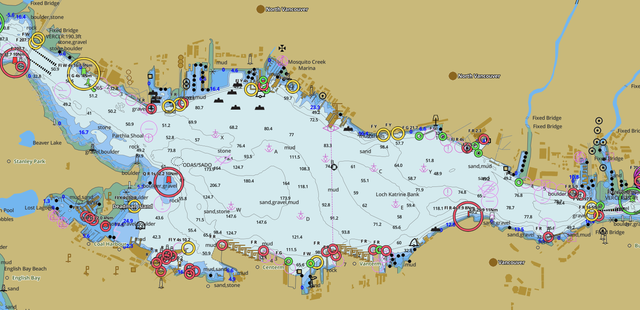
I think the problem there with the Second Narrows is that it would require connections on both sides (eg a Skytrain down Hastings, with a station near the PNE/Playland, and then a switch or transfer there on the Vancouver/Burnaby side. Then it would have to serve both North Vancouver and District sides on the other side ) that make sense, and simply crossing and then having it terminate at Capilano University doesn't take it near the major transit point like Burrard does.

Part of the reason North Vancouver seems neglected for transit is because it's difficult to make anything cross the harbour, which is why the Seabus is what it is. If it's easier to make a skytrain cross the harbour, you would pick a narrower point for it to cross which is where the second narrows is already, or the Lions Gate. Since Lions Gate is a landmark, there might be some opposition to it. So that leaves the second narrows as the better option to put a Skytrain bridge or tunnel.


Map from http://fishing-app.gpsnauticalcharts.com/

Logically speaking, if we were looking for a solution that would last a century, I'd say just go for a tunnel under stanley park, and over-engineer the thing so that it can take the largest version of the Skytrain vehicles that we do not currently use.

We're stuck between two options of "the cheapest" crossing being expensive to get to and not serving the population center it needs to, and the most expensive crossing not being able to be a point-to-point crossing like the Seabus.

The Seikan Tunnel in Japan is 330ft below the seabed. So it's not like it's impossible for a point-to-point crossing, but it probably be super-difficult to just put a TBM down in downtown again. So perhaps some other location would make more sense to avoid the deepest part of the harbour, and we've covered this before a few times already.

https://vancouversun.com/news/local-news...fic-team-up-to-push-for-a-third-crossing
Reply With Quote
     
     
  #1980  
Old Posted Feb 10, 2020, 5:49 AM
jollyburger jollyburger is online now
Registered User
 
Join Date: Dec 2015
Posts: 15,822
Maybe instead of dumping money into a crossing that money could be used for some kind of light transit on the North Shore? They probably could also look at some transit along the highway as a bypass to all the congested arterials with bus only lanes.
Reply With Quote
     
     
This discussion thread continues

Use the page links to the lower-right to go to the next page for additional posts
 
 
Reply

Go Back   SkyscraperPage Forum > Regional Sections > Canada > Alberta & British Columbia > Vancouver > Transportation & Infrastructure
Forum Jump


Forum Jump


All times are GMT. The time now is 7:52 PM.


Powered by vBulletin® Version 3.8.7
Copyright ©2000 - 2026, vBulletin Solutions, Inc.
