HomeDiagramsDatabaseMapsForum About
     

Go Back   SkyscraperPage Forum > Photography Forums > Found City Photos

Closed Thread

 
Thread Tools Display Modes
     
     
  #53281  
Old Posted Dec 18, 2019, 8:02 PM
Lwize Lwize is offline
Registered User
 
Join Date: Aug 2012
Location: Los Angeles
Posts: 592

(Everett Collection)

Quote:
Originally Posted by lacurbed.com
These 1920s apartments inspired one of the best noir films ever made

Chris Eggertsen@chrisjeggertsen

Nicholas Ray’s In a Lonely Place is one of the greatest examples of film noir ever produced—a deft thriller that doubles as a spellbinding meditation on love and its limitations. Nearly as intriguing is what happened behind the scenes.

By all accounts, Ray’s four-year marriage to Lonely Place lead actress Gloria Grahame was contentious. By the time they got around to shooting the film, the state of their relationship had deteriorated so badly that Ray moved out of the couple’s shared home and into the film’s principal set: a soundstage-bound courtyard apartment complex inspired by one of his very first Los Angeles residences.

The residence in question is the Villa Primavera, a hacienda-like West Hollywood apartment building designed in 1923 by Arthur and Nina Zwebell, the husband-and-wife architectural team who introduced Spanish courtyard design to the city’s then-booming multi-family housing market. Twenty seven years later, that same building would inspire the primary location of one of Hollywood’s greatest-ever noirs, its expressive Spanish revival architecture deepening the doomed love story between floundering screenwriter Dix Steele (Humphrey Bogart) and would-be actress Laurel Gray (Grahame).

Also known as the Mexican Village, the Villa Primavera is located at the corner of Harper and Fountain avenues, just two blocks south of famed celebrity playground the Chateau Marmont. The wood-and-stucco building houses 10 compact units that open to a central courtyard, a striking outdoor space that includes a tiled fountain, verdant garden, and majestic fireplace capped by a stone relief of the Madonna and Child.

LA’s population more than doubled over the course of the 1920s, necessitating a huge amount of residential development. The Zwebells—young Midwest transplants whose lack of formal training was made up for by their artistry—were inspired by photography books featuring Spanish architecture, particularly a type that was fashionable in the southern region of Andalusia.

“That [style] was becoming very popular because a lot of people were traveling to Spain,” says Roger Sherwood, coauthor of the 1992 book Courtyard Housing in Los Angeles and professor emeritus at the USC School of Architecture.

One of the few European countries to remain neutral during World War I, Spain remained open during those years to young American architects touring the continent. The country’s architecture soon began circulating in a series of photography books, exerting a particularly powerful influence on Southern California designers like the Zwebells, who would go on to name their most famous courtyard building in Los Angeles after the Andalusia region.

Once they completed the Villa Primavera, the Zwebells spent the next few years designing and building several more courtyard-style complexes around LA, including the Casa Laguna in Los Feliz; the Andalusia, La Ronda, and El Cabrillo in the Hollywood area; and the Villa Primavera’s next door neighbor, Patio del Moro. Sherwood notes the couple would typically build one unit for themselves, often incorporating two-story spaces into the design to accommodate Nina’s beloved pipe organ.

A key aspect of these buildings was the Zwebells’ innovative placement of parking areas, which were housed in separate forecourts hidden from view so as not to detract from the architectural beauty of the living spaces. But when a change in the building code in Los Angeles in the early 1930s mandated a minimum number of parking spaces on what were often small lots, builders were forced to construct costly underground garages that rendered the Zwebells’ unique courtyard garden layout obsolete.

“That was a very expensive, big problem,” says Sherwood. “As soon as you put the garage there, it was much harder to have a garden because you’re building on top of a parking garage.”

Along with the collapse of the housing and stock market in 1929, the new code coincided with the rapid decline of the Zwebells’ careers as the designers of buildings (they later transitioned to designing film sets and furniture).

Roughly 15 years after the Zwebells built the last of their courtyard-style complexes, Ray, who by that time was already a respected theater director in New York, relocated to Los Angeles to pursue a film career. The Villa Primavera was one of his earliest homes in LA, and—judging from his later adoption of its courtyard design for In a Lonely Place—it appears to have made a strong impression.

Ray is widely regarded by film critics and historians as a director highly attuned to spatial considerations in his work, with architecture and design elements often mirroring the psychological states of his characters.

That is unsurprising given his brief but formative stay at Taliesin, the rural, 800-acre estate of architectural giant Frank Lloyd Wright, where budding young architects studied painting, dance, theater, music, and sculpture “in their places as divisions of architecture.”

Ray was among the first crops of students to attend the school, residing there between December 1933 and May 1934. The director’s biographer Patrick McGilligan notes that Wright had lured the talented young creative out from New York by offering him a deal on the school’s tuition in exchange for his services as a stage director.

“He needed someone to organize a playhouse, turn it into the heart and soul of Taliesin,” says McGilligan, author of the 2011 biography Nicholas Ray: The Glorious Failure of an American Director. “They have this huge central performance area, and he was in charge of what was put on on Saturdays and Sundays and sometimes during the week. [It was intended to] be an artistic inspiration for the people who were students.”

Ray’s stint at Taliesin was brief (McGilligan points out that the notoriously-troubled director was likely ejected over “drunkenness and misbehavior”). But in later interviews, he would note the influence of that experience on his work as a filmmaker.

“He always emphasized the broad artistic and philosophical perspective he had absorbed at Taliesin, linked to his own preference for the widescreen Cinemascope format with its horizontal lines of visual expression,” says McGilligan of Ray’s affinity for the anamorphic process, which he first used in the 1955 classic Rebel Without a Cause.

Though Cinemascope wasn’t invented until 1953, many critics have pinpointed the dynamic use of architecture and design in Ray’s earlier films, including his fourth: In a Lonely Place.

After Columbia Pictures hired him to direct the film—loosely based on the 1947 novel by Dorothy B. Hughes—Ray enlisted the services of art director Robert Peterson, who had previously worked with the director on the 1949 courtroom melodrama Knock on Any Door.

“For the look of the patio apartments where Dix and Laurel live in close proximity, Ray asked Columbia art director Robert Peterson to recreate one of the director’s first Hollywood homes, a residence on Harper Avenue... where he briefly stayed in 1944,” McGilligan writes in his book.

That building was, of course, the Villa Primavera, which during its heyday is rumored to have hosted a number of future Hollywood A-listers, including Katharine Hepburn and James Dean. With idyllic courtyards that played upon LA’s idealized image, the Villa Primavera and other courtyard complexes designed by the Zwebells were a draw for Hollywood’s striving class.

“It was Southern California imagery, you know?” says Sherwood of the buildings’ lush courtyards and evocative architecture. “For sure, it was a great place to live… and they were close to the [film] studios.”

Known as the Beverly Patio Apartments in In a Lonely Place, the complex where Laurel and Dix make their home is far from an exact replica of Villa Primavera. Whereas the latter’s circular tiered fountain is located in the direct center of the courtyard, the Beverly Patio’s fountain is rectangular and built into a wall off to one side. The walkways that lead from the street are also entirely different; at the Primavera they are red brick, while the footpath at the Beverly Patio consists of square concrete pavers placed over a spacious lawn.

But the similarities in design are perhaps more striking than the differences. As at the Villa Primavera, Laurel and Dix’s apartments are accessible only through the interior courtyard—a design element that differentiated the Zwebells’ work from typical multi-family buildings in LA at the time. Additionally, both complexes feature ample foliage, tile roofs, and elegant arched entryways.

More importantly, Peterson’s design captures the feel of the Primavera and the Zwebells’ other courtyard complexes, whose cloistered, dreamlike spaces lend themselves to enticing illusions of privacy.

In In a Lonely Place, that illusion is punctured very early on. In a striking shot early in the film, Laurel’s elegant form is framed by Dix’s front window as she stands on her second-floor balcony, her view into his apartment almost entirely unobstructed.

”You know, Miss Gray, you’re one up on me,” Dix tells Laurel later. “You can see into my apartment, but I can’t see into yours.”

”I promise you, I won’t take advantage of it,” she replies, leading Dix to counter: “I would, if it were the other way around.”

The set’s ingenious courtyard design, which serves both plotting and thematic functions, is often singled out in retrospective reviews of the film.

“The courtyard of the Hollywood building occupied by Humphrey Bogart… is one of the most evocative spaces I’ve seen in a movie,” Roger Ebert wrote. Film critic and historian Philip Kemp has noted Ray’s “exceptionally acute sense of space… conflict can be played out, and tension expressed, in terms of spatial areas (upstairs and downstairs, for example, or the courtyards and levels of an apartment complex) pitted against each other.”

Though he doesn’t discount the influence Ray’s stint at Taliesin had on his career as a filmmaker, McGilligan feels the director is sometimes given too much credit for the set design in his movies. He instead makes a point of highlighting Peterson, who worked on a total of three films with Ray: Knock on Any Door, In a Lonely Place and the 1956 musical Hot Blood.

“I think if [Ray] hadn’t worked for Frank Lloyd Wright and his father wasn’t a builder, nobody would say that,” McGilligan says. “It’s a very easy thing to say.”

Whatever the extent of Ray’s contributions, the design of In a Lonely Place’s courtyard apartment building has become an endlessly discussed feature of the film, with many noting echoes between the physical space and the interior lives of its two main characters. When Laurel and Dix first lock eyes in the courtyard, the lush communal area represents a point of connection, even potential salvation, for the two damaged souls. Only later does it reveal itself as a yawning chasm—an unbridgeable divide between two people whose personal hang-ups make any enduring romance between them impossible.

From a plotting standpoint, Peterson’s design of the Beverly Patio set is crucial. When Dix is suspected in the murder of a young woman who visited his apartment the night before, Laurel’s direct perspective into his unit provides an alibi.

Much more interesting are the metaphorical undertones of the space. As some critics have noted, the complex echoes the dualities of Laurel and Dix’s tormented relationship—a deep love torn asunder by rage. When things are good between the couple, however briefly, the almost fairytale-like space feels like an oasis of romance and possibility, cocooning them.

But as Dix’s violent temper becomes more and more apparent to Laurel, the sheltered environment soon comes to feel like a cage, its close spaces constricting around her. The confines of the complex also begin to suggest the psychological prison both Laurel and Dix have constructed for themselves, closing them off to the possibility of true connection with others. This is visualized by their view of one another across the courtyard, confined in separate boxes and partitioned by a gulf.

The film’s heartrending final moments throw the complex’s dual nature into sharp relief. As Dix walks out of Laurel’s life through the building’s mythical front archway, he leaves the tear-stained woman staring out at the vacant but still-beautiful courtyard, now revealed for what it really is: empty space.
https://la.curbed.com/2019/12/18/21025719/historic-apartments-movies-villa-primavera-zwebell
     
     
  #53282  
Old Posted Dec 19, 2019, 12:21 AM
ethereal_reality's Avatar
ethereal_reality ethereal_reality is offline
Registered User
 
Join Date: Feb 2008
Location: Lafayette/West Lafayette IN, Purdue U.
Posts: 17,904
That is a fantastic article, Lwize.


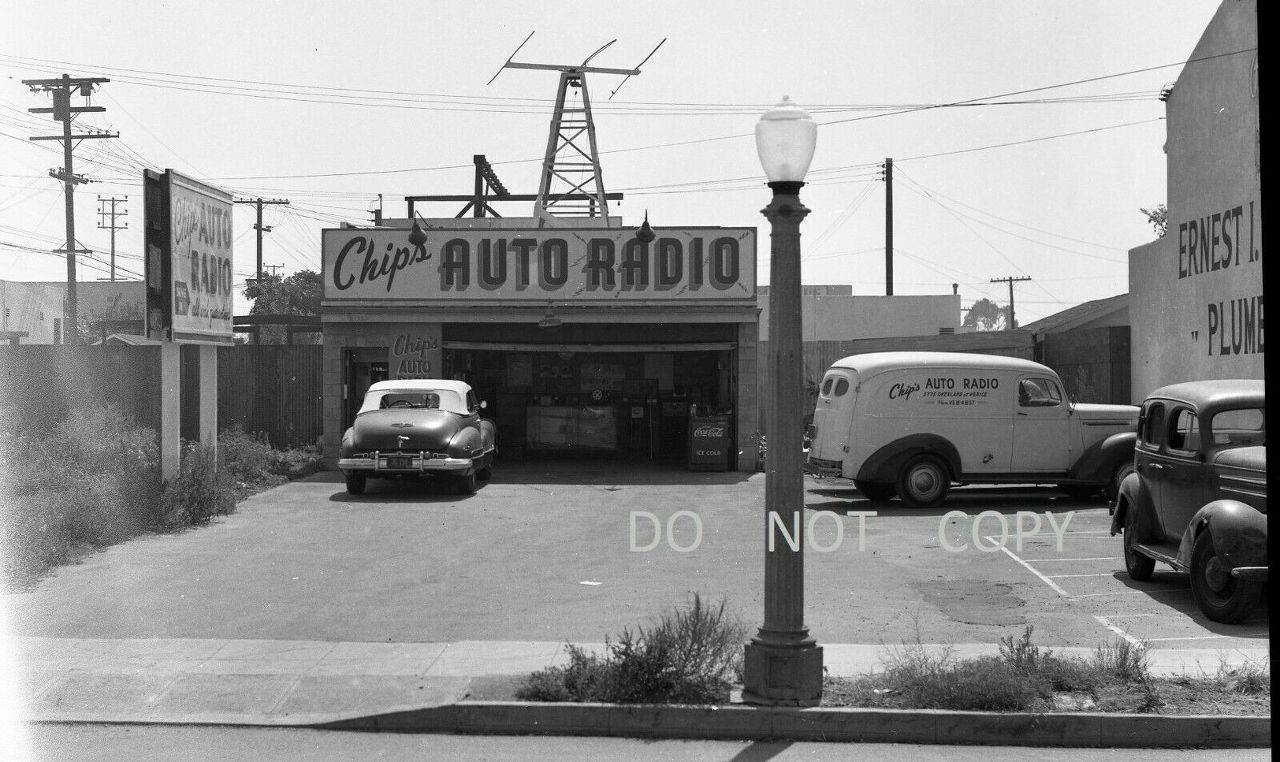
This is a cool little auto shop specializing in CAR RADIOS. ....I especially like the large antenna on top of the building.


Seller's description:...."1930's 4 x 5" Negative...CHIP'S Auto Radio Shop, Los Angeles, California"


eBay

The seller gives a more precise location. . . "B/W film photo negative showing Chip's Auto Radio, Overland at Venice in L.A."

The building doesn't appear to be on a corner so maybe it was in the vicinity of Overland & Venice Blvd.

There are still small buildings in the area that might be Chip's old building.


note - Ernest 'someone' had a plumbing store next door.....Aso note the Coca-Cola machine just inside the garage door.
.

Last edited by ethereal_reality; Dec 19, 2019 at 12:33 AM.
     
     
  #53283  
Old Posted Dec 19, 2019, 2:18 AM
Noir_Noir Noir_Noir is offline
Registered User
 
Join Date: Feb 2018
Posts: 600


The Chips Auto Radio van in the picture says 3775 Overland at Venice.


GSV


Chips is gone and Ernest I. Newton was the plumber next door in the picture. It was still under the Newton name on GSV in 2011 but has changed since then.


The 1930's dating on the picture is likely off the mark as Ernest Newton set up his business in 1946.

Last edited by Noir_Noir; Dec 19, 2019 at 2:31 AM.
     
     
  #53284  
Old Posted Dec 19, 2019, 3:01 AM
ethereal_reality's Avatar
ethereal_reality ethereal_reality is offline
Registered User
 
Join Date: Feb 2008
Location: Lafayette/West Lafayette IN, Purdue U.
Posts: 17,904
Thanks Noir Noir!

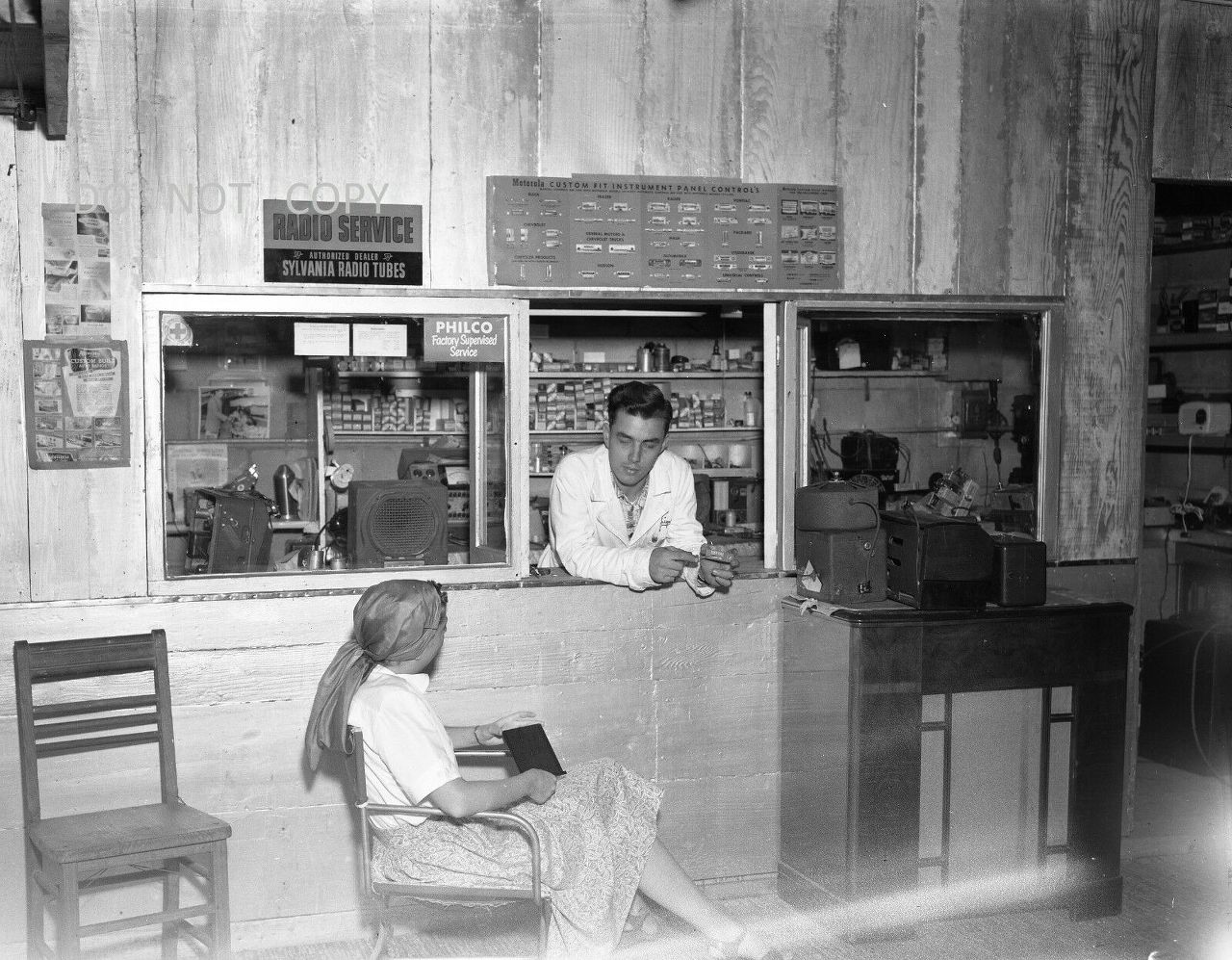
I just found another negative that the same seller just placed on eBay.

I wonder if this could be the interior of Chip's Auto Radio Shop?


SELLER'S VAGUE DESCRIPTION:...."NEGATIVE...SHOP INTERIOR, RADIO SERVICE, DIFFERENT RADIOS, PARTS."


The young man has his name on his white shirt. . . .but I can't tell if it says Chip.

Here's the LINK

.

Last edited by ethereal_reality; Dec 19, 2019 at 3:08 AM. Reason: S
     
     
  #53285  
Old Posted Dec 19, 2019, 3:28 AM
Noir_Noir Noir_Noir is offline
Registered User
 
Join Date: Feb 2018
Posts: 600


Paul Chiappinelli was the owner of the business and the building went up in 1951.

A two story extension was added in 1965. It all came down in 2002.

Last edited by Noir_Noir; Dec 19, 2019 at 3:39 AM.
     
     
  #53286  
Old Posted Dec 19, 2019, 7:40 PM
Martin Pal Martin Pal is offline
Registered User
 
Join Date: Sep 2013
Posts: 2,714
Quote:
Originally Posted by Lwize View Post

(Everett Collection)

WEST HOLLYWOOD
These 1920s apartments inspired one of the best noir films ever made
For the set of In a Lonely Place, director Nicholas Ray recreated one of his first Hollywood homes
By Chris Eggertsen@chrisjeggertsen Dec 18, 2019, 10:20am PST

https://la.curbed.com/2019/12/18/21025719/historic-apartments-movies-villa-primavera-zwebell
Thanks for pointing out this article Lwize, I watched this film again recently and travel by many of the locations in it quite frequently.

Here's a good link to filming locations throughout the film and it has "now" companion photos. Interestingly, none of the several filming location sites show the Beverly Hills Post Office, right next to the Beverly Hills City Hall, which had both an interior and an exterior scene. The post office is now the Wallis Annenberg Center for the Performing Arts.

http://dearoldhollywood.blogspot.com/2011/06/in-lonely-place-1950-film-locations.html
     
     
  #53287  
Old Posted Dec 19, 2019, 7:50 PM
BillinGlendaleCA BillinGlendaleCA is offline
Registered User
 
Join Date: Nov 2016
Posts: 570
Quote:
Originally Posted by Martin Pal View Post
Thanks for pointing out this article Lwize, I watched this film again recently and travel by many of the locations in it quite frequently.

Here's a good link to filming locations throughout the film and it has "now" companion photos. Interestingly, none of the several filming location sites show the Beverly Hills Post Office, right next to the Beverly Hills City Hall, which had both an interior and an exterior scene. The post office is now the Wallis Annenberg Center for the Performing Arts.

http://dearoldhollywood.blogspot.com/2011/06/in-lonely-place-1950-film-locations.html
Exterior of the former Beverly Hills Post Office:
_8160009-1 by BillinGlendaleCA, on Flickr

Main Lobby of the former Post Office:

_8160011-1 by BillinGlendaleCA, on Flickr
     
     
  #53288  
Old Posted Dec 19, 2019, 8:43 PM
ethereal_reality's Avatar
ethereal_reality ethereal_reality is offline
Registered User
 
Join Date: Feb 2008
Location: Lafayette/West Lafayette IN, Purdue U.
Posts: 17,904
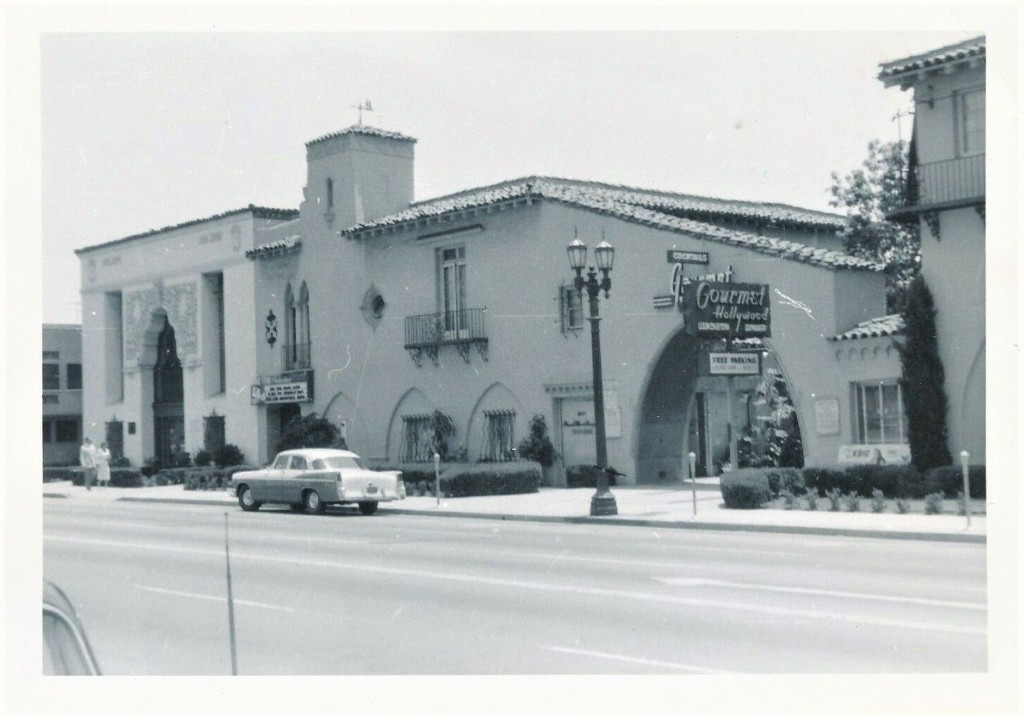
Here are a couple more photographs from 1957 1956.

"Vintage Photo 3x5 - Los Angeles Hollywood Restaurant Street Scene 1956."


eBay

If I remember correctly, this restaurant was across the street (on SUNSET BLVD.) from the Hollywood Athletic Club.


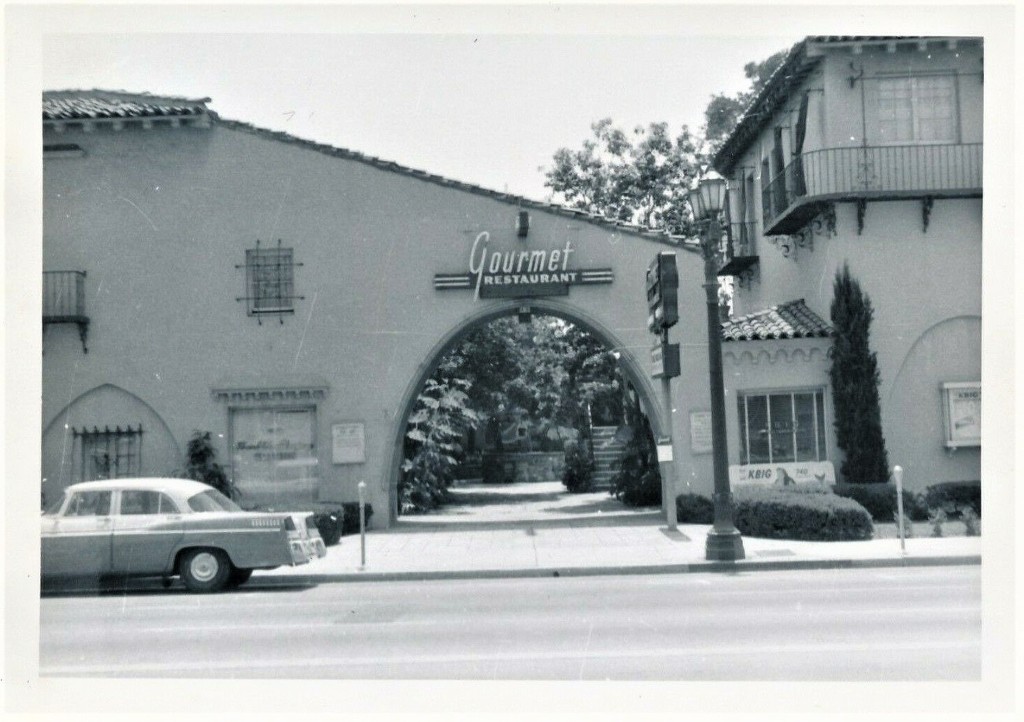
Here's a closer view of the arched entrance.


As you can see, this was obviously taken on the same day. (same parked car)

Was the name really just 'Gourmet Restaurant'? That seems awfully generic.

.
     
     
  #53289  
Old Posted Dec 19, 2019, 8:56 PM
ethereal_reality's Avatar
ethereal_reality ethereal_reality is offline
Registered User
 
Join Date: Feb 2008
Location: Lafayette/West Lafayette IN, Purdue U.
Posts: 17,904
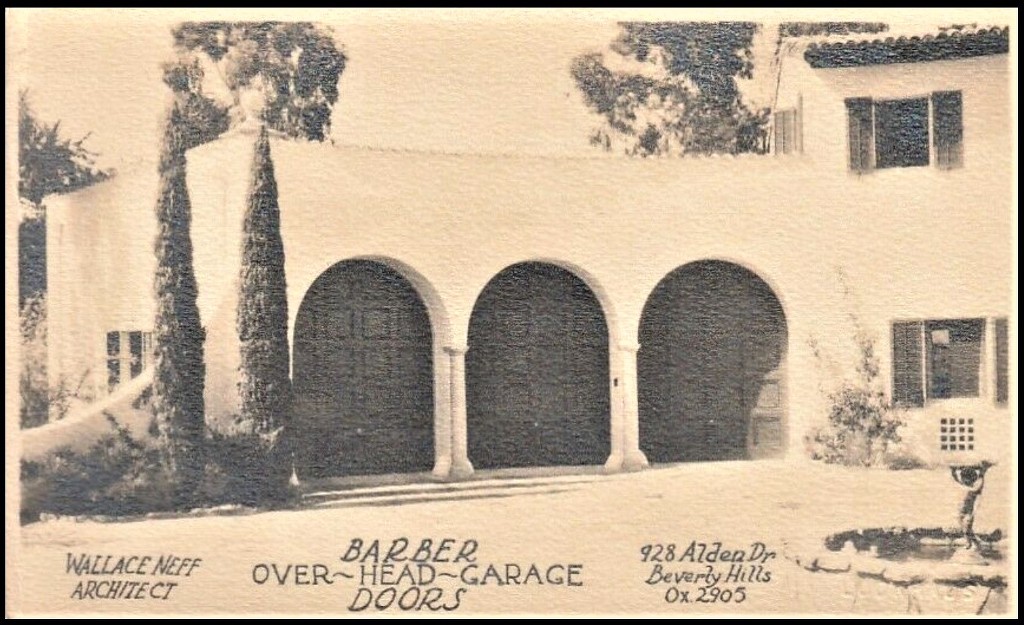
Here's a rare postcard found on eBay a couple weeks ago.


eBay

As most everyone knows, Wallace Neff is a very important architect, especially in the Los Angeles area.

But this rppc must be an advertisement for Barber Over-Head-Garage Doors.


search purposes: ...928 Alden Drive, Beverly Hills Cal.
     
     
  #53290  
Old Posted Dec 19, 2019, 10:37 PM
CityBoyDoug CityBoyDoug is offline
BANNED
 
Join Date: Apr 2013
Posts: 2,868
Quote:
Originally Posted by ethereal_reality View Post

Was the name really just 'Gourmet Restaurant'? That seems awfully generic.

.
The word "gourmet" was a big deal in the 1950s. In 2019 its rather passe, old fashioned or whatever.
     
     
  #53291  
Old Posted Dec 20, 2019, 12:26 AM
oldstuff oldstuff is offline
Registered User
 
Join Date: Aug 2012
Posts: 623
Quote:
Originally Posted by ethereal_reality View Post
Thanks Noir Noir!

I just found another negative that the same seller just placed on eBay.

I wonder if this could be the interior of Chip's Auto Radio Shop?


SELLER'S VAGUE DESCRIPTION:...."NEGATIVE...SHOP INTERIOR, RADIO SERVICE, DIFFERENT RADIOS, PARTS."


The young man has his name on his white shirt. . . .but I can't tell if it says Chip.

Here's the LINK

.

Pulvio (Paul) Chippanelli was born in 1927 in Connecticut. There is a high school yearbook photo of him from Long Beach Polytechnic High School in 1943 who looks like the radio guy. He was married in Los Angeles in 1953 to a Clelia B Mangiameli. Maybe that is his wife in the photo
     
     
  #53292  
Old Posted Dec 20, 2019, 12:36 AM
CityBoyDoug CityBoyDoug is offline
BANNED
 
Join Date: Apr 2013
Posts: 2,868
Quote:
Originally Posted by ethereal_reality View Post
That is a fantastic article, Lwize.


This is a cool little auto shop specializing in CAR RADIOS. ....I especially like the large antenna on top of the building.


Seller's description:...."1930's 4 x 5" Negative...CHIP'S Auto Radio Shop, Los Angeles, California"


eBay

The seller gives a more precise location. . . "B/W film photo negative showing Chip's Auto Radio, Overland at Venice in L.A."

The building doesn't appear to be on a corner so maybe it was in the vicinity of Overland & Venice Blvd.

There are still small buildings in the area that might be Chip's old building.


note - Ernest 'someone' had a plumbing store next door.....Aso note the Coca-Cola machine just inside the garage door.
.
eBay says 1930's photo but that's a late 1940s Buick at the left side. We had one for about a year....my father got it from some LA mafia types as payment for their legal services bill.
It had vacuum windshield wipers I liked to operate at high-speed until one of the blades flew off and disappeared....we never found it.
     
     
  #53293  
Old Posted Dec 20, 2019, 12:48 AM
Scott Charles's Avatar
Scott Charles Scott Charles is online now
Registered User
 
Join Date: Jan 2018
Location: Los Angeles
Posts: 688
News 8 takes a trip to Downtown Los Angeles in 1978

Video Link
     
     
  #53294  
Old Posted Dec 20, 2019, 4:49 AM
odinthor's Avatar
odinthor odinthor is offline
Registered User
 
Join Date: May 2015
Posts: 1,626
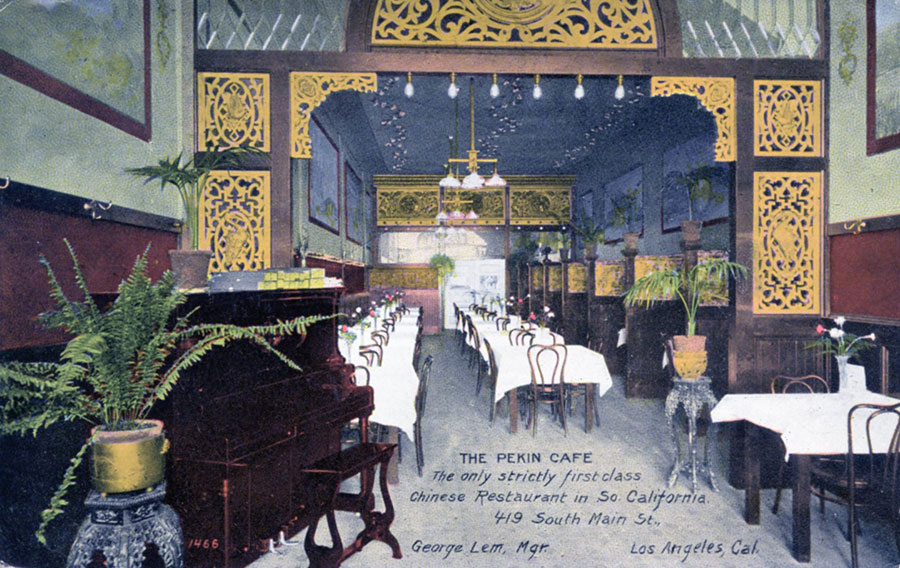
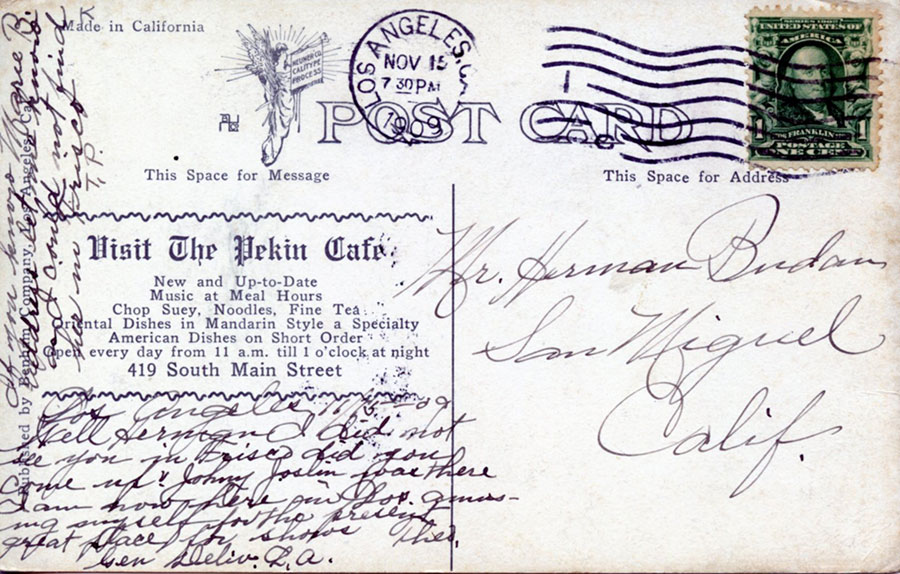
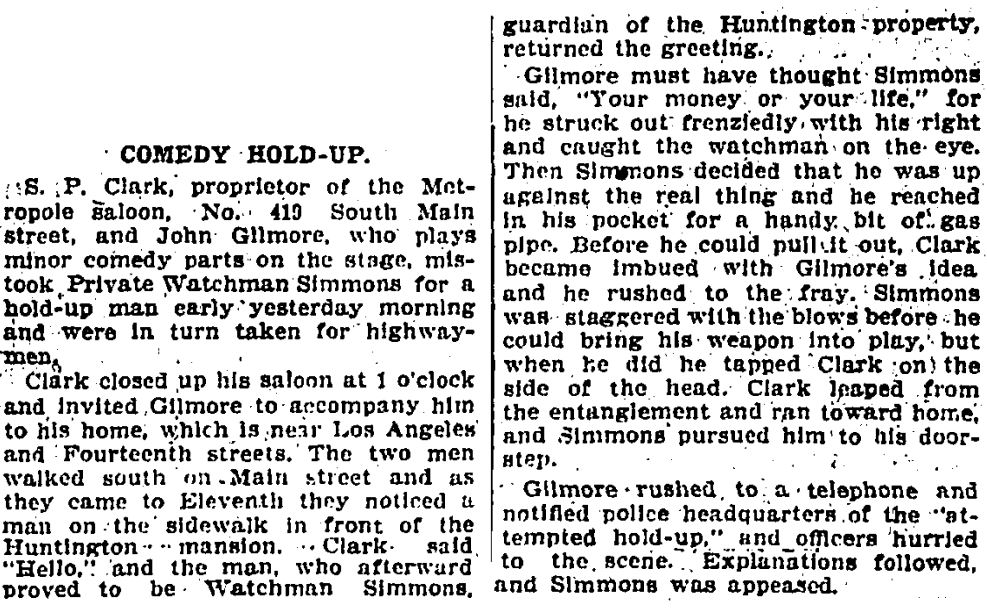
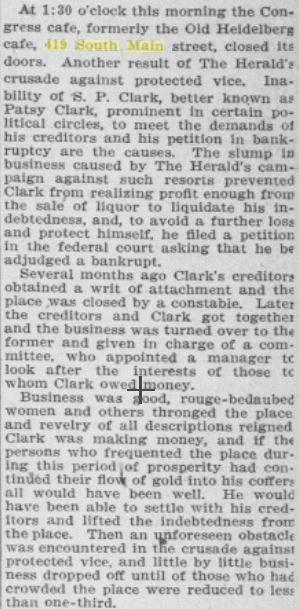
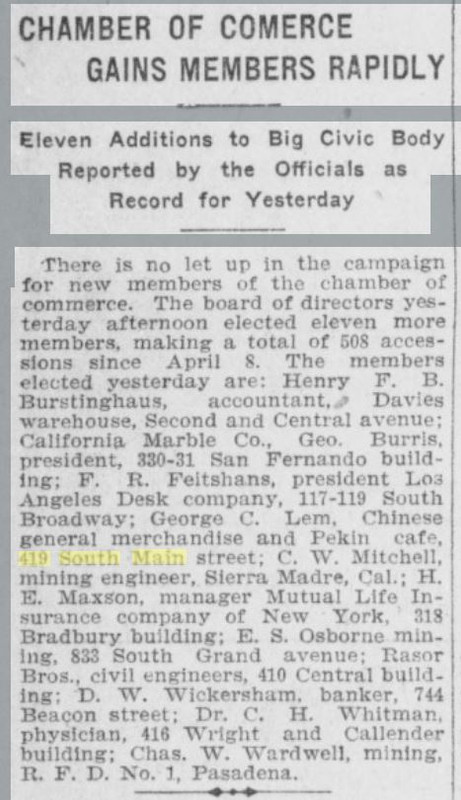
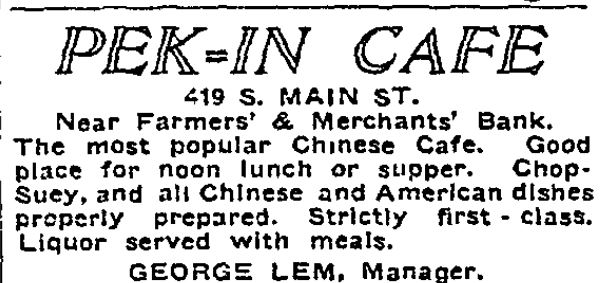
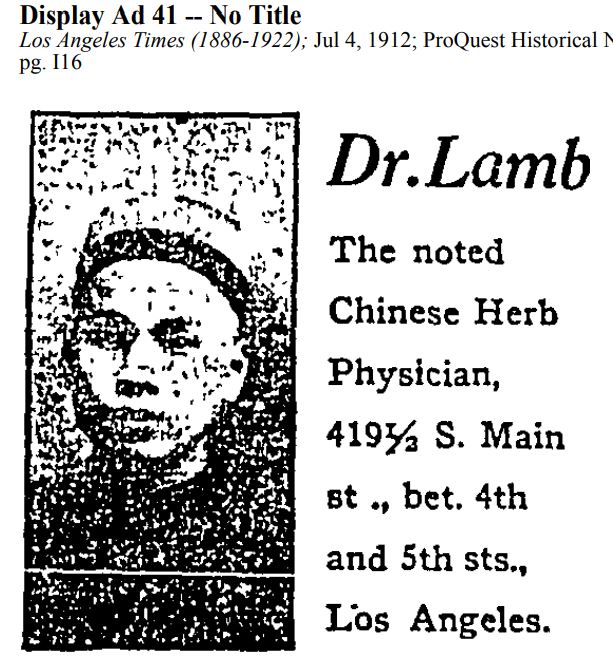
The Pekin Cafe of L.A. (a Pekin Cafe in Long Beach has been mentioned previously on the thread):


odinthor collection


odinthor collection

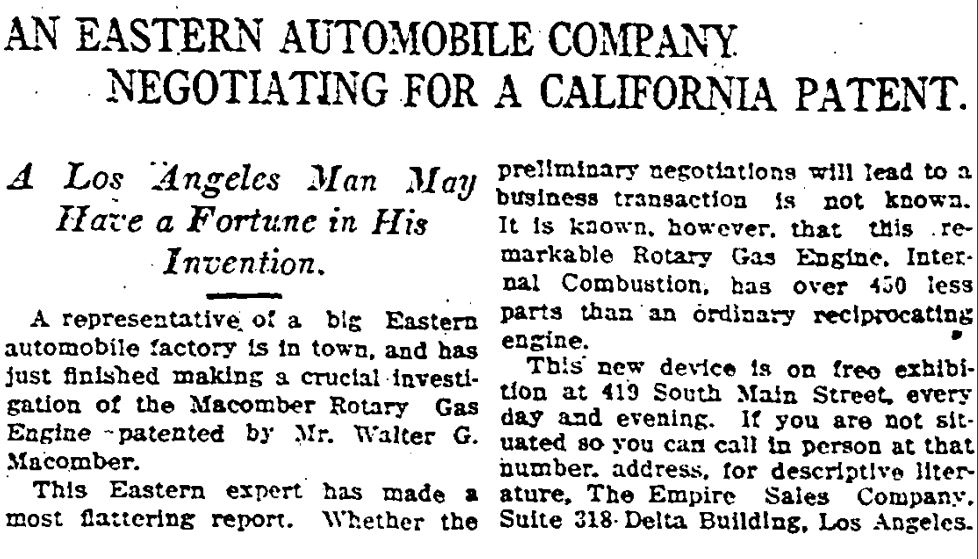
More on the Pekin Cafe and 419 S. Main in due course . . .
     
     
  #53295  
Old Posted Dec 20, 2019, 5:17 AM
odinthor's Avatar
odinthor odinthor is offline
Registered User
 
Join Date: May 2015
Posts: 1,626
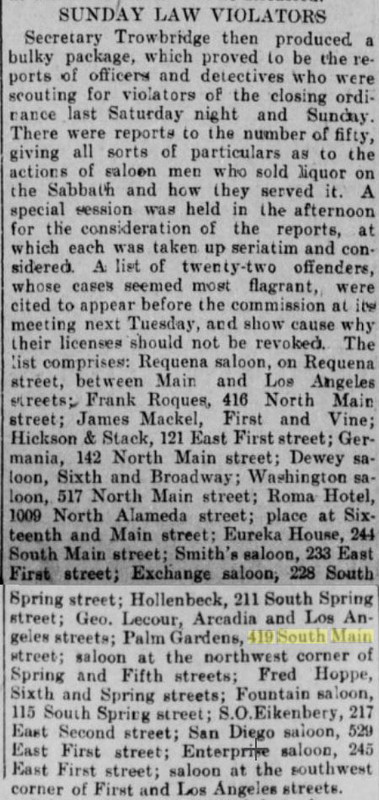
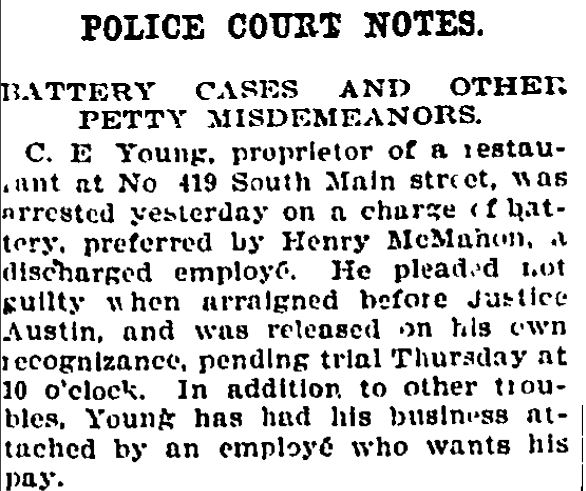
More on 419 S. Main and the Pekin Cafe:


LA Herald, 3/1/1899


LA Times, 2/28/1900


LA Times, 11/1/1902


LA Herald, 2/22/1909


LA Herland, 9/9/1909


LA Times, 3/22/1911


I leave out the various burglaries, thefts, suicides and so on which happened in the rooming house upstairs; but let's include:


LA Times, 7/4/1912


LA Times, 11/4/1913


LA Times, 7/20/1915


And so the Pekin Cafe--the name of which seems to have started off as a feeble pun ("Pek-In," which is to say "Peek-In," vs. the city Pekin)--ran from 1909-1915.
     
     
  #53296  
Old Posted Dec 20, 2019, 5:21 AM
FredH's Avatar
FredH FredH is offline
Registered User
 
Join Date: Aug 2011
Posts: 676
Once in a while, a little Raymond Chandler...

“I used to like this town. A long time ago. There were trees along Wilshire Boulevard.
Beverly Hills was a country town. Westwood was bare hills and lots offering at eleven
hundred dollars and no takers. Hollywood was a bunch of frame houses on the interurban line.
Los Angeles was just a big dry sunny place with ugly homes and no style, but
goodhearted and peaceful. It had the climate they just yap about now.
People used to sleep out on porches. Little groups who thought they were intellectual
used to call it the Athens of America. It wasn’t that, but it wasn’t a neon-lighted slum, either.”
     
     
  #53297  
Old Posted Dec 20, 2019, 4:40 PM
CityBoyDoug CityBoyDoug is offline
BANNED
 
Join Date: Apr 2013
Posts: 2,868
Quote:
Originally Posted by FredH View Post
Once in a while, a little Raymond Chandler...

“I used to like this town. A long time ago. There were trees along Wilshire Boulevard.
Beverly Hills was a country town. Westwood was bare hills and lots offering at eleven
hundred dollars and no takers. Hollywood was a bunch of frame houses on the interurban line.
Los Angeles was just a big dry sunny place with ugly homes and no style, but
goodhearted and peaceful. It had the climate they just yap about now.
People used to sleep out on porches. Little groups who thought they were intellectual
used to call it the Athens of America. It wasn’t that, but it wasn’t a neon-lighted slum, either.”

laweekly
     
     
  #53298  
Old Posted Dec 20, 2019, 6:12 PM
Martin Pal Martin Pal is offline
Registered User
 
Join Date: Sep 2013
Posts: 2,714
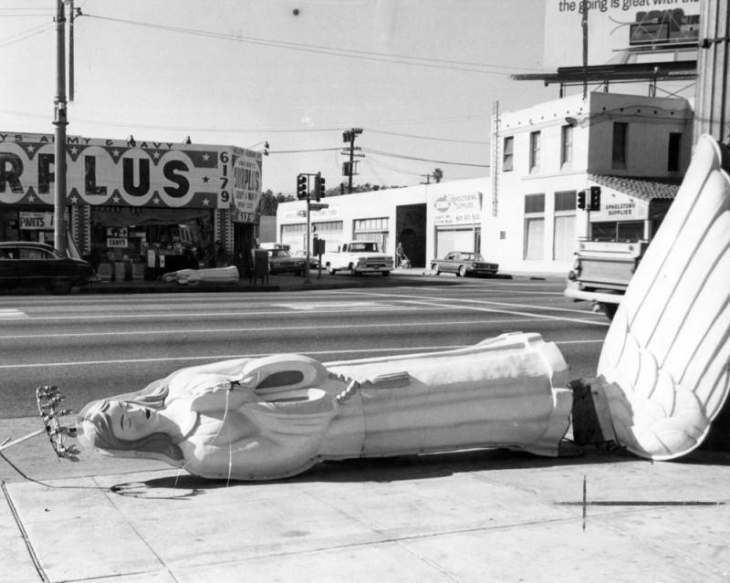
Fallen Angel...

Gordon Dean/LAPL

Well, not fallen, but awaiting to be put up on Van Nuys Blvd., November 24, 1962. You can see one across the street as well. (Yes, there was a time the holiday decorations were not put up so early.) They were 13 feet tall and over 50 of them were put up along Van Nuys Blvd. from Vanowen to Bessemer Street.

December 17, 1962 in Van Nuys.
LAPL
     
     
  #53299  
Old Posted Dec 20, 2019, 6:19 PM
ethereal_reality's Avatar
ethereal_reality ethereal_reality is offline
Registered User
 
Join Date: Feb 2008
Location: Lafayette/West Lafayette IN, Purdue U.
Posts: 17,904
I see a Dr. Scholl's sign. They treat fallen arches.


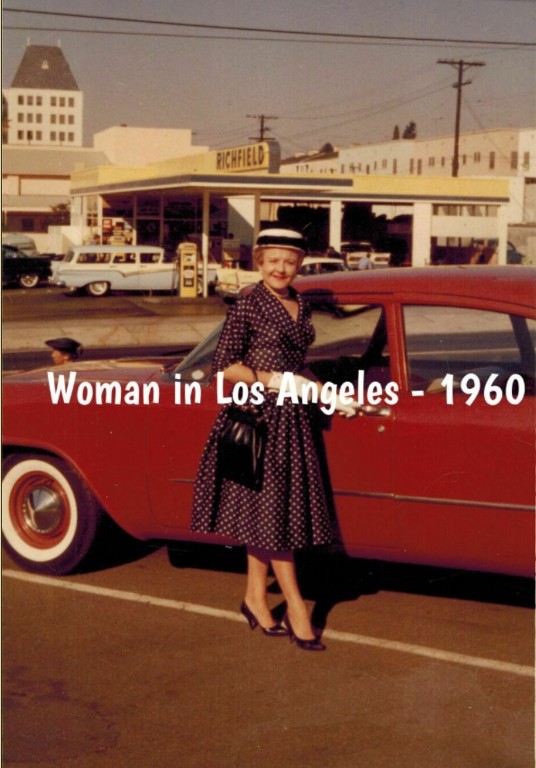
Goin' to church in Hollywood. .....At least, I think it's Hollywood. . . ,


eBay For search purposes:..Richfield Service Station.


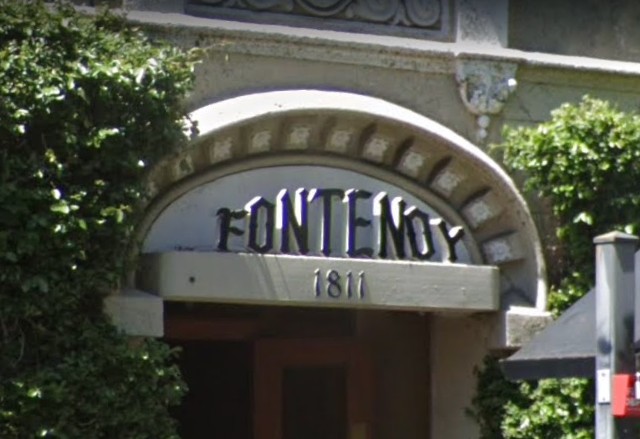
because. . .unless I'm mistaken, the tall building with the mansard roof is the Fontleroy Apts.


update:

I was incorrect about the name of the apartment. It's the Fontenoy. . not Fontleroy.

Located at 1811 Whitley Avenue.


GSV

.

Last edited by ethereal_reality; Dec 20, 2019 at 6:49 PM.
     
     
  #53300  
Old Posted Dec 20, 2019, 6:43 PM
Martin Pal Martin Pal is offline
Registered User
 
Join Date: Sep 2013
Posts: 2,714
Quote:
Originally Posted by Scott Charles View Post
News 8 takes a trip to Downtown Los Angeles in 1978
Thanks, Scott. I don't recall any channel that was News 8? I see the reporter is wearing one of the fashion styles of the 70's...a rugby shirt. I used to have one; I liked them! (And matching socks!)

Watching the Bradbury Building segment reminded me...I've been watching the CSI:NY series this year, I hadn't while it aired. I knew that with a few exceptions, all of the CSI series episodes were shot in Los Angeles. I remember Gary Sinise on David Letterman one time and he asked Gary how he liked working in New York. Letterman seemed shocked when he told him that they did it in Los Angeles. Sinise said, "Well that's what we do in Hollywood."

So watching the series I always wondered if I could spot anything that I knew was L.A. Not really...they did a great job. I'd have a feeling about some streets that they were L.A., but nothing specific. Only by slow motion did I once see a palm tree that whizzed by.

However, one episode in the 6th season there was no question about it. The entire opening chase scene was in the Bradbury Building. A little exterior scene followed after the credits. The episode title is Point of View. Later in the same episode they used the Biltmore Hotel, both interiors and exteriors, the roof, although the roof may have been a different building, can you see the Eastern building from the Biltmore roof?
     
     
This discussion thread continues

Use the page links to the lower-right to go to the next page for additional posts

Closed Thread

Go Back   SkyscraperPage Forum > Photography Forums > Found City Photos
Forum Jump


Forum Jump


All times are GMT. The time now is 7:02 AM.


Powered by vBulletin® Version 3.8.7
Copyright ©2000 - 2026, vBulletin Solutions, Inc.