Quote:
Originally Posted by misher

Edited. Lol. And we do tax the dead through probate fees.
Site C is a large investment and that much power is not currently needed. I'd prefer a small facility to give us a margin for growth and once we anticipate needing more we can building another facility.
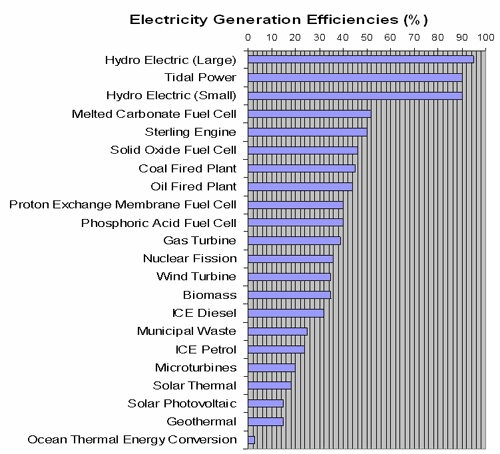
Geothermal seems very promising, it allows us to make a much smaller investment to get something built faster. Site C will likely be 9+ billion dollar project for 900MW. It will take about 5 years to build and occupy much of our workforce at a time we are building other large projects such as the Broadway extension, I honestly don't know where were going to get the workers from and I suspect wages will skyrocket costs (doing all these massive projects that require the same workers at once is insane!). A 100MW geothermal plant is about $400 million and will take us two years. Its a much smaller investment, thus less risk. Also we can scale up and build more geothermal plants when we need power instead of building a giant site C that current numbers predict we probably do not need as our power use isn't increasing. Geothermal is likely more reliable than a dam as well and is likely much better for the environment as it doesn't destroy a habitat or dam a river. I don't want to make accusations, but the main driver of Site C seems to be to funnel a huge amount of money to NDP backers that is paid for via a huge loan. I admit there's some personal preference here. I hate large projects, there unpredictable and high risk as your putting your eggs in one basket. A bunch of smaller, more manageable projects makes sense unless there are huge savings as projects scale. Right now it seems like there's more savings from building smaller geothermal plants.
https://www.cleanenergybc.org/about/clean-energy-sectors/geothermal |
Site C IS needed for future power requirements. Right now, BC is a net importer of electricity, especially electricity from jurisdictions that produce their power from high carbon sources (such as coal):
https://www.neb-one.gc.ca/nrg/ntgrtd/mrkt/snpsht/2015/12-03-1bchdrsstm-eng.html
While there is theoretically enough generating capacity within BC to be self-sufficient, the issue is that as BC's generating capacity is mostly hydroelectric, that depends a lot on water availability, in‐stream requirements and Treaty obligations related to flood control and power generation in the US as per the Columbia River Treaty.
So, while on paper, there is enough electricity generation capacity (and at times, we do have enough generation capacity), in reality, we do not have enough
consistent power generation capability as it is, and with future load expected to increase due to population growth and increased electrification of transportation, eventually even demand will outstrip the current theoretical generating capacity right now.
And geothermal is actually a higher risk situation; because geothermal has a high upfront cost to drill the wells, plus the risk that the wells you do drill might not work out (meaning you could be spending millions to drill empty wells before you actually get a good well), it makes investment in geothermal a fairly risky situation:
https://onlineacademiccommunity.uvic.ca/...hermal-energy-for-electricity-in-canada/
Even assuming a P50 situation, the amount of investment necessary for a successful geothermal well is very high, compared to the lower risk of hydroelectric.





 Prev
Prev




 Linear Mode
