HomeDiagramsDatabaseMapsForum About
     

Go Back   SkyscraperPage Forum > Discussion Forums > City Discussions


Reply

 
Thread Tools Display Modes
     
     
  #1  
Old Posted Apr 6, 2019, 10:48 PM
M II A II R II K's Avatar
M II A II R II K M II A II R II K is offline
Registered User
 
Join Date: Aug 2002
Location: Toronto
Posts: 50,586
Why Is Japanese Zoning More Liberal Than US Zoning?

Why Is Japanese Zoning More Liberal Than US Zoning?


MARCH 19, 2019

BY NOLAN GRAY

Read More: http://marketurbanism.com/2019/03/19/why-is-japanese-zoning-more-liberal-than-us-zoning/

Quote:
.....

Japanese zoning is relatively liberal, with few bulk and density controls, limited use segregation, and no regulatory distinction between apartments and single-family homes. Most development in Japan happens “as-of-right,” meaning that securing permits doesn’t require a lengthy review process. Taken as a whole, Japan’s zoning system makes it easy to build walkable, mixed-use neighborhoods, which is why cities like Tokyo are among the most affordable in the developed world.

- But praise for Japanese zoning skirts an important meta question: Why did U.S. zoning end up so much more restrictive than Japanese zoning? To frame the puzzle a different way, why did U.S. and Japanese land-use regulation which both started off quite liberal diverge so dramatically in terms of restrictiveness? — I will suggest three factors; the first two set out the “why” for restrictive zoning and the third sets out the “how.” Any YIMBY efforts to liberalize cities in the long term must address these three factors. First, the U.S. privileges real estate as an investment where Japan does not, incentivizing voters to prohibit new supply with restrictive zoning.

- Second, most public services in the U.S. are administered at the local level, driving local residents to use exclusionary zoning to “preserve” public service quality. Third, the U.S. practice of near-total deference to local land-use planning and widespread use of discretionary permitting creates a system in which local special interests can capture zoning regulation and remake it around their interests. At the outset, why might Americans voters demand stricter zoning than their Japanese counterparts? One possibility is that they are trying to preserve the value of their only meaningful asset: their home. In the U.S., we use housing as a kind of de facto social safety net.

- Through a mixture of interest deductions, capital gains and property tax exemptions, and subsidized mortgages, current housing policy in the U.S. does everything it can to nudge every American into plowing their life’s savings into a home. Over time, the thinking goes, homes will accrue in value and homeowners will build “wealth.” In reality, even with all these subsidies, a home is a poor investment: it’s highly illiquid, and if a region isn’t growing or if a lot of new housing being built, any meager housing appreciation will be wiped out by maintenance costs and taxes. To overcome this issue, U.S. municipalities systematically restrict the construction of new housing, creating artificial housing scarcity which drives up the values of existing homes.

- The situation in Japan is almost the exact opposite. Homes have little resale value in Japan. By one estimate, the average Japanese home fully depreciates after 22 years. There’s surely a cultural element, but most observers agree that the island’s frequent earthquakes play a big role: with structural damage so frequent and safety standards constantly improving, nobody wants to live in an old home. The result is that the resale value of a home is really only in its land value, so Japanese savers have little to no reason to “invest” in a house, treating shelter like a consumption good.

- This system has two downstream effects on land-use regulation: On the one hand, the average Japanese household simply has no reason to perpetuate housing scarcity, like their American counterpart. On the other hand, the average Japanese household has a vested interest in keeping land-use regulation light, insomuch as they see themselves as potential future developers in the event of a move. — Would it be better if Americans, like the Japanese, demolished most homes after 30 years? I’m not so sure. But it would be wise to stop subsidizing excessive investments in housing, which would encourage smarter investment behavior and reduce demand for restrictive land-use regulations.

- Another reason why Americans might support more restrictive zoning than the Japanese has to do with the peculiar way that we provide public services. Here in the U.S., the quality of essential services like parks, education, and public safety can vary dramatically municipality to municipality. A larger population of low-income households means higher public outlays, higher taxes on middle- and upper-income earners, and lower quality public services. Residents respond by self-selecting into the most affluent communities they can afford and pulling up the ladder once they’re in. To put it another way, to ensure access to quality schools and open space, American households are encouraged to move out to a suburb and employ land-use regulations to keep out anyone poorer than themselves.

- Japan avoids these pressures both by standardizing local public service provision and by enforcing strict economic and racial homogeneity through a mixture of high marginal tax rates and xenophobic immigration policy. The desirability of the latter two policies is highly suspect, but the decoupling of public service quality from local municipal boundaries is a no brainer. Insomuch as U.S. policymakers can expand policies like school choice and city-county consolidation, they minimize the need for local voters to try and exclude outsiders from moving into high opportunity areas. We now know why a certain segment American voters might prefer restrictive land-use regulations. But how do they enforce these preferences against the apparent needs of the country as a whole?

- In the U.S., our 89,000 municipal governments are entitled to develop their own unique system of land-use regulation, with little to no oversight from the courts, state governments, or federal regulators. The result is that zoning restrictiveness rises to the preference of local special interests like homeowners, which in small, homogenous, middle- and upper-income suburbs can be quite restrictive. This severely limits new development in most suburbs, with ugly elements of racism and classism typically mixed in. In cities, the mechanism of enforcing these restrictive preferences is slightly different. More so than in suburbs, many U.S. cities force every development proposal to go through a long and costly discretionary review process.

- Japan bypasses these problems completely through a large national role in land-use planning and an as-of-right system of development. On the first score, the national government sets out 12 zones, which are clear, liberal, and generally focused on actual nuisances. This places a lower bound on how strict a local land-use regulation can be, with even the most strict zone allowing for multifamily, home-based businesses, and small local retailers. This national zoning system takes away the power of local municipalities to develop complicated and exclusionary local land-use regulations. On the second score, Japan combines these liberal use and design guidelines with an “as-of-right” system of permitting, meaning that if a project complies with the zoning, it doesn’t need to go through a discretionary review process.

- In this sense, Japanese zoning gets close to proper planning: policymakers consider upfront what type of development they would like to permit and where, and when developers come up with a conforming proposal, they hand over the needed permits. This provides developers and local residents with a high degree of certainty about what can and cannot be built. So what exactly should we learn from Japanese zoning? At a superficial level, we might take away that Japan shows that a liberal zoning regime is workable and highly desirable. YIMBYs can and should go out and work on liberalizing our local zoning code in the near term. But at a deeper level, YIMBYs should learn that making their mounting victories sustainable in the long term means taking on the policies and institutions that built our system of exclusionary zoning in the first place.

.....


__________________
ASDFGHJK
Reply With Quote
     
     
  #2  
Old Posted Apr 7, 2019, 5:26 AM
pdxtex's Avatar
pdxtex pdxtex is offline
Registered User
 
Join Date: Jan 2004
Location: Portland, OR
Posts: 3,210
japan = collective society jammed on to mountainous island where space is a premium. america = cowboy individualism and get off muh lawn community building....tah dah...
__________________
Portland!! Where young people formerly went to retire.
Reply With Quote
     
     
  #3  
Old Posted Apr 7, 2019, 6:04 AM
M II A II R II K's Avatar
M II A II R II K M II A II R II K is offline
Registered User
 
Join Date: Aug 2002
Location: Toronto
Posts: 50,586
As suggested a Japanese crowded city still has affordable housing. Because individuals wealth are not synonymous with the house they bought.
__________________
ASDFGHJK
Reply With Quote
     
     
  #4  
Old Posted Apr 7, 2019, 7:36 AM
10023's Avatar
10023 10023 is offline
Registered User
 
Join Date: Jun 2007
Location: London
Posts: 21,129
Quote:
Originally Posted by pdxtex View Post
japan = collective society jammed on to mountainous island where space is a premium. america = cowboy individualism and get off muh lawn community building....tah dah...
Japan also doesn’t have historic buildings aside from a smattering of temples. Land is valuable but buildings, especially houses, are generally considered temporary and replaced every 50 years or so.

And of course, Japanese cities are not very attractive aesthetically.
__________________
There is a cult of ignorance in the United States, and there always has been. The strain of anti-intellectualism has been a constant thread winding its way through our political and cultural life, nurtured by the false notion that democracy means that "my ignorance is just as good as your knowledge." - Isaac Asimov
Reply With Quote
     
     
  #5  
Old Posted Apr 7, 2019, 8:49 AM
mousquet's Avatar
mousquet mousquet is offline
Moderator
 
Join Date: Jan 2011
Location: Greater Paris, France
Posts: 5,133
Quote:
Originally Posted by 10023 View Post
Japanese cities are not very attractive aesthetically.
Only a matter of taste, thus biased by definition, right? Some people would disagree and might make some very fair points in the argument.

I never went to Tokyo, but probably would enjoy it. It looks like they've dealt with modernism in a consistent fashion, allowed by their most advanced and extensive public transit system, which is 2nd to none.
They will preserve more and more of their modern fabric, undoubtedly, cause much of it seems a modern reference.

I like their storefronts full of lights and colors in pictures. That is attractive, no question about it.
We could use a lot of the same in Greater Paris. But then our environmentalists wouldn't fail to point out and complain about light pollution at night.
Ha, they're annoying sometimes.
Reply With Quote
     
     
  #6  
Old Posted Apr 7, 2019, 10:04 AM
IMBY IMBY is offline
Registered User
 
Join Date: Sep 2012
Location: Tucson, AZ
Posts: 1,149
Quote:
Originally Posted by mousquet View Post
Only a matter of taste, thus biased by definition, right? Some people would disagree and might make some very fair points in the argument.

I never went to Tokyo, but probably would enjoy it. It looks like they've dealt with modernism in a consistent fashion, allowed by their most advanced and extensive public transit system, which is 2nd to none.
They will preserve more and more of their modern fabric, undoubtedly, cause much of it seems a modern reference.

I like their storefronts full of lights and colors in pictures. That is attractive, no question about it.
We could use a lot of the same in Greater Paris. But then our environmentalists wouldn't fail to point out and complain about light pollution at night.
Ha, they're annoying sometimes.
I'm anti-light pollution myself, what with LED tail light and head lights, enough is enough!

One reason I'm in Tucson, having escaped the light pollution capital (Las Vegas). There's a working observatory atop our Catalina Mountains here so lighting is kept at a minimum.

There are residential streets in my neighborhood with not one single street light, and I love it!
Reply With Quote
     
     
  #7  
Old Posted Apr 7, 2019, 10:39 AM
10023's Avatar
10023 10023 is offline
Registered User
 
Join Date: Jun 2007
Location: London
Posts: 21,129
Quote:
Originally Posted by mousquet View Post
Only a matter of taste, thus biased by definition, right? Some people would disagree and might make some very fair points in the argument.

I never went to Tokyo, but probably would enjoy it. It looks like they've dealt with modernism in a consistent fashion, allowed by their most advanced and extensive public transit system, which is 2nd to none.
They will preserve more and more of their modern fabric, undoubtedly, cause much of it seems a modern reference.

I like their storefronts full of lights and colors in pictures. That is attractive, no question about it.
We could use a lot of the same in Greater Paris. But then our environmentalists wouldn't fail to point out and complain about light pollution at night.
Ha, they're annoying sometimes.
Most buildings in Tokyo look like the worst of the Paris post-war suburbs, or parts of London that were rebuilt after the Blitz. Ugly concrete buildings from the 1950s and 60s (Tokyo of course having been bombed as well).

On the other hand, city streets with lots of 18th and 19th century architecture are worth preserving. We can’t build as well anymore.
__________________
There is a cult of ignorance in the United States, and there always has been. The strain of anti-intellectualism has been a constant thread winding its way through our political and cultural life, nurtured by the false notion that democracy means that "my ignorance is just as good as your knowledge." - Isaac Asimov
Reply With Quote
     
     
  #8  
Old Posted Apr 7, 2019, 11:04 AM
mousquet's Avatar
mousquet mousquet is offline
Moderator
 
Join Date: Jan 2011
Location: Greater Paris, France
Posts: 5,133
^ I have to agree anyway. I came to think that environmentalists teach us about some helpful wisdom, and that preserving ecosystems by avoiding any excessive disturbance has to be a priority these days.

People themselves need to sleep at night, and light or noise pollution turns out to be unhealthy in urban environments.
All those lights might only be some overly aggressive or arrogant marketing.

On the other hand, I'm much more skeptical about some of their anti-growth economic dogma.
Environmentalists of the left wing think economic growth is systematically filthy, which is not only untrue, but also ugly cause it means impoverishing the people.
Now I don't know anybody willing to be impoverished, and certainly not them.
So anti-growth is really a load of political cynicism from the leftists.

Anyway, I must say what's disturbing in this article is the xenophobic trend that Japan is a bit sadly known for.
Wondering why they would be that distrustful to the world when it's been making their wealth since the 1970s/80s.
Possibly what we call cultural "insularité". Like people living on an archipelago or an island somewhat cut off from the connected lands of continents. This is not actually typical of Japan.
E.g. in France's regions, Corsica or Martinique are not particularly known to be super easy to strangers either.
I would take it as local cultural flaws caused by geographical traits of these regions. They are islands physically disconnected from any mainland.
Same as Japan in that respect, though immeasurably smaller by population and much less wealthy or educated on average.
So it must be harder to explain when it comes to the Japanese.
They could afford to receive more immigrants, huh.
Reply With Quote
     
     
  #9  
Old Posted Apr 7, 2019, 2:30 PM
Sun Belt Sun Belt is offline
BANNED
 
Join Date: Sep 2017
Location: The Envy of the World
Posts: 4,897
Quote:
Originally Posted by M II A II R II K View Post
As suggested a Japanese crowded city still has affordable housing. Because individuals wealth are not synonymous with the house they bought.
Japan has a declining population, which followed this event:
https://en.wikipedia.org/wiki/Japanese_asset_price_bubble

Nikkei Chart

https://www.japansimplelife.com/viewtopic.php?t=242
Reply With Quote
     
     
  #10  
Old Posted Apr 7, 2019, 2:52 PM
The North One's Avatar
The North One The North One is offline
Registered User
 
Join Date: Sep 2009
Posts: 5,911
Quote:
Originally Posted by pdxtex View Post
japan = collective society jammed on to mountainous island where space is a premium. america = cowboy individualism and get off muh lawn community building....tah dah...
Japan's excellent post-war urbanism and infrastructure have nothing to do with the geographical size of the nation. Although I agree the United State's toxic culture is a big reason for it being such a dysfunctional society.
__________________
Spawn of questionable parentage!
Reply With Quote
     
     
  #11  
Old Posted Apr 7, 2019, 2:54 PM
The North One's Avatar
The North One The North One is offline
Registered User
 
Join Date: Sep 2009
Posts: 5,911
Quote:
Originally Posted by 10023 View Post
Most buildings in Tokyo look like the worst of the Paris post-war suburbs, or parts of London that were rebuilt after the Blitz. Ugly concrete buildings from the 1950s and 60s (Tokyo of course having been bombed as well).

On the other hand, city streets with lots of 18th and 19th century architecture are worth preserving. We can’t build as well anymore.
You know nothing of what you're talking about, you only project western arrogance. Japan/Tokyo has better urbanism than every western city, even old ones like Paris, even the ones that were bombed like London. Cities like Kyoto are full of old architecture as well.
__________________
Spawn of questionable parentage!
Reply With Quote
     
     
  #12  
Old Posted Apr 7, 2019, 3:50 PM
Sun Belt Sun Belt is offline
BANNED
 
Join Date: Sep 2017
Location: The Envy of the World
Posts: 4,897
Quote:
Originally Posted by The North One View Post
Japan's excellent post-war urbanism and infrastructure have nothing to do with the geographical size of the nation. Although I agree the United State's toxic culture is a big reason for it being such a dysfunctional society.
Well surely you must agree that Japan's geography is the dominant determinant in their settlement pattern/density, right?

Japan has been around for thousands of years. It's a mountainous island nation with 126 million people crammed on it, giving it a population density 10x that of America. Notice how nearly the entire population is clustered along the coast where the land is developable.

They don't really have an option not to be dense. We do.

E] I don't agree with you and your views on our 'toxic culture'. Japan is the complete opposite of America. They're totally homogenous, we are not and have not since our founding.

Quote:
Japanese society is linguistically, ethnically and culturally homogeneous, composed of 98.5% ethnic Japanese, with small populations of foreign workers.
https://en.wikipedia.org/wiki/Japan#Demographics
Reply With Quote
     
     
  #13  
Old Posted Apr 7, 2019, 3:56 PM
M II A II R II K's Avatar
M II A II R II K M II A II R II K is offline
Registered User
 
Join Date: Aug 2002
Location: Toronto
Posts: 50,586
But at least they manage to have affordable housing.
__________________
ASDFGHJK
Reply With Quote
     
     
  #14  
Old Posted Apr 7, 2019, 4:02 PM
iheartthed iheartthed is online now
Registered User
 
Join Date: Oct 2009
Location: New York
Posts: 12,132
Quote:
Originally Posted by pdxtex View Post
japan = collective society jammed on to mountainous island where space is a premium. america = cowboy individualism and get off muh lawn community building....tah dah...
The U.S.'s libertarian values would suggest that it would be the country with fewer zoning rules.
Reply With Quote
     
     
  #15  
Old Posted Apr 7, 2019, 4:07 PM
Sun Belt Sun Belt is offline
BANNED
 
Join Date: Sep 2017
Location: The Envy of the World
Posts: 4,897
Quote:
Originally Posted by iheartthed View Post
The U.S.'s libertarian values would suggest that it would be the country with fewer zoning rules.
We did build our great cities when we had less nanny state regulations and zoning rules.

Imagine if we tried to develop Manhattan in today's world. It would become a bird sanctuary or something.
Reply With Quote
     
     
  #16  
Old Posted Apr 7, 2019, 4:34 PM
JManc's Avatar
JManc JManc is offline
Administrator
 
Join Date: Feb 2003
Location: Houston
Posts: 23,047
Quote:
Originally Posted by The North One View Post
Japan's excellent post-war urbanism and infrastructure have nothing to do with the geographical size of the nation. Although I agree the United State's toxic culture is a big reason for it being such a dysfunctional society.
Japan has a total land area the size of California and only a fraction of that is habitable with a third of US's population crammed in. Of course geographic constraints play a role in their development. When I was in Tokyo, I was amazed in just how efficiently they used what little space they did have. Not even New York used their space in that matter.
Reply With Quote
     
     
  #17  
Old Posted Apr 7, 2019, 4:42 PM
MonkeyRonin's Avatar
MonkeyRonin MonkeyRonin is offline
¥ ¥ ¥
 
Join Date: Sep 2006
Location: Vancouver
Posts: 10,662
Quote:
Originally Posted by 10023 View Post
And of course, Japanese cities are not very attractive aesthetically.

Japanese cities might not be "pretty" in the conventional, appealing-to-grandma sense of the word; but they have a well developed aesthetic identity and some of the best collections of modernist architecture around - which, when placed in a fine-grained built environment and layered with urban vibrancy makes for a pretty attractive, aesthetically stimulating cityscape.
__________________
Reply With Quote
     
     
  #18  
Old Posted Apr 7, 2019, 6:18 PM
mhays mhays is online now
Never Dell
 
Join Date: Jul 2001
Posts: 21,262
Cars aren't mentioned above. A large percentage of US land use codes are about mandated parking. This means no really tiny house sites, and multifamily development that in most places is planned according to how the parking will fit, i.e. large sites etc.

Tokyo is full of buildings on tiny sites that simply can't fit parking. That's a huge part of their phenomenal urbanity.
__________________
"Alot" has never been a word.
Reply With Quote
     
     
  #19  
Old Posted Apr 7, 2019, 10:01 PM
badrunner badrunner is offline
Registered User
 
Join Date: Oct 2016
Posts: 3,134
Quote:
Originally Posted by mousquet View Post
Only a matter of taste, thus biased by definition, right? Some people would disagree and might make some very fair points in the argument.

I never went to Tokyo, but probably would enjoy it. It looks like they've dealt with modernism in a consistent fashion, allowed by their most advanced and extensive public transit system, which is 2nd to none.
They will preserve more and more of their modern fabric, undoubtedly, cause much of it seems a modern reference.

I like their storefronts full of lights and colors in pictures. That is attractive, no question about it.
We could use a lot of the same in Greater Paris. But then our environmentalists wouldn't fail to point out and complain about light pollution at night.
Ha, they're annoying sometimes.
When it comes to street level, human-scale built form. Tokyo and Seoul do it better than any Western city. They are ultramodern cities full of traditional and intimate urban spaces oriented towards foot traffic. European cities do make for pretty postcard images but the reality at street level is often a very different story, especially at night.

Video Link


Video Link
Reply With Quote
     
     
  #20  
Old Posted Apr 7, 2019, 10:20 PM
MonkeyRonin's Avatar
MonkeyRonin MonkeyRonin is offline
¥ ¥ ¥
 
Join Date: Sep 2006
Location: Vancouver
Posts: 10,662
Quote:
Originally Posted by mhays View Post
Cars aren't mentioned above. A large percentage of US land use codes are about mandated parking. This means no really tiny house sites, and multifamily development that in most places is planned according to how the parking will fit, i.e. large sites etc.

Tokyo is full of buildings on tiny sites that simply can't fit parking. That's a huge part of their phenomenal urbanity.

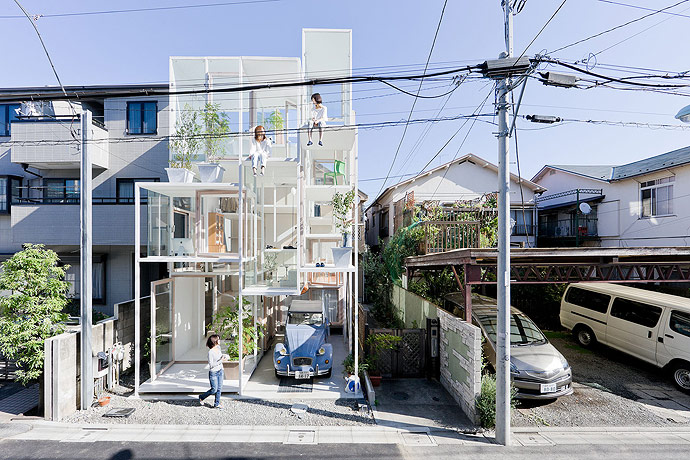
I believe car ownership rates in Japan are actually quite high. I could be wrong, but nonetheless it's actually quite common for houses & apartment buildings even in central Tokyo to accomodate parking space on the ground level.

If anything, it's proof that the existence of cars need not be a hindrance to good urban design.


https://mymodernmet.com/sou-fujimoto-architects-house-na/


(But yes, you're otherwise not wrong that typical North American parking minimums are problematic. They alone do not tell the whole story however)


Quote:
Originally Posted by badrunner View Post
European cities do make for pretty postcard images but the reality at street level is often a very different story, especially at night.

And that's just the flipside of 10023's hyperbole...
__________________
Reply With Quote
     
     
This discussion thread continues

Use the page links to the lower-right to go to the next page for additional posts
 
 
Reply

Go Back   SkyscraperPage Forum > Discussion Forums > City Discussions
Forum Jump


Forum Jump


All times are GMT. The time now is 8:44 PM.


Powered by vBulletin® Version 3.8.7
Copyright ©2000 - 2026, vBulletin Solutions, Inc.