The good old days of rail travel were not so good, were they? Only three trains per day between Ottawa and Toronto, none following the current route via Federal and Richmond. All the trains either were routed via Bedell (near Kemptville) or via Carleton Place, neither of which are possible today.
Yes, some services were pretty poor back in the 1960s and 1970s (all timings approximative):
Most notably, with Ottawa-Toronto:
Morning train via Brockville (dep. 10:00, daily except Saturday) - Between October 1958 and April 1966 only as RDC (transfer required at Brockville), from then on daily
Afternoon train via Brockville (dep. 16:00)
First night train via Havelock (dep. 22:00) - Withdrawn October 1965, reintroduced February 1966 via Napanee (CN)
Second night train via Belleville Sub (dep. 23:00) - Withdrawn October 1960
Montreal-Trois-Rivières-Quebec was another such example:
Early morning train via Trois-Rivières (dep. 07:30, Saturdays only) - Withdrawn October 1961
Morning train via Trois-Rivières (dep. 09:00) - daily, but cancelled on Sundays after October 1970
Midday/Afternoon train via Trois-Rivières (dep. 13:00, on Saturdays until October 1967 and daily after April 1970 / dep. 17:00 daily except Saturday until October 1967 and then daily until April 1970)
Early evening train via Trois-Rivières (dep. 19:00)
Night train via Trois-Rivières (dep. 23:00) - cancelled in October 1960
Thus only 3 trains between October 1961 and June 1987, which abandoned Gare du Palais in October 1976, first serving a temporary station in St-Sacrement street and then St.Foy, where VIA Rail consolidated its two Montreal-Quebec in October 1979 before both services returned to Gare du Palais in October 1985 through the newly established "back entrance":
Quote:
In 1976, the Palais Station is expropriated by the city to build the Dufferin-Montmorency highway. The rails are removed to Cadorna stop, St-Malo industrial park, where the CPR builds a new station (3 miles west of Palais Station, near St-Sacrement street). The CNR uses its Ste-Foy Station, west of Quebec’s bridge. On December 2, 1979, Ste-Foy Station becomes the passenger station of Via Rail. On November 8, 1985, Palais Station reopens after 28 millions$ renovations. As the rails south of St-Charles river were removed, the trains have to run on the north side from Allenby crossing ( CPR and National Transcontinental) on CNR Lairet division (built by CNoR) to Hedley Junction (QLSJR line from Rivière-à-Pierre was abandoned in 1997), then turns south and crosses St-Charles River and reach Palais Station. The Canadian Pacific Railway no longer reaches Palais Station since it sold its rails north of St-Lawrence River to Québec-Gatineau.
Afternoon train (dep. 17:00) - introduced April 1964
Thus only 2 trains between October 1971 and June 1981, with service terminating in St. Foy (rather than Gare du Palais) between October 1976 and October 1985.
Quote:
Originally Posted by lrt's friend
The Montreal route is a little less clear because both CP and CN ran daily transcontinental trains through Ottawa to Montreal.
CN trains ran via Alexandria, CP trains via Rigaud (except those which ran via Gatineau-Montebello-Lachute). All VIA trains operated via Alexandria (except the "Canadian" until its first cancellation in November 1981).
Quote:
Originally Posted by Truenorth00
I am most curious about two things with HFR:
1) Timeline. It’s getting ridiculous that the Liberals sat on just studying this thing for so long. And I think it’s going to be almost 3 years till the first shovels get into the ground. With at least 3 years after, for construction. I wanna see the announcement not just to know it’s going ahead, but so that we can know how long it’s going to take.
Quote:
Originally Posted by acottawa
I would estimate a decade at least even if they decided to proceed (and get re-elected). Infrastructure projects in this country move incredibly slowly.
But I am also not convinced they have any intention to build this or they wouldn’t be ragging the puck for so long.
The federal government seems to have outsourced the funding decision to the Canada Infrastructure Bank (CIB), which I welcome as a badly needed step towards depoliticising infrastructure funding decisions. Yes, progress might appear painfully slow at the moment, but the setup with the CIB might very well mean that once funding decisions are made, they can no longer be reversed by a change in power. Just imagine if the CIB had already been in place when VIA proposed VIAFast, we might have already gotten something very similar to HFR.
Quote:
Originally Posted by Truenorth00
I am most curious about two things with HFR:2) Capability growth capacity. I really wanna see them build this in a way that allows for improvement in speed. Built in a way which allows for sections with higher speeds as appropriate grade separations, banked curves, etc. are added.
Transport Canada's Grade Crossing Regulations explicitly prohibit the construction of any level crossing where "the railway design speed on the line of railway is more than 177 km/h (110 mph)". The Ecotrain Study placed the costs just for grade separations at $3 billion (for the Quebec-Toronto scenario) and that cost is virtually the same for the 200 km/h Higher-Speed (F-200) or the 300 km/h High-Speed (E-300) scenarios. This is one of the main cost drivers which pushed the cost projections for F-200 to $11.8 billion and for E-300 to $14 billion and almost the entire cost premium for E-300 can be attributed to electrification ($2 billion):
That said, the HFR route overlaps with Ecotrain's E-300 alignment in two key areas (Montreal-De Beaujeu and Casselman-Smiths Falls) and these two segments happen to be mostly straight (i.e. with very little need for realignments to later upgrade to HSR speeds):
Compiled with: distances obtained from historic CN/CP timetables or measured with Google Earth and routings obtained from The Globe And Mail (for HFR) and the Ecotrain Study (Deliverable 5).
Note: ROW sections eventually shared with HSR are highlighted in green, whereas existing and new ROW sections which will not be eventually shared with HSR are shown in yellow and red, respectively. Re-post from Urban Toronto.
Quote:
Originally Posted by acottawa
As far as I know they are still at the reviewing the business case phase. It does not seem like they have done any detailed route planning, engineering, environmental assessments, negotiations with railways and landowners, financing, RFQs, tenders, contract negotiations, etc. And all that is necessary before a shovel ever sees the ground.
You don't know what is done behind the scenes as only few of these things need to be published (or in some cases even: can be started) before a funding decision has been done...
Quote:
Originally Posted by roger1818
ICE trains are a form of high speed rail. HSR is a game changer for the feasibility of overnight trains between the same cities.
Yes, the arrival of HSR is usually the nail in the coffin for any night trains present...
Quote:
Originally Posted by roger1818
IF avoiding dead zones is imperative at all costs, then I agree. I figured that the considerable boost in traffic from Ottawa (to Montreal) in the am and to Ottawa (from Montreal) in the PM (compared to Kingston) would be worth the dead zone.
How can the "considerable boost" between Ottawa and Montreal "be worth the dead zone"? You sound as if the latter is a pre-requisite of the former, but what you actually mean is that the future profits between Ottawa and Montreal should cross-subsidise your needlessly unprofitable night train...
Quote:
Originally Posted by roger1818
Nice to know. Thanks.
It's actually not that difficult to figure out without knowing the cycling plans: Those Quebec-Montreal-Ottawa trains with checked baggage service are the Renaissance trains...
Quote:
Originally Posted by roger1818
Interesting. That was before I was born (and well before I moved to Ontario). I assume all of the trains operated by CN used Central Station and those operated by CP used Windsor Station?
If you refer back to the April 1960 CP timetable I posted, some trains (like #6 and #15) departed from Windsor station despite operating over the Kingston Subdivision...
Quote:
Originally Posted by ghYHZ
Here's a portion of an article I had prepared for another forum:
The end of the ‘Pool Era’ and CP’s ‘Last Hurrah’ between Montreal/Ottawa and Toronto......and the beginnings of the Corridor routes we have today:
From the mid 1930s until it ended on October 31, 1965.....Passenger train schedules and equipment had been ‘Pooled’ between Toronto & Montreal, Toronto & Ottawa and Montreal & Quebec City and jointly operated by CN and CP. Tickets were honoured by either railway on the ‘Pool Trains” (Note Montreal – Ottawa trains had not been part of the pool agreement and utilized separate CN and CP routes)
By the mid '60s......CN wanted to pursue passenger trains to their full potential. CP didn't and would gradually exit the intercity market.
The very pro-passenger CN launched their new Rapido: 4 hr/59 min for the 335 miles between Toronto and Montreal.
[...]
CP took on this competition with their new Stainless Steel and Domes....The Royal York w/b to Toronto and Chateau Champlain e/b to Montreal (named after the CP Hotels in the respective cities)
Consists of the new CP trains included Budd Stainless Steel Coaches, Dining Car, Skyline Dome Coffee Shop and Park Car Dome Observation. (and still used today on VIA’s Canadian) There were also Parlour Cars converted from the Stainless Steel Coaches. The coach seats were removed and replaced with 40 Parlour Chairs; Large loose chairs facing into the centre of the car rather than the fixed swivel type.
[...]
The trains ran on CP’s Belleville and Winchester Subdivisions via Trenton and Smiths Falls…..taking 5 hrs/45 min for the 340 miles. But the faster CN Rapidos and lower fares were just too much……so after less than 3 months the new Royal York and Chateau Champlain were discontinued ……ending all CP passenger service between Toronto and Montreal.
At that time CN did not operate any passenger trains between Toronto and Ottawa. This was exclusive CP territory and with the end of the pool agreement....service was drastically reduced to a single RDC ‘Dayliner’ run each way between Toronto and Ottawa (via Peterborough) and an RDC from Ottawa connecting with the Royal York/Chateau Champlain at Smiths Falls. Particularly missed were the overnight trains between Toronto and Ottawa.
Now with the Royal York and Chateau Champlain gone…..CP also ended all passenger services between Ottawa and Toronto and since CN did not operate this route…..there were no longer any Ottawa-Toronto trains.
So being a Crown Corporation…..CN was now tasked with somehow hammering together an Ottawa to Toronto route. They had an old freight only former Canadian Northern Railway route between Ottawa, Richmond and Smiths Falls (VIA’s route today)….then onto Napanee and the new CN daytime trains started using the Ottawa – Smiths Falls segment of this route in mid January 1966. At Smith Falls....CP granted running-rights to CN so they could continue on down to Brockville to connect with their Montreal - Toronto corridor trains…..and essentially the same route VIA’s Ottawa – Toronto trains still use today.
[...]
CN’s new Ottawa – Toronto overnight train started in mid February 1966 but didn’t run via Brockville. Upon reaching Smiths Falls ….it stayed on the old Canadian Northern freight only route to a junction with the Kingston Sub at Napanee... then continued onto Toronto.
CN and CP also went their separate ways between Montreal and Quebec City. CP basically maintained their previous schedules on the route via Trois-Riviere....but CN now had their recently launched (1964) Champlain (which used the ex Reading Railroad Crusader equipment) on a fast 3hr/10min schedule via Drummondville. Until 1964, CN had not operated any through trains between Montreal and Quebec City on the route via Drumondville and Sainte-Foy which is the VIA route today. Until then, passengers changed at Levis and took the ferry across to Quebec City.
I'll just add the year in which these services were abandoned:
Quote:
Originally Posted by ghYHZ
So beginning in 1965 and up until the launch of VIA....you had:
CN: Toronto - Montreal
CN: Toronto - Ottawa
CN: Montreal - Ottawa CP: Montreal - Ottawa via Rigaud (discontinued November 1981) CP: Montreal - Ottawa via Montebello (discontinued October 1981)
CN: Montreal - Quebec City via Drummondville CP: Montreal - Quebec City via Trois-Rivieres (discontinued January 1990)
On corridor routes west of Toronto that had never been Pooled....you had:
CN: Toronto-London-Windsor
CN: Toronto-London-Sarnia (Chicago)
(above train via either Brantford or Guelph) CP: Toronto-London-Windsor (Detroit) (Discontinued in the early '70sOctober 1971)
CN: Toronto-Hamilton-Niagara Falls CP: Toronto-Hamilton-Buffalo (via TH&B and running on CN through Oakville) (discontinued in September 1980)
If we can get HFR off the ground between Montreal and Toronto via Ottawa, and it is successful in attracting substantial new ridership, I could see upgrades to the CP Winchester subdivision in order to add a Montreal-Toronto express service that will cut travel times by 30 to 60 minutes by bypassing the trip into and out of Ottawa. It seems to be a natural upgrade.
Just as the Kingston will become a regional hub on the Lakeshore route, Ottawa will also become a regional hub with less emphasis on through trains.
What a change this will be for Smiths Falls, with Ottawa-Kingston trains, Ottawa-Toronto trains and Montreal-Toronto trains all stopping there. It is an opportunity for this town if they can take advantage of it.
We have seen that the CIB and CDPQ have accelerated the construction of REM in Montreal. I hope we can see the same benefit from CIB in getting Phase 1 of HFR built.
Last edited by lrt's friend; Jan 5, 2019 at 8:11 PM.
You don't know what is done behind the scenes as only few of these things need to be published (or in some cases even: can be started) before a funding decision has been done...
No, but this article https://www.thestar.com/news/gta/2018/12...g-vias-high-frequency-rail-proposal.html (warning, 5 article limit per month) states "Transport Canada is expected to file its response this year to the business case submitted by the Crown corporation in 2016." Which to me indicates they are still reviewing the business case.
Before a funding decision there needs to be a pretty detailed cost estimate, which means a detailed plan (including routing through Toronto and Montreal) needs to be in place and some engineering work needs to be done. It is also the usual practice to do most of the consultations. Maybe this has all been done but both Via and the Government's actions indicate to me that it hasn't.
The usual practice in this sort of situation would be to commission a feasibility study by a third party which would estimate costs for various options, identify risks, etc. which could support a funding decision. Having officials review a business case for three years is odd (and possibly unprecedented).
Quote:
Originally Posted by Urban_Sky
The federal government seems to have outsourced the funding decision to the Canada Infrastructure Bank (CIB), which I welcome as a badly needed step towards depoliticising infrastructure funding decisions. Yes, progress might appear painfully slow at the moment, but the setup with the CIB might very well mean that once funding decisions are made, they can no longer be reversed by a change in power. Just imagine if the CIB had already been in place when VIA proposed VIAFast, we might have already gotten something very similar to HFR.
I'm not sure the CIB is the panacea you think it is. It has fairly limited resources, is primarily in the business of loaning money (and Via can't borrow money) and it is hardly depoliticized (the Finance Minister has to approve all projects).
While I never worked on Via Fast, I had a number of acquaintances who did and I heard stories from time to time. The CIB would not have helped.
Last edited by acottawa; Jan 5, 2019 at 8:49 PM.
Reason: fixing the bold
No, but this article https://www.thestar.com/news/gta/2018/12...g-vias-high-frequency-rail-proposal.html (warning, 5 article limit per month) states "Transport Canada is expected to file its response this year to the business case submitted by the Crown corporation in 2016." Which to me indicates they are still reviewing the business case.
Before a funding decision there needs to be a pretty detailed cost estimate, which means a detailed plan (including routing through Toronto and Montreal) needs to be in place and some engineering work needs to be done. It is also the usual practice to do most of the consultations. Maybe this has all been done but both Via and the Government's actions indicate to me that it hasn't.
The usual practice in this sort of situation would be to commission a feasibility study by a third party which would estimate costs for various options, identify risks, etc. which could support a funding decision. Having officials review a business case for three years is odd (and possibly unprecedented).
Reading the Star article you referenced, it says:
Quote:
The federal government’s 2018 budget included $8 million to study the plan. A Via spokesperson said a government decision is expected in 2019.
So presumably the "$8 million to study the plan" was the third party feasibility study and, if they are saying "a government decision is expected in 2019," the study has been completed or soon will be.
I find it interesting that the only thing the naysayers in the article are saying against it, is that the Government has never approved (much more expensive) HSR plans in the past, so they won't approve the (much cheaper) HFR plan.
I also find it interesting that the pole in the article has 84% of the readers in favour of the plan (and 10% were maybe in favour). Granted poles like this don't represent the population as a whole.
If we can get HFR off the ground between Montreal and Toronto via Ottawa, and it is successful in attracting substantial new ridership, I could see upgrades to the CP Winchester subdivision in order to add a Montreal-Toronto express service that will cut travel times by 30 to 60 minutes by bypassing the trip into and out of Ottawa. It seems to be a natural upgrade.
If you refer back to the table I posted in my last post, there is a distance of 180 km between De Beaujeu Jct. and "Smiths Falls West" via Ottawa, whereas I measure 146 km on Google Earth via the Winchester Subdivision. That saving of 34 km represents only 5.9% of the 580 km long HFR route. This alone would make me very sceptical that a time saving of 30-60 minutes (representing a 10.5-21% cut of the 4:45h travel time) can be achieved. Assuming an average speed of 80 mph (129 km/h) on the HFR route the 180 km would represent a travel time of 84 minutes. This means that you would have to reach on the 146 km long segment of the Winchester Subdivision an average speed of:
64.9 mph (104.4 km/h) in order to match the travel time via Ottawa
101.0 mph (162.6 km/h) in order to save 30 minutes (54 instead of 84 minutes)
227.9 mph (366.8 km/h) in order to save 60 minutes (24 instead of 84 minutes).
Even though the Winchester Subdivision appears to be Track Class 4 (which theoretically allows passenger trains to operate at up to 80 mph or 129 km/h), it would already take considerable investment to just match the travel time via Ottawa and an upgrade to HSR standards to achieve at least the bottom end of the travel time savings you desire. Which raises the question of how many "Express" trains per day would we be building this expensive infrastructure for?
The moment that HFR is overwhelmed by its success should be the moment to start building HSR, not build more infrastructure which might be made redundant by HSR, like your "Ottawa bypass" would certainly be made, given that even a modest increase of the average speed from 80 to 120 mph on the 180 km via Ottawa would shave 28 minutes (travel time: 56 instead of 84 minutes) off whatever time saving your bypass may achieve...
So presumably the "$8 million to study the plan" was the third party feasibility study and, if they are saying "a government decision is expected in 2019," the study has been completed or soon will be.
that money is spread over three years. To me it sounds more like ongoing operations for federal bureaucracies working on the file than a detailed feasibility study or other concrete deliverable.
that money is spread over three years. To me it sounds more like ongoing operations for federal bureaucracies working on the file than a detailed feasibility study or other concrete deliverable.
Why a separate line item then? Surely, VIA has business planners who work full-time at VIA who could work on HFR. A separate commitment would only be needed for contractors.
Why a separate line item then? Surely, VIA has business planners who work full-time at VIA who could work on HFR. A separate commitment would only be needed for contractors.
I would assume the objectives are political. A government department doesn’t need a line in the budget to commission a study either (they might have to go to Treasury Board, depending on their authorities).
I'm not sure the CIB is the panacea you think it is. It has fairly limited resources, is primarily in the business of loaning money (and Via can't borrow money) and it is hardly depoliticized (the Finance Minister has to approve all projects).
While I never worked on Via Fast, I had a number of acquaintances who did and I heard stories from time to time. The CIB would not have helped.
The problem here is that we just don't know enough about the CIB. They were supposed to bring in private capital by offering risk sharing and some subsidized capital. But so far, all they've done so far, is subsidize an existing project..
Unless they start delivering, big and transformative projects, I suspect they could get dissolved when government changes.
The theory of the infrastructure bank was decent. Canadian pension funds are some of the largest infrastructure investors in the world:
Leveraging that capital and expertise makes sense. We still don't know if CIB is doing that effectively. Their inability to close new deals that wouldn't have been otherwise attracted institutional capital, would suggest, prima facie, they aren't doing well.
I keep asking the same question. What if the risk is too high or rate of return too poor for these pension funds? What happens to HFR then?
Last edited by Truenorth00; Jan 6, 2019 at 6:55 PM.
If you refer back to the table I posted in my last post, there is a distance of 180 km between De Beaujeu Jct. and "Smiths Falls West" via Ottawa, whereas I measure 146 km on Google Earth via the Winchester Subdivision. That saving of 34 km represents only 5.9% of the 580 km long HFR route. This alone would make me very sceptical that a time saving of 30-60 minutes (representing a 10.5-21% cut of the 4:45h travel time) can be achieved. Assuming an average speed of 80 mph (129 km/h) on the HFR route the 180 km would represent a travel time of 84 minutes. This means that you would have to reach on the 146 km long segment of the Winchester Subdivision an average speed of:
64.9 mph (104.4 km/h) in order to match the travel time via Ottawa
101.0 mph (162.6 km/h) in order to save 30 minutes (54 instead of 84 minutes)
227.9 mph (366.8 km/h) in order to save 60 minutes (24 instead of 84 minutes).
Even though the Winchester Subdivision appears to be Track Class 4 (which theoretically allows passenger trains to operate at up to 80 mph or 129 km/h), it would already take considerable investment to just match the travel time via Ottawa and an upgrade to HSR standards to achieve at least the bottom end of the travel time savings you desire. Which raises the question of how many "Express" trains per day would we be building this expensive infrastructure for?
The moment that HFR is overwhelmed by its success should be the moment to start building HSR, not build more infrastructure which might be made redundant by HSR, like your "Ottawa bypass" would certainly be made, given that even a modest increase of the average speed from 80 to 120 mph on the 180 km via Ottawa would shave 28 minutes (travel time: 56 instead of 84 minutes) off whatever time saving your bypass may achieve...
The time saving will be achieved by not having to slow down, stop, embark and disembark passengers at Ottawa's two stations. It is not just a distance consideration.
Also, HSR upgrades will likely take place in the lesser populated areas first, where there are fewer restrictions on upgrading and rerouting the track and fewer problems in accommodating neighbouring populations.
I believe that a 30 minute speed improvement between Montreal and Toronto beyond current HFR plans through Ottawa will make the route that much more attractive and more competitive with the airlines. The current proposal makes Ottawa-Toronto quite competitive with the airlines, not so much Montreal-Toronto.
Also, I could see all Montreal-Toronto trains being express skipping Ottawa. I don't see any advantage to passengers making the whole trip for them to travel into Ottawa. This is the same as today where some trains between Montreal and Toronto go through Ottawa with a considerable time penalty. Who would choose this? Not many I expect. As I said, this would be a natural progression if HFR really takes off to offer a yet further enhanced service that does not require very expensive HSR spending.
Now, this may all change if they want to upgrade portions of the track from Smiths Falls to Montreal to HSR. As we all know, VIA owns the old CPR right of way between Ottawa and Rigaud for this purpose. I think this a completely separate project above and beyond HFR.
The problem here is that we just don't know enough about the CIB. They were supposed to bring in private capital by offering risk sharing and some subsidized capital. But so far, all they've done so far, is subsidize an existing project..
Unless they start delivering, big and transformative projects, I suspect they could get dissolved when government changes.
The theory of the infrastructure bank was decent. Canadian pension funds are some of the largest infrastructure investors in the world:
Leveraging that capital and expertise makes sense. We still don't know if CIB is doing that effectively. Their inability to close new deals that wouldn't have been otherwise attracted institutional capital, would suggest, prima facie, they aren't doing well.
I keep asking the same question. What if the risk is too high or rate of return too poor for these pension funds? What happens to HFR then?
It is hard to see where a pension plan or other investor could see profit potential in HFR, with or without the CIB. Via simply can’t charge high enough fares to cover operating costs, capital costs plus profit for the investor. There are just too many transportation options in the corridor.
If the federal government wants this it is going to have to pay for it directly.
It is hard to see where a pension plan or other investor could see profit potential in HFR, with or without the CIB. Via simply can’t charge high enough fares to cover operating costs, capital costs plus profit for the investor. There are just too many transportation options in the corridor.
If the federal government wants this it is going to have to pay for it directly.
I don't know about that if we are able to make the Toronto-Ottawa-Montreal route 25% more efficient and gain a substantial ridership increase at the same time.
It seems to me that a 67% fare recovery (2017) will improve considerably under HFR to the point that turning a profit is not out of the realm of possibilities.
I don't know about that if we are able to make the Toronto-Ottawa-Montreal route 25% more efficient and gain a substantial ridership increase at the same time.
It seems to me that a 67% fare recovery (2017) will improve considerably under HFR to the point that turning a profit is not out of the realm of possibilities.
Investors, particularly conservative investors like pension funds are looking for a fairly high certainty of profit, not something that is within the realm of possibility.
Also, even if it covers operating costs, there are still capital costs before a profit can be seen.
Very few passenger railways anywhere make a profit, so predictions that this will be an exception need further explanation.
Re: Corridor
Transport Canada's Grade Crossing Regulations explicitly prohibit the construction of any level crossing where "the railway design speed on the line of railway is more than 177 km/h (110 mph)". The Ecotrain Study placed the costs just for grade separations at $3 billion (for the Quebec-Toronto scenario) and that cost is virtually the same for the 200 km/h Higher-Speed (F-200) or the 300 km/h High-Speed (E-300) scenarios. This is one of the main cost drivers which pushed the cost projections for F-200 to $11.8 billion and for E-300 to $14 billion and almost the entire cost premium for E-300 can be attributed to electrification ($2 billion):
[spoiler]
Compiled from: Ecotrain (2011, Deliverable 6, Part 1, pp.26+49)
Notes: Conversion factor: 1.1404 (Bank of Canada), re-post from Urban Toronto
I get that. What I was expressing was a hope on upgradability. IE. Don't pick an alignment where speed can't be increased through further investment.
What I am hoping for here is that the success of HFR allows for further capital investment that increases speed. So for example, adding a billion in upgrades and grade separations could create a 100 km stretch where speeds go up to 250 kph from 177 kph, saving 10 mins.
My real hope here is that the Ottawa-Montreal stretch
improves from 1:20 hrs to < 1 hr making Ottawa-Montreal far more commutable, while benefiting Toronto-Ottawa trips. I get that this can't be done at launch. But I hope that it can be achieved with additional capital over time.
Last edited by Truenorth00; Jan 7, 2019 at 2:25 AM.
Let’s say they reduce operating expenses per pax by about 25% to $80.
Let’s say they increase the number of passengers to 4M from 3.1M.
Let’s say that the CPP is willing to take a low return on capital of 5% ($200M).
Each ticket sold would need to cover $50 in capital return plus $80 in expenses. Current revenue is $72 per pax, so ticket prices would need to almost double without hurting demand, which seems extremely unlikely.
If they do HFR and go to 4M from 3.1M today, we should consider that a massive failure. I expect a near doubling of ridership within 5 years.
It is a 35 minute improvement in travel time on the Montreal-Toronto route and an hour on the Ottawa-Toronto route (if Via’s estimates are accurate). I don’t think there is any precedent for time improvements of that magnitude leading to doubling of ridership.
It is a 35 minute improvement in travel time on the Montreal-Toronto route and an hour on the Ottawa-Toronto route (if Via’s estimates are accurate). I don’t think there is any precedent for time improvements of that magnitude leading to doubling of ridership.
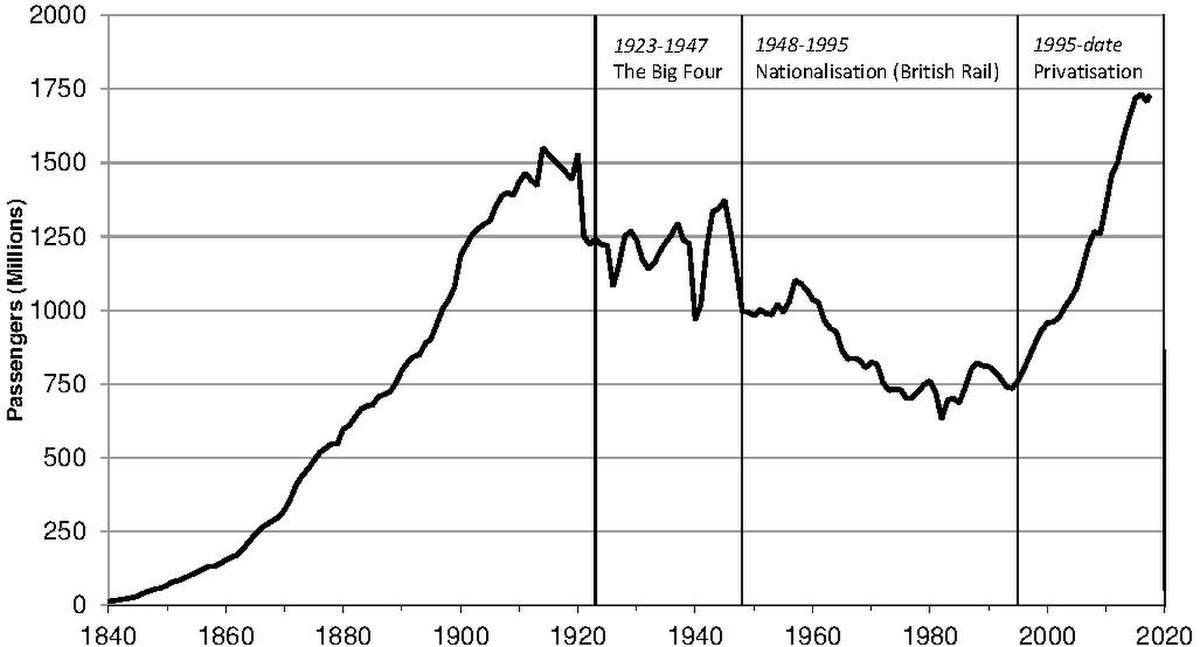
Not 5 years, but a massive ridership increase was seen in the UK since 1995 and I'd say illustrates the magnitude of change possible with service quality increases. Since this is over an entire network, individual lines may have seen even more impressive gains.
The numbers below weren't even caused by any new lines, but a step change in maintenance and incremental improvements in other areas after decades of under investment, ironically with a large increase in government money coinciding with privatization. The one major project was the WCML upgrade which did eventually help massively, but was beset with problems and is a great example of why VIA should want its own line.





 Prev
Prev







 Linear Mode
