Gosh, I wish I had seen this thread when I signed up to this Forum 10 months ago! Here some comments on posts I've seen while reading up since page 50:
Quote:
Originally Posted by roger1818

No one is saying the Lakeshore service will be eliminated. Kingston will most likely see a reduction in service, but all the other cities will likely see the same or better service (in some cases much better). Here is a list of the number of weekday trains to Toronto from various cities: Brockville 7
Gananoque 1
Kingston 17
Napanee 1
Belleville 9
Trenton Jct. 2
Cobourg 6
Port Hope 1
Oshawa 14
Guildwood 5
As discussed in another thread, many of the trains to Kingston are very close together, so don't really count anyway. Without having to worry about keeping trains fast to/from Ottawa and Montreal, many of those small cities could see an increase in the number of trains even if the total number of trains from Kingston is reduced. |
It's not just about the number of connections offered between these cities and Toronto (or Ottawa or Montreal), it's about the number of connections offered between these intermediary cities:

Note: I'm ignoring connections which depart less than 30 minutes after a previous train serving the same O-D.
There is currently not a single connection between Montreal and Gananoque, Napanee, Trenton Junction or Port Hope (and v.v.), just like there is no connection from Ottawa to Napanee or Port Hope and Ottawa (though there are 2 connections in the opposite direction). Even between the major cities along the Kingston Subdivision (Cobourg, Belleville, Kingston) certain O-D's are surprisingly infrequent, such as Kingston=>Cobourg (6x, though 8x times in the opposite direction) or Belleville=>Cobourg (5x, opposite direction: 6x), and with substantial gaps like between Belleville and Cobourg (#41 departs at 8:16, #65 is the next connection at 14:27, i.e. more than 6 hours later). The current timetable is the result of trying to serve two distinct markets with different needs (end-to-end markets desiring short travel times vs. intermediary markets requiring frequent and multiple stops), but separating the two markets and serving them with two different routes will allow intercity trains to do what they can do best: providing reasonably fast and frequent connections along a string of cities...
Quote:
Originally Posted by J.OT13
|
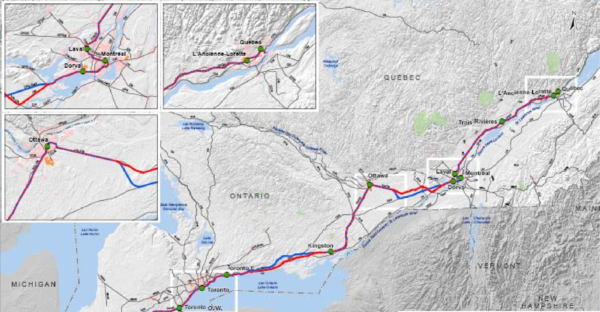
That "HFR map" is actually an H
SR map and can be found as
Appendix B in Deliverable 5 of the Ecotrain Study, while a much more detailed map can be found as Appendix 1 in Deliverable 9.
Quote:
Originally Posted by lrt's friend
A train departing from Toronto at 8 pm would arrive in Ottawa 12:00 to 12:30. A train departing Montreal at 10 pm would arrive in Ottawa around midnight.
Why does this not occur rather than an overnight sleeper train?
|
You seem to assume that there is ample of available capacity in the Corridor to add intercity trains as they are needed. However, if the limit of available slots is reached the question moves from "is there enough demand to justify this new train?" to "will this train generate enough demand to offset the demand I will loose by cancelling a different train on the same route?". You will inadvertently sort your anchor times (approximate departure time at a major node, such as the train's origin) by the largest revenue potential and start inserting them in that order, just like in the examples I provide for one, two, three, four, five or six frequencies:
- One frequency: Depart ~6am towards the more important terminus and return at ~6pm (example: Sarnia-Toronto).
- Five frequencies: Depart ~6am, ~9am, ~noon, ~3pm and ~6pm at either end (Quebec-Montreal).
- Six frequencies: Depart ~6am, ~9am, ~noon, ~3pm, ~5pm and ~6pm at either end ( Toronto-Montreal).
- Seven frequencies: Depart ~6am, ~9am, ~noon, ~3pm, ~5pm, ~6pm and ~8pm at either end (Ottawa-Montreal between January 2012 and June 2015).
There are of course always deviations (e.g.
Windsor=>Toronto with its 4 frequencies has an anchor time at 9am rather than at noon, whereas Toronto=>Windsor has one at 8pm instead of 3pm), but as a general guide, I would not expect a train later than 7.30pm as long as that seventh frequency is missing:

Source: VIA Rail timetables effective
1990-01-15,
1992-10-25,
2012-01-24 and
2018-11-18.
Quote:
Originally Posted by roger1818
If I remember correctly, the old sleeper train departed around 11:00 pm, which would give you 3 more hours in Toronto or Montreal. [...]
I never understood why they didn’t run the sleeper trains through Ottawa. It isn’t as if they were short of time, and they could have picked up/drooped off more passengers.
|
Quote:
Originally Posted by esquire
[...]Anyway, I also wondered why train didn't go through Ottawa. It's not like they couldn't spare the time... the train parked in Kingston for several hours in each direction to kill time and ensure arrival at a reasonable hour.
|
Well, if you try to think up a possible schedule, this might be easier to answer: What time do you want to board a night train? At some point between 10 and midnight (i.e. late enough for fine dining, but early enough to go to bed at a decent time). And what time do you want to arrive at your destination?
If you are on business (or returning from a long weekend away), then probably before 9am. So, if the night train departs Montreal at 10pm (on the dot) and it takes 2 hours to travel to Ottawa, then what is the earliest time passengers in Ottawa can check into their cabin and go to sleep? With the train arriving at 8:30 in Toronto (just like it did when the
Enterprise ran between January 2000 and September 2005) and having to clear the platform shortly after (because it's rush hour and all these GO trains need a place to stop), passengers might almost get their 8 hours of sleep and a breakfast and a shower).
However, in the opposite direction you would already have to leave the train at 6:30 in Ottawa so that passengers continuing to Montreal can arrive their by 8:30. That means getting up well before 6am, in order to have a shower and breakfast before train arrival.
Back in the days, this issue was solved by setting off cars at an intermediary station in the middle of the night and letting passengers stay on board until a more reasonable time and by letting them board earlier in the evening before the car is picked up again in the middle of the night. One such train is shown in the April 1950 CN timetable as trains 57 and 58, with train 58 leaving Montreal at 19:20 and setting off a sleeper car in Riviere-du-Loup at 2:10, where passengers can detrain until 7am while the train continues to Metis Beach and train 57 picking up the Sleeper car again in the evening at 23:35 (with passengers being able to board in Riviere-du-Loup from 9pm onwards), before arriving in Montreal at 6:25:

Source:
CN 1950-04-30 timetable (p.14)
Unfortunately, such an operation is no longer realistic nowadays and the European Commission has recently released a
228-page long report which provides and analyses many reasons why night trains are close to extinction in Europe (and beyond)...
Quote:
Originally Posted by Buggys
I don't think trains leaving Ottawa earlier or arriving back in Ottawa later would really help, as the departure & arrival times needed to be convenient enough for someone else to pick up/drop off (or OC Transpo to still have frequent-enough service).
|
Take the currently earliest departure time from Ottawa (5:30) and the latest arrival time (23:16), assume a travel time of
3:10 hours and you'd have more than 11 hours (8:40 to 20:06) to spend during a day trip in Toronto...
Sorry for the over-long post (but too many interesting discussions here to respond to),
Urban_Sky
PS: any suggestions about how to convert screenshots into a URL which can actually be embedded as pictures in posts in this forum (Images linked via Dropbox don't work - tried and tested) are welcome...






 Prev
Prev





 Linear Mode
