HomeDiagramsDatabaseMapsForum About
     

Go Back   SkyscraperPage Forum > Regional Sections > Canada > Alberta & British Columbia > Vancouver > Transportation & Infrastructure


Reply

 
Thread Tools Display Modes
     
     
  #1821  
Old Posted Dec 5, 2018, 9:52 PM
fredinno's Avatar
fredinno fredinno is offline
Registered User
 
Join Date: Jan 2012
Posts: 2,317
Quote:
Originally Posted by Alex Mackinnon View Post
It has to go uphill at least one direction...

Tunnels work better because they generally aren't as deep as a bridge would be tall. That particular point in the river at Pattullo is very deep though.
Ok, I'm moving the discussion.

They can move the crossing to Sapperton, for example, one of the alternatives for moving the Pautello. It's shallower here, with a sandbar (as shown on the image), and the existing rails can be maintained for servicing the existing industrial areas.

Something like this has to be done eventually, there is no way a HSR to Seattle and Portland, for example, is going to get by with a turntable bridge...

Reply With Quote
     
     
  #1822  
Old Posted Dec 5, 2018, 10:03 PM
Migrant_Coconut's Avatar
Migrant_Coconut Migrant_Coconut is offline
Registered User
 
Join Date: Oct 2015
Location: Kitsilano/Fairview
Posts: 10,028
Quote:
Originally Posted by fredinno View Post
Something like this has to be done eventually, there is no way a HSR to Seattle and Portland, for example, is going to get by with a turntable bridge...
I'm guessing the HSR will need a separate bridge. Sharing a track with freight trains means we end up with the WCE's problems all over again.
Reply With Quote
     
     
  #1823  
Old Posted Dec 5, 2018, 11:27 PM
fredinno's Avatar
fredinno fredinno is offline
Registered User
 
Join Date: Jan 2012
Posts: 2,317
Quote:
Originally Posted by Migrant_Coconut View Post
I'm guessing the HSR will need a separate bridge. Sharing a track with freight trains means we end up with the WCE's problems all over again.
Hey, if you're building one tunnel for commuter Rail/HSR, may as well go all the way and dig a bigger one for freight?
Reply With Quote
     
     
  #1824  
Old Posted Dec 6, 2018, 5:40 AM
Trainguy Trainguy is offline
Registered User
 
Join Date: Apr 2016
Posts: 689
West Coast Express locomotives due for multimillion-dollar overhauls:

Five locomotives, WCEX 901-905 which have been in service for 23 years, need “life-extension and rehabilitative maintenance work."

These Five (of the six locomotives in the fleet) are used to push/pull West Coast Express trains between Vancouver and Mission need immediate overhaul and refurbishment, according to an assessment conducted earlier this year. TransLink Physical inspections of five of the locomotives, which have been in service for 23 years, indicated that they need “life-extension and rehabilitative maintenance work” because of their age and normal wear and tear. A refurbishment program could extend the life of the locomotives for another 10 to 15 years. contracted SNC-Lavalin, at a cost of $78,000, to conduct a mechanical and electrical assessment of its fleet of six locomotives in February, to prepare for planned repair work. “The mid-life refurbishment is required to ensure the locomotives can reach their full design lives in an efficient and cost-effective manner,” TransLink spokeswoman Jill Drews said in an email. “Nothing discovered during the assessment is out of the ordinary for locomotives of this age. Nothing discovered poses a safety risk for our customers or employees.” West Coast Express is a Monday-to-Friday commuter rail service that runs trains during peak morning and evening periods. It had 2.3 million passenger boardings last year, and 1.45 million boardings in the first seven months of 2018. SNC-Lavalin reviewed maintenance history records which showed that scheduled regulatory and preventative maintenance inspections and related repairs were performed and did detailed visual inspections.

“All locomotives have maintenance issues which need to be addressed in order to attain additional reliable service life,” the report states. “These issues are consistent throughout each locomotive, with some units showing signs of more or less severe conditions.” The inspectors noted “moderate to severe” corrosion issues on body panels, structure and electrical components, and evidence that the corrosion has spread to the locomotive substructure. This includes pitted metal, blistered paint, warped body panels, holes, a “badly corroded floor” and trap door, corrosion around doors, thresholds and windshields, and rusty ladder rungs. “Sealant of the carbody is quite problematic on these locomotives and has resulted in water penetration into the interior carbody,” the report states.

The trucks are also in need of an overhaul, and the main alternators and main engines are overdue for complete replacement. “Further deferment of this rehabilitative work may result in degraded revenue service reliability and could result in unplanned corrective repairs and prolonged out-of-service time while long-lead components are procured and repairs are completed,” the report states. The sixth locomotive (WCE 906) is only 12 years old, an MPI-built MP36PH-3C, and is unique to the locomotive roster, and is in better condition, although the inspector noted some corrosion, rust and collision damage, and there are maintenance issues that need to be addressed. A major overhaul is not necessary at this time, but it was suggested that the locomotive receive “a basic mid-life overhaul” within the next two or three years.

All locomotives had damage from minor collisions that has not been addressed. SNC-Lavalin also looked at emissions upgrades for the locomotives. According to an analysis in the report, similar upgrades conducted over the past two years by U.S. transit authorities have cost between $1.2 million US and $2.7 million US per locomotive. It was estimated that refurbishment will take four to five months for each locomotive, and based on the fact that West Coast Express requires five locomotives to be in service each weekday, SNC-Lavalin recommended purchasing two extra locomotives to create a “float” and allow fleet refurbishment to take place over 12 to 14 months. The cost of a used locomotive could be in the $2.7-million to $3-million range. TransLink has already issued a request for proposals, which closed on Monday, related to the refurbishment program.
Reply With Quote
     
     
  #1825  
Old Posted Dec 7, 2018, 1:06 AM
officedweller officedweller is online now
Registered User
 
Join Date: Jul 2001
Location: Vancouver
Posts: 41,459
Noteworthy:

U.S. Finally Legalizes Modern, European-Style Train Cars
https://usa.streetsblog.org/2018/11/23/u-s-finally-legalizes-modern-european-style-train-cars/
Reply With Quote
     
     
  #1826  
Old Posted Dec 7, 2018, 4:16 AM
Xerx Xerx is offline
Registered User
 
Join Date: Apr 2009
Posts: 198
Hopefully, Transport Canada will follow soon and then we can get some more European rolling stock here.
Reply With Quote
     
     
  #1827  
Old Posted Dec 7, 2018, 5:03 AM
swimmer_spe swimmer_spe is offline
BANNED
 
Join Date: Apr 2014
Posts: 10,743
Quote:
Originally Posted by officedweller View Post
Noteworthy:

U.S. Finally Legalizes Modern, European-Style Train Cars
https://usa.streetsblog.org/2018/11/23/u-s-finally-legalizes-modern-european-style-train-cars/
Quote:
Originally Posted by Xerx View Post
Hopefully, Transport Canada will follow soon and then we can get some more European rolling stock here.
If TC does approve this, this will change passenger rail for all of Canada. We could see more investment in VIA and we could see other smaller cities like Calgary, Edmonton, Winnipeg, Ottawa, Quebec City and Halifax bring out commuter rail.
Reply With Quote
     
     
  #1828  
Old Posted Dec 7, 2018, 5:44 AM
zivan56 zivan56 is offline
Registered User
 
Join Date: Oct 2005
Location: Vancouver
Posts: 1,207
That's very good news.
The Ottawa O-Train had to get many exemptions/constraints put in place to allow them to use the Bombardier trains due to these rules.
Reply With Quote
     
     
  #1829  
Old Posted Dec 7, 2018, 5:49 AM
ssiguy ssiguy is online now
Registered User
 
Join Date: Mar 2006
Location: White Rock BC
Posts: 11,893
Toronto will be the biggest benefactor due to the massive upgrade of 200 km of diesel GO commuter rail system into a electrified RER system.
Reply With Quote
     
     
  #1830  
Old Posted Dec 7, 2018, 9:11 AM
fredinno's Avatar
fredinno fredinno is offline
Registered User
 
Join Date: Jan 2012
Posts: 2,317
Quote:
Originally Posted by swimmer_spe View Post
If TC does approve this, this will change passenger rail for all of Canada. We could see more investment in VIA and we could see other smaller cities like Calgary, Edmonton, Winnipeg, Ottawa, Quebec City and Halifax bring out commuter rail.
Sure, but VIA? Large-scale commuter rail across Canada isn't really that viable, this isn't Europe. Canada is just too big, with population centres too spread out to make commuter rail economical across the country. Same thing with the USA.
Reply With Quote
     
     
  #1831  
Old Posted Dec 7, 2018, 5:19 PM
Bdawe Bdawe is offline
Registered User
 
Join Date: Aug 2015
Location: The West End
Posts: 535
Quote:
Originally Posted by fredinno View Post
Sure, but VIA? Large-scale commuter rail across Canada isn't really that viable, this isn't Europe. Canada is just too big, with population centres too spread out to make commuter rail economical across the country. Same thing with the USA.
Commuter rail and intercity rail equipment operate under the same regulatory regime. By importing the EU-standards, the US FRA is allowing commuter and intercity rail operators to use European-type commuter and intercity equipment, which is cheaper, faster, lighter, more reliable, and comes from deeper markets. This could make the bar for investing in better intercity/rural/suburban service by rail of all kinds lower.

Sure, those Alstom DMUs can shuttle back and forth in suburban Ottawa, but with some modification they can be rolling down main & branch lines across the country linking together communities at much lower cost and greater speed than a F-40 and a couple septuagenarian budd coaches
Reply With Quote
     
     
  #1832  
Old Posted Dec 8, 2018, 12:33 AM
aberdeen5698's Avatar
aberdeen5698 aberdeen5698 is offline
Registered User
 
Join Date: May 2010
Posts: 4,770
Quote:
Originally Posted by fredinno View Post
Sure, but VIA? Large-scale commuter rail across Canada isn't really that viable, this isn't Europe.
And one of the big attractions of one of VIA's biggest money-makers, The Canadian, is the 60+ year-old stainless steel Budd equipment it uses.

Reply With Quote
     
     
  #1833  
Old Posted Dec 8, 2018, 6:37 AM
fredinno's Avatar
fredinno fredinno is offline
Registered User
 
Join Date: Jan 2012
Posts: 2,317
Quote:
Originally Posted by Bdawe View Post
Commuter rail and intercity rail equipment operate under the same regulatory regime. By importing the EU-standards, the US FRA is allowing commuter and intercity rail operators to use European-type commuter and intercity equipment, which is cheaper, faster, lighter, more reliable, and comes from deeper markets. This could make the bar for investing in better intercity/rural/suburban service by rail of all kinds lower.

Sure, those Alstom DMUs can shuttle back and forth in suburban Ottawa, but with some modification they can be rolling down main & branch lines across the country linking together communities at much lower cost and greater speed than a F-40 and a couple septuagenarian budd coaches
I'm saying that Canada's cities are too far apart to make inter-city economical commuter rail a reality.
Reply With Quote
     
     
  #1834  
Old Posted Dec 8, 2018, 8:36 AM
Bdawe Bdawe is offline
Registered User
 
Join Date: Aug 2015
Location: The West End
Posts: 535
Quote:
Originally Posted by aberdeen5698 View Post
And one of the big attractions of one of VIA's biggest money-makers, The Canadian, is the 60+ year-old stainless steel Budd equipment it uses.

"Money-maker"
Reply With Quote
     
     
  #1835  
Old Posted Dec 8, 2018, 2:58 PM
Trainguy Trainguy is offline
Registered User
 
Join Date: Apr 2016
Posts: 689
Quote:
Originally Posted by Bdawe View Post
"Money-maker"
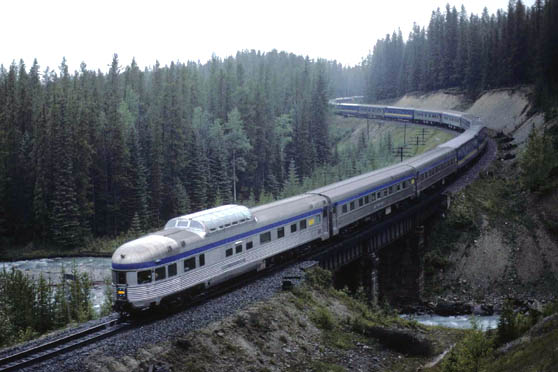
This scene is not possible anymore since it is a photo at Ottertail River on the CP Rail line just west of Field, BC. The CP Rail line line through the Rockies is way more scenic than the CN route through Yellowhead Pass.
Reply With Quote
     
     
  #1836  
Old Posted Dec 9, 2018, 2:38 AM
swimmer_spe swimmer_spe is offline
BANNED
 
Join Date: Apr 2014
Posts: 10,743
Quote:
Originally Posted by fredinno View Post
Sure, but VIA? Large-scale commuter rail across Canada isn't really that viable, this isn't Europe. Canada is just too big, with population centres too spread out to make commuter rail economical across the country. Same thing with the USA.
Quote:
Originally Posted by Bdawe View Post
Commuter rail and intercity rail equipment operate under the same regulatory regime. By importing the EU-standards, the US FRA is allowing commuter and intercity rail operators to use European-type commuter and intercity equipment, which is cheaper, faster, lighter, more reliable, and comes from deeper markets. This could make the bar for investing in better intercity/rural/suburban service by rail of all kinds lower.

Sure, those Alstom DMUs can shuttle back and forth in suburban Ottawa, but with some modification they can be rolling down main & branch lines across the country linking together communities at much lower cost and greater speed than a F-40 and a couple septuagenarian budd coaches
Quote:
Originally Posted by fredinno View Post
I'm saying that Canada's cities are too far apart to make inter-city economical commuter rail a reality.
Thinking of those smaller cities, lets use Calgary for an example. Someone who currently drives from, say Airdrie, could take a commuter rail instead.

Lets say that VIA wanted to replace the self propelled Budd cars. Now they have some inexpensive options.

Or, lets say they wanted to add frequency to the Canadian. They could add cheaper cars.

In short, in the short term we may not see anything come of it, but after a decade or so, we could see more rail accessible for passengers.

Reply With Quote
     
     
  #1837  
Old Posted Dec 9, 2018, 3:55 AM
fredinno's Avatar
fredinno fredinno is offline
Registered User
 
Join Date: Jan 2012
Posts: 2,317
Quote:
Originally Posted by swimmer_spe View Post
Thinking of those smaller cities, lets use Calgary for an example. Someone who currently drives from, say Airdrie, could take a commuter rail instead.

Lets say that VIA wanted to replace the self propelled Budd cars. Now they have some inexpensive options.

Or, lets say they wanted to add frequency to the Canadian. They could add cheaper cars.

In short, in the short term we may not see anything come of it, but after a decade or so, we could see more rail accessible for passengers.

It's still not a game-changer, cheaper cars, which is what people here are acting like it is.
Reply With Quote
     
     
  #1838  
Old Posted Dec 9, 2018, 4:02 AM
swimmer_spe swimmer_spe is offline
BANNED
 
Join Date: Apr 2014
Posts: 10,743
Quote:
Originally Posted by fredinno View Post
It's still not a game-changer, cheaper cars, which is what people here are acting like it is.
If you could save thousands or even millions on a project, how is it not a game changer?
Reply With Quote
     
     
  #1839  
Old Posted Dec 14, 2018, 9:37 PM
roger1818's Avatar
roger1818 roger1818 is offline
Registered User
 
Join Date: Feb 2016
Location: Stittsville, ON
Posts: 6,610
Quote:
Originally Posted by fredinno View Post
I'm saying that Canada's cities are too far apart to make inter-city economical commuter rail a reality.
It depends where in Canada you are talking about. The Quebec City/Windsor corridor already has inter-city rail and VIA has plans to make it faster, more reliable, and more economical. I could also see an Edmonton Calgary train. Vancouver-Whistler would also make a lot of sense. It doesn't need to be HSR as even 160km/h is still very competitive.

The other factor for most of Canada is winter and rail is the safest, most reliable mode of transportation when there is bad weather. Airports and highways will close during a bad storm, but the trains keep running.
Reply With Quote
     
     
  #1840  
Old Posted Dec 14, 2018, 10:57 PM
aberdeen5698's Avatar
aberdeen5698 aberdeen5698 is offline
Registered User
 
Join Date: May 2010
Posts: 4,770
Quote:
Originally Posted by roger1818 View Post
Vancouver-Whistler would also make a lot of sense. It doesn't need to be HSR as even 160km/h is still very competitive.
HA! Where exactly are you going to run 160km/h-capable track between Vancouver and Whistler? Your only choices in that corridor are slow or insanely, prohibitively expensive.
Reply With Quote
     
     
This discussion thread continues

Use the page links to the lower-right to go to the next page for additional posts
 
 
Reply

Go Back   SkyscraperPage Forum > Regional Sections > Canada > Alberta & British Columbia > Vancouver > Transportation & Infrastructure
Forum Jump


Forum Jump


All times are GMT. The time now is 1:30 AM.

     
SkyscraperPage.com - Privacy Statement - Top

Powered by vBulletin® Version 3.8.7
Copyright ©2000 - 2026, vBulletin Solutions, Inc.