HomeDiagramsDatabaseMapsForum About
     

Go Back   SkyscraperPage Forum > Regional Sections > Canada > Alberta & British Columbia > Vancouver > Business & the Economy


Reply

 
Thread Tools Display Modes
     
     
  #12881  
Old Posted Sep 18, 2018, 9:30 PM
theKB theKB is offline
Registered User
 
Join Date: Jul 2010
Posts: 923
Quote:
Originally Posted by connect2source View Post
Walked past this yesterday, wondering if this would work for Uniqlo?

Glad to see any redevelopment on Robson regardless of who takes the space. Also curious as to why the two large CRU's across the street in Robson Centre Place, formally housing BCBG and A/X, haven't been snapped up yet, they've been vacant for 2-3 years.
Wasn't the LL attempting to lease these spaces themselves? One can assume that if the owner is not willing to give courtesy to agents and the only companies that have deep enough pockets to move into these spaces are multinationals which would work with agents it is unlikely they would take the space.

The new development is listed on spacelist. Combine area is ~13000 square feet between both floors with a monthly rent of ~$213,000/mo all in. What is weird is it is listed as a sublease, may be a mistake.
Reply With Quote
     
     
  #12882  
Old Posted Sep 18, 2018, 9:46 PM
SpongeG's Avatar
SpongeG SpongeG is offline
Registered User
 
Join Date: Jun 2006
Location: Coquitlam
Posts: 40,105
that space is smaller than the Uniglo in Guildford, Coquitlam and Metrotown, hardly flagship worthy

But nice to see something new there. I hadn't walked down Robson in months. It's weird that those spots just sit there empty.
__________________
belowitall
Reply With Quote
     
     
  #12883  
Old Posted Sep 18, 2018, 9:48 PM
SpongeG's Avatar
SpongeG SpongeG is offline
Registered User
 
Join Date: Jun 2006
Location: Coquitlam
Posts: 40,105
Quote:
Originally Posted by red-paladin View Post
Fall has technically not started yet.
yea officially starts saturday. When i drove past you could see inside and the store looks pretty close to being done, they had products out on shelves etc.
__________________
belowitall
Reply With Quote
     
     
  #12884  
Old Posted Sep 19, 2018, 4:35 AM
Conrad Yablonski's Avatar
Conrad Yablonski Conrad Yablonski is offline
Registered User
 
Join Date: Dec 2009
Posts: 700
Quote:
Originally Posted by jollyburger View Post
I wonder how this Granville Island seafood retailer feels about them using the name?

In any case I see a lot of the same mistakes being made already

'We have everything Filipinos need'!

'Filipinos will eat here weekly!'

The fact however is that Filipinos eat whateverthehell they want visit any restaurant or food store in the city and Flips are there already-40,000+ kinds of sugarcane Vinegar are only a minor attraction and it's available at No Frills & Superstore already.

Don't get me wrong I'll be one of the first farangs in the place but more for entertainment than value and Hold that sugar on my order of Spaghetti I don't need the calories.
Reply With Quote
     
     
  #12885  
Old Posted Sep 19, 2018, 5:44 AM
SpongeG's Avatar
SpongeG SpongeG is offline
Registered User
 
Join Date: Jun 2006
Location: Coquitlam
Posts: 40,105
Why do Filipinos like spaghetti? even McDonalds over there sells it.
__________________
belowitall
Reply With Quote
     
     
  #12886  
Old Posted Sep 22, 2018, 1:15 AM
officedweller officedweller is offline
Registered User
 
Join Date: Jul 2001
Location: Vancouver
Posts: 41,749
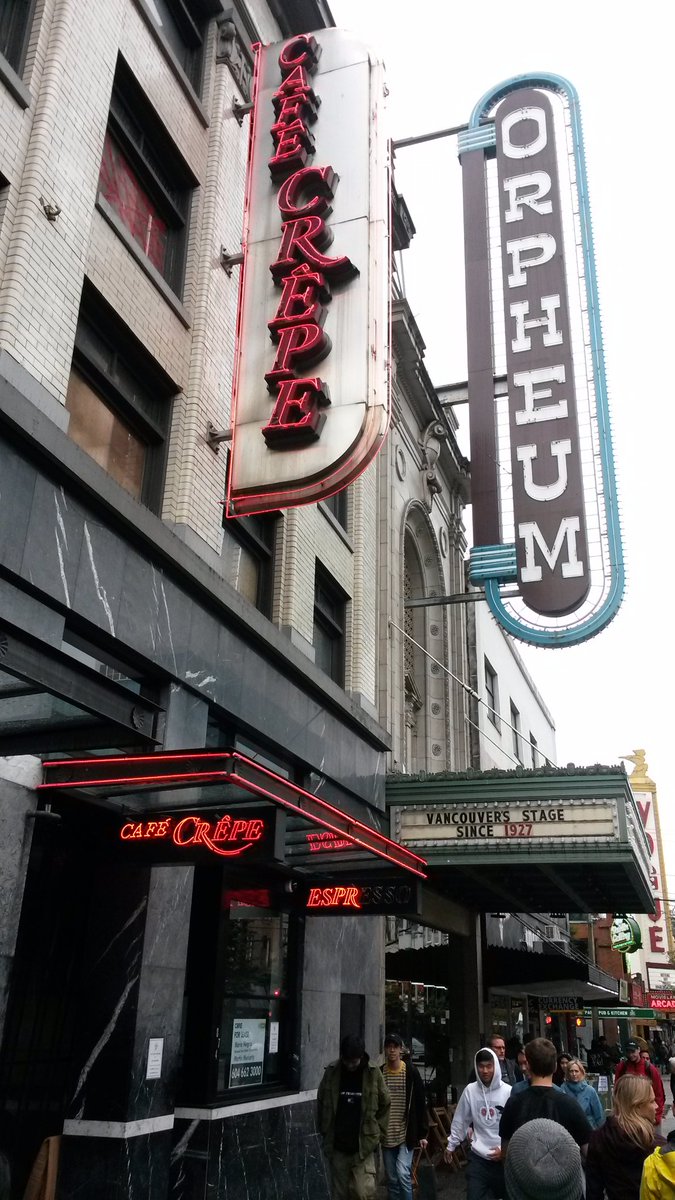
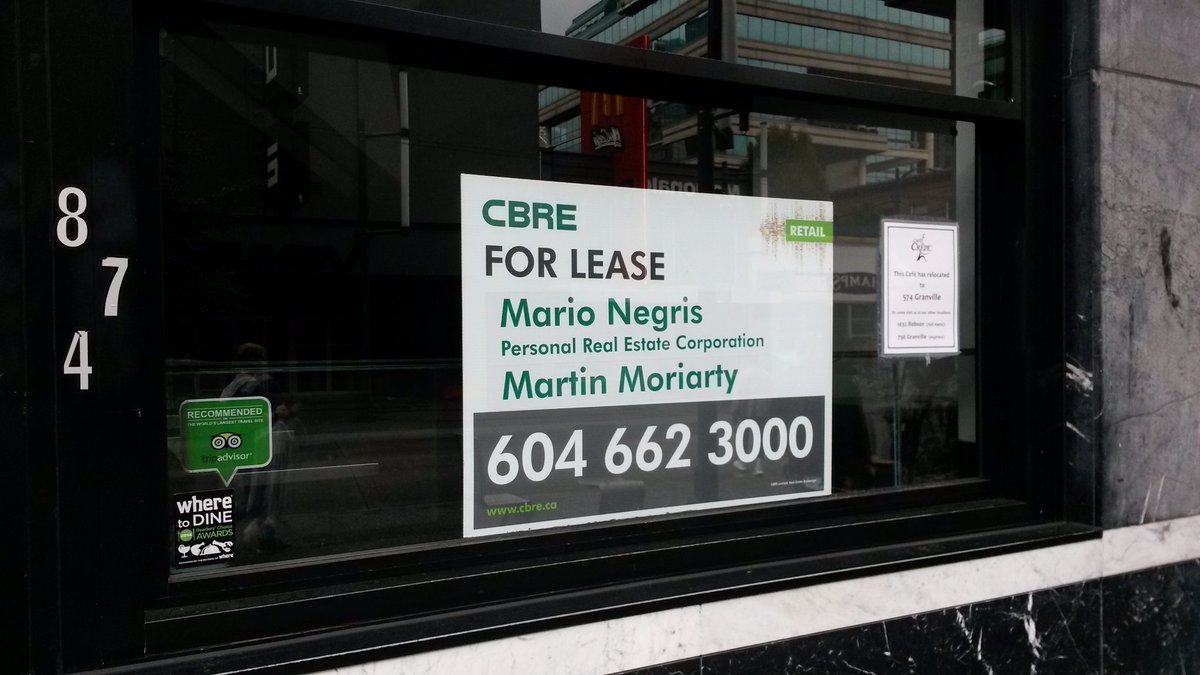
Café Crepe is gone from next to the Orpheum.


Prime space for lease 874 Granville next to The Orpheum.
Cafe Crepe moved to 574 Granville across from Holt Renfrew (another Cafe Crepe is at 796 Granville)

https://twitter.com/GranvilleStreet


https://twitter.com/GranvilleStreet
Reply With Quote
     
     
  #12887  
Old Posted Sep 22, 2018, 5:12 AM
SpongeG's Avatar
SpongeG SpongeG is offline
Registered User
 
Join Date: Jun 2006
Location: Coquitlam
Posts: 40,105
I noticed Brandy Melville moved down there, they were a few stores further north before.
__________________
belowitall
Reply With Quote
     
     
  #12888  
Old Posted Sep 22, 2018, 6:05 AM
SpongeG's Avatar
SpongeG SpongeG is offline
Registered User
 
Join Date: Jun 2006
Location: Coquitlam
Posts: 40,105
Vancouver losing smaller retailers

Major shopping thoroughfare in Vancouver is seeing more vacancies due to higher rents, development pressures

WI Staff Western Investor
September 20, 2018


Empty storefronts on Robson Street, Vancouver. | Rob Kruyt

Empty storefronts pockmarking Vancouver strolls such as Robson Street, Denman Street and south Main Street are due to a mix of higher rents, development pressures and store owners following their customers to the suburbs, analysts say. Small retailers are the most affected.

Craig Patterson, editor of Retail Insider, who has been consulting with the City of Vancouver on the issue, pointed to the 1100 block of Robson, parts of Denman Street and the Punjabi market area around Main Street and East 49th Avenue as retail areas that are struggling.

“Certain areas of Vancouver are hollowing out,” Patterson said.

On Denman and Robson, he suggested, it is due to higher rents, some of which is tied to rezoning potential.

“Some landlords don’t want to lower [retail] rents because it reduces the value of their building,” he said. “They would rather leave [storefronts] empty.”

Retail lease rates on Robson Street range from $120 to $250 per square foot, second highest in the city behind Alberni Street, according to a recent survey by Cushman & Wakefield.

A second-quarter 2018 study by commercial realtor Marcus & Millchap showed the average price of a retail property sold in Vancouver this year was in excess of $1,000 per square foot, up 25 per cent from 2017. Average retail rents now average $30.10 per square foot, up nearly 10 per cent from 2017, the agency added.

On south Main Street, the increasing number of vacancies is due to retailers following their customers to the Fraser Valley, Patterson said.

...

https://www.westerninvestor.com/news/british-columbia/vancouver-losing-smaller-retailers-1.23437338

__________________
belowitall
Reply With Quote
     
     
  #12889  
Old Posted Sep 25, 2018, 7:02 PM
Vin Vin is offline
Registered User
 
Join Date: Sep 2013
Posts: 8,738
Quote:
Originally Posted by LeftCoaster View Post
I'd love to see a Vin Vs. Trump.

Neither has any interest in reality and ignore coherent points made by who they are arguing with and just yell soundbites.

"Build that Mall/Wall"
Yup, that sounds very mature of you for uttering rubbish. Keep it up.

BTW, a new mall will be built at the Post on Georgia. Joke's on you.
Reply With Quote
     
     
  #12890  
Old Posted Sep 25, 2018, 7:14 PM
Vin Vin is offline
Registered User
 
Join Date: Sep 2013
Posts: 8,738
Quote:
Originally Posted by SpongeG View Post
Vancouver losing smaller retailers
I wonder what the City is going to do about this. Such a problem has been festering for years. Any think-tank group formed by the City to address this problem and to enhance retail businesses in the CBD, as well as other retail streets in Vancouver?
Reply With Quote
     
     
  #12891  
Old Posted Sep 25, 2018, 7:47 PM
misher's Avatar
misher misher is offline
BANNED
 
Join Date: Jul 2018
Posts: 4,537
Quote:
Originally Posted by Vin View Post
I wonder what the City is going to do about this. Such a problem has been festering for years. Any think-tank group formed by the City to address this problem and to enhance retail businesses in the CBD, as well as other retail streets in Vancouver?
Its not just smaller retailers. Commercial space in general is at a premium now. We've focused too much on housing and rentals which has left office/commercial/retail by the wayside.

We need to allow rentals or commercial to be built in return for increased densities. Building commercial on the ground floor (or 1st-3rd floors) should be encouraged for most buildings.

Even hotel space it in short supply right now, those mix commercial/residential/rental/hotel buildings are genius and we could definitely use more of those. Daytime commercial/night time residential makes sense as parking lots and services such as the coffee shop, concierge & elevator can be shared so they are used 24 hours.

We also have huge demands for warehouse space and we can't just be pushing it all out to the east. I was thinking of perhaps converting some giant parks/lawns/soccer fields to warehouses (maybe commercial space but hopefully somehow we can make warehouse space affordable) with green roofs (with maybe a soccer field ontop? tennis courts ontop? lol).

Last edited by misher; Sep 25, 2018 at 8:17 PM.
Reply With Quote
     
     
  #12892  
Old Posted Sep 25, 2018, 10:25 PM
LeftCoaster's Avatar
LeftCoaster LeftCoaster is offline
Moderator
 
Join Date: Nov 2005
Location: Toroncouver
Posts: 13,158
Quote:
Originally Posted by Vin View Post
Yup, that sounds very mature of you for uttering rubbish. Keep it up.

BTW, a new mall will be built at the Post on Georgia. Joke's on you.
You keep telling yourself whatever you need to sleep at night Vin.

The rest of us will continue enjoying your highly nuanced and insightful posts.

Keep up the good work, this forum would be lost without you!
Reply With Quote
     
     
  #12893  
Old Posted Sep 25, 2018, 10:30 PM
LeftCoaster's Avatar
LeftCoaster LeftCoaster is offline
Moderator
 
Join Date: Nov 2005
Location: Toroncouver
Posts: 13,158
Quote:
Originally Posted by misher View Post
Its not just smaller retailers. Commercial space in general is at a premium now. We've focused too much on housing and rentals which has left office/commercial/retail by the wayside.

We need to allow rentals or commercial to be built in return for increased densities. Building commercial on the ground floor (or 1st-3rd floors) should be encouraged for most buildings.

Even hotel space it in short supply right now, those mix commercial/residential/rental/hotel buildings are genius and we could definitely use more of those. Daytime commercial/night time residential makes sense as parking lots and services such as the coffee shop, concierge & elevator can be shared so they are used 24 hours.

We also have huge demands for warehouse space and we can't just be pushing it all out to the east. I was thinking of perhaps converting some giant parks/lawns/soccer fields to warehouses (maybe commercial space but hopefully somehow we can make warehouse space affordable) with green roofs (with maybe a soccer field ontop? tennis courts ontop? lol).
With regards to retail space you have it inverted. City policy demanding retail at ground levels has caused an oversupply of retail space which is causing the vacancies. This is even more pronounced outside of downtown in the suburbs and arterials. This combined with a general slowdown in the leasing demands of the global retail industry and the climbing tax burden imposed by the City is causing the issues seen here.

Higher densities are allowed in the CBD when building commercial and minimum commercial FARs are already enforced in multiple neighborhoods. The commercial (office) imbalance will sort itself out, its very much a boom/bust cycle industry so this is very natural. What is happening to retail and industrial on the other hand is a changing of the fundamentals so it will be much more interesting to watch.
Reply With Quote
     
     
  #12894  
Old Posted Sep 26, 2018, 2:39 AM
retro_orange retro_orange is offline
retro_orange
 
Join Date: Sep 2014
Location: East Van
Posts: 2,029
Quote:
Originally Posted by LeftCoaster View Post
With regards to retail space you have it inverted. City policy demanding retail at ground levels has caused an oversupply of retail space which is causing the vacancies. This is even more pronounced outside of downtown in the suburbs and arterials. This combined with a general slowdown in the leasing demands of the global retail industry and the climbing tax burden imposed by the City is causing the issues seen here.

Higher densities are allowed in the CBD when building commercial and minimum commercial FARs are already enforced in multiple neighborhoods. The commercial (office) imbalance will sort itself out, its very much a boom/bust cycle industry so this is very natural. What is happening to retail and industrial on the other hand is a changing of the fundamentals so it will be much more interesting to watch.

Well, Kinda. A lot of the new retail built either stays empty or is guaranteed to have a chain/franchise and very rarely an independent small business. However there is a ton of recently vacated or perpetually vacant old retail spaces throughout the city. A big part of it is the way retail space is taxed. In Vancouver you pay almost double which is ridiculous. Here retailers pay a base rent, of which a big chunk is pocketed by the owner of the space because the leaseholder pays the property taxes for the space on top of the base rent. In other cities your base rent includes property taxes. So while Vancouver lease rates are similar to other Canadian cities with thriving small retail, they pay a lot more in the end. It also boils down to properties in Vancouver are taxed for their best use of the land and not what it's currently being utilized for. So if i understand correctly if you have a standalone single storey retail building with parking and some greenspace that is in an area of the city that was until quite recently valued significantly less and was under no threat of redevelopment, suddenly now it's in a new neighborhood plan that allows 10 storeys plus multiple retail spaces and is now taxed as if that's what is on the land. If the retail space remains empty then the property owner can write it off as a business loss and has little incentive to find someone to lease the space. Most older commercial retail space in Vancouver is of the single storey variety with at least 1/3rd of the land as parking or other underutilized space.

This is a big reason if not the main reason why I have not started my business and am waiting until things correct and start to rebound after things bottom out. If all the crazy policies the US is creating come to fruition then the crash and subsequent rebound may happen sooner than later. if not it could take 5+ for this real estate based economic cycle to follow through. I just want interest rates to rise so we can have a normal economy not based on irresponsible borrowing.

From a Vancourier article:


Quote:
Is small retail dying in Vancouver?

Combination of sky-high rents and property taxes are pushing out all but the biggest players. What can be done?

In a commercial rental, the tenant pays the landlord’s property taxes (based on the proportion of the overall space they occupy in a building), along with the same proportion of upkeep costs. And upkeep costs are getting mighty expensive. In many downtown buildings, they now rival the basic rental costs. It’s like paying twice to occupy the space, and much of that is property tax.

Why so high?
So, other than the obvious factor of land prices, why are Vancouver commercial property taxes so darn high?

One factor may be that the city’s property tax apportionment is currently split roughly 54/46 toward commercial property owners. An idea that has been floated is to bring that split a little closer to 50/50. And the provincial and municipal governments might both reconsider the formulas they use to assess commercial properties for the purposes of taxation from potential usage (what it’s zoned to accommodate) to actual usage (see a recent excellent article on this in Business in Vancouver).

Many people claim that much of the expense lies in City red tape in the zoning/usage approval process. I can personally attest to that at least partly being the case, having had tenant clients who wanted to occupy a space for a ballet school and had to apply for a change of use. It took them six months and cost about $6,000. The ironic thing was that before the immediately previous use, it had been a dojo, with the same general rules applying to it as my client was going to have to satisfy now!
https://www.vancourier.com/opinion/is-small-retail-dying-in-vancouver-1.23289483


Quote:
Solutions offered to keep empty storefronts from plaguing Vancouver city streets

Business leaders push for reduced red tape and tax load to help increase retail survival

Barajas then had to go to the city’s board of variance, which confirmed that his restaurant did not need any on-site parking. By this time, six months had passed. He told BIV that he had to pay more than $12,000 per month in rent for each of those months as well as about $20,000 in fees to professionals to help him with his appeal of the city’s decision. He then had to wait for city staff to approve a change-of-use application for the site.

The end result is that he is more than $360,000 out of pocket, and he has given up on conducting the necessary improvements to the site. He continues to pay more than $12,000 per month on the empty storefront while he seeks a tenant willing to sublease the space.

“One of the biggest issues with empty storefronts is the process of permitting,” said Michael Wiebe, co-president of the Mount Pleasant Business Improvement Association and a BC Green Party candidate for city council.

Krishna said her department has made it a priority to “evaluate and understand the process and what the issues are and come up with recommendations on how to fix it.”


Recent city moves to streamline tenant-improvement permits include:
  • updating the city’s sign bylaw, which Krishna called “complicated and onerous”;
  • getting feedback on how to improve processes from stakeholders such as commercial real estate association NAIOP, the Urban Development Institute and business improvement associations (BIAs); and
  • launching a commercial renovation centre for small-business owners to ask questions one-on-one with city staff.
Wiebe said the city and the province could do more to help empty storefronts get filled.

He has heard some people suggest that the city levy a tax on empty storefronts, but neither he nor other BIA heads such as South Granville Business Improvement Association executive director Sharon Townsend favour such a move. BIAs, after all, are funded by commercial property owners.

Instead, Wiebe would like to see store owners pay less tax and therefore have more capacity to make a go of their businesses.

He also wants the city to shift its tax base from being 54 per cent provided by commercial property owners and 46 per cent by residents to being slightly less from commercial property owners and slightly more from residents.

The province could also change the way it assesses the value of commercial properties – something that factors into the formula that the city uses to charge property taxes.

The current assessment for a one-storey commercial building on Broadway, for example, is likely to be for six storeys of commercial use because that is what the property is zoned for.


If that tax assessment were instead for one level of commercial on the ground, under five levels of unbuilt homes, the tax would be significantly less, Wiebe said.

That is because commercial properties are assessed at a tax rate that is 4.87 times that of a residential property.

“Some properties in Mount Pleasant have gone up in value 100 per cent in a year,” Wiebe said.”
https://www.westerninvestor.com/news/bri...aguing-vancouver-city-streets-1.23277354

From another article:
Quote:
Why Are There So Many Empty Stores on Our Biggest Shopping Streets?

SoGra (are we calling it that?) is currently facing a 10 percent retail vacancy rate. Vancouver’s other main drags are also looking sparse these days: the West End’s BIA reports 12 percent vacancy. Compare that to a healthy rate of about four percent—a turnover just high enough to keep retail districts fun and fresh without upsetting those of us who come from broken homes and have developed a crippling resistance to change—and you would be right to conclude we have a bit of a retail real estate crisis on our hands. Business licences throughout the city dropped 3.5 percent between 2010 and 2015

It’s only natural that businesses come and go (R.I.P., Freddy Pant Room), but it’s strange that these places are staying empty, considering how in-demand Vancouver real estate is. It also turns out there are limits to the laws of supply and demand. According to Sharon Townsend, executive director of the South Granville BIA, a lot of commercial landlords don’t care about rental income at all. Retail buildings are increasingly owned by developers focused on a long-term vision, she says—people with deep pockets who are happy to squat on a place for decades, with or without renters, to await the sweet returns of future redevelopment. For these retail barons, the actual “retail” part isn’t important. So cherish your Pretty Woman-style shopping sprees while you can before our main drags go full-on ghost town.
https://vanmag.com/city/city-informer-empty-stores-biggest-shopping-streets/

Last edited by retro_orange; Sep 26, 2018 at 3:45 AM.
Reply With Quote
     
     
  #12895  
Old Posted Sep 26, 2018, 4:08 AM
SpongeG's Avatar
SpongeG SpongeG is offline
Registered User
 
Join Date: Jun 2006
Location: Coquitlam
Posts: 40,105
Robson's problem is its not kept up. Boutiques that flocked there in the 80's are dead and dying. Mom and pop shops that are left are more likely closing because the kids don't want to take them on, on top of the high rents. I am surprised that the spots next to Zara have stayed empty for so long. The old American Eagle space is just awful.

It's not a nice street to stroll anymore, same with Denman, they are uninviting, crowded or just empty creating a let's not linger too long vibe. In the 80's/90's that was where you went and hung out on a saturday night. Stores used to be more unique, now they are in every mall. The city has many more appealing places to go for a stroll now. The food options aren't great, they are all pretty expensive. The McDonalds where Versace etc is now was always busy. I went by that new ice cream place next to Joe Fortes and it was closed at 9 pm on a friday night, like that would be a prime time to offer something to people mulling around. The Starbucks stays busy until 11 or closing. The further west you go where the more affordable restaurants are have much more life to them.

I read an article last year about New York having the same problem and they were saying its because investors buy out the place, jack up the rent, the big brands come in and some move out and even if they sit empty they are just an investment and not treated as an income property and they know its the location that holds the value so they can afford to let the space site empty knowing one day a condo or some new development will come along and they cash out without hassle of tenants to worry about.
__________________
belowitall
Reply With Quote
     
     
  #12896  
Old Posted Sep 26, 2018, 3:52 PM
rofina rofina is offline
Registered User
 
Join Date: Nov 2013
Posts: 5,149
Quote:
Originally Posted by SpongeG View Post
Robson's problem is its not kept up. Boutiques that flocked there in the 80's are dead and dying. Mom and pop shops that are left are more likely closing because the kids don't want to take them on, on top of the high rents. I am surprised that the spots next to Zara have stayed empty for so long. The old American Eagle space is just awful.

It's not a nice street to stroll anymore, same with Denman, they are uninviting, crowded or just empty creating a let's not linger too long vibe. In the 80's/90's that was where you went and hung out on a saturday night. Stores used to be more unique, now they are in every mall. The city has many more appealing places to go for a stroll now. The food options aren't great, they are all pretty expensive. The McDonalds where Versace etc is now was always busy. I went by that new ice cream place next to Joe Fortes and it was closed at 9 pm on a friday night, like that would be a prime time to offer something to people mulling around. The Starbucks stays busy until 11 or closing. The further west you go where the more affordable restaurants are have much more life to them.

I read an article last year about New York having the same problem and they were saying its because investors buy out the place, jack up the rent, the big brands come in and some move out and even if they sit empty they are just an investment and not treated as an income property and they know its the location that holds the value so they can afford to let the space site empty knowing one day a condo or some new development will come along and they cash out without hassle of tenants to worry about.

Not directed at you, because I read the same, but this is the most counter intuitive thing going right now.

The only reason great streets became desirable for investment, was because they were great streets - unique shops, vibrant, busy etc. People there, low vacancies, money flowing into business'.

Now that has been completely up ended to - its real estate on Robson so its safe, ignoring the fact that Robson is not the same street that was great in the 80's and earlier. The characteristics that made it desirable are no longer in play, now its money chasing money.

Fund A spent 100million here, than that means liquidity must be OK, so I'm going to plop down 110million next door.

It truly is the commodification of real estate. The underlying factors of what make streets, or neighbourhoods great is ignored for the financial consideration like liquidity, appreciation, etc.
Reply With Quote
     
     
  #12897  
Old Posted Sep 26, 2018, 4:26 PM
misher's Avatar
misher misher is offline
BANNED
 
Join Date: Jul 2018
Posts: 4,537
Quote:
Originally Posted by rofina View Post
Not directed at you, because I read the same, but this is the most counter intuitive thing going right now.

The only reason great streets became desirable for investment, was because they were great streets - unique shops, vibrant, busy etc. People there, low vacancies, money flowing into business'.

Now that has been completely up ended to - its real estate on Robson so its safe, ignoring the fact that Robson is not the same street that was great in the 80's and earlier. The characteristics that made it desirable are no longer in play, now its money chasing money.

Fund A spent 100million here, than that means liquidity must be OK, so I'm going to plop down 110million next door.

It truly is the commodification of real estate. The underlying factors of what make streets, or neighbourhoods great is ignored for the financial consideration like liquidity, appreciation, etc.
Robson was great. Now traffic and crappy parking have hurt it some.
In addition its distant from the skytrain stations.
Online shopping has killed a lot of the retailers and now there's too many restaurants.
Reply With Quote
     
     
  #12898  
Old Posted Sep 26, 2018, 6:40 PM
LeftCoaster's Avatar
LeftCoaster LeftCoaster is offline
Moderator
 
Join Date: Nov 2005
Location: Toroncouver
Posts: 13,158
Quote:
Originally Posted by SpongeG View Post
I read an article last year about New York having the same problem and they were saying its because investors buy out the place, jack up the rent, the big brands come in and some move out and even if they sit empty they are just an investment and not treated as an income property and they know its the location that holds the value so they can afford to let the space site empty knowing one day a condo or some new development will come along and they cash out without hassle of tenants to worry about.
It's not just New York of Vancouver, it's everywhere. Smaller independent shops have been getting run out of business by larger capitalized multi-nationals and more importantly e-commerce. There are exceptions to this trend but the retail world is much different than it was a decade ago and will continue to get more difficult for smaller companies in the forseeable future.

This is most definitely not a Vancouver specific issue.
Reply With Quote
     
     
  #12899  
Old Posted Sep 26, 2018, 7:39 PM
Vin Vin is offline
Registered User
 
Join Date: Sep 2013
Posts: 8,738
Quote:
Originally Posted by LeftCoaster View Post
You keep telling yourself whatever you need to sleep at night Vin.

The rest of us will continue enjoying your highly nuanced and insightful posts.

Keep up the good work, this forum would be lost without you!
You mean "I"?? Sure, we should all keep paying homage to the " industry professionals". Yup, we've all seen those "holier than thou" types, and keep on deriding me on the proposal for malls.

See that report about West End and many other parts of Vancouver having 10 to 15% vacancy rates? Well, I need to report to you that Pacific Centre is 100% filled. All well-managed city centre malls around the region are also having close to 0% vacancies.

Last edited by Vin; Sep 26, 2018 at 8:08 PM.
Reply With Quote
     
     
  #12900  
Old Posted Sep 26, 2018, 7:49 PM
Vin Vin is offline
Registered User
 
Join Date: Sep 2013
Posts: 8,738
Quote:
Originally Posted by misher View Post
Its not just smaller retailers. Commercial space in general is at a premium now. We've focused too much on housing and rentals which has left office/commercial/retail by the wayside.

We need to allow rentals or commercial to be built in return for increased densities. Building commercial on the ground floor (or 1st-3rd floors) should be encouraged for most buildings.

Even hotel space it in short supply right now, those mix commercial/residential/rental/hotel buildings are genius and we could definitely use more of those. Daytime commercial/night time residential makes sense as parking lots and services such as the coffee shop, concierge & elevator can be shared so they are used 24 hours.

We also have huge demands for warehouse space and we can't just be pushing it all out to the east. I was thinking of perhaps converting some giant parks/lawns/soccer fields to warehouses (maybe commercial space but hopefully somehow we can make warehouse space affordable) with green roofs (with maybe a soccer field ontop? tennis courts ontop? lol).
Totally agreed. We do need more higher density commercial spaces, particularly in the city centre, like malls, hotels, office towers, institutions, etc. In the long term, this will also help reel in more of the working class back into downtown and its surrounding areas. I also believe that high density residential, be they market or rental housing, should also be part of the equation.

However, there are just way too many city policies that would make this almost impossible. This is the only reason why the suburb city centres are expanding so much, especially when it comes to retail. It is an irony the region supporting the highest density of people is actually losing on retail and other commercial spaces to the suburbs. This means that Vancouver is stupidly encouraging people to go far in order do their shopping, having visitors or tourists stay far away from the attractions they want to see, etc.
Reply With Quote
     
     
This discussion thread continues

Use the page links to the lower-right to go to the next page for additional posts
 
 
Reply

Go Back   SkyscraperPage Forum > Regional Sections > Canada > Alberta & British Columbia > Vancouver > Business & the Economy
Forum Jump


Forum Jump


All times are GMT. The time now is 8:32 AM.


Powered by vBulletin® Version 3.8.7
Copyright ©2000 - 2026, vBulletin Solutions, Inc.