Richmond Updates


Are one of those huge developments by the airport/Bridgeport Station not gonna have any? Like the International Trade Centre or whatever other ones there are.

The International Trade Centre has offices and a hotel (don't think the hotel has convention space ) - it's a boutique hotel.

Next door on the north side of Sea Island Way is an ESL school project, I think.

rendering.jpg

http://itcrichmond.com/
 
Those places you mentioned were never nice: they were pretty run-down in the first place. We are just experiencing a transitional period right now. As for other areas where developments have completed, the previous "blight" is now gone.

Those were all perfectly functioning buildings housing different types of shops and businesses. You have quite a warped view of what you consider "run down" as I remember accessing the businesses that were housed in those areas quite recently, never considered them run down. In any event, a building is infinitely more aesthetically pleasing than a vacant lot. I agree that development comes with a growing city but these lots have sat vacant for upwards of years now. That is an unnecessary amount of time when they could have continued to stand as functioning businesses until the time of construction started. I'd like to get back on topic though. Again, just pointing out Richmond currently has more blight now than it ever had in the past
 
Update of this one from GBL twitter.

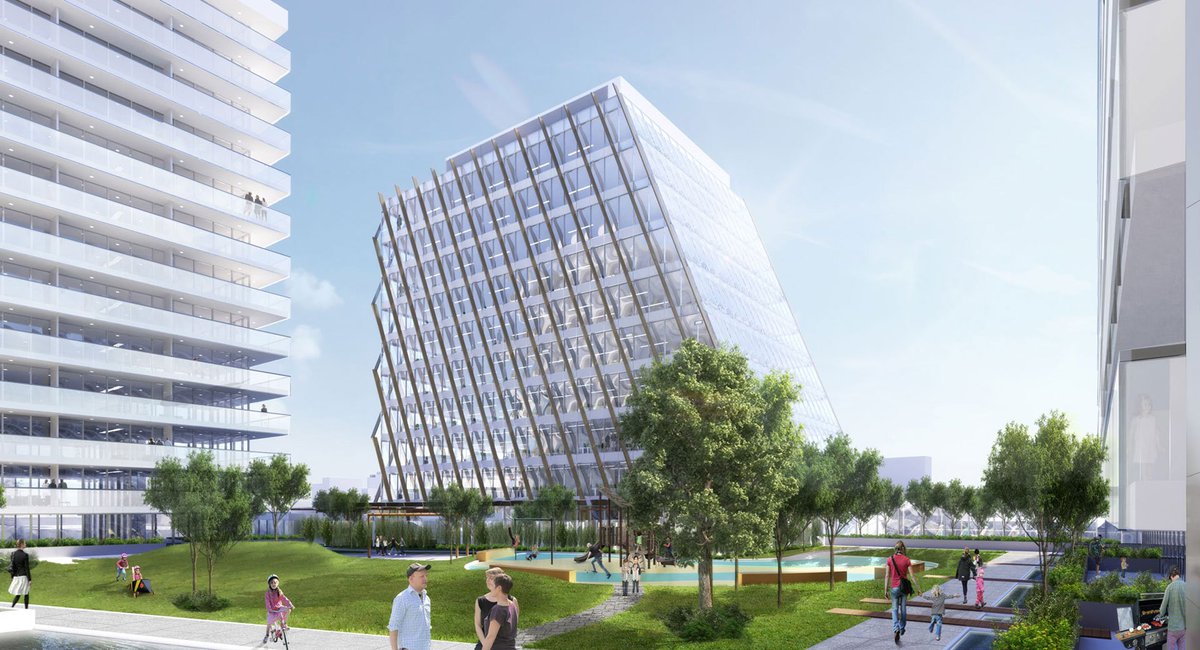
Diagrid => diagonal louvres and X louvres (like 8X Yaletown (also GBL)

PS - note the wide sidewalk setback that would allow space for a Canada Line guideway extension.

6340-No-3-Road-Richmond-3.jpg

Render by GBL architects; image taken from DailyHive article.


DhscFxMUwAAFuwP.jpg

A newly proposed mixed-use development at 6340 No. 3 Road
has successfully progressed through Advisory Design Panel.
The project comprises of 150,000sf of commercial/office space
and 450,000sf of residential units.

https://twitter.com/GBLArchitects

More renderings here:

http://www.gblarchitects.com/work/6340-no-3-road/

GBL_project-slide05.jpg

http://www.gblarchitects.com/work/6340-no-3-road/

GBL_project-slide08.jpg

http://www.gblarchitects.com/work/6340-no-3-road/

GBL_project-slide03.jpg

http://www.gblarchitects.com/work/6340-no-3-road/
 
Truly urban development. This is what I was hoping Olympic Village would look like, and it looks like Richmond is doing it way better!
 
Just awesome. Can't wait to see this up. Nice to have a more definitive cluster right at the main downtown Richmond station/terminus.
 
To be honest Richmond has some of the coolest looking architecture :D
Too bad we can't build higher or we'd see some really cool stuff.
 
Those were all perfectly functioning buildings housing different types of shops and businesses. You have quite a warped view of what you consider "run down" as I remember accessing the businesses that were housed in those areas quite recently, never considered them run down. In any event, a building is infinitely more aesthetically pleasing than a vacant lot. I agree that development comes with a growing city but these lots have sat vacant for upwards of years now. That is an unnecessary amount of time when they could have continued to stand as functioning businesses until the time of construction started. I'd like to get back on topic though. Again, just pointing out Richmond currently has more blight now than it ever had in the past

And you have a pretty low standard for retail and business buildings. "Functioning buildings" does not mean those were intended to be there forever as part of Richmond's City Centre: they were part of the old industrial zoning plan, and such buildings are inefficient with low density usage, especially with all the infrastructure upgrades nearby. Also the vacant lots in prep for future construction that you find to be eyesores are only temporary, as the landscape would improve significantly in a couple of years' time. Just look at the neighbourhood behind Aberdeen Centre: it even has its own neighbourhood park now!

I don't think OV was ever intended to be a complete community with office buildings - just residential and some retail.

And why not? It is close to skytrain stations, road transit routes, an intercity railway station, with workers able to support local businesses in the day time and help ease nearby downtown's congestion.

I think Richmond Centre, Metrotown, Surrey Central and Brentwood were all never intended to be office centres, but look at them now.
 
Last edited:
I think Richmond Centre, Metrotown, Surrey Central and Brentwood were all never intended to be office centres, but look at them now.

And once again, that would be wrong. Richmond and Metrotown are Regional City Centres that are intended to be office centres for many years, to a far greater extent than they have succeeded so far. Brentwood is a Municipal Town Centre that should also have office space, and Surrey Central is a Metro Centre that has the same intent as Vancouver's Metro Core - although so far it has less space than Broadway, never mind the huge amount of space that exists, and is being added Downtown. In fact, there's as much space being added to the Metro Core now than exists in Surrey Central.
 
And once again, that would be wrong. Richmond and Metrotown are Regional City Centres that are intended to be office centres for many years, to a far greater extent than they have succeeded so far. Brentwood is a Municipal Town Centre that should also have office space, and Surrey Central is a Metro Centre that has the same intent as Vancouver's Metro Core - although so far it has less space than Broadway, never mind the huge amount of space that exists, and is being added Downtown. In fact, there's as much space being added to the Metro Core now than exists in Surrey Central.

Nope, once again you are the one who's wrong, not me. Metrotown started as a military reserve and then industrial land. It started building offices recently only because of the rate of growth. Brentwood too started as an industrial land fringing an old highway. All the town centres were set up much later.

OV started as an industrial land, so why must it stay residential now? That's my question. You don't seem to see how Vancouver can morph and evolve for the better, as per your own namesake.


From Wiki regarding Metrotown:

Settlement and industry
On the recommendation of Colonel Richard Moody, the Royal Engineers constructed a trail linking colonial capital New Westminster and False Creek to facilitate troop movement between the two points.[13][14] The trail (which later became Kingsway) opened in 1860, and cut diagonally across Burrard Peninsula;[13] land was set aside as a military reserve at a plateau along the road in the area of modern-day Metrotown.[13][14] The road was improved following Burnaby's municipal incorporation in 1892, and the parallel Central Park interurban line connecting Vancouver and New Westminster opened the previous year, making the area increasingly favourable for settlement.[13] Consequently, the provincial government established a series of holding lots out of the military reserve in the 1890s to accommodate working class residents.[13][14] The lots were drawn at right angles to the interurban line, which ran from the northwest to the southeast, accounting for Metrotown's street orientation.[14]


During the Great Depression, Burnaby reeve William Pritchard instituted a series of make-work programs to put the unemployed to work, using municipal funds and loans.[14] This put a strain on Burnaby's finances, and in 1932 the province stepped in by suspending the functions of Burnaby's government and appointing a commissioner to run municipal affairs.[14][15] Under the province's control, Burnaby struck a deal with the Ford Motor Company to build an assembly plant near Kingsway and McKay Avenue.[16] The plant opened in 1938, and was used to produce military vehicles during World War II;[16] it became an Electrolier facility at some point after the war.[17] Wholesale grocer Kelly-Douglas Company built a manufacturing plant and warehouse to the east of the Ford/Electrolier plant in 1946, and Simpsons-Sears opened a catalogue sales and distribution facility to the east of the Kelly-Douglas plant in 1954.[16]


Again Richmond city centre is taking shape much better than OV or any other districts in Vancouver.
 
Nope, once again you are the one who's wrong, not me. Metrotown started as a military reserve and then industrial land. It started building offices recently only because of the rate of growth. Brentwood too started as an industrial land fringing an old highway. All the town centres were set up much later.

OV started as an industrial land, so why must it stay residential now? That's my question. You don't seem to see how Vancouver can morph and evolve for the better, as per your own namesake.

Metrotown's early history is interesting, but the part you quoted is hardly relevent and there's a much more extensive story that the wiki you quoted has been borrowed from, written by David Pereira. Your statement was "Richmond Centre, Metrotown, Surrey Central and Brentwood were all never intended to be office centres, but look at them now". After the early 1970s - so over forty years ago - Metrotown was identified as an office centre, and once the regional transportation system was built, that started to become a reality - although it has been difficult to get developers to build as many office buildings as Regional Plans have aspired to over the years, and it remains difficult today. The others have also been identified in evolving Regional Plans over the years.

There probably will be more office space near the SEFC area - although not in the Olympic Village as that's already completed. They'll be closer to the Skytrain station, which makes sense, just as 1296 Station Street , for example, will be just across the street from the station, and easily accessesd on foot or by bike by any SEFC residents who work there.

Just put posters who don't let facts change their views on your ignore list and your blood pressure will thank you. Time and again, facts are presented that disprove prior assertions but it doesn't change a thing. Save your time, effort, and energy.

Opinions matter, and everyone is entitled to them, but demonstrable facts matter a great deal more. If one's opinion is based on a set of facts or interpretations that are shown to be incorrect, they ought to accept that and adjust their opinion.
 
And you have a pretty low standard for retail and business buildings. "Functioning buildings" does not mean those were intended to be there forever as part of Richmond's City Centre: they were part of the old industrial zoning plan, and such buildings are inefficient with low density usage, especially with all the infrastructure upgrades nearby. Also the vacant lots in prep for future construction that you find to be eyesores are only temporary, as the landscape would improve significantly in a couple of years' time. Just look at the neighbourhood behind Aberdeen Centre: it even has its own neighbourhood park now!
.

None of those areas were zoned as industrial, they were commercial occupied by shops.


Back
Top