HomeDiagramsDatabaseMapsForum About
     

Go Back   SkyscraperPage Forum > Regional Sections > Canada > Ontario > Ottawa-Gatineau > Transportation


Reply

 
Thread Tools Display Modes
     
     
  #681  
Old Posted Aug 4, 2017, 1:16 PM
acottawa acottawa is offline
Registered User
 
Join Date: Aug 2009
Posts: 18,871
Quote:
Originally Posted by roger1818 View Post
How fast do you expect the trains to get over a 15 km stretch? The city is already planning on grade separating Merivale, Woodroffe and the South-eastern transitway (along with Fallowfield, Greenbank, Jockvale and Strandherd), so that will help travel times a bit. Not sure how much else they can do to speed things up between the two stations. As for the dwell time in Ottawa, they will hopefully be able to shorten that to 5 minutes or less.

As for the track east of Ottawa and west of Fallowfield, they will need more and longer passing tracks. In a perfect world they would double track the entire HFR route, but I don't think that is in the budget. Having said that, if the Smiths Falls Subdivision (along with the track east of the Canadian Northern Ontario Railway Federal Bridge to the station) is getting double duty (both HFR and Lakeshore trains to Ottawa), it may need to be double tracked). That is only about 65 km though. At a minimum they should double track the 13 km from the Junction with the Beachburg Sub until Moodie Dr. once Ottawa completes the grade separation.
I don't see how you can run 48 trains per day without double tracking most if not all of the line, but either way, even if it is lots and lots of passing tracks the line that Via owns between SF and Coteau has not been sufficiently upgraded for the HFR service, which is all I was saying.
Reply With Quote
     
     
  #682  
Old Posted Aug 4, 2017, 3:11 PM
lrt's friend lrt's friend is offline
Registered User
 
Join Date: Dec 2006
Posts: 12,805
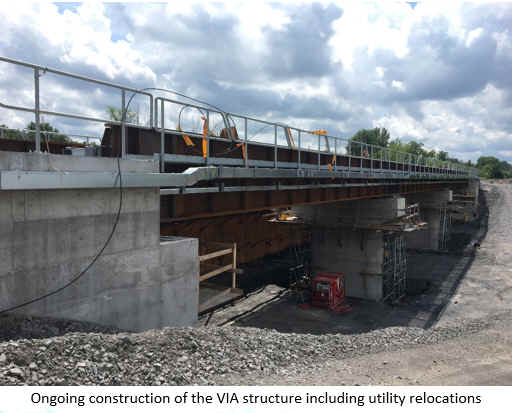
My question: Is the new railway overpass for the Hospital connector road allowing for double tracking? If not, we are being foolish.
Reply With Quote
     
     
  #683  
Old Posted Aug 4, 2017, 4:19 PM
waterloowarrior's Avatar
waterloowarrior waterloowarrior is offline
National Capital Region
 
Join Date: Nov 2005
Location: Eastern Ontario
Posts: 9,254
Quote:
Originally Posted by lrt's friend View Post
My question: Is the new railway overpass for the Hospital connector road allowing for double tracking? If not, we are being foolish.
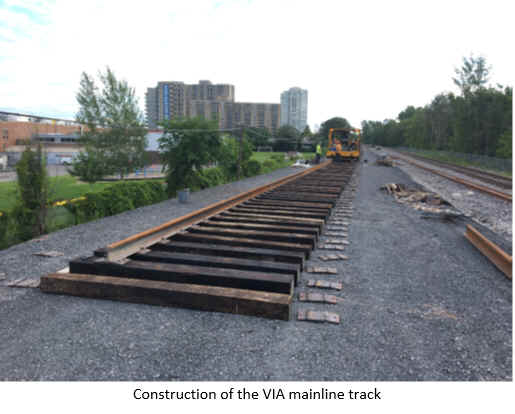
Not sure about the final width, but the recommendation from the EA was to build the ultimate rail structure at the same time as the Hospital Link, as it could not be done in stages.

Here are some Aug 2017 photos

http://ottawa.ca/en/node/1000564


Reply With Quote
     
     
  #684  
Old Posted Aug 4, 2017, 5:05 PM
roger1818's Avatar
roger1818 roger1818 is offline
Registered User
 
Join Date: Feb 2016
Location: Stittsville, ON
Posts: 6,610
Quote:
Originally Posted by acottawa View Post
I don't see how you can run 48 trains per day without double tracking most if not all of the line, but either way, even if it is lots and lots of passing tracks the line that Via owns between SF and Coteau has not been sufficiently upgraded for the HFR service, which is all I was saying.
Where are you getting that 48 trains a day number from? VIA Rail's HFR Backgrounder says "up to 15 departures per day from major urban centers." I assume that is in each direction (about one train an hour), so that would be 30 total. They have had 3 trains about an hour apart along the Alexandria Subdivision in the afternoon in the past, so it is doable, but, as I said before, longer sidings would be necessary to eliminate the need to slow down and wait for an oncoming train. How long the sidings need to be depends on how reliable the service is. If 97% of trains leave within 5 minutes of scheduled departure, a siding that is "10 minutes" long is sufficient and for hourly departures on a route that is 80-90 minutes long, 3 sidings are necessary.

The Smiths Falls Subdivision might also have trains to/from Kingston (we don't know that for sure though), but I can't see that being more than 5 or 6 departures a day, so doubling that (for round trips) could be up to 42 trains on that subdivision, which is why I suggested it may need to be double tracked.

To save money, they could keep the bridges single tracked and schedule the trains so that they won't meet anywhere near those bridges.
Reply With Quote
     
     
  #685  
Old Posted Aug 4, 2017, 5:35 PM
roger1818's Avatar
roger1818 roger1818 is offline
Registered User
 
Join Date: Feb 2016
Location: Stittsville, ON
Posts: 6,610
Quote:
Originally Posted by waterloowarrior View Post
It certainly looks like it is being ballasted for double track. Uncertain if they will install double track right away though. The bridges over Riverside and Smyth are wide enough for double track but the one over Bank isn't.

Last edited by roger1818; Aug 5, 2017 at 2:55 AM. Reason: corrected typo
Reply With Quote
     
     
  #686  
Old Posted Aug 4, 2017, 7:12 PM
acottawa acottawa is offline
Registered User
 
Join Date: Aug 2009
Posts: 18,871
Quote:
Originally Posted by roger1818 View Post
Where are you getting that 48 trains a day number from? VIA Rail's HFR Backgrounder says "up to 15 departures per day from major urban centers." I assume that is in each direction (about one train an hour), so that would be 30 total. They have had 3 trains about an hour apart along the Alexandria Subdivision in the afternoon in the past, so it is doable, but, as I said before, longer sidings would be necessary to eliminate the need to slow down and wait for an oncoming train. How long the sidings need to be depends on how reliable the service is. If 97% of trains leave within 5 minutes of scheduled departure, a siding that is "10 minutes" long is sufficient and for hourly departures on a route that is 80-90 minutes long, 3 sidings are necessary.

The Smiths Falls Subdivision might also have trains to/from Kingston (we don't know that for sure though), but I can't see that being more than 5 or 6 departures a day, so doubling that (for round trips) could be up to 42 trains on that subdivision, which is why I suggested it may need to be double tracked.

To save money, they could keep the bridges single tracked and schedule the trains so that they won't meet anywhere near those bridges.
It is what they told the city of ottawa.

http://ottawacitizen.com/news/local-news...crease-train-frequency-through-barrhaven

Via will not release details (which I have complained about repeatedly) so I have no idea what trains they are talking about.
Reply With Quote
     
     
  #687  
Old Posted Aug 5, 2017, 2:54 AM
roger1818's Avatar
roger1818 roger1818 is offline
Registered User
 
Join Date: Feb 2016
Location: Stittsville, ON
Posts: 6,610
Quote:
Originally Posted by acottawa View Post
Interesting. Here are some observations from that article:
  1. It is talking about Barrhaven, so that likely includes trains from Kingston.
  2. The 48 trains a day isn't until 2031, it would only be 38 in 2021 (assuming HFR).
  3. If HFR isn't approved, VIA still plans to increase the number of trains in Barrhaven (Fallowfield?) from 26 to 32.
  4. The number includes empty trains going to the beginning of their run or coming home from the end of their run.

Quote:
Via will not release details (which I have complained about repeatedly) so I have no idea what trains they are talking about.
True VIA is keeping their cards close, but it doesn't take a rocket scientist to make an educated guess as to what they are planning. It is shaping up to Ottawa being one of VIA's busiest stations (if not the busiest). It is quite likely that there will be one or two early morning trains from Fallowfield to Montreal and maybe even an early morning train from Ottawa to Toronto plus some late trains in the opposite directions (a 6:00am train out of Ottawa to get to Montreal for an 8:00am meeting might work, a 4:45am train out of Toronto for the same arrival time, not so much).

Who knows, if they have the equipment, they may even run an early morning Brockville to Ottawa train (the first train currently doesn't arrive until 11:30, which makes it so the train is not an option). With a stop in Smiths Falls (and adding a stop on a well timed return train) it could be a boon for commuters.
Reply With Quote
     
     
  #688  
Old Posted Aug 5, 2017, 7:36 PM
roger1818's Avatar
roger1818 roger1818 is offline
Registered User
 
Join Date: Feb 2016
Location: Stittsville, ON
Posts: 6,610
Quote:
Originally Posted by eemy View Post
The renders seem inconsistent in this regard, but it looks like there will only be one track between the island platforms and possibly only one track between the north island platform and north platform (depending on the render). It almost seems like a Spanish solution design with the north island platform presumably being used for arriving passengers and departing passengers using the north platform and south island platform. I'm not sure I've ever heard of the Spanish solution being used for intercity trains, though. Is this a common thing?
Sorry for restricting an old post, but I just noticed that the Ottawa station currently only has one track between each platform, but they alternate between passenger and service platforms so that they can service the train without interfering with passenger activity. The new design appears to remove the service platforms and reduces the number of tracks from 6 to 5 (though the north most track will still be split into two terminal tracks). There will still only be 3 passenger platforms so tracks 2, 3 and 5 will have a platform on one side, where as track 4 will have platforms on both sides.

This will allow for wider platforms hopefully allowing passengers on them prior to the train arriving, allowing the stop to be shorter.

Presumably the plan would be for westbound trains to use tracks 2&3 and eastbound trains will use tracks 4 and 5 (though they may want to use track 4 for through trains whenever possible, as it has 2 platforms). If so, they would need to rearrange the switches accordingly. Currently track 6 has no switches in the station and only merges well outside the station (especially to the west).
Reply With Quote
     
     
  #689  
Old Posted Aug 7, 2017, 3:13 AM
roger1818's Avatar
roger1818 roger1818 is offline
Registered User
 
Join Date: Feb 2016
Location: Stittsville, ON
Posts: 6,610
Quote:
Originally Posted by acottawa View Post
200 kph plus class 7 track would be classified as a high speed route, which is much more expensive proposition than the budget esimates.
Upgrading all existing track to class 7 would be very expensive. For the roughly 150km of new track to be built between Havelock and Glen Tay, it would be more expensive than class 5 track, but probably worth the cost in the long run and would more likely be within the budget estimates.

My theory on this is that VIA hasn't given up on HSR, but instead is using HFR as a stepping stone towards it. History has shown that there hasn't been any appetite for the high cost of a full HSR but maybe something with a lower price tag could be achievable. Once built, upgrades could gradually be made to convert the line to HSR.

Quote:
The only 200 kph service in North America is the Acela Express, so you either have to wait until Amtrak is doing an order for new Acela trains or buy something custom (and custom as we've learned many times adds a lot of cost).
But Amtrack is replacing the Acela Express trainsets with new Avelia Liberty trainsets (made by Alstom). It is capable of a top speed of 220 miles per hour (350 km/h), with track and signalling upgrades, so they may not be what VIA is looking at.

Instead, VIA might be looking at the Siemens trainsets that Florida's Brightline is having built. They will be used at a top speed of 125 miles per hour (201 km/h) and are currently in production (4 of 5 trainsets have been delivered and more will be required for Phase 2).

Quote:
Also, class 7 track requires more grade separations, fencing, etc. which adds more money.
The abandoned part of the Havelock Subdivision is pretty remote, greatly reducing the number of grade separations needed compared to more densely populated areas, making it an ideal candidate for high speed. The distances between stations mean they can maintain the speed for longer, giving them a better bang for the buck.


Last edited by roger1818; Aug 7, 2017 at 3:29 AM.
Reply With Quote
     
     
  #690  
Old Posted Aug 7, 2017, 3:12 PM
acottawa acottawa is offline
Registered User
 
Join Date: Aug 2009
Posts: 18,871
Quote:
Originally Posted by roger1818 View Post

The abandoned part of the Havelock Subdivision is pretty remote, greatly reducing the number of grade separations needed compared to more densely populated areas, making it an ideal candidate for high speed. The distances between stations mean they can maintain the speed for longer, giving them a better bang for the buck.
Yes, and also very zig-zaggy to get around the many hills, lakes, etc. in that part of Ontario. Upgrading to a high speed standard (tunnels, causeways, bridges, etc) is certainly possible, but I wouldn't agree it is cheap or within the lowball budget Via has proposed.

Reply With Quote
     
     
  #691  
Old Posted Aug 7, 2017, 5:06 PM
roger1818's Avatar
roger1818 roger1818 is offline
Registered User
 
Join Date: Feb 2016
Location: Stittsville, ON
Posts: 6,610
I don't remember seeing this on here before, but here is a link to the Honourable David Collenette's 2017 - Special Advisor Report Ontario High Speed Rail.

https://drive.google.com/file/d/0B6QvXHw7cJQ2aGJUSG41OVVhMWs/view

Some interesting notes:
  • He is recommending GO RER and an HSR stop at the historic Guelph Station.
  • Initially the Malton GO Station should be expanded to support HSR and use a people-mover system to link it and Pearson Airport.
  • Long term, provide direct access for HSR in a future Pearson Airport multi-modal hub being planned by the GTAA.
  • A new, dedicated HSR line be built between K-W and London (optimally beside the hydro corridor).
Reply With Quote
     
     
  #692  
Old Posted Aug 7, 2017, 6:09 PM
acottawa acottawa is offline
Registered User
 
Join Date: Aug 2009
Posts: 18,871
Quote:
Originally Posted by roger1818 View Post
I don't remember seeing this on here before, but here is a link to the Honourable David Collenette's 2017 - Special Advisor Report Ontario High Speed Rail.
There's a pretty extensive discussion starting at #391 on this thread.
Reply With Quote
     
     
  #693  
Old Posted Aug 7, 2017, 7:27 PM
roger1818's Avatar
roger1818 roger1818 is offline
Registered User
 
Join Date: Feb 2016
Location: Stittsville, ON
Posts: 6,610
Quote:
Originally Posted by acottawa View Post
There's a pretty extensive discussion starting at #391 on this thread.
There was, but I don't think it included this information. For example there was discussions as to if it will bypass Guelph or not.
Reply With Quote
     
     
  #694  
Old Posted Aug 8, 2017, 8:45 PM
roger1818's Avatar
roger1818 roger1818 is offline
Registered User
 
Join Date: Feb 2016
Location: Stittsville, ON
Posts: 6,610
Quote:
Originally Posted by acottawa View Post
Yes, and also very zig-zaggy to get around the many hills, lakes, etc. in that part of Ontario. Upgrading to a high speed standard (tunnels, causeways, bridges, etc) is certainly possible, but I wouldn't agree it is cheap or within the lowball budget Via has proposed.
The 2011 HSR study said that Toronto-Montreal segment would cost between $9.1 billion and $11 billion (depending on if they electrified the line or not). That would be for the full 500+ km route (most of which would need to be replaced), including new HSR trainsets. We are talking about 150km (less than 1/3 of the distance) of new track. It seems very realistic for a scaled back version to cost $5.25 billion.

As I said before, my guess is they are using the 80/20 rule on the HSR study, cut out the most expensive bits and are called the result HFR. They very well may need to slow down for some stretches that would be expensive to build to HSR standards, but that doesn't mean that it isn't worth building any segments to HSR standards.
Reply With Quote
     
     
  #695  
Old Posted Aug 8, 2017, 9:37 PM
acottawa acottawa is offline
Registered User
 
Join Date: Aug 2009
Posts: 18,871
Quote:
Originally Posted by roger1818 View Post
The 2011 HSR study said that Toronto-Montreal segment would cost between $9.1 billion and $11 billion (depending on if they electrified the line or not). That would be for the full 500+ km route (most of which would need to be replaced), including new HSR trainsets. We are talking about 150km (less than 1/3 of the distance) of new track. It seems very realistic for a scaled back version to cost $5.25 billion.

As I said before, my guess is they are using the 80/20 rule on the HSR study, cut out the most expensive bits and are called the result HFR. They very well may need to slow down for some stretches that would be expensive to build to HSR standards, but that doesn't mean that it isn't worth building any segments to HSR standards.
So the full route costs 9.1 billion in 2009 dollars, so 10.3 in 2017 dollars. If you assume about 2 billion of that is rolling stock, that is 8B for a 500 km route. Havelock to Glen Tay is 28% of the route would be 2.4 billion. Plus 1.5 billion to upgrade the Toronto-Peterborough track, they are already 1.4 billion over budget without upgrading the Peterborough to Havelock track, building new track from Glen Tay to Smiths Falls, upgrading the Smiths Falls to Coteau track and finding some way to get from Coteau to Central Station much faster.

High speed rail is very expensive, which is fine if governments want to pay for it, but it certainly doesn't fit in Via's budget for HFR.
Reply With Quote
     
     
  #696  
Old Posted Aug 9, 2017, 1:32 AM
Truenorth00 Truenorth00 is offline
Registered User
 
Join Date: May 2017
Posts: 29,060
This discussion is getting circular and tiresome. I hope we get new facts soon.

Arguing over a ROME is pretty pointless at the depth we've taken it. It may be all we have. But unless we know the assumptions behind it, it's fidelity is debatable. I think it's reasonable. But I can see why others (such as acottawa) do not share that opinion.

I am still of the belief that electrification is part of the discussion because it gives the feds a way to subsidize the electrification activities of GO and AMT.

Given population trends in the cities in question, I actually there might be a reasonable case for High Speed Rail, or rather getting up to a good speed between Peterborough and Smith's Falls. Hopefully once all the investors get their analysis going in earnest, I'll be proven right.

There is decent talent and experience with high speed rail among the Canadian pension funds. I hope to see the day where some of that experience is put to use in their home nation!
Reply With Quote
     
     
  #697  
Old Posted Aug 9, 2017, 2:21 PM
roger1818's Avatar
roger1818 roger1818 is offline
Registered User
 
Join Date: Feb 2016
Location: Stittsville, ON
Posts: 6,610
Quote:
Originally Posted by acottawa View Post
So the full route costs 9.1 billion in 2009 dollars, so 10.3 in 2017 dollars. If you assume about 2 billion of that is rolling stock, that is 8B for a 500 km route. Havelock to Glen Tay is 28% of the route would be 2.4 billion. Plus 1.5 billion to upgrade the Toronto-Peterborough track, they are already 1.4 billion over budget without upgrading the Peterborough to Havelock track, building new track from Glen Tay to Smiths Falls, upgrading the Smiths Falls to Coteau track and finding some way to get from Coteau to Central Station much faster.
First of all, you aren't taking the 80/20 rule into account. Get rid of the 20% of the upgrades that have 80% of the cost. Probably the biggest cost savings can come from re-using existing bridges and crossings (across the entire route) that are in good condition. The HSR plan would have assumed every single track bridge needs to be either twinned or replaced and all crossings need to be grade separated. For HFR, only when you need to replace a bridge do you have it meet HSR standards. Most (though not necessarily all) new crossings can be grade separated, but most existing crossings can be left alone (or upgraded as part of a separate rail safety programme). It is cheaper to do a crossing right the first time than to fix it later while keeping the line open.

Secondly, why are you assuming the entire Toronto-Peterborough track needs to be upgraded? While some upgrades will be necessary (like more sidings), they could likely make do with what exist in most cases. The same goes with the other sections of existing track. Some work will be necessary, but they can cherry pick the upgrades that provide the biggest bang for the buck.
Reply With Quote
     
     
  #698  
Old Posted Aug 9, 2017, 2:54 PM
acottawa acottawa is offline
Registered User
 
Join Date: Aug 2009
Posts: 18,871
Quote:
Originally Posted by roger1818 View Post
First of all, you aren't taking the 80/20 rule into account. Get rid of the 20% of the upgrades that have 80% of the cost.
Do you have any reason to believe this principle is applicable to the rail transportation business? If you only do the cheap upgrades (straight sections on level ground) and the train has to slow down for every curve, crossing, bridge, hill, etc. (the expensive stuff) then the train will have to slow down every few km. Who wants to ride that train?

Quote:
Originally Posted by roger1818 View Post
Probably the biggest cost savings can come from re-using existing bridges and crossings (across the entire route) that are in good condition.
What are you basing this on? The Toronto-Havelock route hasn't been used for passenger service in 30 years (and it was used for passenger service it was very slow). There is no track between Havelock and Glen Tay (the track was ripped up decades ago and is currently used for a snowmobile trail). The route from Glen Tay to Smiths Falls is the CP mainline and remember sharing freight lines is the problem the HFR is supposed to address. The Smiths falls to Montreal portion currently runs way to slow for the kinds of speeds Via is promising.

We've certainly seen that when long-disused track is brought back into service, major upgrades are necessary (the Trillium line, for example). This is something the Moose people will also encounter for some of their proposed lines.


Quote:
Originally Posted by roger1818 View Post

Secondly, why are you assuming the entire Toronto-Peterborough track needs to be upgraded? While some upgrades will be necessary (like more sidings), they could likely make do with what exist in most cases. The same goes with the other sections of existing track. Some work will be necessary, but they can cherry pick the upgrades that provide the biggest bang for the buck.
1. Toronto-Havelock last saw passenger service in about 1990 (when Via cutbacks ended it). The train took 2 hours and 45 minutes. Even if the track has not deteriorated in the last 30 years (which it probably has) those speeds are nowhere near what Via is promising for HFR, which means the line needs upgrades.

2. The Metrolinx study identified major upgrades that were necessary even for a basic GO service (at lower speeds and less frequency than Via is proposing). This is the only part of the Via proposal that has been subject to analysis in the public domain (and as far as I'm concerned the only credible source currently available).
Reply With Quote
     
     
  #699  
Old Posted Aug 9, 2017, 3:25 PM
acottawa acottawa is offline
Registered User
 
Join Date: Aug 2009
Posts: 18,871
From the Metrolinx report:

Quote:
The line is operated as a Class III main line permitting freight trains to operate at speeds of up to 30 miles per hour. Given that no passenger trains currently operate on this line, rules for their operation are not currently mentioned in the current CPR Timetable. Class III track does however permit the operation of passenger trains at speeds up to 60 miles per hour. Due to limited freight traffic on this line the railway has reduced capital expenditures and the entire subdivision is currently under a 10 mile per hour slow order. Based on discussions with CP staff and field observations made by the project team a substantial track upgrade program would be required to bring the subdivision back up to unrestricted Class III specifications.

Last edited by acottawa; Aug 9, 2017 at 3:25 PM. Reason: formatting
Reply With Quote
     
     
  #700  
Old Posted Aug 9, 2017, 4:52 PM
lrt's friend lrt's friend is offline
Registered User
 
Join Date: Dec 2006
Posts: 12,805
I don't know what the point of all these discussions are. The proposal needs a proper study and we will see what the cost is. There will be a degree of incremental upgrades over time, but the critical parts including replacing dilapidated track will have to come at the beginning. This is a given. I am sure that there will be some give and take in order to contain costs. Maybe it will never happen but I see great merit in the project based on the concept. The details may point us in a different direction. In any event, this part of Canada needs to move more away from car dependency and eventually, we are going to face enormous costs of further expanding Highway 401, which is already maxed out in the Toronto area.
Reply With Quote
     
     
This discussion thread continues

Use the page links to the lower-right to go to the next page for additional posts
 
 
Reply

Go Back   SkyscraperPage Forum > Regional Sections > Canada > Ontario > Ottawa-Gatineau > Transportation
Forum Jump


Forum Jump


All times are GMT. The time now is 4:33 PM.


Powered by vBulletin® Version 3.8.7
Copyright ©2000 - 2026, vBulletin Solutions, Inc.