Quote:
Originally Posted by TakeFive

mr1138... Aurora being much newer grew up installing greenbelt open space for this purpose. But in at least one case at Utah Park NEC of Jewell and Peoria it was I assume a similar retrofit, Over 20 years ago I used to take my toddler son up there to play. Maybe once a year a part of the park would flood and be unusable for maybe a day. Twas no big deal and in fact a bit curious or nifty to see when it happened.
|
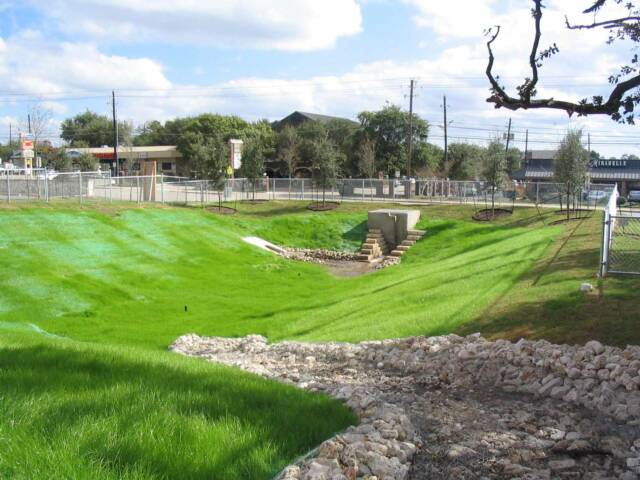
I lived for quite a long time in suburban Longmont, and had one of these right behind my house that doubled as a community green space. I walked my dog by
this one almost daily, and there were oftentimes kids having little-league sports practice on the turf. I would give it a 6 out of 10 from a design creativity standpoint. You're right that they tend to be standard features in newer urban areas - I think this actually resulted from federal legislation in the mid-late 20th century (possibly the Clean Water Act?). If you look at the current maps of flood potential and storm sewers in the area north of City Park, it is a disaster waiting to happen. This is a very worthwhile project, and people will probably end up golfing right IN the detention pond without even realizing it.
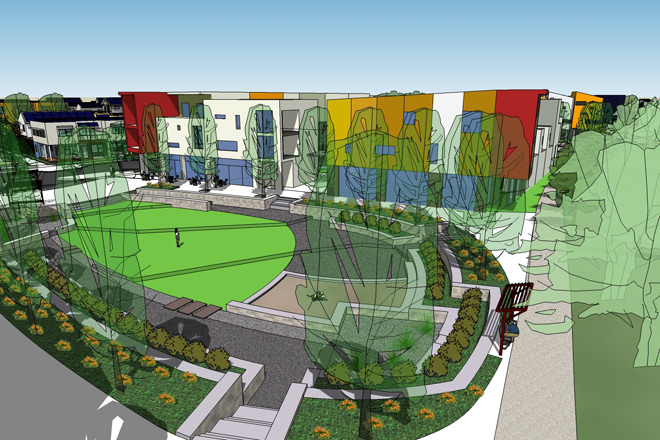
My dad has worked in flood/water engineering my whole life, but it wasn't until I went through the ENVD program at CU that I really learned what these structures are for and why they are important. The concept is actually quite simple, and one of the few ways that modern urban design is superior to traditional design, which usually paid no attention to water quality and thought nothing of turning small creeks into underground sewers (a practice dating back to the ancient Romans). We often see these ponds as a kind of AWFUL afterthought, usually behind the loading dock of a big-box store to handle the runoff from the enormous paved area. But there's no reason that they can't also be designed in a thoughtful, urban context - either integrated into a park, plaza, or even a series of
street-tree rain gardens - and still achieve their purpose from an engineering standpoint. The design possibilities are actually as limitless as an architect's imagination. Boulder is also currently planning series of flood detention ponds for the east side of town - one on a natural prairie, another on a middle school soccer field, and a third on the city's golf course.





 Prev
Prev




 My apologies but this site doesn't have a sarcasm or tongue-in-cheek font. I'm not srsly advocating for building more freeways.






 Linear Mode
