From Los Angeles Downtown News:
A New Vision With the Civic Center Master Plan
Six-Phase Plan Aims to Add Housing, Retail and a Lot of Office Space to the District
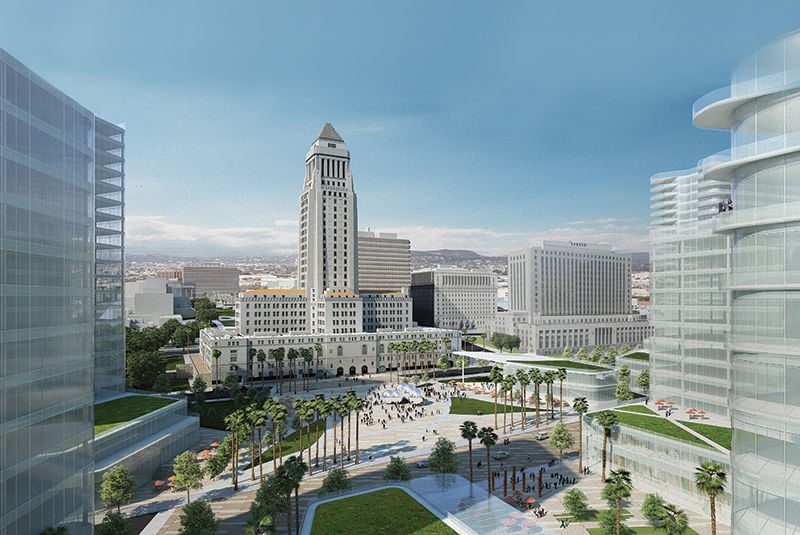

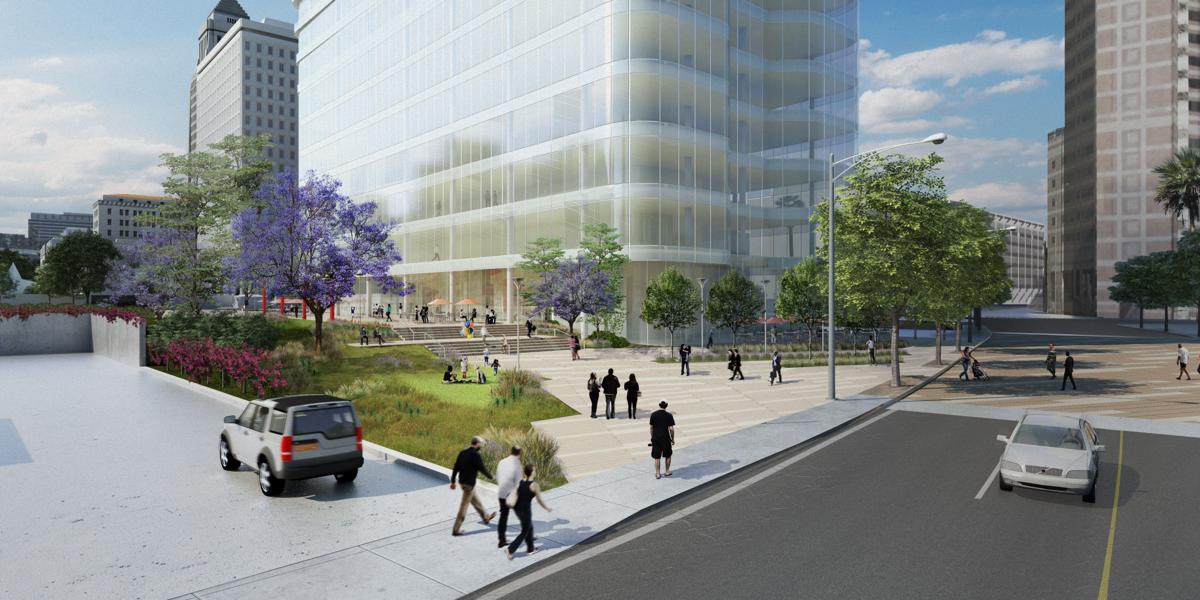
Images from IBI Group
DTLA - During the workweek, the Civic Center is one of the busiest parts of Downtown, with thousands of city, county, state and federal workers navigating the sidewalks and filling a dozen-plus large office buildings.
Beyond work hours, however, the district regresses to a collection of dead blocks with a bare sliver of foot traffic.
Altering that reality amid a quickly changing Downtown Los Angeles is one of the priorities in the recently approved Civic Center Master Plan. The document, prepared by the office of the City Administrative Officer, IBI Group and Ernst & Young and completed in January, lays out six distinct phases of work spread over 15 years, with strategies that mirror Downtown’s current embrace of density and uses that mix residential, retail and office with fewer seams.
The issue came into sharp focus late last month, when the City Council unanimously voted to approve the Master Plan, which was originally introduced in 2015 by 14th District City Councilman José Huizar. The council also voted to raze Parker Center, the former police headquarters, to make way for a 27-story city office tower.
“The Civic Center Master Plan provides an exciting blueprint for the future of Los Angeles that will open up City Hall and the Civic Center to increased public interaction through paseos and open space intermingled with multi-use City towers that will provide ample space to more efficiently do the city’s business, while also providing for other uses, such as retail, residential and restaurants,” Huizar said in a March 24 statement after the council vote.
A key to the Master Plan is to reduce the costs of leasing office space by building city-owned structures. About 1.2 million square feet are needed to accommodate city employees, according to the report.
Bringing in new residents and retail is a secondary aim, but those factors could improve connectivity, said Robert Jernigan, regional managing principal for the Downtown office of architecture and design firm Gensler.
“Baby boomers loved boundaries, and we designed a boundary-filled world. But a civic area that is dedicated to purely government uses is an inefficient idea,” said Jernigan, who is not involved with the project. “If people work eight to nine hours a day, and the buildings are otherwise empty, you’re getting a smaller percent of utilization. Because of that, none of the amenities that make a neighborhood great exist there.”
[...]
Link:
http://www.ladowntownnews.com/developmen...3d6834a-2918-11e7-ae2d-67458c53157b.html





 Prev
Prev


 Linear Mode
