Baseline Road rapid transit corridor travelling towards opposition
13.8-kilometre transit corridor requires the partial expropriation of more than 200 properties
By Chloé Fedio, CBC News Posted: Jan 04, 2017 5:00 AM ET Last Updated: Jan 04, 2017 5:00 AM ET
The City of Ottawa's $160-million plans for a new rapid transit corridor between Billings Bridge and Bayshore Station could face hoards of opposition at an upcoming committee meeting over concerns of installing bus-only lanes in the middle of Baseline Road.
The proposed 13.8-kilometre Baseline Road Rapid Transit Corridor also requires the partial expropriation of more than 200 residential and commercial properties, as well as the complete acquisition of up to 15 properties, to maintain two lanes of traffic on each side of the road, and include segregated bike lanes for cyclists and sidewalks for pedestrians.
Marjorie Shaver-Jones, the head of the Copeland Park Community Association, has helped collect feedback from hundreds of people in her three-building condo complex, including a petition with some 500 signatures opposing various elements of the city's plan.
A sticking point is the city's plan to place bus stops at medians instead of curbside pickup.
The condos at 1565, 1485 and 1505 Baseline Road have a total of 1,800 units.
"The current proposed project isn't the best the city can offer and we'd like something better," she said.
"We think that the dollars can be spent much more wisely to create a much more user-friendly bus system that is an improvement on Baseline Road."
Feedback so far has already yielded a key change to the proposal: a signal to allow eastbound vehicles to turn left through the transit corridor for access to the condo complex.
But Shaver-Jones is concerned the planning and environmental assessment study on the project will be rubber-stamped by the Transportation Committee at its February 1 meeting.
The federal government has already pegged $6 million for the design of the transit corridor.
"We're worried it's a done deal," Shaver-Jones said.
Plans for the rapid bus corridor are not new: the city's first open house for the project began in April 2012 and it was included in the city's 2013 Transportation Master Plan, which sets out projects to complete by 2031.
The Baseline rapid bus corridor includes 24 new transit stations to link east to west, intersecting with bus and rail stations, without going through the downtown core.
The first phase of the project would have median bus-only lanes from Heron Station near Billings Bridge to Baseline Station, said Vivi Chi, the city's manager of transportation planning.
Chi said there would be "improvements at intersections" to speed up buses between Baseline Station and Bayshore Station, but no median lane all the way through until after 2031.
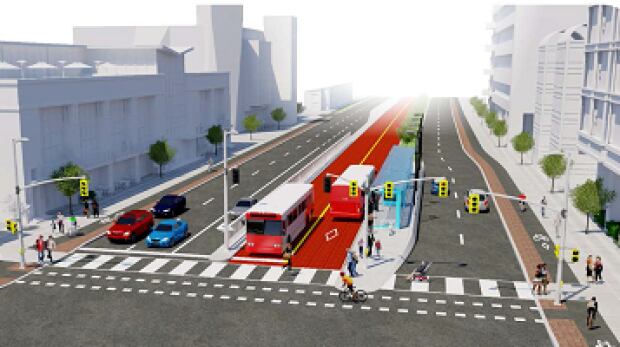
Shaver-Jones suggested median bus stations would be a struggle for people with mobility issues, particularly in winter when the roads are covered in ice, slush and snow.
But Chi said it would actually cut the travel time in half for those who need to cross the street to catch a bus.
Chi said that city staff rejected the curbside option for bus lanes mainly because it would be impede right turns for vehicles travelling along the road.
Because the option was rejected, there is no cost estimate, but Chi said she believes it's not much different than the median option.
"There's lots of streets where cars want to make a right turn so that would impede the operation of the buses," she said. She added that having bus stations on the sidewalk was also raised as a concern by folks living in homes along Baseline Road.
"We've heard a lot of complaints from people when it's just a simple bus stop from a local route — how they don't like people congregating there, smoking, throwing cigarette butts around and staring into their windows," she said.
"Maybe the condo owners don't care because their buildings are set back but other properties along the way, along the corridor, wouldn't like that."
Jabbar Siddique, the project manager for the Baseline Road Rapid Transit Corridor, said bus commuters would save 6.5 minutes travelling between Heron Station and Baseline Station once the corridor is complete, or 11 minutes travelling the entire length of the corridor.
Chi said that as the city grows, rapid transit infrastructure is needed to support increased ridership.
There are about 6,500 riders along the corridor now, but the City of Ottawa expects that number to increase to 10,000 by 2031.
If the plan passes at Transportation Committee, it would go for approval at City Council on Feb. 8.
Chi said the province would have to approve the plan before the city could go ahead with the design process, which would take about two years before construction could begin.
http://www.cbc.ca/news/canada/ottawa/ottawa-baseline-road-transit-corridor-concerns-1.3919275





 Prev
Prev




 Linear Mode
