HomeDiagramsDatabaseMapsForum About
     

Go Back   SkyscraperPage Forum > Regional Sections > Canada > Alberta & British Columbia > Vancouver > Transportation & Infrastructure


Closed Thread

 
Thread Tools Display Modes
     
     
  #2601  
Old Posted Jul 30, 2016, 2:31 AM
Kisai Kisai is offline
 
Join Date: Jun 2014
Posts: 1,154
http://www.langleyadvance.com/news/388459741.html

Quote:
by Matthew Claxton - Langley Advance
posted Jul 27, 2016

The mayors of Langley City, Township, and Surrey are trying to determine if light rail or SkyTrain is the way of the future.

Langley City Mayor Ted Schaffer said staff from all three communities are working together on a comparison of the two systems.

Part of the long-term plans of TransLink, still not fully funded, is a rail link from the Surrey SkyTrain terminus down Fraser Highway to Langley City.

“We want to see what the best model is for the community,” said Schaffer.

The study will look at both short and long term costs. Which system is more expensive to build, which to run. Some considerations are the costs for drivers for a light rail system, or whether a new maintenance yard would be needed.

...
     
     
  #2602  
Old Posted Jul 30, 2016, 3:04 AM
Caliplanner1 Caliplanner1 is offline
 
Join Date: Mar 2015
Posts: 692
Wink

Quote:
Originally Posted by twoNeurons View Post
Yes, it would be crazy to push the SkyTrain out past Langley. It's already 29km from Downtown to Surrey, Langley alone adds another 15km. Going to Langley is like building HALF an Expo Line!

To put that into context, the longest single-ride line in New York is the A-Train and it's 51km long and that stretches both ways from 209th in Harlem ( north of Manhattan ) and south-east into Brooklyn:


If you take out statistical anomalies like shuttles and the A Train to Far Rockaway, you end up with an average line length of about 29km, but all the lines fit within a 19km radius from Midtown ( obviously mostly extending east ).

So in terms of distance from the core, the Expo Line is ALREADY further from Vancouver than almost every line in New York!!!

The Millennium Line extension to Coquitlam will be about the same as the Expo Line.

I've argued in the past that Vancouver's SkyTrain is different from Subways like Toronto and due to station spacing can operate more as a hybrid commuter/subway system... I still will argue that, but due to New York's 4-track Express system, the A train can operate in a somewhat similar manner. We need to start connecting INSIDE the circle. Vancouver will need another East-West Line after Broadway ( Hastings or 49th ) before Langley needs a High capacity connection to Vancouver.

Anyway, what I'm trying to say is that even Langley is a questionable priority for rapid transit. It would be good to connect Langley and Surrey together, but it's LESS important to connect Langley to Vancouver.

For further context, approximate radius of systems:
London, UK: 25km radius
New York City: 20km radius
Paris, France: 10km radius (Metro) ( the RER stretches out 60km )
Tokyo: ~16km radius ( Metro )
Moscow : ~16km
Berlin: ~16km ( U-Bahn )
Toronto: ~18km ( including SRT )

Vancouver: ~24km ( Downtown to Surrey )

Even if you argued the real center of our transit system is Commercial/Broadway, or the triangle between there, downtown and City Hall... it's still 20km.

I'm not saying Langley shouldn't be connected to the system... but a definitive cost analysis SHOULD be done as to whether we extend SkyTrain to Langley or not. And it's NOT about cost. Seattle's LRT was expensive because of all the tunnelling, but it's a great example of what a good LRT should be. It's mostly grade separated where it makes sense. I'm as big a fan of SkyTrain as the next guy, but partially at-grade separated systems that have some level crossings seem like a better model SoFR.

Remember, if they're grade-separated, they can be JUST as fast as SkyTrain and in many cases, they can be MORE comfortable than SkyTrain. Wider cars, larger windows, more friendly stations.

Seattle's LRT is more pleasant to ride than SkyTrain and it's not just that it's newer. Having a wider more spacious train makes a big difference. The stretch between 156th and 168th is EASILY run at-grade, as well as much of Fraser Highway.

This image says it better than I could. Check out where most of Langleyites commute to.
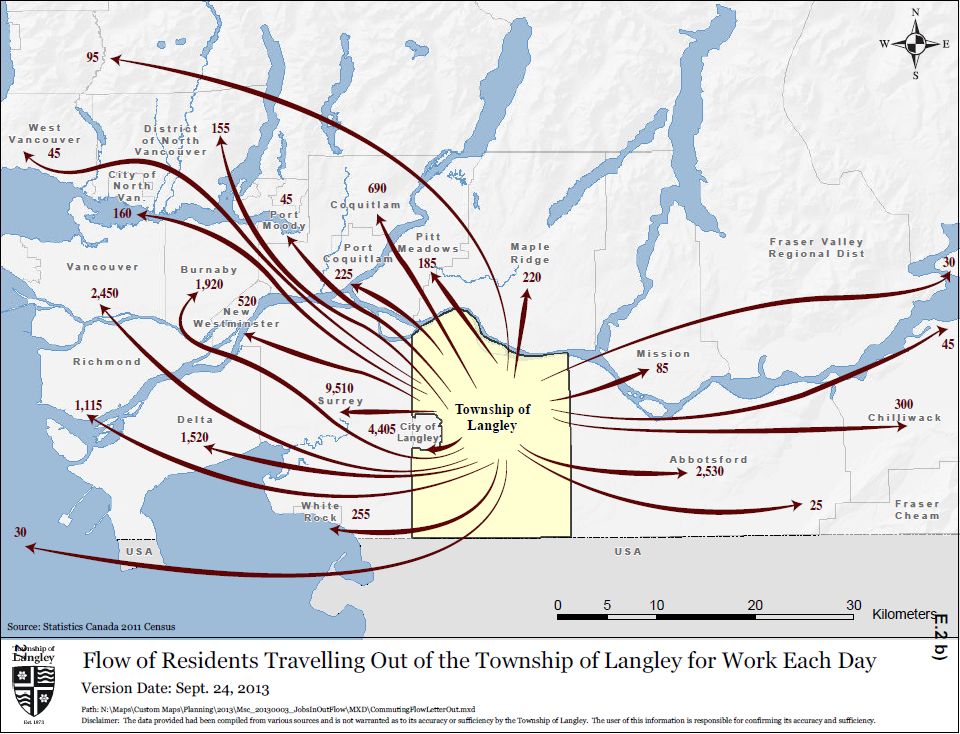

The vast majority stay SoF. More travel to Abby than Vancouver... ( though I guess you SHOULD include Burnaby, which is basically part of Vancouver )


Pushing the Skytrain lines to Langley City/Township of Langley, Maple Ridge and/or the Northern Delta region via the Canada Line could help accommodate more real estate based affordable housing solutions for the Vancouver metro area, in the process stimulating more commuter trips to downtown Vancouver and urban points in between.

Last edited by Caliplanner1; Jul 30, 2016 at 3:14 AM.
     
     
  #2603  
Old Posted Jul 30, 2016, 3:51 AM
Rico Rico is offline
 
Join Date: Feb 2012
Posts: 319
Quote:
Originally Posted by Caliplanner1 View Post
Pushing the Skytrain lines to Langley City/Township of Langley, Maple Ridge and/or the Northern Delta region via the Canada Line could help accommodate more real estate based affordable housing solutions for the Vancouver metro area, in the process stimulating more commuter trips to downtown Vancouver and urban points in between.
A Skytrain commute from Langly to downtown would be horribly long and painful (even longer and more painful with LRT). Luckily Skytrain to places like Surrey central or Metrotown would be nice. That said going even further out would be just silly. An extra option like RER/Sbahn would be best for those long trips.
     
     
  #2604  
Old Posted Jul 30, 2016, 4:01 AM
Caliplanner1 Caliplanner1 is offline
 
Join Date: Mar 2015
Posts: 692
Quote:
Originally Posted by Rico View Post
A Skytrain commute from Langly to downtown would be horribly long and painful (even longer and more painful with LRT). Luckily Skytrain to places like Surrey central or Metrotown would be nice. That said going even further out would be just silly. An extra option like RER/Sbahn would be best for those long trips.
As is the case on some of the longer NYC lines non-stop/express trains could be run between Langley and Metrotown and/or downtown Vancouver to offset commute times/distance concerns.
     
     
  #2605  
Old Posted Jul 30, 2016, 4:38 AM
Migrant_Coconut's Avatar
Migrant_Coconut Migrant_Coconut is offline
 
Join Date: Oct 2015
Posts: 10,194
Quote:
Originally Posted by Caliplanner1 View Post
As is the case on some of the longer NYC lines non-stop/express trains could be run between Langley and Metrotown and/or downtown Vancouver to offset commute times/distance concerns.
Not without getting stuck behind regular service - the Expo's only got one track in each direction, remember?

It also robs the ALRT of its ability to compensate for small trains with higher frequency. Extend the headways from 1.5 to 3 minutes, and Skytrain becomes a poor man's subway.
     
     
  #2606  
Old Posted Jul 30, 2016, 5:38 AM
Caliplanner1 Caliplanner1 is offline
 
Join Date: Mar 2015
Posts: 692
Quote:
Originally Posted by Migrant_Coconut View Post
Not without getting stuck behind regular service - the Expo's only got one track in each direction, remember?

It also robs the ALRT of its ability to compensate for small trains with higher frequency. Extend the headways from 1.5 to 3 minutes, and Skytrain becomes a poor man's subway.
I was thinking that some stations would have to be expanded to accommodate side (train service holding) tracks. In any event mathematical schedule programming genius is key.
     
     
  #2607  
Old Posted Jul 30, 2016, 1:17 PM
Rico Rico is offline
 
Join Date: Feb 2012
Posts: 319
Quote:
Originally Posted by Caliplanner1 View Post
I was thinking that some stations would have to be expanded to accommodate side (train service holding) tracks. In any event mathematical schedule programming genius is key.
Can't be done at 108 second frequency even if they did every station.
     
     
  #2608  
Old Posted Jul 30, 2016, 3:11 PM
Caliplanner1 Caliplanner1 is offline
 
Join Date: Mar 2015
Posts: 692
Quote:
Originally Posted by Rico View Post
Can't be done at 108 second frequency even if they did every station.
Maybe longer trains with lower frequency minutes? It would be interesting to look at some of Toronto longer subway lines/travel times in comparison.
     
     
  #2609  
Old Posted Jul 30, 2016, 4:45 PM
Sheba Sheba is offline
 
Join Date: Jan 2015
Posts: 4,598
Quote:
Originally Posted by Caliplanner1 View Post
Maybe longer trains with lower frequency minutes? It would be interesting to look at some of Toronto longer subway lines/travel times in comparison.
The point of Skytrain is to have frequent short trains - why would we want longer trains with lower frequency?

I'd rather see some trains short turned. Have some of the trains run to say Scott Road Station (not sure off the top of my head where crossover tracks are) from both Waterfront and Langley. Sure some people would have to wait on the platform for the next train but that's not the end of the world - it would only be a few minutes until the next one.
     
     
  #2610  
Old Posted Jul 30, 2016, 5:28 PM
Caliplanner1 Caliplanner1 is offline
 
Join Date: Mar 2015
Posts: 692
Quote:
Originally Posted by Sheba View Post
The point of Skytrain is to have frequent short trains - why would we want longer trains with lower frequency?

I'd rather see some trains short turned. Have some of the trains run to say Scott Road Station (not sure off the top of my head where crossover tracks are) from both Waterfront and Langley. Sure some people would have to wait on the platform for the next train but that's not the end of the world - it would only be a few minutes until the next one.
Not sure why shorter trains are more favorable in the first place (as a Skytrain policy goal) but your mid train line turn around strategy is definitely another solution to be considered towards shortening train service flow times and attendant scheduling conflicts.
     
     
  #2611  
Old Posted Jul 30, 2016, 6:22 PM
aberdeen5698's Avatar
aberdeen5698 aberdeen5698 is offline
 
Join Date: May 2010
Posts: 4,819
Quote:
Originally Posted by Caliplanner1 View Post
Not sure why shorter trains are more favorable in the first place
Higher frequency means less wait time. Wait time is just as important as travel time - if you have to wait 5 minutes for the next train then that's 5 minutes added to your travel time. That's important because almost every Skytrain ride includes a bus ride to or from it, and each transfer adds up. And it's especially important when not every train goes to your destination.
     
     
  #2612  
Old Posted Jul 30, 2016, 6:27 PM
Caliplanner1 Caliplanner1 is offline
 
Join Date: Mar 2015
Posts: 692
Quote:
Originally Posted by aberdeen5698 View Post
Higher frequency means less wait time. Wait time is just as important as travel time - if you have to wait 5 minutes for the next train then that's 5 minutes added to your travel time. That's important because almost every Skytrain ride includes a bus ride to or from it, and each transfer adds up. And it's especially important when not every train goes to your destination.
...the question/issue posed was not about scheduled frequency times per se but rather train (re: linked passenger car capacity) length (a possible function of longer station platforms).
     
     
  #2613  
Old Posted Jul 30, 2016, 6:45 PM
aberdeen5698's Avatar
aberdeen5698 aberdeen5698 is offline
 
Join Date: May 2010
Posts: 4,819
Quote:
Originally Posted by Caliplanner1 View Post
...the question/issue posed was not about scheduled frequency times per se but rather train (re: linked passenger car capacity) length (a possible function of longer station platforms).
But for a given fleet size, shorter trains = higher frequencies. It's the same question.
     
     
  #2614  
Old Posted Jul 30, 2016, 6:53 PM
Bdawe Bdawe is offline
 
Join Date: Aug 2015
Posts: 535
Quote:
Originally Posted by Caliplanner1 View Post
Not sure why shorter trains are more favorable in the first place (as a Skytrain policy goal) but your mid train line turn around strategy is definitely another solution to be considered towards shortening train service flow times and attendant scheduling conflicts.
The point is to have big city subway quality service with less-than big city subway ridership and big city subway operating and capital costs.

Hence, viaducts (vs tunnels), automation (vs drivers), short platforms (80m, vs 200m), and other such features.

As such, you don't have longer less frequent trains without a massive re-build of the system to platform them. Moreover, I don't see huge positive value in cutting urban service quality so that we can have express trains from Langley. Multiple service patterns consume track capacity rather rapidly.

Moreover, skytrain to Langley really isn't for the daily downtown commuter, though there would be some number of them (such as my sister-in-law's absurd existing transit commute from Langley City to VCC). It's for the daily commuter to Surrey, to New Westminster, to Metrotown and other areas. Given that Surrey has similar journey-to-work mode share to, say, Los Angeles or Portland metro areas, it makes more sense why such extensions can pencil out here.
     
     
  #2615  
Old Posted Jul 30, 2016, 7:02 PM
Caliplanner1 Caliplanner1 is offline
 
Join Date: Mar 2015
Posts: 692
Quote:
Originally Posted by aberdeen5698 View Post
But for a given fleet size, shorter trains = higher frequencies. It's the same question.
....are fleet sizes set in stone (and if so why)???
     
     
  #2616  
Old Posted Jul 30, 2016, 7:03 PM
Bdawe Bdawe is offline
 
Join Date: Aug 2015
Posts: 535
Quote:
Originally Posted by Caliplanner1 View Post
....are fleet sizes set in stone (and if so why)???
No, but platforms are cast in concrete
     
     
  #2617  
Old Posted Jul 30, 2016, 7:09 PM
Caliplanner1 Caliplanner1 is offline
 
Join Date: Mar 2015
Posts: 692
Quote:
Originally Posted by Bdawe View Post
The point is to have big city subway quality service with less-than big city subway ridership and big city subway operating and capital costs.

Hence, viaducts (vs tunnels), automation (vs drivers), short platforms (80m, vs 200m), and other such features.

As such, you don't have longer less frequent trains without a massive re-build of the system to platform them. Moreover, I don't see huge positive value in cutting urban service quality so that we can have express trains from Langley. Multiple service patterns consume track capacity rather rapidly.

Moreover, skytrain to Langley really isn't for the daily downtown commuter, though there would be some number of them (such as my sister-in-law's absurd existing transit commute from Langley City to VCC). It's for the daily commuter to Surrey, to New Westminster, to Metrotown and other areas. Given that Surrey has similar journey-to-work mode share to, say, Los Angeles or Portland metro areas, it makes more sense why such extensions can pencil out here.
The conflict that I see here is with the overall agency mission of Translink's urban rail service,...re: long range/regional intra urban commuter connectivity versus short range intra urban commuter connectivity via Skytrain as the GVA grows eastwards (as a relative function of either economies or diseconomies of scale). As I've said above, a factor to consider is that a Skytrain extension towards Langley can open up affordable real estate housing options for Vancouver.

Last edited by Caliplanner1; Jul 30, 2016 at 8:41 PM.
     
     
  #2618  
Old Posted Jul 30, 2016, 7:14 PM
Caliplanner1 Caliplanner1 is offline
 
Join Date: Mar 2015
Posts: 692
Quote:
Originally Posted by Bdawe View Post
No, but platforms are cast in concrete
Precisely,...and though controversial/politically expensive such concrete platforms can be demolished and expanded (if needed) over time (to handle geometric increased service demand).
     
     
  #2619  
Old Posted Jul 30, 2016, 8:32 PM
Alex Mackinnon's Avatar
Alex Mackinnon Alex Mackinnon is offline
 
Join Date: May 2008
Posts: 2,223
It would be a lot of money to upgrade the station capacity significantly. All the entrances and exits would need to be expanded to account for the additional passenger count. Renovations without shutdowns are often pricier than new builds for good reason. They're a pain.

It would be a lot easier just to build second line with wider station spacing. Then you'd have system redundancy which is pretty valuable at this point.
     
     
  #2620  
Old Posted Jul 30, 2016, 9:30 PM
aberdeen5698's Avatar
aberdeen5698 aberdeen5698 is offline
 
Join Date: May 2010
Posts: 4,819
Quote:
Originally Posted by Caliplanner1 View Post
....are fleet sizes set in stone (and if so why)???
It doesn't matter what the fleet size is. With an automated system there are no drivers to pay, so there's no penalty for breaking your fleet up into smaller trains that run more frequently. The only time you need to increase the size of the trains is when passenger loads have justified buying so many trainsets that you've already reached minimum possible headways. And you'd only need to increase the size of the stations when trains at their maximum lengths and minimum headways are unable to service demand. And even at that point it might make more sense to build an alternate line instead, given the greater connectivity, coverage and network benefits and relatively smaller incremental cost (i.e., the cost of building the new line avoids having to pay for expanding the stations).

I'm speaking in general terms, of course. A Skytrain extension to Langley would share Expo line trains, and the Expo line is getting to be capacity constrained at the downtown end- which means it's mostly grown to using the longest trains that the stations can accommodate.

But I can't imagine it being capacity constrained at the Langley end. In theory, you could run smaller trains at that end of the system - for example, you could have two-car trains that shuttle back and forth between Langley and King George while a separate set of longer trains runs between King George and downtown. That would provide more frequent (and therefore better) service for people on the outer edge of the system. It would also have the advantage isolating the two segments so that problems one one wouldn't affect the other (although that isolation could also be done dynamically as and when needed).

That would force Langley-bound passengers to switch trains, but the high frequencies and the simplicity of just having to walk across the platform would minimize the pain and the delay.

In practice, though, I suspect it's unlikely that an extended Expo line would be operated that way - what would probably happen is to short turn every other train or perhaps 2/3 of the trains at King George. That would result in less frequency on the Langley segment, which would mean poorer service.
     
     
This discussion thread continues

Use the page links to the lower-right to go to the next page for additional posts
   
Closed Thread

Go Back   SkyscraperPage Forum > Regional Sections > Canada > Alberta & British Columbia > Vancouver > Transportation & Infrastructure
Forum Jump


Forum Jump


All times are GMT. The time now is 3:00 PM.


Powered by vBulletin® Version 3.8.7
Copyright ©2000 - 2026, vBulletin Solutions, Inc.
