HomeDiagramsDatabaseMapsForum About
     

Go Back   SkyscraperPage Forum > Regional Sections > Canada


Reply

 
Thread Tools Display Modes
     
     
  #481  
Old Posted Feb 14, 2016, 4:01 PM
Beedok Beedok is offline
Exiled Hamiltonian Gal
 
Join Date: Jun 2012
Posts: 6,796
Quote:
Originally Posted by ssiguy View Post
When it comes to transit there is no such thing as "one size fit's all". All cities have unique demographic, employment, economic, geographic, and political concerns that have to weighed.

Transit should not be rated by the simplistic "we have more subways than you" mentality but rather the system that provides the safest, most comfortable, most efficient, fastest, affordable, and accessible service whether that be by trains, LRT, ferry, subway, or bus.
Definitely, but we can't build transit for today with no plans for expansion when our cities are almost all growing strongly. We also shouldn't say there will never be 'x' in the country/city again.
Reply With Quote
     
     
  #482  
Old Posted Feb 14, 2016, 7:17 PM
lrt's friend lrt's friend is offline
Registered User
 
Join Date: Dec 2006
Posts: 12,797
Quote:
Originally Posted by Beedok View Post
Definitely, but we can't build transit for today with no plans for expansion when our cities are almost all growing strongly. We also shouldn't say there will never be 'x' in the country/city again.
Building rapid transit is so expensive, you better make sure that it will be workable for more than 20 or 30 years and you should have a reasonable upgrade path that is not disruptive.

Don't ever do what Ottawa did, spend a fortune to build a rapid transit system and now spend billions to rebuild it with years of service disruption. Once we finish Phase 1, onto to Phase 2 and years more disruption. Either we should have built rail in the first place, or we should have approached rapid transit expansion differently. How the current plan leads to ridership growth, I am very skeptical.
Reply With Quote
     
     
  #483  
Old Posted Feb 14, 2016, 7:45 PM
Aylmer's Avatar
Aylmer Aylmer is offline
Still optimistic
 
Join Date: Nov 2007
Location: Montreal (C-D-N) / Ottawa (Aylmer)
Posts: 5,407
I think that Ottawa's is a special case: the problem isn't as much that we need more ridership, it's that the current technology has reached it's absolute limit and no more ridership is physically possible at certain hours. So if you have a build and a no build scenario, they might both have the same ridership at 2018, but the no-build will hit a wall and not be able to grow whereas the build scenario can continue to grow for the next three-quarter century. This also means that, unlike with the Transitway, we can now go full-on TOD since the capacity exists; We can already see massive growth and planned growth around stations and future stations such as Carling, South Keys, Bayview, Pimisi and Tunney's Pasture which I'm certain are directly linked to the coming of LRT.

I know that you think otherwise, but I think that ridership growth is inevitable even without these massive new TOD clusters. I remember an American study from the 1970's that found that, for the equivalent service (frequency and trip duration), a rail-based line will fetch 35-45% more ridership than the bus alternative. Moreover, the tunnel will lead to significantly faster trips, especially at peak or whenever it snows - it can often take 10-15 minutes to clear the 1km downtown section. I know that you'll come back and talk about how much people will hate the additional transfer, but (1) people are much more forgiving of bus-metro transfers than they are of bus-bus transfers in the cold/heat/wind/rail/whatever on a streetcorner and (2) I think the positives outweigh the negatives.

As for whether it should have been built it as rail, I think that considering the Transitway is the spine of Ottawa's commuter traffic and it was designed to reach capacity within 20 years of its completion (1980's), I definitely think that it should have been built as rail from day 1. This isn't unforeseeable growth like the Yonge Line - this is planned obsolescence to kick the transit can down the road.
__________________
I've always struggled with reality. And I'm pleased to say that I won.
Reply With Quote
     
     
  #484  
Old Posted Feb 15, 2016, 2:57 AM
lrt's friend lrt's friend is offline
Registered User
 
Join Date: Dec 2006
Posts: 12,797
Quote:
Originally Posted by Aylmer View Post
I think that Ottawa's is a special case: the problem isn't as much that we need more ridership, it's that the current technology has reached it's absolute limit and no more ridership is physically possible at certain hours. So if you have a build and a no build scenario, they might both have the same ridership at 2018, but the no-build will hit a wall and not be able to grow whereas the build scenario can continue to grow for the next three-quarter century. This also means that, unlike with the Transitway, we can now go full-on TOD since the capacity exists; We can already see massive growth and planned growth around stations and future stations such as Carling, South Keys, Bayview, Pimisi and Tunney's Pasture which I'm certain are directly linked to the coming of LRT.

I know that you think otherwise, but I think that ridership growth is inevitable even without these massive new TOD clusters. I remember an American study from the 1970's that found that, for the equivalent service (frequency and trip duration), a rail-based line will fetch 35-45% more ridership than the bus alternative. Moreover, the tunnel will lead to significantly faster trips, especially at peak or whenever it snows - it can often take 10-15 minutes to clear the 1km downtown section. I know that you'll come back and talk about how much people will hate the additional transfer, but (1) people are much more forgiving of bus-metro transfers than they are of bus-bus transfers in the cold/heat/wind/rail/whatever on a streetcorner and (2) I think the positives outweigh the negatives.

As for whether it should have been built it as rail, I think that considering the Transitway is the spine of Ottawa's commuter traffic and it was designed to reach capacity within 20 years of its completion (1980's), I definitely think that it should have been built as rail from day 1. This isn't unforeseeable growth like the Yonge Line - this is planned obsolescence to kick the transit can down the road.
I know the hope is that TOD will do magic. We will see where the housing market takes us as this depends on large numbers of people wanting to move to high density housing, often at premium prices near rapid transit. As you know, that market segment is currently saturated. So many of the projects that you mention are all competing for the same housing market. Will all of these projects be successful and over what time frame? There is a similar plan for Billings Bridge Shopping Centre and Westgate Shopping Centre that isn't even on proposed rail lines, at least not that will be built in the next 20 years.

A lot of these shopping centre plans will also completely depend on a major change in society. As we eliminate parking lots, switching back to transit for shopping, something that was common until the 1940s but we have gone through three generations when most people have used a car to shop. This switch, particularly in the suburbs (all of these shopping centres are in post war suburbs), will depend on a major investment in transit, something I doubt that our politicians will follow through on. Even if they did, will the public actually switch? And the alternative, will be a further shift in shopping patterns out to fringe of the city with little or no transit.

I would also not trust a 1970s American study, where buses are often referred to as 'loser cruisers' and are associated with race and poverty issues. Also, American LRT projects have more often than not, been not meeting ridership expectations. A lot of that has to do with robbing Peter to pay Paul, where resources are taken out of the bus network to pay for LRT. And then there is also the well documented 'last mile' problem. Trains are not going to reach their potential if you can't quickly reach your final destination quickly. Ottawa's situation has been worrisome since they have been reducing service in local neighbourhoods. So yes, bus to train works, but you also have to go home and if the train to bus transfer involves a 15 or 30 minute wait, people are going to switch to other forms of transportation. I know in Toronto or Montreal, bus routes will connect at subway stations every 5 minutes but that is not going to happen in Ottawa.
Reply With Quote
     
     
  #485  
Old Posted Feb 15, 2016, 5:06 AM
miketoronto miketoronto is offline
Registered User
 
Join Date: Jul 2001
Location: Toronto, Ontario, Canada
Posts: 9,932
It has already been mentioned. But if Ottawa does not start running more frequent transit service (and that includes in off peak times) in the suburban areas, then the LRT is not going to be a success, and could actually see a ridership decline.

In the book Transport for Suburbia, the author goes into how Ottawa had ridership declines in the 1990's. The data pointed to high ridership declines in off peak hours, which is when OC Transpo reduced service levels, making transfers between Transitway services and local services less easy.
If they continue to operate 30 - 60 min off peak local service, forget getting people onto transit.
One only need to look across the river to the STO, to see the major problems they have had since they opened the Rapibus. And a big part of the problem is the low frequency feeder buses.

Feeder buses aside. If Ottawa does not address the continued decentralization of jobs from downtown Ottawa, then transit is going to continue to struggle. The previous government moved a ton of jobs out of downtown, and while not the full reason, it is partly to blame for stagnant ridership in Ottawa.
At one time, the Government of Canada was a partner with Ottawa, and agreed to locate jobs in downtown and charge parking. This was part of the early success for OC Transpo.
__________________
Miketoronto

Last edited by miketoronto; Feb 16, 2016 at 12:26 AM.
Reply With Quote
     
     
  #486  
Old Posted Feb 15, 2016, 8:39 AM
ssiguy ssiguy is offline
Registered User
 
Join Date: Mar 2006
Location: White Rock BC
Posts: 11,964
Or don't do what Vancouver did by building a subway with 40 meter station, single tracked at both ends, no turn around at it's terminus downtown station and stations that are dangerously thin with only one exit including the downtown ones.
Reply With Quote
     
     
  #487  
Old Posted Feb 15, 2016, 12:56 PM
Aylmer's Avatar
Aylmer Aylmer is offline
Still optimistic
 
Join Date: Nov 2007
Location: Montreal (C-D-N) / Ottawa (Aylmer)
Posts: 5,407
Well concerning feeder buses, one of the advantages of LRT (over the status quo or the Rapibus) is that it frees up both more buses and operating costs for bus service elsewhere in the city. The city's early estimates are that during the first year of service, OC Transpo will save $100M/year on operating costs, meaning that that money can go to beefing up frequencies and coverage all over the city. By 2031, the annual cost difference between the no-build scenario and the LRT scenario is projected to reach $400M even before you factor in phase 2. The Rapibus, on the other hand, has had to commandeer buses from elsewhere in the city and has not significantly reduced operating costs, forcing the city to have to choose between overcrowded Rapibus buses or infrequent local buses. Somehow, we managed to chose both!

So yes, better bus service is necessary - it is the bread and butter of almost every transit agency in the world. But in order to have the money to operate them and the garage space to store them, we need LRT.
__________________
I've always struggled with reality. And I'm pleased to say that I won.
Reply With Quote
     
     
  #488  
Old Posted Feb 15, 2016, 8:11 PM
nname nname is offline
Registered User
 
Join Date: Aug 2005
Posts: 5,095
Quote:
Originally Posted by ssiguy View Post
Or don't do what Vancouver did by building a subway with 40 meter station, single tracked at both ends, no turn around at it's terminus downtown station and stations that are dangerously thin with only one exit including the downtown ones.
The platforms are pretty much same width as any other stations in the system. A 3-4m side-platform or a 8-10m center platform is no where near "dangerously thin".

Now this is a dangerously think station (Caltrain Broadway station)
Reply With Quote
     
     
  #489  
Old Posted Feb 15, 2016, 9:44 PM
SkahHigh's Avatar
SkahHigh SkahHigh is offline
More transit please
 
Join Date: Jul 2013
Location: Montreal
Posts: 3,794
Quote:
Originally Posted by nname View Post
The platforms are pretty much same width as any other stations in the system. A 3-4m side-platform or a 8-10m center platform is no where near "dangerously thin".

Now this is a dangerously think station (Caltrain Broadway station)
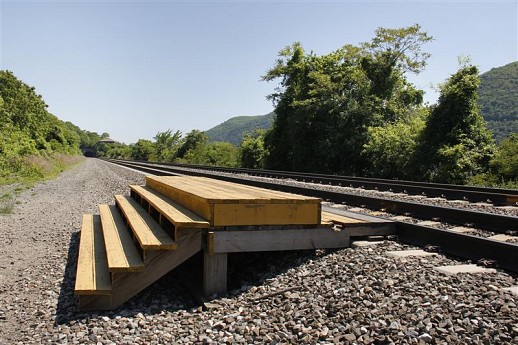
Metro-North's Breakneck Ridge Station is worse...


http://www.iridetheharlemline.com/resize...des/images/upload_images2/breakneck3.jpg
Reply With Quote
     
     
  #490  
Old Posted Feb 16, 2016, 3:01 AM
lrt's friend lrt's friend is offline
Registered User
 
Join Date: Dec 2006
Posts: 12,797
Quote:
Originally Posted by Aylmer View Post
Well concerning feeder buses, one of the advantages of LRT (over the status quo or the Rapibus) is that it frees up both more buses and operating costs for bus service elsewhere in the city. The city's early estimates are that during the first year of service, OC Transpo will save $100M/year on operating costs, meaning that that money can go to beefing up frequencies and coverage all over the city. By 2031, the annual cost difference between the no-build scenario and the LRT scenario is projected to reach $400M even before you factor in phase 2. The Rapibus, on the other hand, has had to commandeer buses from elsewhere in the city and has not significantly reduced operating costs, forcing the city to have to choose between overcrowded Rapibus buses or infrequent local buses. Somehow, we managed to chose both!

So yes, better bus service is necessary - it is the bread and butter of almost every transit agency in the world. But in order to have the money to operate them and the garage space to store them, we need LRT.
I have no doubts that LRT will save the city money but I am not holding my breath on whether much of that saving will be directed to improved local service. The question is whether most of the savings will be plowed into Phase 2 costs.

Ottawa's track record on improving local bus service has been terrible in recent years. Generally when express service is eliminated, no frequency improvement is provided to compensate and if there was improvement, it has subsequently been taken away. The latest express service eliminations in December offered nothing to the user other than adding a transfer. And the quiet service reductions on countless routes when oversized buses are put into the suburbs. You will just have to wait a few more minutes is garbage when you apply this more than one time.

We have seen American style service introduced where off-peak service on many routes only comes every 2 hours or one trip after 7 pm. How does this generate ridership? It doesn't. It drives it away.

But overall the standard levels of service during off-peak hours almost never exceeds 15 minutes on even the busiest streets and in the suburbs, it will be 30 minutes or worse. I will be very surprised if off-peak service will receive a boost, leaving LRT less appealing than the current system.

I know we need to move to LRT to address downtown congestion and service costs but I remain unconvinced that simply replacing buses with trains on the same route is going to generate much new ridership. And there is really no talk about plans that will truly move passengers faster such as the Baseline BRT. Is the forgotten part of the 'affordable' plan truly forgotten?

Remember, that future for many will not be bus-train but bus-bus-train or bus-train-train-train as is the current proposal for Riverside South.

I just don't have confidence that Ottawa transit experts and politicians are going to be delivering the service improvements that Ottawans are hoping for or expecting after spending billions.

Reply With Quote
     
     
  #491  
Old Posted Feb 16, 2016, 3:19 AM
lrt's friend lrt's friend is offline
Registered User
 
Join Date: Dec 2006
Posts: 12,797
Quote:
Originally Posted by miketoronto View Post
It has already been mentioned. But if Ottawa does not start running more frequent transit service (and that includes in off peak times) in the suburban areas, then the LRT is not going to be a success, and could actually see a ridership decline.

In the book Transport for Suburbia, the author goes into how Ottawa had ridership declines in the 1990's. The data pointed to high ridership declines in off peak hours, which is when OC Transpo reduced service levels, making transfers between Transitway services and local services less easy.
If they continue to operate 30 - 60 min off peak local service, forget getting people onto transit.
One only need to look across the river to the STO, to see the major problems they have had since they opened the Rapibus. And a big part of the problem is the low frequency feeder buses.

Feeder buses aside. If Ottawa does not address the continued decentralization of jobs from downtown Ottawa, then transit is going to continue to struggle. The previous government moved a ton of jobs out of downtown, and while not the full reason, it is partly to blame for stagnant ridership in Ottawa.
At one time, the Government of Canada was a partner with Ottawa, and agreed to locate jobs in downtown and charge parking. This was part of the early success for OC Transpo.
Ha, well the federal government now charges for parking even in the suburbs as if transit is really an option for more than a few.

Service cuts have been a way of life in Ottawa since the 1990s both in off-peak and peak hours. The new strategy is to put an articulated bus on in order to avoid adding trips for particular routes. The worst thing came with double decker buses, which gave them an excuse to cut trips on many routes in the suburbs. To add to that was that double decker buses are much slower to operate, something that bloggers here denied, when city officials were informed in advance that this would be the case.

When the Transitway was extended into our part of the city in the 1990s, frequency was added to compensate for added transfers and less convenient routing. They gradually took back the added frequency, so in the end, we just ended up with worse service.

Ottawa's rapid transit plans have not included a cost/benefit analysis. Since the 2006 fiasco, there has been no objective studies on whether proposals are expected to generate new ridership or speed up typical trip times. Who cares if it takes 20 minutes to get to Blair Station, if your trip takes you further? What is the total trip time? Nobody looks at that.
Reply With Quote
     
     
  #492  
Old Posted Feb 16, 2016, 8:04 PM
big W big W is offline
Registered User
 
Join Date: Oct 2003
Location: E-Town
Posts: 5,426
I am sure it is posted in this thread somewhere but I could not find it. The contracts for Edmonton's Valley Line LRT have been signed and construction will soon commence on a 13 station 12 KM extension.

Work is to start in the spring with completion and the line open in 2020. Current system is 24.3 kms with 18 stations. This will bring the total to 36.3 kms with 30 stations (only counting Churchill Station once as this is where the new line intersects with the old) once the current extension is completed.

I should also mention that the plan is to continue expanding the system once the extension to Millwoods is completed with the line heading west which is another 14 km extension with 16 new stations (hope is to start construction once money is available tentatively looking at 2020 start date).

At that point the system in Edmonton would be 50 kms with 46 stations. Which would bring it up to a decent sized system for the population of Edmonton (about 1.4 million and over 1.5 if we use the Alberta census divisions).
__________________
SHOFEAR- "The other goalie should have to turn in his man card. What a sorry display that was." - March 24, 2008

Last edited by big W; Feb 16, 2016 at 8:19 PM.
Reply With Quote
     
     
  #493  
Old Posted Feb 16, 2016, 8:07 PM
FFX-ME's Avatar
FFX-ME FFX-ME is offline
Registered User
 
Join Date: Oct 2006
Posts: 1,053
Quote:
Originally Posted by SkahHigh View Post
This is what we need to build at the O-train passing tracks. The train is so slow we might as well add temporary stops there since they are essentially where the stops are planned for 2023.
Reply With Quote
     
     
  #494  
Old Posted Feb 16, 2016, 8:27 PM
speedog's Avatar
speedog speedog is offline
Moran supreme
 
Join Date: Sep 2010
Posts: 2,579
Quote:
Originally Posted by nname View Post
The platforms are pretty much same width as any other stations in the system. A 3-4m side-platform or a 8-10m center platform is no where near "dangerously thin".

Now this is a dangerously think station (Caltrain Broadway station)
Let's compare apples to apples though as I would dare say that Vancouver's station in question probably has much more regular trains and much higher passenger counts than any of these two mentioned stations.
__________________
Just a wee bit below average prairie boy in Canada's third largest city and fourth largest CMA
Reply With Quote
     
     
  #495  
Old Posted Feb 16, 2016, 8:36 PM
GlassCity's Avatar
GlassCity GlassCity is offline
Rational urbanist
 
Join Date: Aug 2012
Location: Metro Vancouver
Posts: 5,270
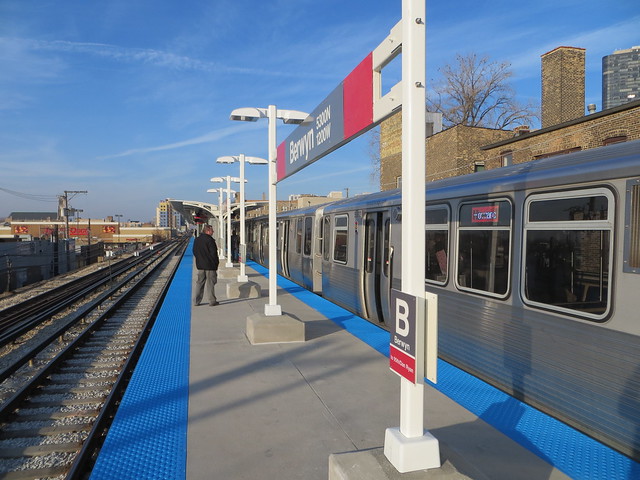
The Canada Line platforms could definitely be wider, but they are absolutely fine and there's nothing dangerous about them. If you think the commuter rail pictures aren't fair, then take a look at the platforms on Chicago's L to compare:


http://anirik-01.livejournal.com/1008400.html?thread=3806224


http://chi.streetsblog.org/tag/red-line/
Reply With Quote
     
     
  #496  
Old Posted Feb 16, 2016, 9:38 PM
hipster duck's Avatar
hipster duck hipster duck is offline
Registered User
 
Join Date: Oct 2014
Location: Toronto
Posts: 4,920
The Canada Line platforms are fine. What's irritating is that some key stations that are either in very dense areas, or areas that will be subject to a lot of future development, were only built with a single entrance and exit.

It doesn't have to apply to all stations, but Richmond-Brighouse, Oakridge-41st, Broadway City Hall and Vancouver City Centre should have been built with more entrance and exit points.
Reply With Quote
     
     
  #497  
Old Posted Feb 16, 2016, 10:00 PM
urbancanadian urbancanadian is offline
Registered User
 
Join Date: Aug 2014
Location: Vancouver
Posts: 713
Quote:
Originally Posted by hipster duck View Post
The Canada Line platforms are fine. What's irritating is that some key stations that are either in very dense areas, or areas that will be subject to a lot of future development, were only built with a single entrance and exit.

It doesn't have to apply to all stations, but Richmond-Brighouse, Oakridge-41st, Broadway City Hall and Vancouver City Centre should have been built with more entrance and exit points.
Save for Richmond-Brighouse, those stations have all been built with potential future entrances in mind. I think we all wish the Canada Line were built a little bigger, but ssiguy needs to stop with the constant misinformation. He's been called out literally dozens of times (and even suspended because of it) and just keeps at it, for years now.

The fact is the line is at around one third of its eventual planned peak hour capacity.
Reply With Quote
     
     
  #498  
Old Posted Feb 18, 2016, 1:42 PM
red-paladin red-paladin is offline
Vancouver Moderator
 
Join Date: Sep 2008
Location: Burnaby
Posts: 3,626
And TransLink is not repeating the same mistakes. The Evergreen extension to the Millennium line has 80m platforms and stations like Inlet Centre have two entrances, and Lincoln is being built with another exit in mind for the future. The final station, Douglas, is a centre platform with two tail tracks and a switch before the station.
Reply With Quote
     
     
  #499  
Old Posted Feb 18, 2016, 7:06 PM
Kitchissippi's Avatar
Kitchissippi Kitchissippi is offline
Busy Beaver
 
Join Date: Nov 2005
Location: Ottawa
Posts: 4,687
Quote:
Originally Posted by Beedok View Post
Montreal had about a ~500K people in 1916 and 3 million in 2000. If the 21st has half the relative growth you could see a Montreal of 12 million in 2100.
Highly unlikely. Even the highest projections has global population less than double what it is now by 2100, somewhere between 9 and 13 billion with most of the growth in Africa. A lot of the increase in our population can be attributable to higher lifespan and immigration in the last half century. The average global age will be past childbearing age in the near future, so the rate has to decline. The improving standards of living in developing countries could also mean that less people will be motivated to immigrate.

That said, if the North American population starts to decline, it would be smart for cities to be more efficient as they shrink, shedding suburban sprawl and maintaining their denser cores amid a contracting tax and labour base, so yeah bring on more urban subway lines!
Reply With Quote
     
     
  #500  
Old Posted Feb 18, 2016, 9:27 PM
J.OT13's Avatar
J.OT13 J.OT13 is offline
Moderator
 
Join Date: Mar 2012
Location: Ottawa
Posts: 28,961
Quote:
Originally Posted by SkahHigh View Post
Since we have a few LRT/rapid transit projects under construction right now and some more planned in the future, I suggest we make a specific thread where users can post construction updates of listed projects instead of doing it in one big transit thread with other modes.

Here's the list.

Planned
  • Edmonton - Valley Line Phase 1 (ETS) - 13 stations - 13km - start 2016
  • Toronto - Finch West LRT (Metrolinx) - 19 stations - 11km - start 2017
  • Montreal - South Shore Line (STM) - 10 stations - 15km - start 2017
  • Montreal - West Island LRT (STM) - 8 stations - 28km - start 2017
  • Montreal - Blue line extension (STM) - 5 stations - 5.5km - start 2017
  • Toronto - Bloor-Danforth Extension (TTC) - 3 stations - 7.6km - start 2018
Think you could add to your planned:

Ottawa - Confederation Line (OC Transpo) - 14 stations - 23km - start 2018
Ottawa - Trillium Line (OC Transpo) - 5 stations - 8km - start 2018
Reply With Quote
     
     
This discussion thread continues

Use the page links to the lower-right to go to the next page for additional posts
 
 
Reply

Go Back   SkyscraperPage Forum > Regional Sections > Canada
Forum Jump


Forum Jump


All times are GMT. The time now is 11:59 AM.


Powered by vBulletin® Version 3.8.7
Copyright ©2000 - 2026, vBulletin Solutions, Inc.