HomeDiagramsDatabaseMapsForum About
     

Go Back   SkyscraperPage Forum > Regional Sections > Canada


Closed Thread

 
Thread Tools Display Modes
     
     
  #4661  
Old Posted Jan 31, 2016, 10:39 PM
lio45 lio45 is offline
 
Join Date: Aug 2007
Posts: 44,901
Quote:
Originally Posted by geotag277 View Post
It's kind of interesting to consider what a guy like whatnext stands to gain from curbing foreign investment in Vancouver single family detached homes.
Just because someone's saying something in here, it shouldn't be an automatic jump to the conclusion they have something to gain.

I think the Vancouver market is in a bubble (personal opinion based on rents and wages and the fact that the city doesn't compete directly with Manhattan and the City in London as a global magnet for capital), but that's only my opinion. If you're trying to figure out what I have to gain by being right, you're wasting your time.
     
     
  #4662  
Old Posted Jan 31, 2016, 10:43 PM
geotag277 geotag277 is offline
 
Join Date: Nov 2013
Posts: 5,091
Quote:
Originally Posted by lio45 View Post
SFH housing stock is decreasing with time in every single downtown I know. Nothing unusual there.

And you're saying Vancouver doesn't have its own places like Surrey, Langley, Coquitlam, Maple Ridge, etc. where commuters can own a SFH?
Single family housing stock is going down everywhere in metro Vancouver. Seattle has plenty of places to build and is adding stock to meet demand. That is the fundamental difference.

Quote:
Okay, then if that's the case, "normal" Vancouver property prices can be obtained based on current Vancouver rents, using the same ratio as San Francisco prices compared to San Francisco rents.

The conclusion: current Vancouver prices are out of whack with San Francisco. There is something else at play in Vancouver that is driving prices up and which has nothing to do with demand for housing (which is reflected in rents).
Again you seem a little obsessed with one metric (rent to land value), likely because you are a land lord. I won't argue it is a rational way to value land as an investor, but I think one major difference between San Francisco and Vancouver is that Vancouver is much more constrained in terms of developmental land in general and Vancouver is much further behind on development in terms of tearing down these SFH and replacing them with multi-family. The land is currently being priced for multifamily valuations that should have been developed decades ago.
     
     
  #4663  
Old Posted Jan 31, 2016, 10:53 PM
geotag277 geotag277 is offline
 
Join Date: Nov 2013
Posts: 5,091
Quote:
Originally Posted by lio45 View Post
Just because someone's saying something in here, it shouldn't be an automatic jump to the conclusion they have something to gain.

I think the Vancouver market is in a bubble (personal opinion based on rents and wages and the fact that the city doesn't compete directly with Manhattan and the City in London as a global magnet for capital), but that's only my opinion. If you're trying to figure out what I have to gain by being right, you're wasting your time.
whatnext loves to question everyone else's motives as if anyone who bothers to question aspects of his rhetoric must be working for the Chinese Ministry of State Security, which is what inspired to me question his.

Outside of targeting whatnext in particular - it is a fair question. Who really stands to gain from the absolute exit of foreign investment in Vancouver? Really, only the richest Canadians who might have the off chance of entering the market. The vast majority of Vancouver residents will remain priced out of the market, just like they were in the 1990s. I'm talking exclusively about single family detached homes here.
     
     
  #4664  
Old Posted Jan 31, 2016, 11:26 PM
someone123's Avatar
someone123 someone123 is online now
 
Join Date: Nov 2001
Posts: 36,020
Quote:
Originally Posted by geotag277 View Post
The vast majority of Vancouver residents will remain priced out of the market, just like they were in the 1990s. I'm talking exclusively about single family detached homes here.
Housing affordability in metro Vancouver has varied a lot over the past 30 years.

Chart 2 here plots affordability by housing type by year: http://www.rbc.com/economics/economic-reports/pdf/other-reports/vancouverhouse.pdf

The cost of a two-storey house peaked at nearly 80% of gross income in 1990, dropped to around 50% around 1998, then was as low as 60% as late as 2004. Condos have followed a similar path. I don't think you can say most people are priced out when the two-storey detached housing costs are up around 50% of the average income. I know middle class people who were purchasing homes in Vancouver as late as about 2004. That was the point when housing sale prices finally rose back to the levels of 1995.

This is all relevant because there have been peaks and valleys in affordability in the past. The cycles tend to take a number of years, they are related to wider economic cycles (national interest rates and debt cycles). This goes against the argument that housing prices are just a function of a reduced land supply (prices were dropping in the 90's when the ALR was already in place and the population was growing). The idea that a "bubble" can't persist for more than a few years is also clearly wrong. You can get caught debating whether or not the term "bubble" is accurate, but the fact is that cycles in housing prices often last 10 years or more. You can watch housing prices go up for 10 years or more than watch them go down in real terms for another decade or more. That happens in all sorts of places and has happened in Vancouver.

Another argument I sometimes hear is that housing is more affordable because mortgages rates have gone down. This isn't true; you might be able to borrow more money for less, but the same amount of house costs more now in Vancouver than it did when interest rates were higher.
     
     
  #4665  
Old Posted Jan 31, 2016, 11:34 PM
geotag277 geotag277 is offline
 
Join Date: Nov 2013
Posts: 5,091
Quote:
Originally Posted by someone123 View Post
Chart 2 here plots affordability by housing type by year: http://www.rbc.com/economics/economic-reports/pdf/other-reports/vancouverhouse.pdf
This is a good chart, thanks for sharing. I think you can see the first inflection point in Vancouver's market occurring in the early 1990s which was the first wave of elevated prices caused by constrained development - which was the major factor in Vancouver overtaking Toronto. That inflection point created the "new normal" for Vancouver of having more expensive real estate compared to Toronto. The City of Vancouver should have at that point taken the steps to replace single family detached lots with multi family on a huge scale.

They didn't, and now you can see in 2004 a new inflection point and and what may be considered the new normal for the modern age. I believe around that time Toronto started to face similar constraints as Vancouver did in 1990 regarding new developments to supply SFH.

Canadians on the whole have been slow as slugs to adapt to this idea that multifamily developments are the path forward to urban living. Many in Vancouver still expect to be able to afford their own plot of land even though Vancouver as a city is more than twice as populated as it was when their parents bought a house (likely stretching their own budget to afford it as well).
     
     
  #4666  
Old Posted Feb 1, 2016, 4:11 AM
Procrastinational's Avatar
Procrastinational Procrastinational is offline
 
Join Date: Jan 2014
Posts: 958
When it comes down to it, there are really only two fundamental metrics in determining whether Vancouver is in the midst of a real estate bubble. The first is land value per square foot in absolute terms.

In Vancouver, it's not that SFH are appreciating faster than multi-unit buildings per say. It's that the land (which is what is actually appreciating) is split more ways on a multi-unit lot. Land value makes up a more significant portion of the value of a single family dwelling. Thus, a run up in land values would lead to SFH housing appreciating more dramatically. This has certainly been the case.

Something striking to consider... Per square foot land values (which is what should be compared when comparing cities) in the west side of Vancouver are almost universally over $300 and quite often over $400.


That is quite similar to the average land values on Manhattan (save for the most expensive areas around Midtown, etc).

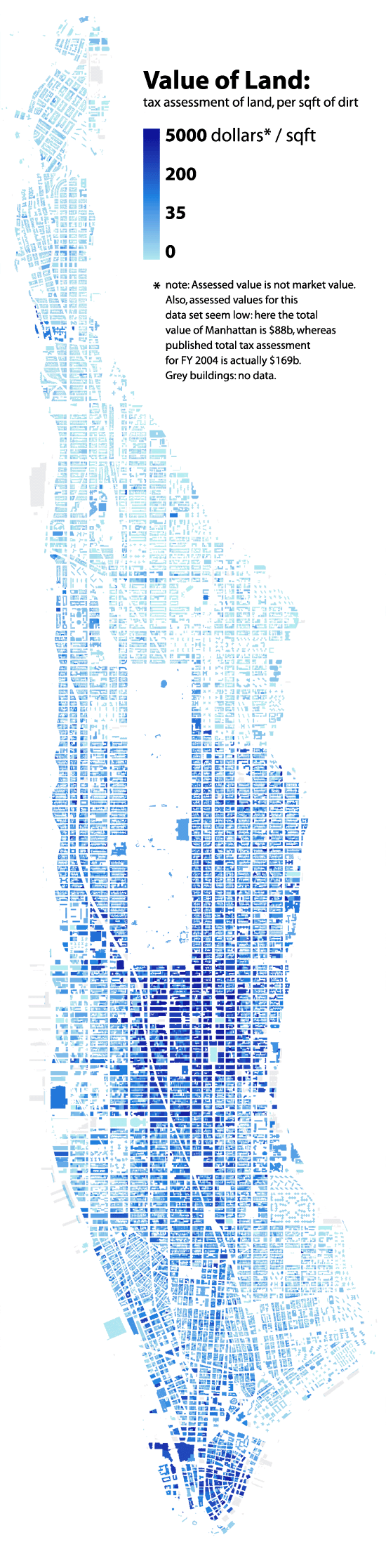


Does it strike you that the economic fundamentals between New York City and Vancouver are similar? Hopefully not. New York is on an entire different level. The GDP of the New York city metro area is similar to the GDP of Canada, and it is one of the largest financial hubs in the world. Manhattan also finds itself with similar, possibly even more restrictive land constraints.
If this doesn't raise some alarm bells you are doing the equivalent of plugging your ears and saying LaLaLa.


The second important indicator is the ratio between land value and rents. As Lio has pointed out, rents are a much better indicator of market demand and the domestic economy. No matter what property prices do, landlords can only charge rents that the market will bear. It wouldn't matter if single family homes were worth $100 million each.. Landlords would still ultimately only be able to charge rent based on demand, which is directly determined by income. So while rent is fundamentally tied to local incomes (the domestic economy), land values are not. Land values can be affected by lending rules, foreign buyers, among other things.

Thus, to see whether land value is overvalued (a classic asset bubble), rent to land value ratios are very accurate in their predictive power. That ratio is more accurate than land value to income in determining whether a market is overvalued.

Rent is a much better proxy for the local economy than income because it takes both demand (determined by income) and supply constraints into account. When comparing rent in Vancouver to land value, the supply constraint created by geography/ALR is already factored into average rents! So even with the supply argument accounted for the ratio still suggests bubble conditions.

When comparing American cities to Vancouver, it is important to note that rents in American cities are often quite a bit higher. So with the Seattle comparison, you can easily see that after the housing bubble briefly formed then popped, land to rent ratios returned roughly to their historical average and have stayed there.
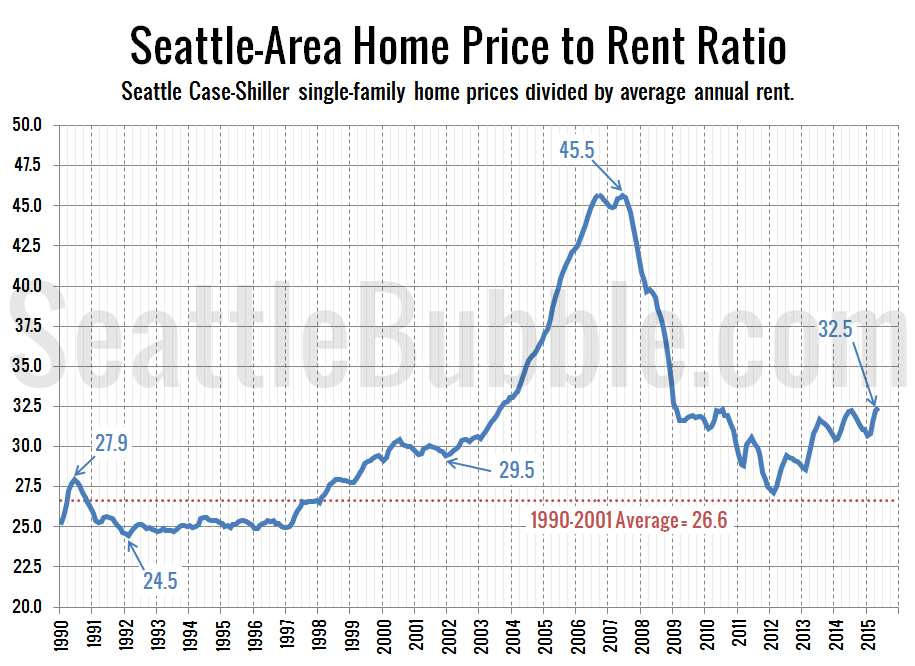


In Vancouver this ratio was already "off the charts" as of 2011 and it has risen significantly since. For those who aren't familiar, anything beyond 3 standard deviations is considered a significant outlier (although the sample only goes back to 1980 so the standard error probably isn't all that accurate).


Sorry for the long post.

TL/DR: By pretty much every important economic indicator, Vancouver is facing bubble conditions in land values. There is no such thing as "this time it's different", or we are "an exception to the rule". That being said, the bubble will continue to grow until foreign investment slows significantly, so it's not necessarily a risk in the short term.

     
     
  #4667  
Old Posted Feb 1, 2016, 4:26 AM
ssiguy ssiguy is offline
 
Join Date: Mar 2006
Posts: 12,003
Is someone actually comparing the world's premier city to a backwater that is only the 25th largest in NA without a single head office that cracks the top 40 in the country?
     
     
  #4668  
Old Posted Feb 1, 2016, 4:28 AM
Procrastinational's Avatar
Procrastinational Procrastinational is offline
 
Join Date: Jan 2014
Posts: 958
Quote:
Originally Posted by ssiguy View Post
Is someone actually comparing the world's premier city to a backwater that is only the 25th largest in NA without a single head office that cracks the top 40 in the country?
Well it's an important question to be asking ourselves considering land values are somewhat comparable. There is no rational justification for that.
     
     
  #4669  
Old Posted Feb 1, 2016, 4:35 AM
geotag277 geotag277 is offline
 
Join Date: Nov 2013
Posts: 5,091
Quote:
Originally Posted by Procrastinational View Post
Something striking to consider... Per square foot land values (which is what should be compared when comparing cities) in the west side of Vancouver are almost universally over $300 and quite often over $400.
Something also striking to consider - is that the number of single family detached homes on the island of Manhattan compared to Vancouver. Vancouver and Manhattan are actually not that different in size (87km2 for Manhattan and 115km2 for the entire City of Vancouver).

One other big difference - New York has orders of magnitude more land surrounding it and is part of a giant continuous urban block stretching all the way to Washington DC. Vancouver has no where else to grow.

It should also be noted that every single city in Canada has rich wealthy expensive neighbourhoods. Certain lots in Calgary go for over 700 per square foot. It is not that interesting to point out that cities have wealthy areas. Specifically regarding Vancouver, we are talking about prime, wealthy neighbourhoods walking distance from the ocean.

Land is rapidly appreciating in Vancouver and ask yourself if those legions of single family detached housing neighbourhoods are really the optimal use of the land, the way of the future, and if everyone who happens to live in Vancouver should expect to be able to own a plot of land walking distance to the ocean in Vancouver's desirable west side?
     
     
  #4670  
Old Posted Feb 1, 2016, 5:02 AM
blueandgoldguy blueandgoldguy is offline
 
Join Date: Jul 2012
Posts: 2,854
Quote:
Originally Posted by Procrastinational View Post
When it comes down to it, there are really only two fundamental metrics in determining whether Vancouver is in the midst of a real estate bubble. The first is land value per square foot in absolute terms.

In Vancouver, it's not that SFH are appreciating faster than multi-unit buildings per say. It's that the land (which is what is actually appreciating) is split more ways on a multi-unit lot. Land value makes up a more significant portion of the value of a single family dwelling. Thus, a run up in land values would lead to SFH housing appreciating more dramatically. This has certainly been the case.

Something striking to consider... Per square foot land values (which is what should be compared when comparing cities) in the west side of Vancouver are almost universally over $300 and quite often over $400.


That is quite similar to the average land values on Manhattan (save for the most expensive areas around Midtown, etc).


Does it strike you that the economic fundamentals between New York City and Vancouver are similar? Hopefully not. New York is on an entire different level. The GDP of the New York city metro area is similar to the GDP of Canada, and it is one of the largest financial hubs in the world. Manhattan also finds itself with similar, possibly even more restrictive land constraints.
If this doesn't raise some alarm bells you are doing the equivalent of plugging your ears and saying LaLaLa.


The second important indicator is the ratio between land value and rents. As Lio has pointed out, rents are a much better indicator of market demand and the domestic economy. No matter what property prices do, landlords can only charge rents that the market will bear. It wouldn't matter if single family homes were worth $100 million each.. Landlords would still ultimately only be able to charge rent based on demand, which is directly determined by income. So while rent is fundamentally tied to local incomes (the domestic economy), land values are not. Land values can be affected by lending rules, foreign buyers, among other things.

Thus, to see whether land value is overvalued (a classic asset bubble), rent to land value ratios are very accurate in their predictive power. That ratio is more accurate than land value to income in determining whether a market is overvalued.

Rent is a much better proxy for the local economy than income because it takes both demand (determined by income) and supply constraints into account. When comparing rent in Vancouver to land value, the supply constraint created by geography/ALR is already factored into average rents! So even with the supply argument accounted for the ratio still suggests bubble conditions.

When comparing American cities to Vancouver, it is important to note that rents in American cities are often quite a bit higher. So with the Seattle comparison, you can easily see that after the housing bubble briefly formed then popped, land to rent ratios returned roughly to their historical average and have stayed there.


In Vancouver this ratio was already "off the charts" as of 2011 and it has risen significantly since. For those who aren't familiar, anything beyond 3 standard deviations is considered a significant outlier (although the sample only goes back to 1980 so the standard error probably isn't all that accurate).


Sorry for the long post.

TL/DR: By pretty much every important economic indicator, Vancouver is facing bubble conditions in land values. There is no such thing as "this time it's different", or we are "an exception to the rule". That being said, the bubble will continue to grow until foreign investment slows significantly, so it's not necessarily a risk in the short term.

This is very interesting. Can you tell me what the most recent (2014 or 2015) average land value would be in Vancouver based on these charts and what the annual average rent would be as well? Same for Seattle? Thanks!
     
     
  #4671  
Old Posted Feb 1, 2016, 5:15 AM
whatnext whatnext is online now
 
Join Date: Feb 2009
Posts: 28,190
Quote:
Originally Posted by geotag277 View Post
whatnext loves to question everyone else's motives as if anyone who bothers to question aspects of his rhetoric must be working for the Chinese Ministry of State Security, which is what inspired to me question his.

Outside of targeting whatnext in particular - it is a fair question. Who really stands to gain from the absolute exit of foreign investment in Vancouver? Really, only the richest Canadians who might have the off chance of entering the market. The vast majority of Vancouver residents will remain priced out of the market, just like they were in the 1990s. I'm talking exclusively about single family detached homes here.
Another garbage post. The "vast majority of Vancouver residents will remain priced out of the market, just like they were in the 1990s"? Do you even know what you are talking about, were you even in Canada in the 1990's? I purchased my SFH then for the princely sum of $350k, hardly unaffordable for most middle class Vancouverites of the time.

Your argument that somehow only the one percenters of Vancouverites would benefit from restricting foreign ownership is a) bizarre b) wrong.
     
     
  #4672  
Old Posted Feb 1, 2016, 5:53 AM
geotag277 geotag277 is offline
 
Join Date: Nov 2013
Posts: 5,091
Quote:
Originally Posted by whatnext View Post
Another garbage post. The "vast majority of Vancouver residents will remain priced out of the market, just like they were in the 1990s"? Do you even know what you are talking about, were you even in Canada in the 1990's? I purchased my SFH then for the princely sum of $350k, hardly unaffordable for most middle class Vancouverites of the time.

Your argument that somehow only the one percenters of Vancouverites would benefit from restricting foreign ownership is a) bizarre b) wrong.
If you think spending 350k on a home in the 90s was no big deal then you were living in a bit of a bubble, especially if your budget was not especially stretched to be able to afford it. Also important to note that metro Vancouver during that time had almost a million less people in it.

Your own articles point to local Vancouver residents bidding 6 figures over ask for single family detached housing properties in the area. Sometimes they happen to be outbid by overseas investors.

Do you really think that the sudden stoppage of foreign investment in Vancouver will allow the average Vancouver resident to suddenly own plots of land? Do you think that is the appropriate future for Vancouver given the developmental challenges?

This Vancouver mindset is stuck in the 90s. You guys should have recognized the developmental challenges with single family detached homes and started to run them out of town 30 years ago. You are sleeping in the bed you made for yourself and doing more harm than good pretending that everyone who works in Vancouver should be entitled to own their own land there.

There is only one path forward for Vancouver - increasing density by converting these inefficient single family neighbourhoods into townhomes, condos, and multi family.

It would be interesting to isolate condos, townhomes, and single family detached in terms of affordability for residents. There is only one runaway train there, and the solution to that problem is obvious.
     
     
  #4673  
Old Posted Feb 1, 2016, 7:25 AM
whatnext whatnext is online now
 
Join Date: Feb 2009
Posts: 28,190
Quote:
Originally Posted by geotag277 View Post
If you think spending 350k on a home in the 90s was no big deal then you were living in a bit of a bubble, especially if your budget was not especially stretched to be able to afford it. Also important to note that metro Vancouver during that time had almost a million less people in it.

Your own articles point to local Vancouver residents bidding 6 figures over ask for single family detached housing properties in the area. Sometimes they happen to be outbid by overseas investors.

Do you really think that the sudden stoppage of foreign investment in Vancouver will allow the average Vancouver resident to suddenly own plots of land? Do you think that is the appropriate future for Vancouver given the developmental challenges?

This Vancouver mindset is stuck in the 90s. You guys should have recognized the developmental challenges with single family detached homes and started to run them out of town 30 years ago. You are sleeping in the bed you made for yourself and doing more harm than good pretending that everyone who works in Vancouver should be entitled to own their own land there...
Sigh. There you go again, do some homework before commenting on something you obviously know nothing about.

Median household income in Vancouver in 1996: $53,704 2006: $55,231.
Population of Vancouver CMA in 1996: 1,831,665 2006: 2,116,581
* Statistics Canada

So it's quite clear where ever you were in the Nineties it wasn't Vancouver, and you certainly aren't here now, so why is anything you're posting about it supposed to be considered remotely credible?
     
     
  #4674  
Old Posted Feb 1, 2016, 1:34 PM
Drybrain Drybrain is offline
 
Join Date: Sep 2012
Posts: 4,568
Quote:
Originally Posted by geotag277 View Post
There is only one path forward for Vancouver - increasing density by converting these inefficient single family neighbourhoods into townhomes, condos, and multi family.

It would be interesting to isolate condos, townhomes, and single family detached in terms of affordability for residents. There is only one runaway train there, and the solution to that problem is obvious.
Again with this. You seem to be suggesting that Vancouver's affordability crisis is a fiction based upon people's irrational attachment to single family homes.

That is not (or at least not entirely or even largely) the case. The average condo across the entire region, not just in the city, is $521,000. That means that if you isolate only condos in the market, Vancouver's average price is still almost $100,000 than the nationwide average across all housing types (which sites at $433,000). And as of August 2015, Vancouver-area condo prices had increased 14 percent over one year earlier.

This is not a reasonable or affordable market, and it no longer has anything to do with the household incomes of Vancouverites, who are not especially high, or increasing especially fast.

Vancouver is very expensive, and it's not just SFHs driving that.
     
     
  #4675  
Old Posted Feb 1, 2016, 1:40 PM
geotag277 geotag277 is offline
 
Join Date: Nov 2013
Posts: 5,091
Quote:
Originally Posted by whatnext View Post
Sigh. There you go again, do some homework before commenting on something you obviously know nothing about.

Median household income in Vancouver in 1996: $53,704 2006: $55,231.
Population of Vancouver CMA in 1996: 1,831,665 2006: 2,116,581
* Statistics Canada

So it's quite clear where ever you were in the Nineties it wasn't Vancouver, and you certainly aren't here now, so why is anything you're posting about it supposed to be considered remotely credible?
How about you actually cite your sources?

If you want to cherry pick 1996, fine, here's the data:

http://www.metrovancouver.org/services/r...dMedianHouseholdIncomebyMunicipality.pdf

http://www.bankofcanada.ca/wp-content/uploads/2010/09/selected_historical_v122521.pdf

Mortgage rates were double digits in 1995 and as high as 8.5% in 1996, with median incomes for the City of Vancouver at 35k.

Do the math. Homes were prohibitively expensive for residents. Especially 350k ones. Your family either stretched their finances or you were one of the top percentile earners in Vancouver, likely both. Again, your obsession with single family homes only stands to help the same demographics in Vancouver and does nothing to address overall affordability trends.
     
     
  #4676  
Old Posted Feb 1, 2016, 1:42 PM
geotag277 geotag277 is offline
 
Join Date: Nov 2013
Posts: 5,091
Quote:
Originally Posted by Drybrain View Post
Again with this. You seem to be suggesting that Vancouver's affordability crisis is a fiction based upon people's irrational attachment to single family homes.

That is not (or at least not entirely or even largely) the case. The average condo across the entire region, not just in the city, is $521,000. That means that if you isolate only condos in the market, Vancouver's average price is still almost $100,000 than the nationwide average across all housing types (which sites at $433,000). And as of August 2015, Vancouver-area condo prices had increased 14 percent over one year earlier.

This is not a reasonable or affordable market, and it no longer has anything to do with the household incomes of Vancouverites, who are not especially high, or increasing especially fast.

Vancouver is very expensive, and it's not just SFHs driving that.
I agree that condos, especially in downtown, and town homes in certain areas, are extremely expensive, and will likely need a correction, but new supply of those will help balance the market, and the only way to do that is to tear down the single family homes. There are town homes in New West for around 400k.

One would expect the city of Vancouver to command a huge premium to the national average as well. We aren't talk about Brandon, Winnipeg here, we are talking about the third largest city in Canada.
     
     
  #4677  
Old Posted Feb 1, 2016, 2:26 PM
geotag277 geotag277 is offline
 
Join Date: Nov 2013
Posts: 5,091
Some pretty clear indications that Vancouver is particularly unprepared and way behind the 8 ball on developments:

http://www.cbc.ca/news/canada/british-co...irst-sellers-market-in-4-years-1.2980124

I would characterize the situation in Vancouver as "urban planning failure".
     
     
  #4678  
Old Posted Feb 1, 2016, 4:29 PM
Drybrain Drybrain is offline
 
Join Date: Sep 2012
Posts: 4,568
Quote:
Originally Posted by geotag277 View Post
I agree that condos, especially in downtown, and town homes in certain areas, are extremely expensive, and will likely need a correction, but new supply of those will help balance the market, and the only way to do that is to tear down the single family homes. There are town homes in New West for around 400k.

One would expect the city of Vancouver to command a huge premium to the national average as well. We aren't talk about Brandon, Winnipeg here, we are talking about the third largest city in Canada.
I'd expect it to be pricier than Winnipeg, but Toronto? Chicago? D.C? Boston? Vancouver--not just the city, but the whole region--is actually pricier than most major American metros.

So I think it is fair to call it expensive, and not just for the SFH crowd. Having said that, I do agree the city needs to turn more SFH neighbourhoods over to multi-unit buildings.
     
     
  #4679  
Old Posted Feb 1, 2016, 5:40 PM
someone123's Avatar
someone123 someone123 is online now
 
Join Date: Nov 2001
Posts: 36,020
Quote:
Originally Posted by Drybrain View Post
I'd expect it to be pricier than Winnipeg, but Toronto? Chicago? D.C? Boston? Vancouver--not just the city, but the whole region--is actually pricier than most major American metros.

So I think it is fair to call it expensive, and not just for the SFH crowd. Having said that, I do agree the city needs to turn more SFH neighbourhoods over to multi-unit buildings.
But why is Toronto more expensive than Chicago? The median house price there is around $200,000.

I think part of the answer is that US real estate prices went through a correction and Canadian prices did not. Coastal cities also command a premium on both sides of the border; Vancouver's natural setting is a lot more desirable than Toronto's and land is in shorter supply.

I think there are a handful of factors at play in Vancouver, and most of them were created and are being perpetuated by humans. There's speculation due to the history of rising prices, low interest rates allow people to sink more money into real estate, the weak money laundering laws make Canada an attractive destination for foreign cash, and NIMBYs restrict the housing supply in the most desirable areas.
     
     
  #4680  
Old Posted Feb 1, 2016, 5:51 PM
Acajack's Avatar
Acajack Acajack is offline
 
Join Date: Aug 2006
Posts: 72,949
Quote:
Originally Posted by someone123 View Post
But why is Toronto more expensive than Chicago? The median house price there is around $200,000.
I think part of the answer is that US real estate prices went through a correction and Canadian prices did not. Coastal cities also command a premium on both sides of the border; Vancouver's natural setting is a lot more desirable than Toronto's and land is in shorter supply.

I think there are a handful of factors at play in Vancouver, and most of them were created and are being perpetuated by humans. There's speculation due to the history of rising prices, low interest rates allow people to sink more money into real estate, the weak money laundering laws make Canada an attractive destination for foreign cash, and NIMBYs restrict the housing supply in the most desirable areas.
Part of the reason is also probably that in a city like Chicago a decent-sized chunk of the housing stock is in totally blighted areas and the prices are rock-bottom. This is all counted in the city-wide average and drives it down. A city like Toronto doesn't have the same factor at play at all.

So housing in nice areas of Chicago aren't really that much of a bargain compared to Toronto. At least not as much as that low average price might lead you to think.
     
     
This discussion thread continues

Use the page links to the lower-right to go to the next page for additional posts
   
Closed Thread

Go Back   SkyscraperPage Forum > Regional Sections > Canada
Forum Jump


Forum Jump


All times are GMT. The time now is 5:47 PM.


Powered by vBulletin® Version 3.8.7
Copyright ©2000 - 2026, vBulletin Solutions, Inc.
